

What Is a Scrum Master? Role, Skills, Responsibilities
 Suyash Raizada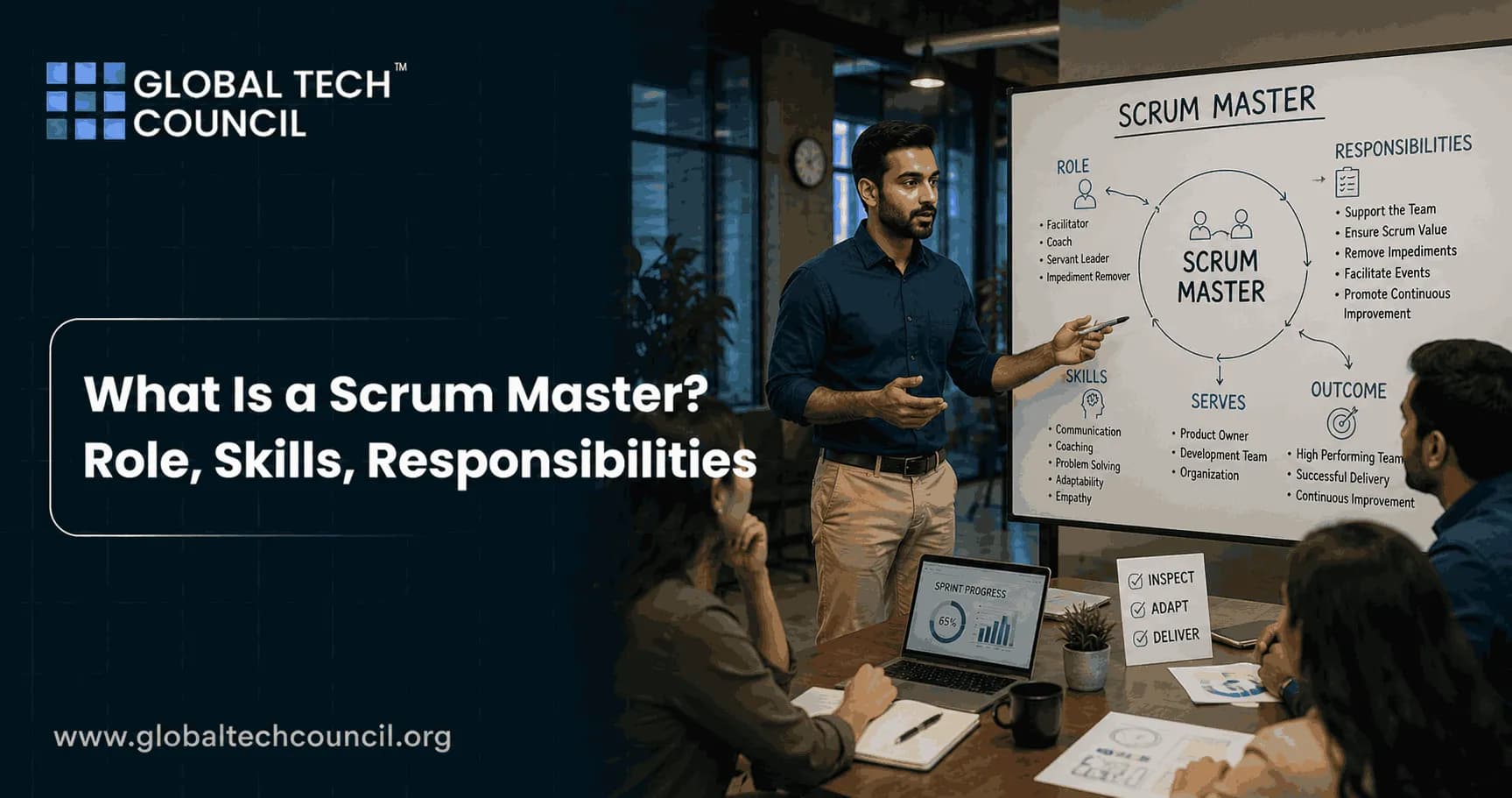
A Scrum Master is the person accountable for helping a team use Scrum correctly, improve how it works, and clear the obstacles that slow delivery. The role is not a project manager with a new title. A good Scrum Master coaches, facilitates, protects focus, and helps the Scrum Team ship useful product increments in short cycles called sprints.
If you are moving into this role, the first thing to unlearn is command-and-control management. You do not assign tickets. You do not approve code. You do not own the product backlog. Your job is to make Scrum work in practice, especially when pressure, unclear priorities, or old organizational habits pull the team back into bad patterns. Understanding the role of a Scrum Master begins with learning Agile methodologies while developing the technical skills needed to lead modern software teams. Pursuing a Tech Certification helps professionals gain expertise in Agile project management, AI-powered collaboration tools, cloud technologies, DevOps, and digital transformation. These certifications prepare aspiring Scrum Masters to facilitate team collaboration, remove project obstacles, and successfully manage technology-driven initiatives across industries.

What Is Scrum?
Scrum is an agile framework for solving complex problems through iterative delivery. The Scrum Guide, maintained by Ken Schwaber and Jeff Sutherland, defines Scrum around a small set of accountabilities, events, artifacts, and commitments. The three accountabilities are:
Product Owner: Owns product value, the product goal, and product backlog ordering.
Developers: Build the product increment and decide how to meet the sprint goal.
Scrum Master: Establishes Scrum as defined in the Scrum Guide and helps the team and organization apply it well.
Scrum is deliberately lightweight. That is why it exposes problems quickly. If your backlog is vague, the daily Scrum feels awkward. If leaders interrupt the team mid-sprint, the sprint goal becomes fiction. If quality is treated as optional, the increment is not really done. The Scrum Master helps the team see these issues and fix them instead of burying them under reports.
What Does a Scrum Master Actually Do?
The Scrum Master works on process, team effectiveness, and continuous improvement. That sounds abstract until you look at the calendar. Most Scrum Masters spend their week facilitating events, talking to the Product Owner, clearing blockers, coaching team members, and making delivery risks visible without turning the team into a reporting machine.
Facilitating Scrum Events
A Scrum Master makes Scrum events useful, not ceremonial. The standard events are:
Sprint planning: The team agrees on a sprint goal and selects backlog items that support it.
Daily Scrum: Developers inspect progress toward the sprint goal and adapt their plan. It is timeboxed to 15 minutes.
Sprint review: The Scrum Team and stakeholders inspect the increment and discuss what to do next.
Sprint retrospective: The team inspects its working process and chooses improvements for the next sprint.
Here is a practical detail that trips up many new Scrum Masters: the daily Scrum is for the Developers, not a status meeting for the Scrum Master. If everyone answers, What did I do yesterday? while staring at you, you have accidentally become the project supervisor. Move the conversation back to the sprint goal, blocked work, and the plan for the next 24 hours. As organizations increasingly build AI, blockchain, automation, and cloud-based products, Scrum Masters benefit from understanding the technologies their teams develop. Becoming a Deeptech Expert equips professionals with interdisciplinary knowledge of emerging technologies, enabling them to collaborate effectively with developers, architects, and technical stakeholders while supporting innovation and enterprise-scale Agile delivery.
Removing Impediments
An impediment is anything that stops the team from making progress. Some are simple. A developer needs access to a staging environment. A test database is down. A design decision is waiting on a stakeholder.
Others are organizational. A security review takes three weeks. Two teams depend on the same platform engineer. A manager keeps adding urgent work during the sprint. The Scrum Master does not solve every problem personally, but you make impediments visible, find the right owner, and keep pressure on the system until the blockage clears.
One real example: a team can lose half a sprint because Jira tickets pile up in a status called Ready for QA while testers are already overloaded. The board looks active, but cycle time grows quietly. A Scrum Master should spot that queue, raise the idea of work-in-progress limits, and help the team fix the flow instead of celebrating that development tasks are marked complete.
Coaching the Team and Organization
Scrum Masters coach the Scrum Team on values such as focus, openness, respect, courage, and commitment. That coaching extends beyond the team. Product Owners may need help writing clearer backlog items. Stakeholders may need to understand why changing priorities every two days damages delivery. Managers may need coaching on how to support self-management.
To be blunt, this is where many Scrum adoptions fail. Teams are told to be agile, but budgeting, approvals, performance reviews, and release governance still reward big upfront plans. A strong Scrum Master can speak to both sides: the engineering team that wants less process and the leadership group that wants predictability.
Scrum Master vs Project Manager
The Scrum Master and project manager roles are often confused. They can overlap in some companies, but they are not the same.
A project manager often manages scope, timeline, budget, status reporting, and resource allocation.
A Scrum Master helps the Scrum Team use Scrum, improve collaboration, and remove impediments.
A Product Owner decides what is most valuable to build next.
If your company expects the Scrum Master to assign work, approve estimates, and hold individuals accountable for task completion, it is using the title incorrectly. The Scrum Master can provide visibility and help manage risk, but the Developers own the plan for delivering the sprint goal.
Core Skills Every Scrum Master Needs
Facilitation
You need to guide difficult conversations without dominating them. Retrospectives are a good test. If the same two people speak every time, your facilitation is not working. Try silent writing, dot voting, small groups, or a start-stop-continue format to draw out quieter voices.
Communication
Scrum Masters translate between teams and stakeholders. You need clear language. Drop the jargon when speaking to business leaders, but do not oversimplify technical risk. If an API dependency will delay integration, say so early and show the impact on the sprint goal.
Conflict Resolution
Disagreement is normal in Scrum. The Product Owner wants more scope. Developers want more time for quality. Stakeholders want dates. Your job is not to make everyone happy. Your job is to create transparency so the right trade-offs are made out in the open.
Agile and Technical Literacy
You do not have to be the best engineer in the room. Still, technical literacy helps. If the team says flaky tests are blocking continuous integration, you should understand why that matters. If deployment is manual, you should recognize the drag on flow and support DevOps practices where they fit.
Metrics Judgment
Use metrics carefully. Velocity can help a team forecast, but it is a poor tool for comparing teams or judging individuals. Better signals include cycle time, escaped defects, work-in-progress, sprint goal success rate, and stakeholder feedback. Numbers should start conversations, not end them. Beyond managing Scrum ceremonies, successful Scrum Masters communicate effectively with stakeholders and ensure development efforts align with customer needs. A Marketing Certification helps professionals strengthen leadership, communication, branding, customer engagement, and strategic planning skills. These business-focused capabilities enable Scrum Masters to deliver greater value by aligning Agile execution with organizational objectives and customer expectations.
Scrum Master in Remote and Distributed Teams
Remote Scrum is common now, but it takes discipline. Digital boards in Jira, Azure DevOps, Trello, or Linear can help, but tools do not create collaboration on their own.
For distributed teams, you should:
Keep the sprint goal visible on the board and in team channels.
Use asynchronous updates when time zones make daily overlap hard.
Record decisions in a shared space, not only in meetings.
Design retrospectives so people can contribute before the call.
Watch for silence. In remote teams, disengagement hides easily.
A remote daily Scrum that turns into 15 disconnected status updates is a warning sign. Ask the team to walk the board from right to left, starting with items closest to done. That small change often surfaces blocked work faster.
Scrum Master in Scaled Agile Environments
In larger enterprises, Scrum Masters may work across several teams or within scaled frameworks such as SAFe. SAFe Scrum Masters often coordinate dependencies, support program-level events, and work with Release Train Engineers. The role gets more complex because impediments may sit outside the team.
Scaling Scrum is useful when many teams genuinely need coordination. It is the wrong answer when a company uses scale as a way to add meetings without fixing decision-making. Start with team-level Scrum done well. Then scale only what must be scaled.
Scrum Master Certifications and Learning Paths
Certification is not a substitute for experience, but it helps you learn the vocabulary, the responsibilities, and the exam-style interpretation of Scrum. Common industry options include Certified ScrumMaster from Scrum Alliance, Professional Scrum Master from Scrum.org, and SAFe Scrum Master from Scaled Agile.
If you are building a broader technology career, connect Scrum knowledge with delivery skills. Global Tech Council readers can explore related training in agile project delivery, DevOps practices, software engineering, data science, AI, and cybersecurity through the Global Tech Council certification catalog. Scrum Masters who understand modern engineering environments are better equipped to clear real blockers, not just run meetings. A successful Scrum Master combines technical knowledge, Agile leadership, and strong business communication to deliver value across every project. Advance your professional development with a Scrum Master Expert certification, strengthen your understanding of enterprise AI implementation through a Forward Deployed Engineer Certification, and build future-ready business skills with an AI-powered Digital Marketing Course to confidently lead Agile teams, support digital transformation, and drive long-term organizational success.
Common Mistakes New Scrum Masters Make
Running every meeting as the central speaker: Facilitate, then step back.
Becoming a task manager: Developers own the sprint plan.
Ignoring the Product Owner: Weak backlog refinement damages every sprint.
Protecting the team from all stakeholder contact: Shield focus, but do not create isolation.
Using velocity as a performance score: This encourages estimate inflation and bad behavior.
Skipping retrospectives when busy: That is usually when the team needs one most.
Is Scrum Master a Good Career?
Yes, if you like people, systems, and delivery improvement. No, if you mainly want authority over task assignment or product decisions. The role takes patience. Some wins are invisible: a shorter approval path, a calmer sprint planning session, fewer carryover items, or a team that finally raises risks early.
Scrum Masters work in software product teams, consulting groups, enterprise transformation programs, marketing teams, and operations teams. The best opportunities usually go to people who can pair Scrum knowledge with domain understanding. A Scrum Master in a cloud platform team, for example, benefits from knowing the basics of CI/CD, incident response, infrastructure as code, and security review gates.
How to Start as a Scrum Master
Read the Scrum Guide carefully. It is short, but every word matters.
Observe a real Scrum Team for at least one sprint.
Practice facilitation techniques in retrospectives and planning sessions.
Learn one agile tool well, such as Jira or Azure DevOps, but do not let the tool define the process.
Study for a recognized Scrum Master certification if you want a formal credential.
Build complementary knowledge in DevOps, product management, and technical delivery.
Your next step is simple: pick one Scrum event your team already runs and improve it this week. Tighten the goal, cut the passive status reporting, or make one impediment visible to the right decision-maker. That is Scrum Master work in its most useful form.
Related Articles
View All
Scrum Master
Top Scrum Master Expert Skills Employers Look for in 2026
Learn the Scrum Master expert skills employers want in 2026, including agile coaching, AI literacy, data-driven agility, technical fluency, and leadership.

Scrum Master
Scrum Master Expert vs Agile Coach: Key Differences, Skills, Salary, and Career Opportunities
Compare Scrum Master Expert vs Agile Coach roles, skills, salary ranges, market demand, and career paths for agile professionals.

Scrum Master
Scrum Master Expert Role in Scaling Agile Across Enterprises
Learn how a Scrum Master Expert scales agile across enterprises through coaching, flow metrics, cross-team coordination, and leadership enablement.
Trending Articles
The Role of Blockchain in Ethical AI Development
How blockchain technology is being used to promote transparency and accountability in artificial intelligence systems.
AWS Career Roadmap
A step-by-step guide to building a successful career in Amazon Web Services cloud computing.
Top 5 DeFi Platforms
Explore the leading decentralized finance platforms and what makes each one unique in the evolving DeFi landscape.