

Claude Fable 5 Responsible AI: Privacy, Ethics, and Governance Considerations
 Suyash Raizada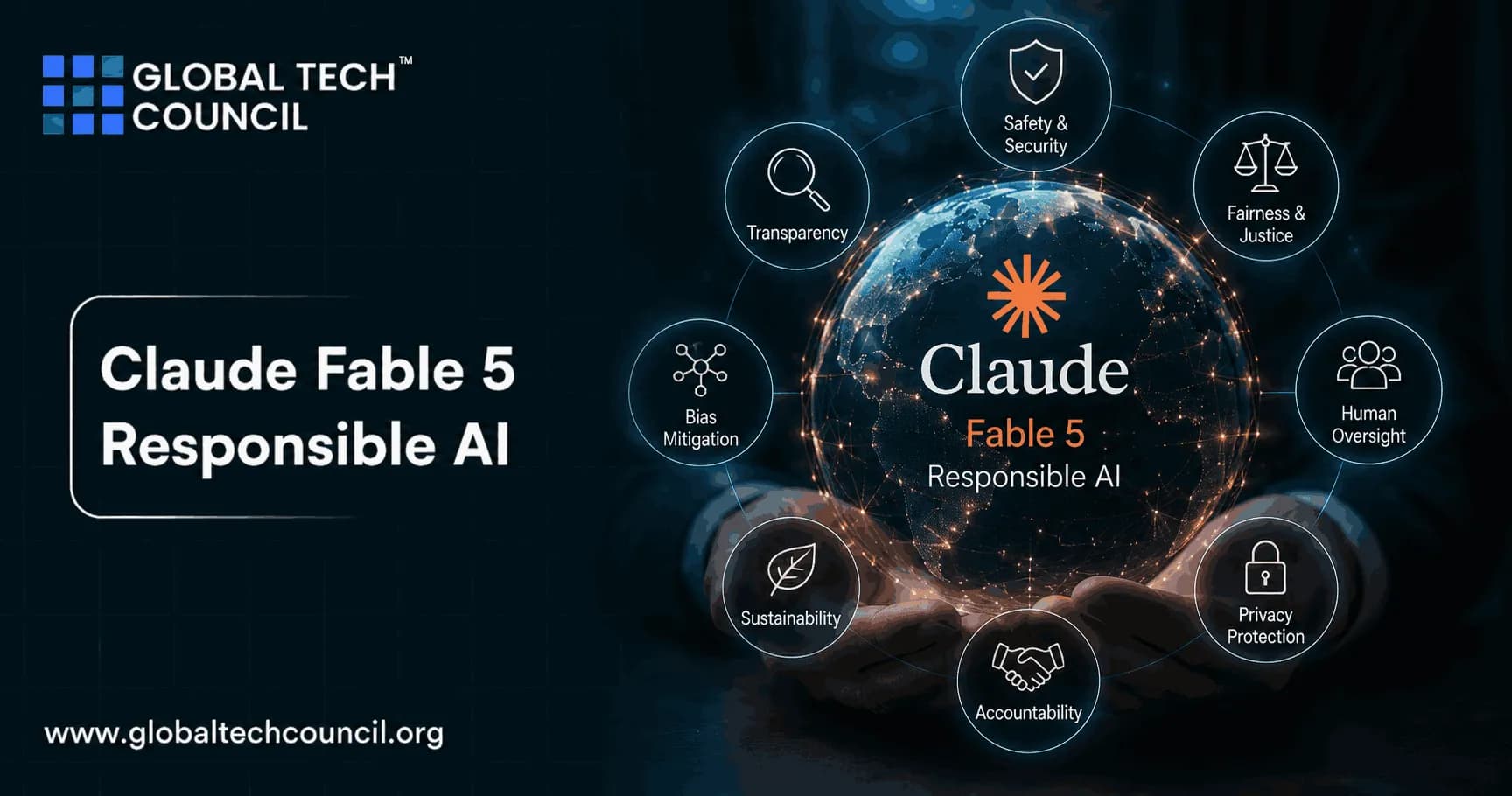
Claude Fable 5 responsible AI discussions are gaining importance because the model represents a frontier-model release strategy: a highly capable public model with additional safeguards, while the more powerful Mythos 5 remains restricted to vetted organizations. This approach reflects a broader shift in AI governance, where privacy, ethics, access control, and organizational oversight are treated as core design requirements rather than optional compliance activities.
For enterprises, developers, and technology leaders, Claude Fable 5 is not only a productivity tool. It is also a case study in how advanced AI systems should be deployed responsibly. Its use of tiered access, model routing for sensitive topics, and safety-focused release controls offers practical lessons for organizations building or integrating generative AI systems.

Understanding Claude Fable 5 and Its Responsible AI Context
Anthropic describes Claude Fable 5 as its most capable generally available model, positioned as a public model with frontier-level capabilities. At the same time, Mythos 5, a more advanced variant, is limited to vetted organizations. This distinction matters because it shows how model providers are applying risk-tiered access to manage powerful AI capabilities.
Fable 5 is presented as a Mythos-class model adapted for general use. In practice, the model can support complex reasoning, writing, analysis, coding, and enterprise workflows while operating within stronger public-use safeguards. Anthropic has also acknowledged that some high-risk domains, especially cybersecurity, require additional caution. For certain sensitive requests, Fable 5 queries may be routed to Claude Opus 4.8, a less capable model configured to reduce misuse risk.
This release strategy aligns with emerging responsible AI principles from organizations such as Microsoft, Amazon, Snowflake, Berkeley Haas EGAL, and IEEE-focused governance communities. Across these frameworks, the common themes are fairness, safety, transparency, privacy, accountability, and human oversight.
Why Responsible AI Matters for Claude Fable 5
Advanced AI systems can generate valuable insights, automate complex tasks, and accelerate software development. They can also introduce risks when used without governance. These risks include privacy leakage, biased outputs, inaccurate recommendations, security misuse, lack of explainability, and unclear accountability.
Snowflake describes responsible AI as the operational result of AI governance and AI ethics working together. In other words, principles must become concrete controls. Microsoft identifies responsible AI principles such as fairness, reliability and safety, privacy and security, inclusiveness, transparency, and accountability. Amazon similarly frames responsible AI around fairness, explainability, privacy and security, safety, controllability, robustness, governance, and transparency.
For Claude Fable 5, these principles translate into practical questions:
Who is allowed to access the model and for what purpose?
How are user prompts, logs, and outputs protected?
Which high-risk topics require routing, blocking, or human review?
How can organizations monitor model behavior over time?
Who is accountable when an AI-assisted decision causes harm?
Privacy and Data Governance Considerations
Privacy is one of the most important dimensions of Claude Fable 5 responsible AI. Any organization integrating the model into customer support, coding, analytics, HR, finance, healthcare, or legal workflows must understand how data flows through the system.
Input and Log Governance
Prompts may contain personal data, confidential business information, source code, credentials, intellectual property, or regulated records. Responsible deployment requires clear policies for how prompts and outputs are collected, encrypted, retained, accessed, and deleted. Snowflake's AI governance guidance emphasizes role-based access control, encryption, data minimization, retention standards, and metadata management as foundations for ethical AI.
Data Minimization
Organizations should collect and retain only the data needed for legitimate purposes such as debugging, safety monitoring, compliance, and performance improvement. Sensitive fields should be masked or removed where possible. Teams should avoid sending unnecessary personal information to any AI model, including Claude Fable 5.
Access Segregation
Enterprise deployments should separate access for administrators, developers, auditors, business users, and end users. Role-based permissions can reduce the likelihood of unauthorized prompt review, data export, or configuration changes. This is especially important when Fable 5 is connected to internal databases, code repositories, customer records, or workflow automation systems.
Regulatory Alignment
Responsible privacy practice also means mapping Claude Fable 5 use cases to applicable data protection rules. Depending on geography and sector, organizations may need to consider privacy impact assessments, data residency, consent, retention requirements, auditability, and vendor risk management.
Professionals working on AI privacy and data protection can strengthen their skills through Global Tech Council programs such as Certified Artificial Intelligence Expert, Certified Data Science Expert, and cybersecurity-focused certifications.
Ethics and Safety Controls in Claude Fable 5
The most visible responsible AI feature of Claude Fable 5 is its safety-oriented access model. By keeping Mythos 5 restricted and routing some sensitive Fable 5 queries to Claude Opus 4.8, Anthropic is applying technical governance at the model layer.
This matters because frontier models are dual-use technologies. The same reasoning and coding capabilities that help developers build secure applications may also help malicious actors find vulnerabilities, automate phishing, or improve harmful cyber techniques. Model routing is one way to reduce risk without eliminating broad access to useful AI capabilities.
Ethical deployment should also address fairness and bias. Berkeley Haas EGAL guidance stresses that bias mitigation requires structured processes, leadership accountability, tools for identifying unfair outcomes, and incentives that encourage employees to raise concerns. For Fable 5 deployments, this may include testing outputs across demographic groups, reviewing high-impact recommendations, and monitoring user complaints for patterns of harm.
Transparency for Users
Users should know when AI is being used, what the system can and cannot do, and when requests are blocked or redirected because of safety policies. Transparency improves trust and helps users interpret outputs appropriately. It is also essential for regulated settings where explanations, audit trails, and human review may be required.
Human Oversight
Claude Fable 5 should not be treated as an autonomous decision-maker in high-impact contexts. Human review is especially important for hiring, lending, healthcare, legal analysis, cybersecurity response, education assessment, and public-sector services. AI can assist, summarize, classify, and recommend, but accountable humans must remain involved where decisions affect rights, safety, or access to essential services.
Governance Structures for Enterprise Deployments
AI governance turns ethical principles into repeatable processes. For Claude Fable 5, governance should cover the full AI lifecycle, from use-case selection and risk assessment to monitoring, auditing, incident response, and retirement.
Leading organizations offer useful models. Microsoft has established responsible AI governance through structures such as the Office of Responsible AI and the Aether Committee. Amazon reports significant investment in responsible AI tools, research, governance mechanisms, and employee training. The EGAL playbook recommends AI ethics leads, AI ethics boards, defined prohibited uses, escalation paths, and alignment with leadership performance metrics.
Enterprises using Fable 5 can adapt these patterns through:
AI review boards: Evaluate sensitive use cases before launch.
Responsible AI leads: Coordinate risk assessments, documentation, and policy alignment.
Use-case inventories: Track where Fable 5 is deployed, what data it accesses, and who owns each system.
Prohibited-use policies: Define applications the organization will not pursue.
Incident response plans: Establish steps for harmful outputs, privacy issues, misuse, or model failure.
Audit logs: Maintain traceable records while preserving user privacy.
A Practical Claude Fable 5 Responsible AI Checklist
Organizations can use the following checklist before deploying Claude Fable 5 in production:
Classify the use case: Determine whether the application is low, medium, or high risk.
Map data flows: Identify what data enters and leaves the model.
Apply data minimization: Remove sensitive or unnecessary information from prompts.
Configure access controls: Limit access based on job role and business need.
Test for safety and bias: Conduct red-teaming, subgroup evaluation, and adversarial testing.
Document limitations: Explain where the model may fail or require human judgment.
Monitor continuously: Review outputs, incidents, user feedback, and drift over time.
Create escalation paths: Define who responds when an issue is detected.
Train employees: Provide responsible AI, privacy, cybersecurity, and prompt governance training.
Teams building governance capability can explore Global Tech Council certifications in AI, machine learning, cybersecurity, data science, and responsible technology leadership.
The Future of Claude Fable 5 and AI Governance
The Fable 5 release strategy points toward a future where AI access is more granular and context-aware. Instead of a simple public or private model distinction, organizations are likely to see capability tiers, organization-specific safety profiles, policy-based routing, and stronger monitoring for sensitive domains.
Regulatory expectations are also increasing. Snowflake notes that AI governance is moving beyond voluntary policy statements toward structural requirements embedded in regulation, procurement, and system design. This means enterprises may face growing pressure to show evidence of risk assessments, audit trails, data controls, fairness testing, and human oversight.
Independent audits and third-party evaluations may also become more common for frontier-model deployments. As models such as Claude Fable 5 become embedded in critical workflows, organizations will need stronger proof that their AI systems are safe, privacy-preserving, and accountable.
Conclusion
Claude Fable 5 responsible AI practices highlight the direction of modern AI deployment: powerful models must be paired with privacy protections, ethical safeguards, tiered access, model routing, and formal governance. Anthropic's decision to make Fable 5 broadly available while restricting Mythos 5 and routing certain sensitive requests reflects a broader industry move toward risk-based AI control.
For professionals and enterprises, the lesson is clear. Responsible AI is not a single policy or technical feature. It is a lifecycle discipline involving data governance, safety testing, transparency, human oversight, accountability, and continuous improvement. Organizations that build these capabilities now will be better prepared to use Claude Fable 5 and future frontier models safely, ethically, and effectively.
Related Articles
View All
Claude
Claude Fable 5 and the Future of AI Assistants: What Tech Leaders Should Know
Claude Fable 5 signals a shift from chatbots to governed, agentic AI assistants for enterprise data, software, and cybersecurity workflows.

Claude
Claude Fable 5 for Developers: Prompt Engineering Tips, API Possibilities, and Best Practices
Learn how Claude Fable 5 helps developers build safer, cost-aware AI agents with structured prompts, API routing, caching, and best practices.
Claude
Top Claude Fable 5 Use Cases in Education, Business, Coding, and Content Creation
Explore top Claude Fable 5 use cases in education, business, coding, and content creation, with practical examples and future trends.
Trending Articles
The Role of Blockchain in Ethical AI Development
How blockchain technology is being used to promote transparency and accountability in artificial intelligence systems.
AWS Career Roadmap
A step-by-step guide to building a successful career in Amazon Web Services cloud computing.
Top 5 DeFi Platforms
Explore the leading decentralized finance platforms and what makes each one unique in the evolving DeFi landscape.