

Top Claude Fable 5 Use Cases in Education, Business, Coding, and Content Creation

Claude Fable 5 use cases are expanding across education, business, software engineering, and content creation because the model is designed for long-horizon reasoning, large-context analysis, coding, vision, and autonomous workflows. As Anthropic's first generally available Mythos-class model, Claude Fable 5 sits above the Claude Opus series and is positioned for complex tasks that require sustained planning rather than simple prompt-and-response interactions.
Claude Fable 5 is available through the Claude API as claude-fable-5 and through platforms such as Amazon Bedrock, Google Cloud Vertex AI, Microsoft Foundry, and the GitLab Duo Agent Platform. Anthropic reports strong safety controls, including strict cyber misuse filters and safeguards for sensitive biology and chemistry queries. This makes the model relevant for organizations that need high capability alongside practical risk controls.

What Makes Claude Fable 5 Different?
Claude Fable 5 is built for demanding reasoning, long-running agentic tasks, complex coding, vision-based understanding, and large-document analysis. These capabilities matter because many professional workflows are not single-step tasks. They involve reading large volumes of information, making decisions, revising outputs, checking constraints, and iterating over time.
Several reported performance points help explain its importance:
- Advanced coding performance: Claude Fable 5 reportedly achieved strong results on SWE-Bench Pro, ahead of several competing frontier models.
- Large-scale engineering capability: Anthropic has cited tests involving a large-scale codebase migration completed in a short timeframe in collaboration with Stripe.
- Long-context work: The model is optimized for multi-step work over very large context windows, making it suitable for research, tutoring, compliance, and software modernization.
- Safety-focused design: Anthropic reports that Fable 5 refused harmful cyberattack planning and exploit development requests across common public jailbreak methods.
For professionals building AI skills, these shifts connect directly to areas covered in Global Tech Council learning paths, including Artificial Intelligence, Machine Learning, Data Science, Cybersecurity, and Programming certifications.
Claude Fable 5 Use Cases in Education
AI Teaching Assistants for Complex Learning
One practical Claude Fable 5 use case is the development of AI teaching assistants that support learners through multi-step assignments. In programming, mathematics, data science, and academic writing, students often need iterative guidance rather than one-off answers.
Fable 5 can maintain context across long sessions, review prior work, explain concepts step by step, and adapt feedback to a learner's progress. For coding education, it can inspect larger project files, explain bugs, suggest improvements, and help students understand why a solution works.
Education providers have already used Claude-based models for learning support. Fable 5's long-context capability makes similar systems more suitable for semester-long projects, capstone work, and structured tutoring journeys.
Automated Feedback on Essays and Projects
Educators can use Claude Fable 5 to review essays, research reports, technical documentation, and capstone submissions. Beyond checking grammar, the model can evaluate argument structure, clarity, evidence quality, organization, tone, and rubric alignment.
For technical courses, it can also review code style, documentation quality, and the connection between implementation choices and written explanations. This makes it valuable for institutions that want faster feedback cycles while keeping educators in control of final grading decisions.
Curriculum and Assessment Design
Claude Fable 5 can help instructional designers create lesson plans, quizzes, examples, project briefs, and scaffolded learning materials. Because it can analyze large documents, it can align outputs with existing syllabi, institutional standards, or competency frameworks.
For example, a training team could provide course outcomes, reading material, assessment rubrics, and learner personas, then ask Fable 5 to generate weekly lesson outlines and practice exercises. Professionals interested in building such systems can connect this use case with Global Tech Council's AI certification and prompt engineering learning opportunities.
Claude Fable 5 Use Cases in Business
Long-Horizon Business Process Automation
Business workflows often involve multiple systems, many documents, and decisions that unfold over days. Claude Fable 5 is designed for long-horizon agentic work, which makes it suitable for tasks such as due diligence, policy review, financial modeling, competitor analysis, and operational planning.
Rather than generating a short summary, a Fable 5-based agent can break a goal into steps, collect relevant details, compare sources, identify gaps, draft outputs, and revise based on constraints. This is especially useful for enterprises looking to automate knowledge-heavy workflows while preserving human oversight.
Knowledge Management and Document Intelligence
Another major Claude Fable 5 use case is corporate knowledge management. Enterprises store critical information across contracts, policies, standard operating procedures, research reports, meeting notes, and compliance documents. Fable 5 can analyze large document sets and produce structured answers, summaries, risk notes, and decision briefs.
Example applications include:
- M&A teams comparing clauses across hundreds of contracts.
- Compliance teams checking policy updates against regulatory requirements.
- Legal teams identifying inconsistencies in contract language.
- Executives receiving concise briefs from long internal reports.
These workflows align closely with skills taught in data science, AI governance, and cybersecurity programs, where professionals must understand both automation and responsible deployment.
Strategic Research and Market Analysis
Fable 5 can support market intelligence teams by synthesizing earnings calls, analyst reports, whitepapers, web research, and internal business data. Its long-context reasoning helps it track themes, compare claims, and produce structured outputs such as market maps, SWOT analyses, and scenario planning documents.
This does not remove the need for expert review. It can, however, reduce the time analysts spend organizing source material and drafting first versions, allowing more time for judgment, validation, and strategic interpretation.
Claude Fable 5 Use Cases in Coding and Software Engineering
Codebase Migration and Large-Scale Refactoring
Coding is one of the strongest Claude Fable 5 use cases because the model is optimized for autonomous coding and large repository understanding. Its reported SWE-Bench Pro performance suggests strong ability to solve real software issues that require reading, modifying, and testing code.
Large organizations can use Fable 5 for framework migrations, legacy system modernization, dependency upgrades, and codebase restructuring. The reported large-scale migration example shows why enterprises are paying attention: tasks that once required months of coordinated engineering effort may become shorter, more iterative modernization projects.
Autonomous Development Agents
GitLab has integrated Claude Fable 5 into its Duo Agent Platform to support long-horizon autonomous coding and code review. In this type of workflow, an agent can interpret an issue, plan the solution, edit files, run tests, fix failures, and open a merge request for human review.
This is a significant shift from autocomplete-style coding assistants. Fable 5 is better suited to owning multi-step development tasks, especially when requirements are clear and repository context is available.
Debugging, Testing, and Code Review
For developers, Fable 5 can function as an advanced pair programmer. It can inspect large code sections, locate likely defects, suggest test coverage, generate edge cases, and explain tradeoffs between implementation choices.
Teams can use it to improve pull request reviews, identify regression risks, document architecture decisions, and generate test suites. Developers building expertise in this area may benefit from related Global Tech Council programming, software development, and AI engineering certifications.
Claude Fable 5 Use Cases in Content Creation
Long-Form Reports and Whitepapers
Claude Fable 5 is well suited to high-stakes content creation, especially when the task involves long-form structure, research synthesis, and consistency across sections. It can help draft whitepapers, policy briefs, technical documentation, executive reports, and research summaries.
Its value is not just writing fluency. The model can analyze source material, maintain a consistent argument, identify missing evidence, and refine tone for different audiences. For technical content teams, this supports more reliable documentation and thought leadership workflows.
Multi-Asset Editorial Campaigns
Content teams can use Fable 5 to plan and produce coordinated campaigns across articles, scripts, email sequences, social posts, and slide narratives. Because it can keep a style guide, audience profile, and messaging framework in context, it can maintain consistency across many assets.
This makes it useful for editorial calendar planning, content repurposing, brand voice alignment, and quality checks. Human editors still play a critical role in fact-checking, originality, compliance, and final approval.
Vision-Enhanced Content Analysis
Claude Fable 5 also supports vision-based analysis. It can interpret charts, screenshots, slides, diagrams, and PDF visuals, then generate summaries or explanatory content. Anthropic has reported improved non-text comprehension in its Mythos-class models, including vision-only performance in complex environments.
In practical content workflows, this can help teams convert slide decks into reports, explain dashboard insights, summarize visual research, or create alternative text for accessibility.
Future Outlook for Claude Fable 5
The broader trend is clear: AI systems are moving from chat-style helpers to autonomous workers that handle longer, more complex workflows. Claude Fable 5 brings this shift into education, enterprise operations, software engineering, and content production.
In education, expect more course-long AI mentors and assessment tools. In business, expect deeper integration into compliance, research, business intelligence, and knowledge management systems. In coding, Fable 5 will likely accelerate the development of autonomous agents that manage major parts of the software development lifecycle. In content creation, teams will increasingly use it to manage full editorial workflows rather than isolated drafts.
Conclusion
The top Claude Fable 5 use cases share a common theme: complex, multi-step work that requires large context, reasoning, and iteration. From AI tutors and curriculum design to enterprise research, codebase migration, and long-form content creation, Fable 5 is positioned as a capable model for knowledge-intensive tasks.
For professionals, the opportunity is not only to use tools like Claude Fable 5, but to understand how to design, evaluate, and govern AI-powered workflows. Building skills through Global Tech Council certifications in AI, machine learning, cybersecurity, data science, and programming can help teams apply these capabilities responsibly and effectively.
Related Articles
View All
Claude
Claude Opus 4.8: What's New, Key Features, and Enterprise Use Cases
Claude Opus 4.8 is Anthropic's latest Opus-tier model, optimized for honest reasoning, long-running agent workflows, and advanced coding with a 1M token context window.
Claude
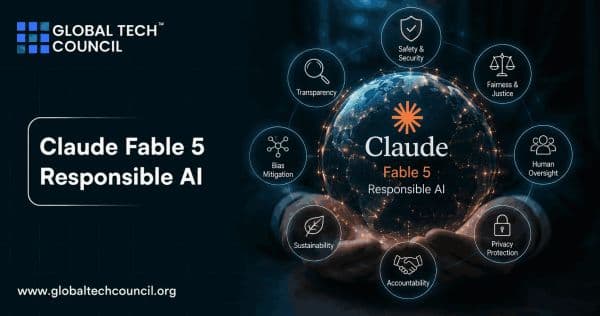
Claude Fable 5 Responsible AI: Privacy, Ethics, and Governance Considerations
Explore Claude Fable 5 responsible AI considerations across privacy, ethics, governance, safety controls, and enterprise deployment best practices.
Claude
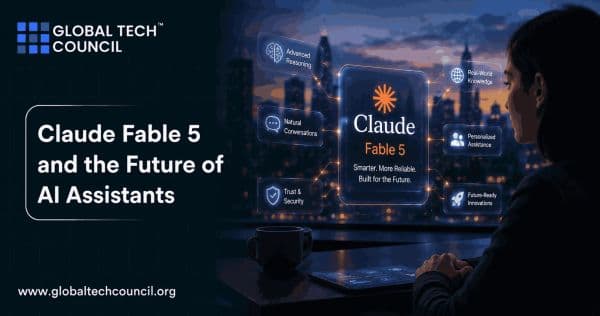
Claude Fable 5 and the Future of AI Assistants: What Tech Leaders Should Know
Claude Fable 5 signals a shift from chatbots to governed, agentic AI assistants for enterprise data, software, and cybersecurity workflows.
Trending Articles
The Role of Blockchain in Ethical AI Development
How blockchain technology is being used to promote transparency and accountability in artificial intelligence systems.
AWS Career Roadmap
A step-by-step guide to building a successful career in Amazon Web Services cloud computing.
Top 5 DeFi Platforms
Explore the leading decentralized finance platforms and what makes each one unique in the evolving DeFi landscape.