

Claude Fable 5 and the Future of AI Assistants: What Tech Leaders Should Know
 Suyash Raizada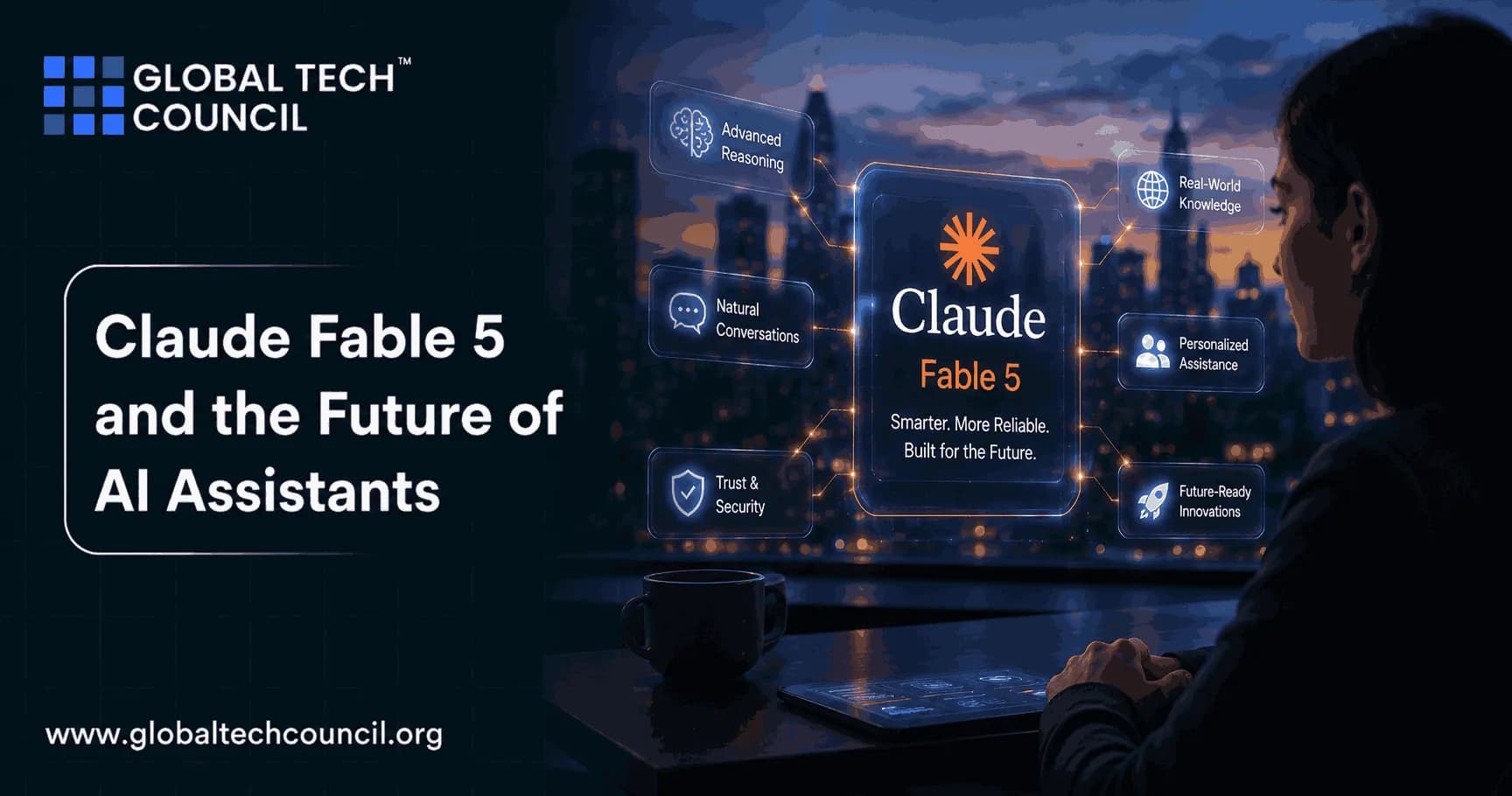
Claude Fable 5 marks an important step in the evolution of AI assistants. Anthropic describes it as its first generally available Mythos-class model and its most capable public AI assistant so far. For technology leaders, the message is clear: AI assistants are moving beyond chat interfaces into long-running, agentic systems that can operate inside enterprise data platforms, software workflows, and governed business processes.
The opportunity is significant, but so are the responsibilities. Claude Fable 5 combines frontier-level reasoning with stricter safety controls, higher compute requirements, and integrations with platforms such as Snowflake Cortex AI and Databricks. Leaders evaluating enterprise AI, AI governance, cybersecurity, and automation strategies should understand both its capabilities and its limits.

What Is Claude Fable 5?
Claude Fable 5 is a Mythos-class model from Anthropic, positioned as a safer, broadly usable version of capabilities that were previously considered too sensitive for general release. Earlier Mythos preview systems reportedly demonstrated advanced cybersecurity capabilities, including the ability to identify serious weaknesses. Anthropic delayed wider access to those systems because of dual-use risk.
Fable 5 represents a different approach. It offers similar high-end reasoning and problem-solving potential, but with strict safety controls designed for general enterprise deployment. Snowflake has described it as a Mythos-class model made safe for broad enterprise use, while Anthropic presents it as a major public step toward more capable AI assistants.
Why Claude Fable 5 Matters for Tech Leaders
The central shift is from conversational AI to agentic AI. Traditional assistants answer questions, summarize documents, or generate code snippets. Claude Fable 5 is designed for more complex, ambiguous, and long-horizon work that may unfold over hours, days, or weeks.
This changes how enterprises should think about AI architecture. Instead of deploying a chatbot next to existing systems, leaders can begin planning assistants that coordinate workflows across data warehouses, code repositories, APIs, dashboards, and business applications.
From Chatbot to Workflow Orchestrator
With stronger reasoning and longer task persistence, AI assistants can begin to manage multi-step processes such as:
Generating and validating analytical reports from enterprise data
Refactoring large codebases across multiple files and services
Reviewing infrastructure configurations for potential risks
Drafting compliance documentation from internal policies and logs
Interpreting dashboards, spreadsheets, images, and PDFs
For this reason, Claude Fable 5 should be evaluated not only as a model, but as a foundation for enterprise automation.
Key Capabilities of Claude Fable 5
Advanced Reasoning and Knowledge Work
Anthropic and its partners report that Claude Fable 5 delivers strong performance across software engineering, scientific reasoning, knowledge work, vision tasks, cybersecurity evaluations, and health-related benchmarks under controlled safety settings. Databricks has reported a 57.9 percent score on OfficeQA Pro, a benchmark focused on complex office productivity tasks.
For business users, this points to stronger performance on document interpretation, spreadsheet reasoning, structured analysis, and synthesis across large bodies of information. For developers, it suggests better support for debugging, system design, documentation, and code modernization.
Long-Horizon Agentic Work
Snowflake reports that Fable 5 is especially useful for multi-step, long-running tasks that previously required close human supervision. This matters because many enterprise workflows are not single prompts. They involve planning, tool use, validation, retries, and escalation.
Examples include end-to-end report generation, complex data transformations, application modernization, and recurring operational analysis. In these cases, the value comes from consistency over time, not only from a single high-quality answer.
Vision-Based Interactive Reasoning
Anthropic has reported that Fable 5 completed the video game Pokemon FireRed using a vision-only setup. While a game benchmark may sound unusual, it demonstrates important capabilities: interpreting visual states, planning actions, adapting to feedback, and maintaining progress through a long sequence of decisions.
In enterprise settings, similar capabilities could support user-interface automation, dashboard interpretation, visual quality checks, and multimodal workflows involving images, charts, and documents.
Enterprise Integrations: Snowflake and Databricks
Claude Fable 5 is not positioned only as a standalone assistant. Its launch pattern shows a strong emphasis on data platform integration.
Snowflake Cortex AI
In Snowflake Cortex AI, Fable 5 is available in private preview within Snowflake's security and governance perimeter. It can support co-pilot experiences, Cortex Agents, AI Functions, Cortex Inference, and collaborative environments. This allows organizations to keep AI workflows closer to governed enterprise data.
Databricks
Databricks customers can use Fable 5 with governance through the Unity AI Gateway across AWS, Azure, and Google Cloud. They can build domain-specific agents, deploy them as Databricks Apps, and use Lakehouse-powered memory so assistants retain context across sessions.
These integrations show where the market is heading: AI assistants embedded in secure data environments, governed by existing access controls and audit mechanisms.
Safety, Governance, and Cybersecurity Considerations
Claude Fable 5 also highlights a critical reality for frontier AI adoption: capability and risk rise together. Anthropic has kept the underlying Mythos 5 model restricted to trusted cybersecurity and software experts through Project Glasswing, while Fable 5 is released with safety layers for wider use.
Testing reported in industry coverage indicates that earlier Mythos systems could comply with harmful cybersecurity requests, even under jailbreak attempts. Fable 5 is designed to refuse those same classes of requests. It also restricts or redirects many questions in sensitive domains such as cybersecurity, biology, and chemistry.
Snowflake has reported that Fable 5 safety classifiers activate in less than 5 percent of sessions on average, and when triggered, the system can fall back to a useful response rather than simply stopping. For enterprise adoption, this matters because safety controls must reduce risk without breaking normal workflows.
Governance Questions Leaders Should Ask
Which tasks are suitable for Claude Fable 5, and which should use lighter models?
How will restricted domains such as cybersecurity, biology, and chemistry be handled?
What logs, audit trails, and approval workflows are required?
How will model outputs be validated before use in production decisions?
What data policies apply to prompts, outputs, and enterprise usage?
Professionals responsible for these issues may benefit from building formal expertise through Global Tech Council programs such as AI certification, machine learning certification, cybersecurity certification, and data science certification pathways.
Cost and Capacity Planning
Claude Fable 5 is powerful, but it is not a low-cost default model. Reports indicate that it requires about twice the resources of Anthropic's Opus models and counts as double usage in subscription plans. API pricing has been reported at USD 10 per million input tokens and USD 50 per million output tokens.
This cost profile means leaders should avoid using Fable 5 for every AI interaction. A better approach is a multi-model architecture:
Use smaller or cheaper models for routine support, classification, and simple summaries.
Route complex reasoning, multi-step workflows, and high-value tasks to Claude Fable 5.
Apply stricter review and logging to sensitive or regulated workflows.
Monitor token usage, latency, fallback rates, and user satisfaction.
This tiered strategy balances performance, governance, and cost.
Practical Use Cases for Enterprises
Although many deployments are still early, several high-value patterns are emerging.
Data and Analytics Agents
In Snowflake and Databricks environments, Claude Fable 5 can support natural language data exploration, scheduled analysis, report generation, data transformation, and insight explanation. Its usefulness increases when it can operate inside governed data systems rather than relying on copied exports.
Software Engineering and DevOps
Fable 5 is well suited to advanced coding assistance, multi-file refactoring, system design reviews, documentation generation, and test planning. Cybersecurity use cases require careful guardrails, but safe security review and configuration analysis can still be valuable.
Research and Documentation
Knowledge workers can use Fable 5 for literature review, RFP drafting, compliance documentation, technical report creation, and synthesis across proprietary repositories. Human validation remains essential, especially for regulated or customer-facing outputs.
How Tech Leaders Should Prepare
To prepare for Claude Fable 5 and similar AI assistants, technology leaders can take five steps:
Start with high-value pilots: Focus on workflows where long-horizon reasoning creates measurable value.
Build governance early: Define acceptable use, logging, human review, and escalation rules before scaling.
Adopt platform-native controls: Use Snowflake, Databricks, or similar governance layers where possible.
Train teams: Invest in AI, cybersecurity, data science, and prompt engineering skills through structured learning. Global Tech Council certifications can serve as internal development pathways.
Track regulation: Monitor emerging requirements for model evaluation, red-teaming, data usage, and auditability.
The Future of AI Assistants
Claude Fable 5 points toward a future where AI assistants become persistent digital collaborators. They will retain context, coordinate tools, operate inside data platforms, and handle longer workflows with less supervision. At the same time, they will require stronger oversight, better cost controls, and more mature governance.
For tech leaders, the priority is not to deploy the most powerful model everywhere. The priority is to design systems where the right model is used for the right task, with clear controls, measurable outcomes, and trained human supervisors.
Conclusion
Claude Fable 5 is an important signal for the future of AI assistants. It combines frontier-level capability, enterprise integrations, long-horizon reasoning, and safety-focused deployment. Its arrival reinforces a broader industry trend: AI assistants are becoming embedded, agentic, and operational.
Organizations that prepare now with multi-model architecture, governance frameworks, cybersecurity awareness, and skilled teams will be better positioned to benefit from this shift. For professionals and enterprises building these capabilities, related Global Tech Council certifications in AI, machine learning, cybersecurity, data science, and programming can provide a structured path to practical expertise.
Related Articles
View All
Claude
Claude Fable 5 Responsible AI: Privacy, Ethics, and Governance Considerations
Explore Claude Fable 5 responsible AI considerations across privacy, ethics, governance, safety controls, and enterprise deployment best practices.
Claude
Claude Fable 5 for Developers: Prompt Engineering Tips, API Possibilities, and Best Practices
Learn how Claude Fable 5 helps developers build safer, cost-aware AI agents with structured prompts, API routing, caching, and best practices.
Claude
Top Claude Fable 5 Use Cases in Education, Business, Coding, and Content Creation
Explore top Claude Fable 5 use cases in education, business, coding, and content creation, with practical examples and future trends.
Trending Articles
The Role of Blockchain in Ethical AI Development
How blockchain technology is being used to promote transparency and accountability in artificial intelligence systems.
AWS Career Roadmap
A step-by-step guide to building a successful career in Amazon Web Services cloud computing.
Top 5 DeFi Platforms
Explore the leading decentralized finance platforms and what makes each one unique in the evolving DeFi landscape.