Suyash Raizada
Jev Typed Decisions Explained
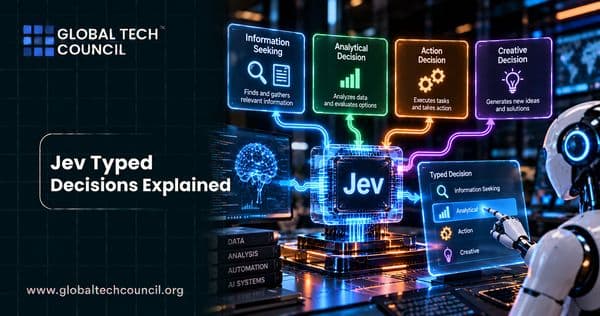
Learn how Jev typed decisions work, including predefined outputs, calibrated probabilities, confidence scores, and how software can use them directly in automated workflows.


Browse the latest ai articles, tutorials, and research from Global Tech Council.(623 articles)
Learn how Jev typed decisions work, including predefined outputs, calibrated probabilities, confidence scores, and how software can use them directly in automated workflows.

Learn how Jev uses state and structured questions to understand software context, evaluate decisions, and return typed answers with calibrated probabilities and confidence scores.
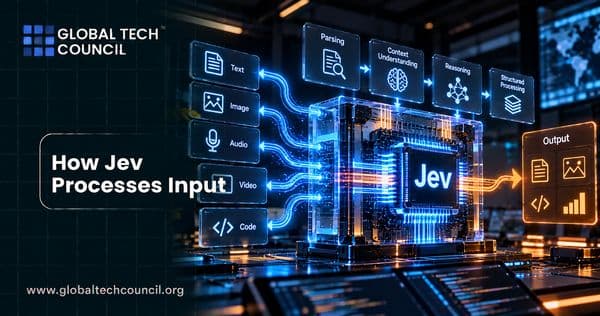
Learn how Jev processes input by interpreting structured program state and unstructured data, evaluating questions, and producing typed probabilistic decisions for software automation.
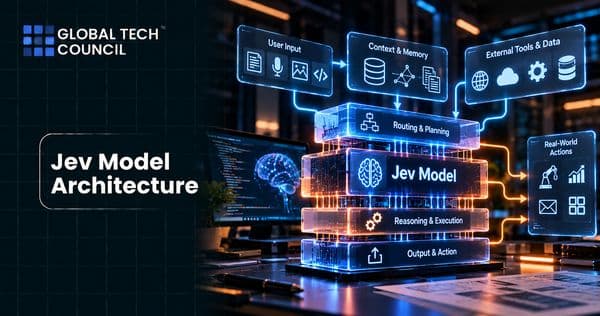
Explore the Jev model architecture, including TypeSafe AI’s System One design, parallel sampling, RLCD training, typed outputs, and calibrated probabilistic decisions.

Learn how the Jev architecture works, including its System One design, parallel sampling, RLCD training, typed outputs, calibrated probabilities, and fast software decision-making.

Explore Jev’s architecture, including TypeSafe AI’s System One design, parallel sampling, RLCD training, typed outputs, calibrated probabilities, and machine-native decision-making.

Explore how System One AI supports real-time decision-making through fast, structured, probabilistic outputs designed for automation, routing, scoring, verification, and responsive software systems.

Explore how System One AI supports automation through fast, structured, probabilistic decisions for routing, scoring, verification, workflow control, and real-time software tasks.

Explore how System One Models can be used in software to make fast, structured, probabilistic decisions for automation, routing, scoring, verification, and real-time applications.

Explore how System One Models can support AI agents with fast, structured decisions, calibrated confidence, routing, verification, scoring, and reliable workflow automation.
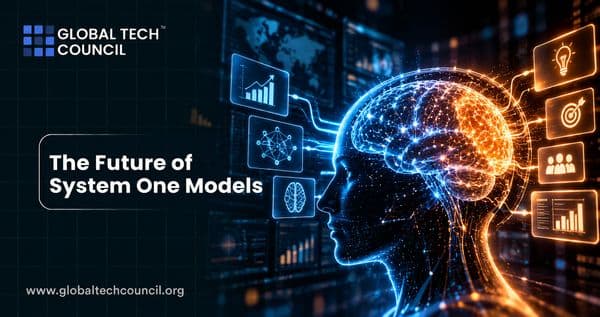
Explore the future of System One Models, including how fast, structured, probabilistic AI could reshape automation, real-time software, decision systems, and machine-native intelligence.

Explore the rise of decision-centric AI, including how models built for prediction, scoring, optimization, and structured decision-making are reshaping automation and intelligent software.