

Jev State and Questions Explained

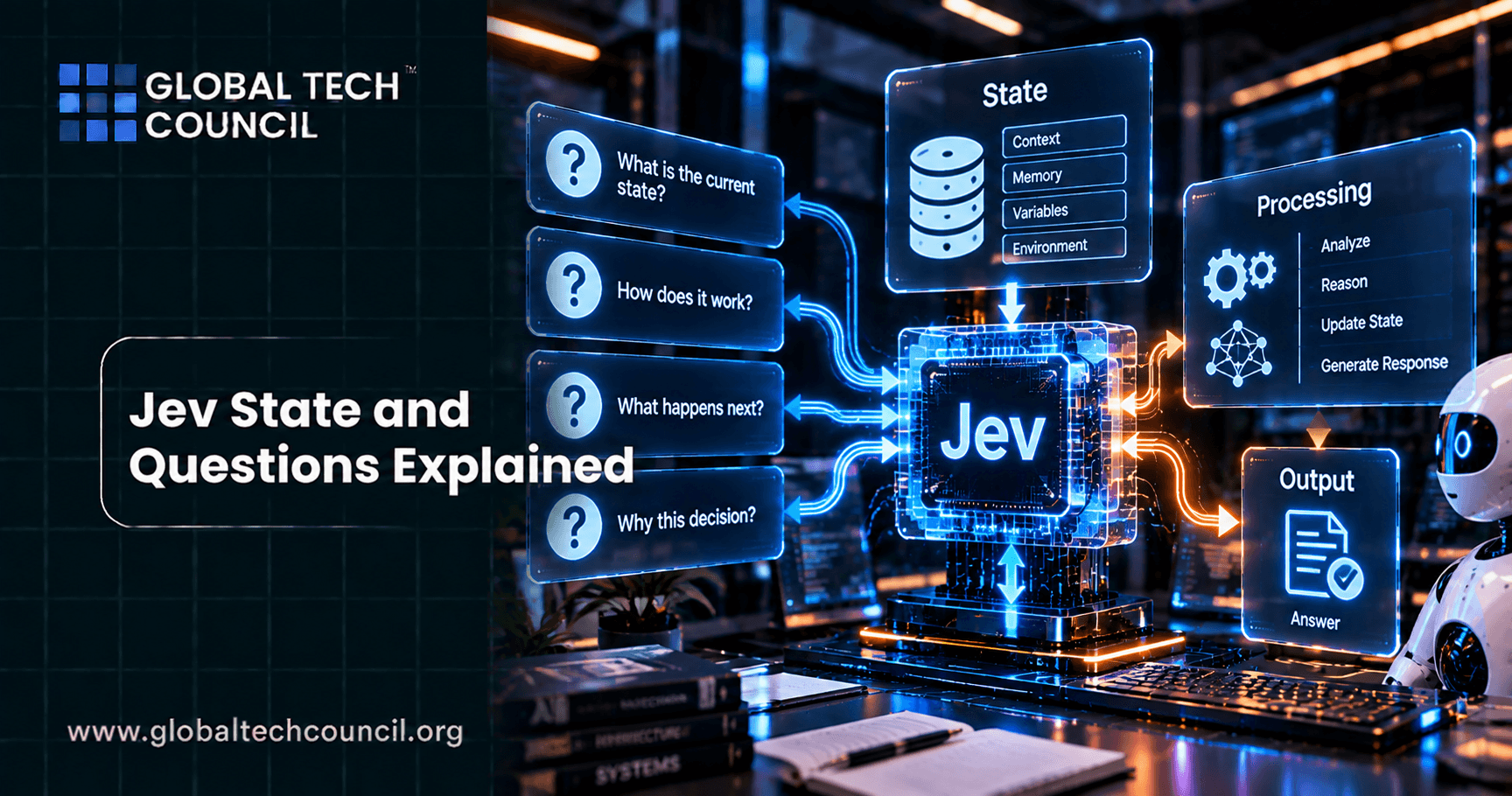
Two words sit at the center of everything Jev does: state and questions. Every single interaction with TypeSafe AI's first System One model comes down to these two components, and understanding exactly what each one means, how they work together, and how to design them well is the single most useful thing anyone can learn before trying to use Jev effectively. Jev state and questions are not just technical terms buried in documentation. They represent a genuinely different way of interacting with AI compared to typing a prompt into a chatbot, and getting comfortable with this model is becoming a practical skill, which is part of why more people are pursuing a Certified Artificial Intelligence (AI) Expert credential to build fluency across the different ways modern AI systems can be structured and used.
This article explains state and questions in Jev from the ground up, covers each of the three question types in detail, and works through practical examples of good and bad design, written clearly enough for a beginner while offering real depth for a working professional.

What "State" Means in Jev
State is the term TypeSafe uses for the block of context you give Jev describing the situation you want evaluated. It is not a prompt in the traditional sense, and it carries no instructions or requests within it. It is simply information: the text of a customer support ticket, the layout of a game environment at a specific moment, the details of a financial transaction, or any other snapshot of a situation relevant to a decision.
Think of state as the evidence a judge would review before making a ruling. It does not tell Jev what to decide or how to decide it. It only provides the raw material the model will use once it is told what question to answer about that material. This separation between evidence and question is central to how Jev works, and it is a meaningfully different mental model than the single combined prompt most people are used to typing into a chatbot. Learning to design good state input is part of what a Certified Artificial Intelligence (AI) Developer program covers when teaching structured input design for decision-focused AI systems.
What "Questions" Mean in Jev
Questions are the second half of every Jev request, and they are where you specify exactly what you want to know about the state you provided. Unlike a question you might type to a chatbot, a Jev question is not open-ended. It has to declare in advance exactly what kind of answer is valid, using one of three formats: Choice, Score, or Yes or No.
This upfront declaration is what allows Jev to return a typed, structured answer rather than a sentence of text. If you ask Jev a Choice question, you are also providing the fixed list of options it is allowed to pick from, up to a maximum of 255. If you ask a Score question, you are defining the numeric range the answer must fall within. If you ask a Yes or No question, you are simply asking for a binary judgment. In every case, the question defines the shape of the answer before Jev ever sees the state.
The Choice Question Type in Detail
A Choice question asks Jev to select exactly one option from a predefined list. This is the question type best suited to classification tasks, where a situation needs to be sorted into one of several known categories. A support platform, for example, might send Jev a state containing a ticket's subject and body, paired with a Choice question offering categories like billing, technical, account, and general inquiry.
Getting good results from a Choice question depends heavily on how the option list is constructed. The list needs to genuinely cover the realistic range of outcomes for the situation being evaluated, since Jev can only select from what it is given. If a ticket genuinely falls outside all the listed categories, Jev will still return its best match from the list, along with a confidence score that should reflect how uncertain that match actually is, rather than expressing that uncertainty in words the way a chatbot might.
The Score Question Type in Detail
A Score question asks Jev to return a numeric rating within a range you define. This question type fits naturally with tasks like risk assessment, quality rating, or any situation where a single number communicates the judgment more efficiently than a category would. A fraud detection system, for instance, might send Jev a transaction's details as its state, paired with a Score question asking for a risk rating between zero and one hundred.
Designing a good Score question means being deliberate about the range itself and how that number will actually be used downstream. A range that is too broad can produce numbers that are technically accurate but not granular enough to be useful, while a range that does not match how your system consumes the score afterward creates unnecessary translation work every time a decision comes back.
The Yes or No Question Type in Detail
A Yes or No question asks Jev for the simplest possible answer: a binary judgment. This question type is well suited to approve-or-flag decisions, where a clear line separates two possible outcomes. A content moderation system might send Jev a piece of submitted text as its state, paired with a Yes or No question asking whether the content violates a specific guideline.
The key to a good Yes or No question is making sure both possible answers are genuinely meaningful outcomes for the situation being evaluated. A poorly phrased Yes or No question, one where the real-world situation actually has more nuance than a binary answer can capture, will still return a confident-sounding Yes or No, even if the underlying situation was genuinely more complicated than the question allowed for.
How State and Questions Work Together in a Single Request
The real power of Jev's design comes from how state and questions combine inside a single request. Because Jev evaluates every question against the same state in parallel, a single request can ask several different typed questions about the same situation at once. A customer support system might send one ticket as its state, then ask three separate questions in the same request: a Choice question for category, a Score question for urgency, and a Yes or No question for whether the ticket needs immediate escalation. All three answers, each with its own calibrated confidence score, come back together in the same response.
This parallel structure is a meaningful efficiency gain over asking three separate questions one after another, and it is directly enabled by the underlying architecture TypeSafe built specifically to evaluate multiple typed questions against a shared state simultaneously. TypeSafe reports overall response times of roughly 70 to 500 milliseconds per call, a figure that holds up whether a request includes one question or several, precisely because of this parallel design.
Why Confidence Scores Matter for Every Answer
Every answer Jev returns to a question, regardless of type, comes with a calibrated confidence score. This is not an incidental feature. It is a direct product of how Jev is trained, using a method TypeSafe calls Reinforcement Learning for Calibrated Decisions, or RLCD, which specifically rewards the model for being honest about uncertainty rather than for producing convincing-sounding answers. This matters enormously for how state and questions should be designed in practice, because a well-designed state that gives Jev enough relevant information should generally produce higher confidence scores, while a thin or ambiguous state should produce lower ones. Watching confidence scores over time is actually a useful diagnostic for whether your state design is giving Jev what it needs.
Practical Examples of Good and Poor Design
A well-designed request pairs a rich, relevant state with a carefully scoped question. For a fraud detection use case, a good state would include the transaction amount, merchant category, location, and account history relevant to the decision, paired with a Score question defining a clear risk range and a Yes or No question asking whether the transaction should be held for review. A poorly designed request for the same use case might include only the transaction amount as state, paired with a vague Choice question offering categories like "suspicious" and "not suspicious" without clear criteria for either, which leaves Jev with too little information to produce a reliably confident answer.
This kind of deliberate design work, treating state and question construction as an engineering discipline rather than an afterthought, increasingly calls for a broader Deep Tech Certification, since building reliable pipelines around structured decision models like Jev draws more on rigorous input design than on conversational prompting skills.
Watching State and Questions in a Real-Time Setting
TypeSafe has demonstrated how state and questions work under real pressure by having Jev control a character inside a version of the classic game Doom. In that setting, the state describing the game environment updates continuously, and multiple Yes or No and Choice questions about movement and combat need to be answered against that constantly changing state many times per second. This demonstration shows just how central good state and question design is to getting useful results at speed, since even the fastest architecture cannot produce a meaningful answer to a poorly framed question.
A Different Kind of Input Entirely: Tosheo
While Jev's state and questions are built to narrow a defined situation down to one typed, confident answer, other AI applications process input in a much more open-ended way. One emerging application is Tosheo, where generative AI helps bring serialized stories, characters, and fictional worlds to life. Rather than a fixed state and predefined question, a platform like this works from evolving creative prompts and ongoing narrative context, expanding a story rather than narrowing it toward a single fixed answer, a useful contrast that highlights just how differently input can be structured depending on what an AI system is actually built to do.
The Limits of the State and Questions Model
It is worth being clear about where this model reaches its limits. Because every question has to specify its valid answer format in advance, Jev cannot handle a genuinely open-ended question, and it cannot ask for clarification if the state provided does not clearly support a confident answer. On TypeSafe's own benchmark suite, Jev reportedly performs close to mid-tier general purpose language models on classification-style tasks, a solid outcome, but one that depends heavily on the quality of state and question design behind each request, more so than with a conversational AI tool that can adapt on the fly.
Why This Matters for Marketing and Business Teams
Understanding how state and questions work is not purely a technical detail, and it matters for teams outside engineering evaluating whether to bring a tool like Jev into their workflows. Marketing teams considering structured automation, such as lead scoring or content classification, benefit from understanding that the quality of results depends directly on how carefully the underlying state and questions are defined, rather than assuming the model will interpret a loosely defined request the way a chatbot might. This kind of practical understanding is part of why interest in a Marketing Certification has grown alongside more technical AI credentials, helping non-technical teams set realistic expectations for how well a structured decision model can actually perform.
Conclusion
Jev state and questions form the foundation of everything the model does, splitting every request into a block of context and a precisely typed question about that context, evaluated in parallel and returned with a calibrated confidence score. Understanding how to design good state and well-scoped questions, whether Choice, Score, or Yes or No, is the single most important skill for getting reliable results from Jev, since the model's speed and structure come with the tradeoff of requiring careful, deliberate input design upfront rather than the iterative, conversational back-and-forth typical of a chatbot.
Frequently Asked Questions
1. What does "state" mean in Jev?
State refers to the block of unstructured context given to Jev describing a situation, such as a support ticket or transaction, that the model uses to answer its assigned questions.
2. What does "questions" mean in Jev?
Questions are the typed queries sent alongside a state, each specifying exactly what kind of answer is valid, using one of three formats: Choice, Score, or Yes or No.
3. Who created Jev?
Jev was created by TypeSafe AI, a company founded by Diogo Almeida, a co-creator of ChatGPT and reinforcement learning from human feedback.
4. What is a Choice question in Jev?
A Choice question asks Jev to select one option from a predefined list of up to 255 possibilities, useful for classification-style tasks.
5. What is a Score question in Jev?
A Score question asks Jev to return a numeric rating within a defined range, useful for tasks like risk or quality assessment.
6. What is a Yes or No question in Jev?
A Yes or No question asks Jev for a simple binary judgment, useful for approve-or-flag decisions.
7. Can Jev answer multiple questions about the same state at once?
Yes. Jev evaluates every question in a request against the same state in parallel, allowing several typed answers to be returned together in a single response.
8. Why does confidence scoring matter for Jev's answers?
Confidence scores reflect how certain Jev is about a given answer, trained through Reinforcement Learning for Calibrated Decisions, or RLCD, which rewards honest calibration over convincing-sounding answers.
9. What happens if a Choice question's options don't match the real situation?
Jev can only select from the predefined options it was given, so a mismatch between the option list and the actual situation can produce a technically valid but less useful answer.
10. How is designing state and questions different from prompting a chatbot?
Designing state and questions requires precise, upfront structure similar to specifying a function's parameters in software, while prompting a chatbot is typically a more flexible, conversational process.
11. How fast can Jev process a state with multiple questions?
TypeSafe reports Jev responds in roughly 70 to 500 milliseconds per call, a figure that remains largely stable regardless of how many typed questions are included in a single request.
12. Can Jev ask for clarification if the state is unclear?
No. Jev cannot generate follow-up questions or clarifications, so all necessary context and precision need to be built into the state and questions before the request is sent.
13. What makes for good state design in Jev?
Good state design includes enough relevant context for the model to make an informed decision, without including irrelevant detail that could dilute the signal needed to answer the question confidently.
14. What is the maximum number of options a Choice question can include?
A Choice question can include up to 255 valid options for Jev to select from.
15. Where has Jev's handling of state and questions been demonstrated publicly?
TypeSafe has publicly demonstrated Jev processing a continuously updating game state inside a version of the classic game Doom, answering multiple typed questions many times per second.
16. How does state and questions design fit into AI agent workflows?
Well-structured state and questions allow Jev to serve as a fast, reliable decision layer inside agent frameworks such as LangChain, without requiring the agent to parse free-form text.
17. What is Tosheo and how does its input differ from Jev's state and questions model?
Tosheo is an emerging generative AI platform where AI helps bring serialized stories, characters, and fictional worlds to life, working from open-ended creative prompts rather than the structured state and typed questions Jev requires.
18. What certifications help someone learn to design state and questions effectively?
A Certified Artificial Intelligence (AI) Expert, a Certified Artificial Intelligence (AI) Developer credential, or a broader Deep Tech Certification can help learners understand structured input design for models like Jev.
19. Why does understanding state and questions matter for businesses adopting Jev?
The quality of Jev's answers depends directly on how carefully the state and questions are designed, making this understanding essential for teams hoping to get reliable, useful results.
20. Will best practices for designing Jev's state and questions continue to evolve?
It is still early, but as more developers and teams work with Jev, clearer best practices and tooling for state and question design are likely to develop over time.
Related Articles
View All
AI & ML
Jev Structured Outputs Explained
Learn how Jev structured outputs work, including predefined response types, calibrated probabilities, confidence scores, and how software can use decisions directly in automated workflows.

AI & ML
Jev Typed Decisions Explained
Learn how Jev typed decisions work, including predefined outputs, calibrated probabilities, confidence scores, and how software can use them directly in automated workflows.

AI & ML
Jev Architecture Explained
Explore Jev’s architecture, including TypeSafe AI’s System One design, parallel sampling, RLCD training, typed outputs, calibrated probabilities, and machine-native decision-making.
Trending Articles
The Role of Blockchain in Ethical AI Development
How blockchain technology is being used to promote transparency and accountability in artificial intelligence systems.
AWS Career Roadmap
A step-by-step guide to building a successful career in Amazon Web Services cloud computing.
Top 5 DeFi Platforms
Explore the leading decentralized finance platforms and what makes each one unique in the evolving DeFi landscape.