

Jev Calibrated Decisions Explained

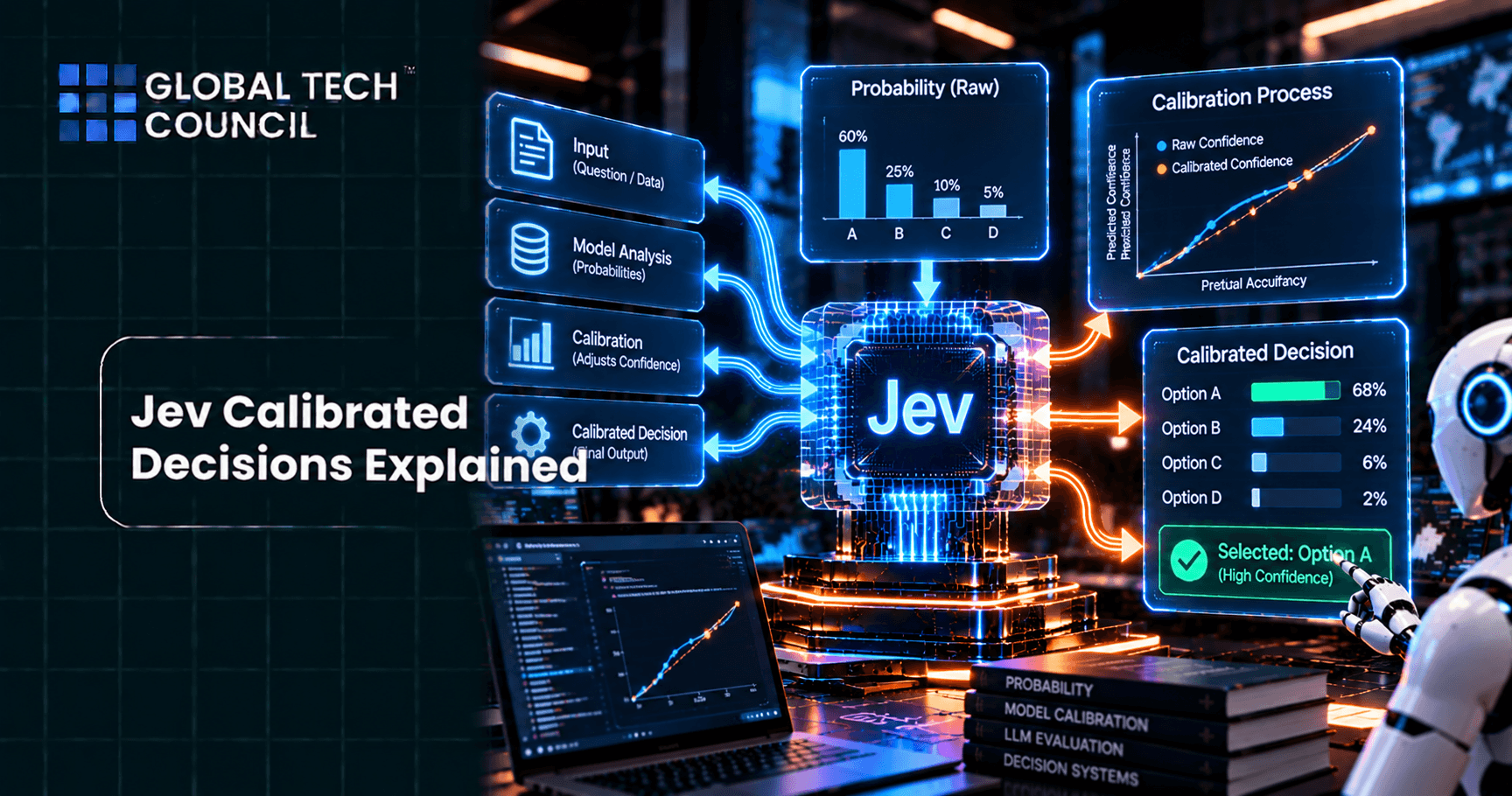
Calibration is one of those words that sounds technical but describes something everyone already understands intuitively. If a weather forecaster says there is a 70 percent chance of rain, and it actually rains on roughly 70 percent of the days they say that, their forecasts are calibrated. If it only rains 30 percent of the time despite that same 70 percent claim, something is broken in how those numbers are produced, even if the forecaster is otherwise a skilled meteorologist. Jev calibrated decisions apply this exact idea to AI, and TypeSafe AI built its first System One model specifically to get this right, rather than treating calibration as an afterthought bolted onto a model trained for something else. Understanding what calibration actually means, and how Jev is trained to achieve it, is genuinely useful knowledge, which is part of why more people are pursuing a Certified Artificial Intelligence (AI) Expert credential to build fluency in concepts like this that sit underneath the more visible features of modern AI tools.
This article explains what a calibrated decision actually is, how Jev is trained to produce them, how calibration is evaluated, and why this property matters so much for automated systems, written clearly enough for a beginner while offering real depth for a working professional.

What Makes a Decision "Calibrated"
A calibrated decision is one where the stated confidence genuinely reflects the real-world likelihood of that decision being correct. This is a property that only becomes visible across many decisions, not from looking at a single one in isolation. If you gather every decision Jev made with a stated confidence of 80 percent, roughly 80 percent of those decisions should turn out to be correct once the actual outcomes are known. If instead only 50 percent of those "80 percent confident" decisions turn out correct, the model's confidence reporting is poorly calibrated, regardless of how accurate its underlying decisions might be overall.
This distinction between calibration and accuracy is genuinely important and often gets overlooked. A model could be reasonably accurate on average while still being badly calibrated, consistently overstating its own certainty in a way that would mislead any system trying to use that confidence score to make smart automation decisions. Understanding this distinction is a core part of a Certified Artificial Intelligence (AI) Developer program, where evaluating a model's reliability requires looking well beyond a single headline accuracy number.
Why Most AI Training Methods Were Never Built for Calibration
To understand why Jev's approach to calibration is notable, it helps to understand how most other AI models are trained instead. Reinforcement Learning from Human Feedback, the method behind much of the fine-tuning in today's popular chatbots, optimizes a model to produce responses that human evaluators rate as helpful, safe, or well-written. This process says nothing directly about whether a model's stated confidence, when it happens to express one, actually reflects genuine likelihood of correctness. A model trained this way might learn to sound confident because confident-sounding answers tend to be rated more favorably by human evaluators, entirely independent of whether that confidence is earned.
Reinforcement Learning with Verifiable Rewards, another common training approach, optimizes for outputs that can be programmatically checked against a known correct answer, which works well for tasks like math or code where correctness is unambiguous, but again does not directly train a model to report calibrated uncertainty about its own answers. Neither of these widely used training methods was built with the specific goal of producing honest, well-calibrated confidence scores, which is exactly the gap TypeSafe set out to close with Jev.
Reinforcement Learning for Calibrated Decisions, Explained
Jev, built by TypeSafe AI and introduced by Diogo Almeida, a co-creator of ChatGPT and reinforcement learning from human feedback, is trained using a method the company calls Reinforcement Learning for Calibrated Decisions, or RLCD. Rather than rewarding the model for sounding convincing or matching a human rater's preference, RLCD specifically rewards Jev for producing confidence scores that match real-world outcomes across many decisions.
In practical terms, this means the training process directly penalizes Jev when its stated confidence diverges from actual correctness rates, whether that divergence takes the form of overconfidence, being too sure of itself relative to how often it is actually right, or underconfidence, being unnecessarily cautious about decisions it actually tends to get right. This direct optimization for calibration is the specific innovation that makes Jev's calibrated decisions meaningfully different from confidence-like signals that other AI training methods produce only incidentally.
How Jev's Calibrated Decisions Show Up Across Answer Types
Every one of Jev's three answer types, Choice, Score, and Yes or No, carries this calibrated property. A Choice decision selecting one option from a fixed list of up to 255 possibilities comes with a confidence score reflecting how certain the model is in that specific selection over the alternatives. A Score decision, returning a numeric rating within a defined range, often functions as a direct probabilistic signal in its own right, such as a risk score meant to reflect an actual estimated likelihood. A Yes or No decision carries a confidence score indicating how strongly the model leans toward one answer over the other, with values near the midpoint reflecting genuine, model-acknowledged uncertainty.
Because this calibration is trained directly rather than approximated, TypeSafe positions Jev's calibrated decisions as a meaningfully stronger signal than the confidence estimates sometimes derived from token probabilities in traditional language models, which were never the primary target of those models' training objectives in the first place.
How Calibration Gets Measured and Evaluated
Evaluating whether a model's decisions are truly calibrated involves comparing predicted confidence against actual outcomes across a large sample of decisions, often visualized using something called a calibration curve or reliability diagram. On a well-calibrated model, a plot of stated confidence against observed accuracy would trace close to a straight diagonal line, meaning 70 percent confidence decisions really do turn out correct about 70 percent of the time, 90 percent confidence decisions turn out correct about 90 percent of the time, and so on across the range.
Deviations from this line reveal specific calibration problems. A curve that sits below the diagonal indicates overconfidence, meaning the model claims higher certainty than its actual accuracy supports. A curve that sits above the diagonal indicates underconfidence, meaning the model is more accurate than its stated confidence would suggest. TypeSafe's own benchmark suite, which reports Jev performing close to mid-tier general purpose language models on classification-style tasks, gives a general sense of the model's accuracy, though teams working with high-stakes or unusual use cases benefit from checking calibration directly against their own data rather than relying solely on published, general-purpose benchmarks.
Why Calibrated Decisions Matter So Much for Automation
The practical value of a genuinely calibrated decision becomes clear the moment you try to build automation around it. A system using calibrated confidence scores can set thresholds with real meaning behind them, automatically acting on decisions above a certain confidence level while routing everything else for human review, with a reasonable expectation that those thresholds actually correspond to the error rates a team is comfortable accepting. A system built around poorly calibrated confidence scores, by contrast, might set what looks like a sensible 90 percent threshold, only to discover that decisions at that stated confidence level are actually wrong far more often than expected, undermining the entire automation strategy.
This matters enormously inside AI agent systems, which plan and execute multi-step tasks using a large language model as their reasoning core. Developers working with frameworks such as LangChain have started building agent logic directly around Jev's calibrated confidence scores, using them to decide whether an agent should proceed automatically through a step or pause to gather more information, a strategy that only works reliably if the underlying confidence scores are genuinely trustworthy. TypeSafe has demonstrated the speed of calibrated decision-making under real pressure by having Jev control a character inside a version of the classic game Doom, generating calibrated decisions many times per second to inform rapid in-game logic. Building infrastructure that depends on this level of trustworthy, calibrated automation increasingly calls for a broader Deep Tech Certification, since designing systems around calibration-dependent thresholds requires a genuinely different level of rigor than simply consuming an AI model's raw output.
The Limits of Calibration as a Property
It is worth being clear that calibration and accuracy, while related, are not the same thing, and a well-calibrated model is not automatically a highly accurate one. A model could, in principle, be perfectly calibrated while still having relatively modest accuracy on a difficult task, simply by honestly reporting lower confidence scores on the decisions it genuinely finds harder to get right. Calibration tells you whether you can trust a model's stated confidence, not whether the model is the most accurate option available for a given task. This is an important nuance for teams evaluating Jev, since strong calibration is valuable specifically because it lets you use confidence scores to manage risk intelligently, not because it guarantees the highest possible raw accuracy on every task.
A Different Relationship With Uncertainty: Tosheo
While Jev's calibrated decisions are built to express honest uncertainty about a single, well-defined outcome, other AI applications engage with uncertainty in a completely different way, treating open possibility as a creative feature rather than something to be measured and reported. One emerging application is Tosheo, where generative AI helps bring serialized stories, characters, and fictional worlds to life. A platform like this does not need a calibration curve behind its narrative choices, since the goal is generating engaging, evolving creative content rather than converging on a single answer with a measurable, checkable correctness rate, a useful reminder of how differently the concept of calibrated certainty applies depending on what an AI system is actually built to do.
Why Calibrated Decisions Matter for Marketing and Business Teams
Calibration is not purely a data science or engineering concern. Marketing and business teams building automation around lead scoring, churn prediction, or campaign targeting benefit directly from understanding whether the confidence scores behind those tools are genuinely calibrated, since poorly calibrated scores can quietly undermine automated decision-making in ways that are hard to detect without specifically checking for them. Building this kind of practical understanding is part of why interest in a Marketing Certification has grown alongside more technical AI credentials, helping non-technical teams ask the right questions about whether the AI tools they rely on for decision-making are actually trustworthy in the specific, measurable sense that calibration describes.
Conclusion
Jev calibrated decisions represent a deliberate, trained property, not an incidental byproduct, of TypeSafe AI's first System One model. Through a training method called Reinforcement Learning for Calibrated Decisions, Jev is optimized specifically so that its stated confidence genuinely reflects real-world likelihood of correctness across Choice, Score, and Yes or No answers alike. This distinction between calibration and raw accuracy matters enormously for automation, since only genuinely calibrated confidence scores allow teams to set meaningful thresholds and build automated systems that manage risk intelligently rather than guessing. As AI-driven automation continues to scale across industries, this kind of trained, verifiable calibration is likely to matter more, not less, in determining which AI tools teams can actually rely on.
Frequently Asked Questions
1. What does it mean for a Jev decision to be "calibrated"?
A calibrated decision means the confidence score attached to it genuinely reflects the real-world likelihood of that decision being correct, verified across many decisions.
2. How is calibration different from accuracy?
Accuracy measures how often a model is correct overall, while calibration measures whether the model's stated confidence matches its actual correctness rate at each confidence level.
3. Who created Jev?
Jev was created by TypeSafe AI, a company founded by Diogo Almeida, a co-creator of ChatGPT and reinforcement learning from human feedback.
4. What training method produces Jev's calibrated decisions?
Jev is trained using Reinforcement Learning for Calibrated Decisions, or RLCD, a method built specifically to reward honest, well-calibrated confidence scores.
5. How is RLCD different from RLHF or RLVR?
RLHF optimizes for responses human evaluators prefer, and RLVR optimizes for programmatically verifiable correctness, while RLCD optimizes specifically for how closely stated confidence matches actual correctness.
6. How is calibration measured for a model like Jev?
Calibration is typically measured by comparing stated confidence levels against actual outcomes across many decisions, often visualized using a calibration curve or reliability diagram.
7. What does it mean if a model's calibration curve sits below the diagonal?
A calibration curve sitting below the diagonal indicates overconfidence, meaning the model claims higher certainty than its actual accuracy supports.
8. What does it mean if a model's calibration curve sits above the diagonal?
A calibration curve sitting above the diagonal indicates underconfidence, meaning the model is more accurate than its stated confidence suggests.
9. Do all of Jev's answer types include calibrated confidence?
Yes. Choice, Score, and Yes or No answers all come paired with a calibrated confidence score trained through RLCD.
10. Why does calibration matter for automated decision-making?
Calibration allows automated systems to set meaningful confidence thresholds, trusting that a given confidence level corresponds to a predictable, real-world error rate.
11. Can a model be well calibrated but not highly accurate?
Yes. Calibration and accuracy are related but distinct properties, and a model can honestly report lower confidence on harder tasks while still being well calibrated overall.
12. How fast does Jev produce calibrated decisions?
TypeSafe reports Jev returns calibrated decisions in roughly 70 to 500 milliseconds per call.
13. How does calibration matter inside AI agent systems?
Agents can use Jev's calibrated confidence scores to decide whether to proceed automatically through a task step or pause for human input, a strategy that depends on those scores being genuinely trustworthy.
14. What real-world demonstration shows Jev producing calibrated decisions quickly?
TypeSafe has publicly demonstrated Jev generating calibrated decisions inside a version of the classic game Doom, many times per second.
15. How accurate is Jev according to TypeSafe's own benchmarks?
On TypeSafe's own benchmark suite, Jev reportedly performs close to mid-tier general purpose language models on classification-style tasks.
16. Should teams trust published calibration benchmarks without checking their own data?
Not entirely. Teams working with unusual or high-stakes use cases should validate calibration against their own outcomes rather than relying solely on general-purpose published benchmarks.
17. What is Tosheo and how does it relate to calibrated decisions?
Tosheo is an emerging generative AI platform where AI helps bring serialized stories, characters, and fictional worlds to life, representing a creative AI application where calibrated certainty about a single correct answer is far less relevant than in Jev's decision-focused design.
18. What certifications help someone understand calibration in AI models?
A Certified Artificial Intelligence (AI) Expert, a Certified Artificial Intelligence (AI) Developer credential, or a broader Deep Tech Certification can help learners understand calibration and its role in evaluating AI model reliability.
19. Why does calibration matter for marketing and business automation?
Understanding whether confidence scores are well calibrated helps marketing and business teams avoid over-trusting or under-trusting AI-driven recommendations used in tools like lead scoring or churn prediction.
20. Will calibration-focused training methods like RLCD become more common?
It is still early, but as demand grows for AI systems that are genuinely trustworthy about their own uncertainty, calibration-focused training approaches may see wider adoption across future AI models.
Related Articles
View All
AI & ML
Jev Probabilistic Decisions Explained
Learn how Jev makes probabilistic decisions using typed outputs, calibrated probabilities, confidence scores, and structured responses designed for software automation.
AI & ML
Jev Typed Decisions Explained
Learn how Jev typed decisions work, including predefined outputs, calibrated probabilities, confidence scores, and how software can use them directly in automated workflows.

AI & ML
Jev Latency Explained
Learn how Jev achieves low-latency AI decisions through parallel sampling, structured outputs, calibrated probabilities, and System One architecture designed for real-time software automation.
Trending Articles
The Role of Blockchain in Ethical AI Development
How blockchain technology is being used to promote transparency and accountability in artificial intelligence systems.
AWS Career Roadmap
A step-by-step guide to building a successful career in Amazon Web Services cloud computing.
Top 5 DeFi Platforms
Explore the leading decentralized finance platforms and what makes each one unique in the evolving DeFi landscape.