

Jev Probabilistic Decisions Explained


An AI model that says "yes" and an AI model that says "yes, and I'm 94 percent sure" are doing two very different jobs, even though the headline answer looks identical. The second kind of output, a decision paired with an honest, well-calibrated probability, is exactly what Jev, TypeSafe AI's first System One model, is built to produce. Jev probabilistic decisions sit at the heart of why the model is useful for automation in the first place, since a bare answer without a reliable confidence signal leaves software guessing about how much to trust it. Understanding how probabilistic decision-making actually works, and why calibration matters so much more than raw accuracy in isolation, is genuinely useful knowledge, which is part of why more people are pursuing a Certified Artificial Intelligence (AI) Expert credential to build a deeper understanding of how confidence and uncertainty are actually handled inside modern AI systems.
This article explains what a probabilistic decision means, how Jev produces calibrated confidence scores, why calibration is different from accuracy, and where this matters most in real systems, written clearly enough for a beginner while offering real depth for a working professional.

What "Probabilistic" Actually Means in This Context
A probabilistic decision is an answer paired with a stated likelihood of being correct, rather than a flat, unqualified statement. When Jev returns a Choice decision categorizing a support ticket as billing-related, it does not just say "billing." It says something closer to "billing, with 88 percent confidence," giving the receiving system a genuine measure of how much to trust that specific answer.
This distinction matters more than it might initially seem. A system that only receives a flat answer has to treat every decision the same way, either trusting all of them equally or applying a blanket level of human review regardless of how clear-cut any individual case actually was. A system that receives a probabilistic decision can differentiate, automatically acting on high-confidence answers while routing uncertain ones for closer review, which is a meaningfully more efficient way to run automation at scale. Understanding how to design systems around this kind of probabilistic signal is a core part of a Certified Artificial Intelligence (AI) Developer program, where confidence-aware system design is treated as a genuine skill separate from simply choosing an accurate model.
Why Calibration Matters More Than Raw Confidence
It is easy to assume that any AI model reporting a confidence score is automatically giving you something useful, but this is only true if that confidence score is well calibrated. Calibration refers to how closely a model's stated confidence matches its actual likelihood of being correct across many decisions. A model that says it is 90 percent confident should, if you check enough of its 90 percent confidence decisions, turn out to be right roughly 90 percent of the time. If it is right only 60 percent of the time despite claiming 90 percent confidence, its confidence scores are poorly calibrated and effectively misleading, even if the model's raw accuracy on the underlying task is reasonably good.
This is a genuinely different property from accuracy alone, and it is entirely possible for a model to be reasonably accurate overall while still being poorly calibrated, consistently overstating or understating its own certainty. TypeSafe has built Jev's entire training approach specifically around solving this calibration problem, rather than treating confidence scoring as a secondary feature layered on top of an accuracy-focused model.
How Jev Is Trained to Produce Calibrated Probabilities
Jev, built by TypeSafe AI and introduced by Diogo Almeida, a co-creator of ChatGPT and reinforcement learning from human feedback, is trained using a method TypeSafe calls Reinforcement Learning for Calibrated Decisions, or RLCD. This stands apart from Reinforcement Learning from Human Feedback, which many traditional large language models use to optimize for responses that human evaluators find helpful or convincing, and from Reinforcement Learning with Verifiable Rewards, which optimizes for outputs that can be programmatically checked as correct or incorrect.
RLCD specifically rewards the model for producing confidence scores that genuinely reflect the actual likelihood of a decision being correct, rather than rewarding confident-sounding output regardless of whether that confidence is earned. This means Jev's training process is directly optimizing for the exact property, calibration, that determines whether its probabilistic decisions are actually trustworthy for downstream automated use, rather than optimizing for something adjacent, like sounding persuasive or matching a human rater's preferences.
What a Jev Probabilistic Decision Looks Like in Practice
Every decision Jev returns, whether it is a Choice, Score, or Yes or No answer, comes paired with this kind of calibrated probability. For a Choice decision, this might mean returning a selected category along with a percentage reflecting how confident the model is in that specific category over the alternatives. For a Score decision, the number itself often functions as the probabilistic signal, such as a risk score reflecting an estimated likelihood of fraud. For a Yes or No decision, the probability reflects how confident the model is that "yes" is the correct answer, with values near 50 percent indicating a genuinely uncertain, close call.
This structure gives software receiving Jev's output a clear, actionable signal beyond the raw answer itself. A fraud detection system, for example, might automatically clear any transaction Jev scores below a certain probability of fraud, automatically block any transaction above a much higher threshold, and route everything in between to a human analyst, using Jev's calibrated probability as the deciding factor for which path each transaction takes.
Why Probabilistic Decisions Are More Useful Than Flat Answers for Automation
The practical value of a probabilistic decision becomes clear the moment you compare it against a flat, unqualified answer inside an automated pipeline. A flat answer forces a binary choice on the system receiving it: trust it completely, or apply the same level of scrutiny to every single decision regardless of how clear-cut it actually was. A probabilistic decision lets the system calibrate its own response to match the model's actual certainty, applying light-touch automation to confident decisions while reserving more careful handling, including human review, for genuinely uncertain ones.
This is particularly valuable inside AI agent systems, which plan and execute multi-step tasks using a large language model as their reasoning core. Many of the small decisions embedded inside an agent's workflow benefit enormously from a probabilistic signal, letting the agent proceed confidently through clear-cut steps while pausing or escalating on genuinely uncertain ones. Developers working with frameworks such as LangChain have started using Jev's probabilistic decisions specifically for this reason, treating the confidence score as a first-class part of the agent's decision-making logic rather than an afterthought. TypeSafe has demonstrated this kind of rapid, probabilistic decision-making under real pressure by having Jev control a character inside a version of the classic game Doom, where each movement and combat decision needs a calibrated confidence signal to inform how the surrounding system responds, many times per second. Building infrastructure that takes advantage of probabilistic decision-making at this scale increasingly calls for a broader Deep Tech Certification, since designing systems around confidence-aware automation requires a different engineering mindset than working with flat, unqualified AI outputs.
How to Evaluate Whether Jev's Probabilistic Decisions Are Trustworthy
For any team considering building automation around Jev's probabilistic decisions, it is worth understanding how calibration can actually be checked in practice. This typically involves collecting a sample of decisions across a range of confidence levels and comparing the stated confidence against the actual outcome once it becomes known, checking whether decisions Jev marked as 80 percent confident really do turn out correct roughly 80 percent of the time. TypeSafe's own benchmark suite reports Jev performing close to mid-tier general purpose language models on classification-style tasks, which offers a general sense of the model's underlying accuracy, but teams working with high-stakes or unusual use cases should still validate calibration against their own specific data rather than assuming published benchmarks translate directly to every possible application.
The Limits of Probabilistic Decisions
Probabilistic decisions are genuinely useful for structured automation, but they are not a substitute for explanation or nuanced judgment. A Jev probabilistic decision tells you what the model decided and how confident it is, but it cannot tell you why, since Jev cannot generate written reasoning of any kind. This matters in situations where an explanation is legally or practically necessary, such as certain regulated industries where a decision affecting a customer needs to be justified in words, not just backed by a number. In those cases, a probabilistic decision from Jev might still inform a workflow, but a generative AI component or human reviewer would need to provide the accompanying explanation.
A Very Different Use of AI Probability: Tosheo
While Jev's probabilistic decisions are built to quantify certainty about a single, well-defined outcome, other AI applications use probability in a completely different, generative way, shaping which word or plot direction comes next in an evolving piece of creative content. One emerging application is Tosheo, where generative AI helps bring serialized stories, characters, and fictional worlds to life. The probabilistic modeling happening behind a platform like this is aimed at producing engaging, coherent narrative content rather than a calibrated confidence score about a fixed decision, a useful contrast that shows just how differently the concept of probability can be applied depending on an AI system's underlying purpose.
Why Probabilistic Decisions Matter for Marketing and Business Teams
Understanding calibrated probability is not purely a data science concern. Marketing and business teams building automation around lead scoring, churn prediction, or campaign targeting benefit directly from understanding whether the underlying model's confidence scores are actually trustworthy, since a poorly calibrated score can lead a team to over-trust or under-trust automated recommendations in ways that hurt results. This kind of practical literacy is part of why interest in a Marketing Certification has grown alongside more technical AI credentials, helping non-technical teams ask sharper questions about whether the AI tools they use for decision-making are actually calibrated well enough to trust.
Conclusion
Jev probabilistic decisions bring a genuinely important property to automated AI decision-making: a confidence score that has actually been trained to reflect real-world accuracy, rather than a number generated as an afterthought. Trained through Reinforcement Learning for Calibrated Decisions, Jev's Choice, Score, and Yes or No outputs all come paired with this kind of calibrated probability, letting automated systems differentiate between clear-cut and uncertain decisions rather than treating every answer with the same blanket level of trust or scrutiny. As more automated systems come to depend on AI-driven decisions at scale, this distinction between a flat answer and a genuinely calibrated probabilistic one is likely to matter more, not less, over time.
Frequently Asked Questions
1. What is a probabilistic decision in Jev?
A probabilistic decision is an answer paired with a calibrated confidence score reflecting how likely the model believes that answer is to be correct.
2. Why does calibration matter more than raw confidence alone?
Calibration measures whether a model's stated confidence actually matches its real-world accuracy, since a model can sound confident without that confidence being trustworthy.
3. Who created Jev?
Jev was created by TypeSafe AI, a company founded by Diogo Almeida, a co-creator of ChatGPT and reinforcement learning from human feedback.
4. What training method produces Jev's calibrated probabilities?
Jev is trained using Reinforcement Learning for Calibrated Decisions, or RLCD, which specifically rewards honest, well-calibrated confidence rather than confident-sounding output.
5. How is RLCD different from RLHF used in many traditional language models?
RLHF optimizes for responses human evaluators prefer, while RLCD optimizes specifically for how closely a model's stated confidence matches its actual correctness.
6. What does a probabilistic decision look like for a Choice answer?
A Choice decision returns a selected category along with a percentage reflecting how confident the model is in that category compared to the alternatives.
7. Why are probabilistic decisions more useful than flat answers in automation?
Probabilistic decisions let automated systems apply lighter handling to high-confidence answers while routing uncertain ones for closer review, rather than treating every decision the same way.
8. Can Jev explain why it made a particular probabilistic decision?
No. Jev provides the decision and its confidence score, but it cannot generate written reasoning or explanation for why it reached that conclusion.
9. How does Jev's probabilistic output fit into AI agent workflows?
Agents can use Jev's confidence scores to decide whether to proceed automatically through a step or pause for escalation, making probabilistic decisions a useful signal inside multi-step workflows.
10. How fast does Jev return a probabilistic decision?
TypeSafe reports Jev returns decisions, including their confidence scores, in roughly 70 to 500 milliseconds per call.
11. How can a team check whether Jev's probabilistic decisions are well calibrated?
Teams can compare Jev's stated confidence levels against actual outcomes over a sample of decisions, checking whether, for example, 80 percent confidence decisions turn out correct roughly 80 percent of the time.
12. What real-world demonstration shows Jev's probabilistic decisions in action?
TypeSafe has publicly demonstrated Jev returning probabilistic movement and combat decisions inside a version of the classic game Doom, many times per second.
13. How accurate is Jev overall compared to general purpose language models?
On TypeSafe's own benchmark suite, Jev reportedly performs close to mid-tier general purpose language models on classification-style tasks, offering a general sense of its underlying accuracy.
14. Are Jev's probabilistic decisions suitable for regulated industries requiring explanations?
Not on their own. Since Jev cannot generate written justification, industries requiring explained decisions would need to pair Jev's probabilistic output with a generative AI component or human reviewer.
15. What is the risk of using a poorly calibrated confidence score in automation?
A poorly calibrated confidence score can lead a system to over-trust incorrect decisions or unnecessarily flag correct ones, undermining the efficiency automation is meant to provide.
16. Does Jev's Score answer type function as a probability itself?
In many use cases, yes. A Score decision, such as a risk rating, often functions as a direct probabilistic signal about the likelihood of a particular outcome.
17. What is Tosheo and how does its use of probability differ from Jev's?
Tosheo is an emerging generative AI platform where AI helps bring serialized stories, characters, and fictional worlds to life, using probability to shape creative narrative choices rather than to express calibrated confidence in a fixed decision.
18. What certifications help someone understand probabilistic decision-making in AI?
A Certified Artificial Intelligence (AI) Expert, a Certified Artificial Intelligence (AI) Developer credential, or a broader Deep Tech Certification can help learners understand calibration and probabilistic decision-making across different AI architectures.
19. Why does calibration matter for marketing and business automation?
Poorly calibrated confidence scores can lead teams to over-trust or under-trust AI-driven recommendations for tasks like lead scoring or churn prediction, directly affecting business outcomes.
20. Will calibrated probabilistic decision-making become more common in future AI models?
It is still early, but as demand grows for AI systems that are not just accurate but genuinely trustworthy about their own uncertainty, calibration-focused training methods like RLCD may see wider adoption.
Related Articles
View All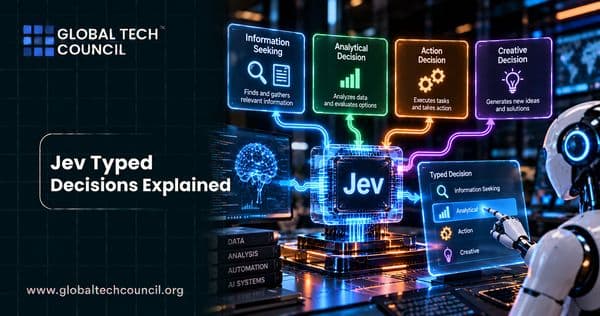
AI & ML
Jev Typed Decisions Explained
Learn how Jev typed decisions work, including predefined outputs, calibrated probabilities, confidence scores, and how software can use them directly in automated workflows.

AI & ML
Jev Confidence Scores Explained
Learn how Jev confidence scores work, how calibrated probabilities communicate uncertainty, and how software can use confidence thresholds for safer automated decisions.

AI & ML
Jev Structured Outputs Explained
Learn how Jev structured outputs work, including predefined response types, calibrated probabilities, confidence scores, and how software can use decisions directly in automated workflows.
Trending Articles
The Role of Blockchain in Ethical AI Development
How blockchain technology is being used to promote transparency and accountability in artificial intelligence systems.
AWS Career Roadmap
A step-by-step guide to building a successful career in Amazon Web Services cloud computing.
Top 5 DeFi Platforms
Explore the leading decentralized finance platforms and what makes each one unique in the evolving DeFi landscape.