

AI-Powered Product Positioning: Find the Right Market Message Faster
 Suyash Raizada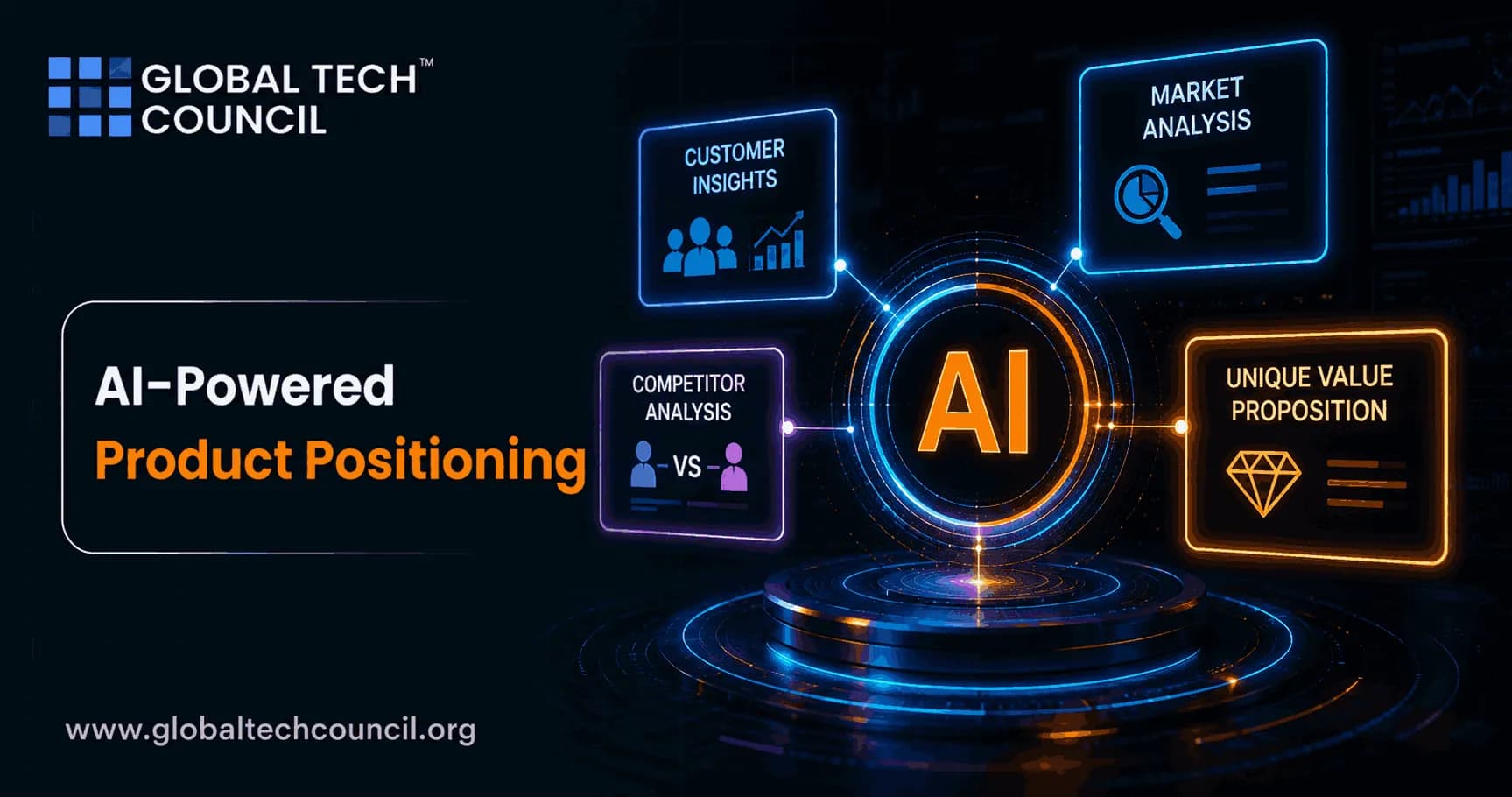
AI-powered product positioning moves you from guesswork to evidence faster. Instead of waiting weeks for manual interviews, survey coding, competitor reviews, and message tests, you can use machine learning, natural language processing, and predictive analytics to identify audience segments, draft positioning options, and test which message is likely to perform.
The point is not to let a model invent your strategy. That is a bad shortcut. The better use is narrower: use AI to process more signals than a human team can handle, then let product, marketing, sales, and data teams decide what is credible, differentiated, and true.

What AI-Powered Product Positioning Actually Means
Product positioning defines where your product fits in the market, who it is for, what problem it solves, and why someone should choose it over alternatives. AI-powered positioning adds data models to that workflow.
A typical workflow uses:
AI customer segmentation to group users by behavior, needs, usage patterns, intent, and predicted value.
Natural language processing to analyze reviews, support tickets, sales calls, social comments, and competitor pages.
Generative AI to draft positioning statements, value propositions, headlines, and objection-handling copy.
AI message testing to evaluate clarity, credibility, differentiation, and emotional response.
Predictive analytics to estimate which message is more likely to convert for a specific segment or channel.
Marketing AI adoption is no longer a side project. Recent industry estimates put the AI marketing market at roughly 47 billion USD in 2025, with forecasts pointing toward more than 80 billion USD later in the decade. Enterprise teams are moving faster too. Survey data shows larger enterprise marketing teams report higher willingness to use AI than smaller companies, a gap of close to 17 percentage points in some 2024 reports. AI is enabling organizations to analyze customer behavior, competitor strategies, and market trends faster than ever before. Pursuing a Tech Certification helps professionals build expertise in AI, analytics, cloud computing, automation, and data-driven decision-making. These certifications provide the technical knowledge needed to leverage AI for product positioning, customer insights, and faster go-to-market execution.
Why Traditional Positioning Work Takes So Long
Classic positioning research is useful, but slow. You collect customer interviews, run surveys, build personas, study competitor claims, test copy, wait for results, and then repeat. Good teams do it carefully. Still, the bottleneck is obvious: humans can only read, tag, and compare so much unstructured feedback.
AI changes the timing. A model can scan thousands of customer reviews, cluster recurring complaints, compare competitor homepages, and surface repeated value claims in minutes. That does not make the output automatically correct. It does give you a sharper first draft.
Here is the trade-off. AI is excellent at pattern detection but weak at business judgment. If your product cannot actually deliver a claimed outcome, AI will happily write a persuasive message around it anyway. You need humans in the loop.
How AI Finds the Right Market Message Faster
1. Segment customers by behavior, not just demographics
Static personas like "IT manager, age 35 to 50" rarely explain why someone buys. AI customer segmentation can group people by product usage, renewal signals, transaction patterns, content behavior, feature adoption, or churn risk.
For example, a SaaS company may find three segments that look similar on paper but behave differently:
Teams that need fast setup and low admin overhead.
Power users who care about integration depth and API access.
Executives who want reporting, governance, and lower operational risk.
Each group needs a different message. One wants "go live this week." Another wants "connects cleanly with your existing stack." The executive group may care more about audit trails and accountability.
A practical warning from real segmentation work: if you use scikit-learn KMeans, check your version. In scikit-learn 1.4, the default n_init changed to auto. With init='k-means++', that can mean one run instead of the older default of 10. On small or noisy marketing datasets, that quiet default can shift your clusters enough to change the message you choose. Set it explicitly.
2. Mine customer language from real conversations
The best positioning often comes from customers, not brainstorms. AI can summarize sales call transcripts, support tickets, chat logs, NPS comments, and app store reviews to find the exact phrases people use.
You are looking for patterns such as:
Problems customers describe before they buy.
Alternatives they compare you against.
Words they use for pain, risk, speed, trust, or cost.
Claims they find believable or suspicious.
Reasons they churn, delay, or expand.
This matters because buyers are changing how they discover products. Many now use AI-assisted search, peer communities, review platforms, and comparison content before speaking to sales. Recent trend research found that a large majority of marketers, more than 90 percent in some surveys, plan to optimize for both traditional and AI-powered search engines. If your positioning is vague, AI search systems may summarize you as just another generic vendor.
3. Generate multiple positioning routes
AI positioning tools can help map the competitive landscape and draft several routes. You might test positioning around cost reduction, speed, compliance, ease of use, specialist expertise, or category leadership.
Ask for contrast, not just copy. For example:
What claims are competitors repeating?
Which benefits are underused in the category?
Which segment has the strongest urgency?
Which proof points support each claim?
Which message sounds distinctive but still believable?
To be blunt, AI-generated taglines are usually average. The value is in the comparison work: seeing 20 viable angles quickly, then rejecting 17 of them with evidence.
4. Test messages with synthetic and real audiences
AI message testing can evaluate draft copy for clarity, tone, differentiation, objections, and likely fit by segment. Some tools use synthetic audiences, which simulate target groups from modeled data. Vendor reports describe synthetic audience tools claiming accuracy in the range of 80 to 95 percent when predicting real audience response.
Treat that as useful, not final. Synthetic panels are strong for early filtering. They are weak when your category has unusual buying committees, regulatory constraints, cultural nuance, or a product that creates a new behavior. Always validate finalists with real customers or prospects.
A sensible testing stack looks like this:
Use AI to remove weak or unclear messages.
Run qualitative interviews on the top 3 to 5 options.
Test landing pages or ads with real traffic.
Compare conversion rate, sales acceptance, demo quality, and pipeline value.
Feed the results back into your segmentation and messaging model.
AI-powered product positioning combines intelligent automation, predictive analytics, and emerging technologies to improve business decision-making. Becoming a Deeptech Expert equips professionals with interdisciplinary expertise in AI, advanced computing, blockchain, and intelligent systems. This knowledge enables organizations to analyze customer needs more effectively while developing differentiated product positioning strategies supported by real-time market intelligence.
Where AI-Powered Positioning Works Best
AI-powered product positioning is most useful when you have enough data and a messy market. It works especially well in ecommerce, SaaS, financial services, education technology, consumer apps, and B2B platforms with multiple buyer roles.
Ecommerce launches
An ecommerce brand can cluster shoppers by price sensitivity, sustainability interest, quality signals, repeat purchase behavior, or browsing intent. Product pages can then emphasize convenience for one group and material quality for another.
SaaS in crowded categories
SaaS teams can use AI to scan competitor pages and flag overused claims like "all-in-one," "simple," or "modern." If everyone says the same thing, say something more specific. "Reduce manual QA review time by 30 percent" beats "improve team productivity" if you can prove it.
Financial services personalization
Banks and fintech firms can segment by transaction behavior, product usage, and risk profile. Here, governance is not optional. You need fairness checks, explainability, and careful review of who sees which offer.
A Practical AI Positioning Workflow You Can Use
Use this process when launching a product, entering a new market, or refreshing a stale message.
Define the decision. Are you choosing a homepage headline, a category narrative, a sales deck message, or a full repositioning?
Collect inputs. Pull CRM notes, win-loss data, support tickets, reviews, call transcripts, competitor pages, pricing pages, and product analytics.
Clean the data. Remove duplicates, private data, irrelevant records, and outdated claims.
Run segmentation. Combine behavioral data with qualitative themes. Do not rely only on job titles.
Generate options. Create message variants by segment, benefit, proof point, and objection.
Score each option. Rate clarity, difference, credibility, emotional pull, SEO fit, and sales usefulness.
Test. Use synthetic audiences first, then real interviews and live experiments.
Govern the output. Check claims, privacy, bias, compliance, and brand fit before publishing.
Skills Teams Need to Do This Well
This is where training matters. Product marketers need enough AI literacy to question model output. Data professionals need enough marketing context to avoid clustering users into groups that are mathematically neat but commercially useless.
If you are building this capability, look at structured learning paths through Global Tech Council in artificial intelligence, machine learning, data science, and prompt engineering. Certification-based programs give you a defined curriculum and an assessment, which beats stitching together scattered tutorials when you want a team to reach a shared baseline.
Risks You Should Not Ignore
AI can speed up positioning, but it can also make bad thinking look polished. Watch for these problems:
Generic output: If your prompts are generic, the message will sound like every competitor.
False confidence: Synthetic testing is not a replacement for real buyer evidence.
Data bias: Historical customer data may exclude segments you want to reach.
Privacy exposure: Do not paste sensitive customer data into tools without proper controls.
Claim inflation: AI may create promises your product cannot support.
What Comes Next
AI-powered product positioning is becoming standard for teams that need to move quickly across channels, segments, and search environments. The winners will not be the teams that generate the most copy. They will be the teams that connect customer evidence, machine analysis, creative judgment, and responsible testing.
Start small. Pick one product page or campaign message, collect 100 real customer comments, cluster the themes, generate five positioning options, and test them with both AI-assisted review and real prospects. If you want to build the technical depth behind that workflow, make an artificial intelligence, machine learning, or data science certification your next step. Successful product positioning requires understanding customers, competitors, and market opportunities. Earning a Marketing Certification helps professionals strengthen product messaging, AI-powered market research, branding, competitive positioning, and customer engagement. These capabilities enable businesses to communicate value propositions more effectively while increasing product adoption and long-term growth.
FAQs
1. What Is AI-Powered Product Positioning?
AI-powered product positioning uses artificial intelligence to analyze customer behavior, competitor messaging, market trends, and audience preferences to develop compelling product positioning and value propositions that resonate with target customers.
2. How Does AI Improve Product Positioning?
AI analyzes customer feedback, search intent, competitor content, buying behavior, and market data to identify positioning opportunities, refine messaging, and help marketers communicate product value more effectively.
3. Why Is Product Positioning Important for Business Growth?
Strong product positioning differentiates a product from competitors, communicates unique value, attracts the right customers, improves brand perception, increases conversions, and supports long-term business growth.
4. How Can AI Help Identify Target Audiences?
AI segments audiences using demographics, psychographics, purchasing behavior, engagement data, geographic information, and predictive analytics, enabling marketers to tailor positioning for specific customer groups.
5. How Does AI Analyze Competitor Positioning?
AI evaluates competitor websites, product messaging, customer reviews, pricing strategies, content, search visibility, and market trends to identify strengths, weaknesses, and opportunities for differentiation.
6. Can AI Improve Product Messaging?
Yes. AI generates and refines product messaging by analyzing customer language, identifying high-performing keywords, testing messaging variations, and aligning communication with audience preferences and search intent.
7. How Does AI Help Create Strong Value Propositions?
AI identifies customer pain points, desired outcomes, competitive advantages, and market opportunities to help businesses develop clear, relevant, and differentiated value propositions.
8. What Are the Benefits of AI-Powered Product Positioning?
Benefits include faster market research, stronger messaging, better audience targeting, improved conversion rates, enhanced customer engagement, competitive differentiation, data-driven decisions, and increased marketing efficiency.
9. Which AI Tools Support Product Positioning?
AI-powered platforms can assist with customer analytics, competitive intelligence, content generation, keyword research, sentiment analysis, CRM insights, predictive analytics, and marketing automation. The best tool depends on business needs and workflows.
10. How Can AI Improve Product Launch Positioning?
AI helps identify the ideal audience, optimize messaging, analyze market demand, recommend pricing strategies, generate launch content, and monitor customer feedback throughout the product launch process.
11. Which Industries Benefit Most From AI-Powered Product Positioning?
Industries including SaaS, technology, healthcare, retail, financial services, manufacturing, education, telecommunications, consumer goods, and professional services benefit from AI-enhanced positioning strategies.
12. How Does AI Personalize Product Messaging?
AI adapts messaging based on customer preferences, browsing behavior, purchase history, engagement patterns, lifecycle stage, and predictive insights to create more relevant and personalized customer experiences.
13. What Challenges Should Businesses Consider When Using AI for Product Positioning?
Challenges include maintaining brand consistency, ensuring high-quality customer data, avoiding AI bias, protecting customer privacy, integrating AI into existing workflows, and validating AI-generated recommendations.
14. How Can Businesses Measure Product Positioning Success?
Success can be measured using conversion rate, customer acquisition cost (CAC), brand awareness, click-through rate (CTR), engagement, customer lifetime value (CLV), retention rate, and overall marketing ROI.
15. What Skills Should Product Marketers Learn for AI-Powered Positioning?
Professionals should develop expertise in customer research, AI fundamentals, prompt engineering, competitive analysis, content strategy, SEO, marketing analytics, positioning frameworks, and AI governance.
16. How Is AI Transforming Product Positioning in 2026?
In 2026, AI is enabling predictive positioning, autonomous market analysis, real-time messaging optimization, AI-powered customer insights, personalized value propositions, and intelligent competitive intelligence.
17. Can Small Businesses Use AI for Product Positioning?
Yes. Affordable AI tools help small businesses conduct market research, analyze competitors, generate positioning statements, optimize marketing content, and improve customer targeting without large marketing budgets.
18. What Career Opportunities Are Growing in AI-Powered Product Marketing?
Growing adoption is creating opportunities for product marketers, positioning strategists, AI marketing specialists, competitive intelligence analysts, growth marketers, brand strategists, marketing automation experts, and AI product managers.
19. What Common Mistakes Should Marketers Avoid When Using AI for Positioning?
Marketers should avoid relying solely on AI without customer validation, ignoring competitor analysis, using generic messaging, overlooking customer feedback, failing to test positioning statements, and neglecting brand differentiation.
20. Why Is AI Becoming Essential for Product Positioning?
AI enables businesses to identify customer needs, analyze competitors, refine messaging, and optimize positioning with greater speed and accuracy than traditional methods. By combining AI-driven insights with strategic marketing expertise, organizations can create compelling market messages, strengthen competitive positioning, improve customer engagement, and accelerate product success in increasingly competitive markets.
Related Articles
View All
AI & ML
Meet Google Playground: Create Games With AI
Meet Google Playground, Google's new experimental platform that lets you create, play, and share custom games with text prompts. Learn how it works, basic game design tips, a sample session, safety and sharing features, Unity Spark plans, and limits.

AI & ML
OpenAI Dots vs Grok Bot vs Muse
Compare OpenAI Dots, Grok Bot, and Meta Muse to understand how these persistent AI agents differ in cloud computer use, connected apps, automation, memory, and long-running workflows.

AI & ML
What Is OpenAI Dots?
Learn what OpenAI Dots are, how these always-on AI agents work, and how they use GPT-6 Astra, cloud computers, connected apps, and persistent context to manage ongoing tasks.
Trending Articles
The Role of Blockchain in Ethical AI Development
How blockchain technology is being used to promote transparency and accountability in artificial intelligence systems.
AWS Career Roadmap
A step-by-step guide to building a successful career in Amazon Web Services cloud computing.
Top 5 DeFi Platforms
Explore the leading decentralized finance platforms and what makes each one unique in the evolving DeFi landscape.