

AI Customer Segmentation and Personalization for Product Marketers

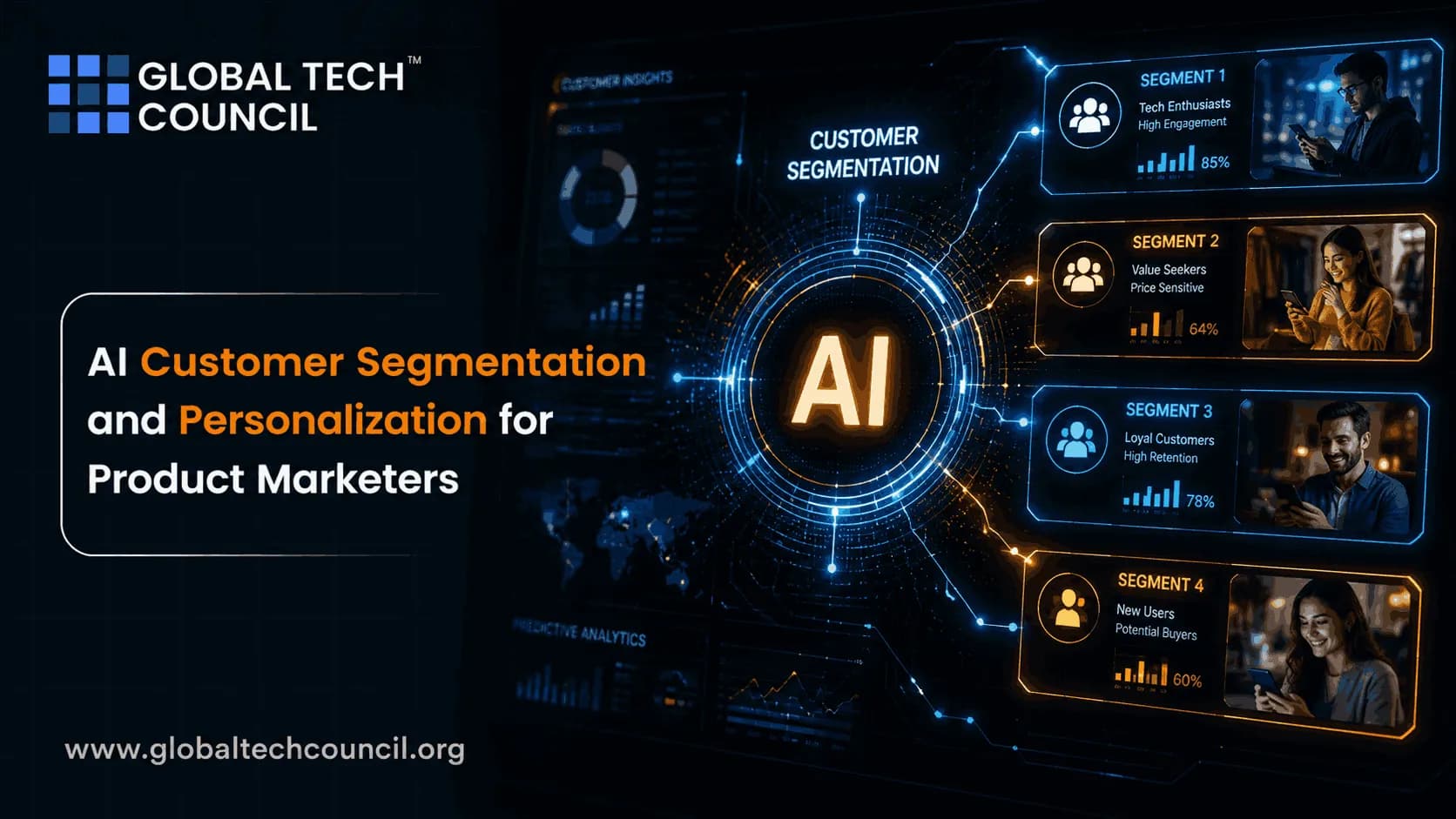
AI customer segmentation and personalization help product marketers move past static personas and build experiences around what customers actually do. That matters. A user who signs up from a pricing page, invites three teammates, and ignores onboarding emails should not be treated like a user who reads five help articles but never reaches activation.
The practical shift is simple: stop segmenting only by firmographics or demographics, and start segmenting by behavior, intent, value, and risk. AI makes that possible at scale. It also raises a harder question. How do you personalize without becoming intrusive?

Why AI Customer Segmentation and Personalization Matter Now
AI is now part of normal marketing work. Industry research in 2024 found that nearly three out of four marketers used at least one AI tool, more than double the prior year. One marketing report from 2023 noted that over 68% of marketers worldwide use AI to automate personalization at scale.
Budgets tell the same story. Marketers now allocate about 40% of their budgets to personalization, up from 22% in 2023. Bain has reported that retailers using AI-powered personalization have seen 10 to 25% improvements in return on ad spend in early targeted campaign trials.
For product marketers, the bigger opportunity is not just better ads. It is better onboarding, sharper feature adoption campaigns, smarter upsell timing, and retention programs that respond to product behavior in near real time. Modern customer segmentation relies on AI, analytics, and data-driven decision-making. Pursuing a Tech Certification helps professionals develop expertise in artificial intelligence, data analytics, cloud technologies, automation, and digital transformation. These certifications provide the technical foundation needed to leverage AI for customer insights, predictive analytics, and personalized marketing strategies that improve engagement and conversion rates.
How AI Customer Segmentation Works
Traditional segmentation often starts with categories like company size, role, geography, or industry. Useful, but blunt. AI customer segmentation uses machine learning to find patterns across many signals, including behavior that a spreadsheet filter would miss.
Common data inputs
Product behavior: feature usage, activation events, session frequency, time in app, workspace invitations.
Transactional data: purchases, renewals, upgrades, basket size, plan changes.
Marketing engagement: email clicks, landing page visits, ad interactions, webinar attendance.
Support and feedback: ticket themes, NPS, review text, chat transcripts, cancellation reasons.
Context signals: device type, time zone, referral source, and location where consent allows it.
AI models can turn those signals into segments such as stalled evaluators, high-intent trial users, power users ready for expansion, or quiet churn risks. These groups are more useful than broad labels because they point to an action.
Clustering, scoring, and predictive segmentation
Clustering algorithms group customers based on similarity. Predictive models estimate probabilities, such as churn risk, trial-to-paid conversion likelihood, or propensity to adopt a feature. Platforms such as Braze, Mailchimp, customer data platforms, and analytics stacks often package these capabilities inside campaign workflows.
One practitioner warning: watch for leakage. If you train an upsell propensity model and accidentally include an event like plan_upgraded inside the training window, the model will look brilliant in testing and fail in production. The same thing happens with churn models that use cancellation survey data from before the predicted churn date. Split your data by time, not just random rows.
Another small detail that can change results: scikit-learn changed the default n_init behavior for KMeans to auto in version 1.4. If your marketing analyst reruns an old clustering notebook without pinning versions, cluster assignments may shift. Pin your environment. Document the model version. Boring work saves awkward campaign reviews. AI-powered personalization combines machine learning, predictive modeling, customer analytics, and intelligent automation. Becoming a Deeptech Expert equips professionals with interdisciplinary expertise that enables them to design intelligent personalization systems, optimize customer experiences, and leverage emerging technologies to improve marketing performance while maintaining responsible AI practices.
How AI Personalization Works for Product Marketers
AI personalization decides which message, offer, content, or product experience a user should see at a specific moment. Salesforce describes AI personalization as using models to deliver tailored recommendations and experiences across channels, often in real time.
Where personalization applies
Onboarding: show different checklists to self-serve users, enterprise evaluators, and technically advanced users.
Feature adoption: recommend tutorials or in-app prompts based on unused features that match the user's goal.
Lifecycle messaging: trigger emails or push notifications from product signals, not just fixed dates.
Upsell and expansion: identify accounts likely to need higher limits, advanced controls, or additional seats.
Retention: detect declining usage and send value-focused interventions before the renewal risk becomes visible.
Netflix, Amazon, and Spotify are familiar examples because personalization is part of the product surface itself. Netflix adapts the home screen based on viewing behavior. Amazon personalizes recommendations and search experiences. Spotify uses listening behavior and feedback signals to produce playlists such as Discover Weekly and Daily Mix.
Product marketers can borrow the same idea without building a streaming-grade recommendation system. If a user has invited teammates but has not configured integrations, show integration guidance. If a trial account reaches a high-value action twice in one week, send a sales-assist signal or a pricing education message. Keep it relevant. That is the line between helpful and creepy.
Generative AI for Personalization at Scale
Generative AI adds a new layer. It can draft, adapt, or select creative variations for different segments. That includes subject lines, in-app microcopy, product education, landing page modules, and chatbot responses.
Use it carefully. Generative AI is good at producing variants, but it should not invent claims, pricing rules, compliance statements, or feature availability. Keep source-of-truth content in a controlled knowledge base. Human review still matters for regulated industries and high-risk customer communications.
A practical workflow looks like this:
Define the segment and customer state.
Provide approved positioning, product facts, and exclusions.
Generate three to five message variants.
Score variants against brand, clarity, and compliance criteria.
Test performance through A/B testing or multi-armed bandits.
Harvard Business Review has discussed how AI tools can use performance data to optimize messaging, including email subject lines, before launch. That is useful, but do not optimize only for clicks. A subject line that wins opens and attracts the wrong users can lower activation or expansion quality.
A Practical AI Segmentation and Personalization Playbook
1. Build a first-party data foundation
Start with consented first-party data from your product, website, CRM, email platform, support desk, and billing system. Use consistent event names. For example, workspace_created, team_invited, and integration_connected are easier to model than vague events such as button_clicked.
Connect these signals in a customer data platform or warehouse. Twilio Segment's 2024 State of Personalization report highlights how companies are increasing investment in AI-supported omnichannel personalization. But AI will not fix messy identifiers or duplicate profiles.
2. Define segments around product outcomes
Do not start with the model. Start with the decision. What will change if the user belongs to this segment?
Activation: which users need guidance to reach the first value moment?
Adoption: which accounts should learn about a specific feature?
Expansion: which customers show signals of growth?
Retention: which customers are drifting away?
Use AI clustering to discover patterns, then validate them with sales, support, and customer success. To be blunt, a cluster nobody can explain is not a segment. It is a chart.
3. Personalize the journey, not just the email
Product marketers often begin with email because it is easy to change. Go further. Personalize onboarding checklists, help center recommendations, in-product banners, sales alerts, and release notes. A release announcement for an admin control should look different for a security lead than for an individual contributor.
4. Measure business outcomes
Track activation rate, feature adoption, expansion revenue, churn, retention, ARPU, and NPS. Use controlled experiments. Compare AI-driven personalization against a clear baseline. If the personalized path increases clicks but reduces trial conversion, turn it off.
Personalization is transforming how organizations build customer relationships and drive revenue growth. Earning a Marketing Certification helps professionals strengthen expertise in customer segmentation, AI-powered marketing, digital branding, campaign optimization, and growth strategy. These capabilities enable product marketers to deliver highly relevant customer experiences while improving marketing performance and business outcomes.
Privacy, Consent, and AI Governance
AI customer segmentation and personalization depend on trust. GDPR, CCPA, and the EU ePrivacy Directive give users rights over data collection, tracking, and consent. More than 40 jurisdictions now have distinct cookie and consent rules, which makes global personalization harder than it looks in a campaign brief.
The EU AI Act entered into force on 1 August 2024, with obligations phased in over time. It increases pressure on organizations to be transparent about AI systems, especially where risk or sensitive data is involved.
Build privacy into the operating model:
Use explicit consent and granular preference centers.
Avoid sensitive attributes unless there is a clear legal basis and strong governance.
Use aggregation, anonymization, and data minimization where possible.
Explain how data supports personalization in plain language.
Review models for bias, proxy variables, and unintended exclusion.
McKinsey has reported that advanced AI-based anonymization techniques can improve personalization accuracy while strengthening privacy protection. That finding matters because privacy and performance are often framed as opposites. They do not have to be.
Skills Product Marketers Need Next
You do not need to become a full-time machine learning engineer, but you do need enough fluency to ask better questions. Learn the basics of clustering, propensity modeling, experimentation, consent management, and model governance.
If you want a structured path, explore Global Tech Council's certification programs in artificial intelligence, machine learning, data science, and prompt engineering. Product marketers who can connect positioning, data, AI systems, and privacy rules will be far more useful than marketers who only know how to prompt a copy tool.
Your next step: pick one lifecycle moment, such as trial activation or churn prevention. Define the outcome, list the first-party signals, create two or three behavior-based segments, and test one personalized experience against your current baseline. Keep the scope small. Make the measurement clean. Then scale what works.
FAQs
1. What Is AI Customer Segmentation in Product Marketing?
AI customer segmentation is the process of using artificial intelligence to group customers based on demographics, behavior, purchase history, preferences, engagement, and predictive insights. It helps product marketers deliver highly targeted campaigns and personalized customer experiences.
2. How Does AI Improve Customer Segmentation?
AI analyzes large volumes of customer data to identify patterns, predict behavior, discover hidden audience segments, and continuously update customer profiles, enabling more accurate and dynamic segmentation than traditional methods.
3. Why Is Customer Segmentation Important for Product Marketers?
Customer segmentation helps product marketers understand audience needs, create personalized messaging, improve campaign performance, increase customer engagement, optimize marketing spend, and drive higher conversion rates.
4. How Does AI Personalization Improve Marketing Results?
AI personalizes product recommendations, email campaigns, website experiences, advertisements, and customer journeys based on individual preferences and behavior, leading to better engagement, customer satisfaction, and revenue growth.
5. What Types of Data Does AI Use for Customer Segmentation?
AI uses demographic data, behavioral data, purchase history, browsing activity, customer interactions, geographic information, psychographics, engagement metrics, and first-party customer data to create meaningful audience segments.
6. What Are the Benefits of AI-Powered Customer Segmentation?
Benefits include improved targeting, higher conversion rates, personalized customer experiences, increased retention, optimized marketing campaigns, faster decision-making, better resource allocation, and improved return on investment (ROI).
7. How Does Predictive Analytics Enhance Customer Segmentation?
Predictive analytics enables AI to forecast customer behavior, identify high-value audiences, estimate purchase intent, predict churn risk, and recommend personalized marketing strategies before customer actions occur.
8. Can AI Segment Customers in Real Time?
Yes. AI continuously analyzes customer interactions and updates audience segments in real time, allowing marketers to deliver personalized experiences based on the latest customer behavior and preferences.
9. How Does AI Help Product Recommendation Systems?
AI analyzes purchase patterns, browsing history, customer preferences, and contextual signals to recommend products that are most relevant to each individual customer, improving sales and customer satisfaction.
10. Which Industries Benefit Most From AI Customer Segmentation?
Industries including e-commerce, SaaS, retail, banking, healthcare, travel, education, telecommunications, media, and consumer products benefit significantly from AI-driven customer segmentation and personalization.
11. How Can AI Improve Customer Retention?
AI identifies customers at risk of churn, recommends personalized engagement strategies, automates targeted campaigns, and helps marketers deliver relevant experiences that strengthen long-term customer relationships.
12. What Role Does Machine Learning Play in Customer Segmentation?
Machine learning identifies customer patterns, clusters similar users, predicts future behavior, improves segmentation accuracy, and continuously refines marketing models as new customer data becomes available.
13. What Challenges Do Marketers Face When Implementing AI Personalization?
Common challenges include data quality, privacy compliance, system integration, customer trust, model bias, data governance, implementation costs, and maintaining transparency in AI-driven marketing decisions.
14. How Can Product Marketers Measure AI Personalization Success?
Success can be measured using metrics such as conversion rate, customer lifetime value (CLV), click-through rate (CTR), engagement rate, average order value (AOV), retention rate, churn reduction, and marketing ROI.
15. What Skills Should Product Marketers Learn for AI Segmentation?
Product marketers should understand customer analytics, AI fundamentals, predictive analytics, marketing automation, prompt engineering, CRM platforms, data visualization, personalization strategies, and privacy regulations.
16. How Is AI Customer Segmentation Evolving in 2026?
AI is evolving toward real-time personalization, predictive customer journeys, autonomous marketing agents, first-party data optimization, privacy-preserving analytics, and AI-driven decision-making across omnichannel experiences.
17. Can Small Businesses Use AI Customer Segmentation?
Yes. Many AI-powered marketing platforms provide affordable customer segmentation, predictive analytics, personalized recommendations, and campaign automation, making AI accessible to businesses of all sizes.
18. What Career Opportunities Are Growing in AI Product Marketing?
Growing demand is creating opportunities for product marketers, marketing analysts, AI marketing specialists, customer insights managers, growth marketers, CRM strategists, marketing automation experts, and AI product managers.
19. What Common Mistakes Should Marketers Avoid With AI Personalization?
Marketers should avoid relying on poor-quality data, over-personalizing customer experiences, ignoring privacy regulations, failing to test AI recommendations, neglecting human oversight, and using generic messaging across all customer segments.
20. Why Is AI Customer Segmentation Essential for Modern Product Marketing?
AI customer segmentation enables product marketers to better understand customer behavior, deliver personalized experiences, optimize marketing campaigns, and improve business performance through data-driven decision-making. As AI capabilities continue to advance, intelligent segmentation and personalization will become essential for creating relevant customer journeys, increasing loyalty, and driving sustainable growth in competitive digital markets.
Related Articles
View All
AI & ML
Meet Google Playground: Create Games With AI
Meet Google Playground, Google's new experimental platform that lets you create, play, and share custom games with text prompts. Learn how it works, basic game design tips, a sample session, safety and sharing features, Unity Spark plans, and limits.
AI & ML
OpenAI Dots vs Grok Bot vs Muse
Compare OpenAI Dots, Grok Bot, and Meta Muse to understand how these persistent AI agents differ in cloud computer use, connected apps, automation, memory, and long-running workflows.
AI & ML
What Is OpenAI Dots?
Learn what OpenAI Dots are, how these always-on AI agents work, and how they use GPT-6 Astra, cloud computers, connected apps, and persistent context to manage ongoing tasks.
Trending Articles
The Role of Blockchain in Ethical AI Development
How blockchain technology is being used to promote transparency and accountability in artificial intelligence systems.
AWS Career Roadmap
A step-by-step guide to building a successful career in Amazon Web Services cloud computing.
Top 5 DeFi Platforms
Explore the leading decentralized finance platforms and what makes each one unique in the evolving DeFi landscape.