

How AI Is Transforming Product Marketing Strategies in 2026

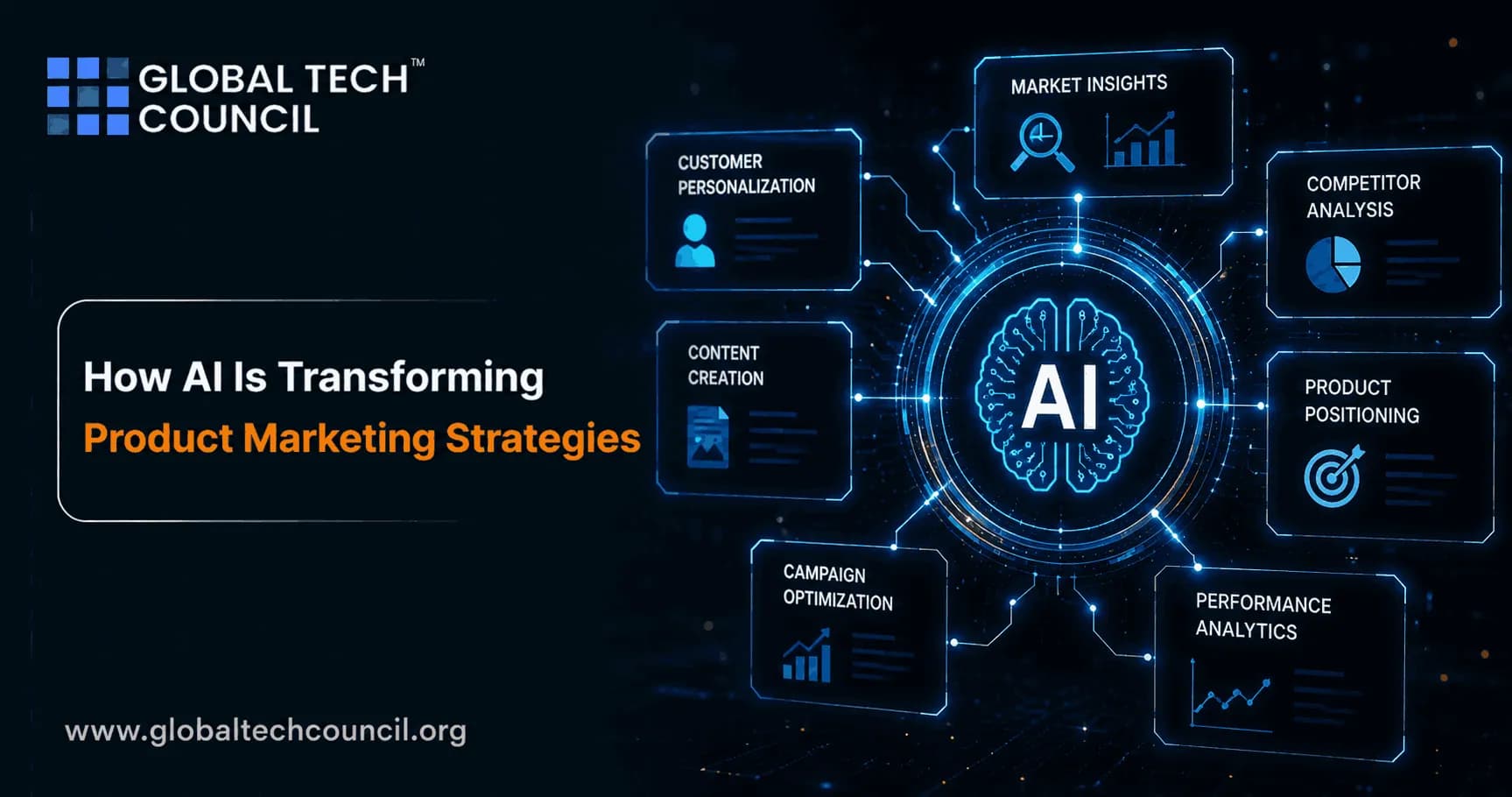
AI product marketing strategies in 2026 are built around continuous insight, model-assisted segmentation, faster creative testing, and tighter data governance. The biggest change is not that marketers can generate copy faster. It is that product marketing is becoming an AI-native operating model, where positioning, offers, content, pricing, and customer journeys are designed so machine learning systems can read, test, and improve them.
That shift is already visible in adoption data. McKinsey reported that 88 percent of organizations used AI regularly in at least one business function in 2025. A global marketing survey found that 32 percent of marketing organizations had fully implemented AI, while 43 percent were actively experimenting. The AI marketing industry was valued at about 47.32 billion dollars in 2025, and Gartner forecast worldwide generative AI spending to reach 644 billion dollars that year. Product marketers are not waiting on the sidelines anymore.

What changed in product marketing by 2026?
Until recently, many teams used AI as an assistant for isolated tasks: write an email subject line, summarize a call transcript, or generate five ad variations. Useful, yes. Strategic, not really.
In 2026, stronger teams build their product marketing strategies around AI from the start. They structure product data, customer signals, creative assets, landing pages, and CRM fields so AI systems can classify intent, recommend content, and optimize campaigns across channels.
That sounds technical because it is. A messy product catalog with inconsistent naming, missing metadata, and duplicated account records will confuse your AI tools. I have seen a predictive lead scoring model fail for a painfully ordinary reason: the training data had empty lifecycle stage values. In scikit-learn, the run ended with the familiar error, ValueError: Input contains NaN, infinity or a value too large for dtype('float64'). The fix was not a smarter model. It was better data hygiene. Artificial intelligence is reshaping product marketing through predictive analytics, customer insights, automation, and personalized experiences. Pursuing a Tech Certification helps professionals build expertise in AI, cloud computing, automation, analytics, and digital transformation. These certifications prepare marketers and business leaders to leverage intelligent technologies that improve campaign performance, customer engagement, and strategic decision-making in an increasingly AI-driven marketplace.
AI-powered research is replacing slow, periodic insight cycles
Traditional product marketing research often depended on quarterly surveys, sales interviews, analyst reports, and a few customer calls before a launch. Those inputs still matter. But AI now gives teams a live view of customer language and market movement.
Customer feedback analysis
Natural language processing can cluster reviews, support tickets, win-loss notes, community posts, and call transcripts. Instead of manually reading 500 comments, you can identify recurring objections, desired features, and phrases customers actually use.
This changes messaging. If enterprise buyers keep raising deployment risk, do not lead with productivity. Address deployment risk directly. AI helps you find that signal earlier.
Competitive intelligence
AI systems can monitor competitor pricing pages, release notes, ad copy, webinar themes, job postings, and product documentation. The goal is not to copy competitors. It is to spot positioning gaps.
Take a cybersecurity category where every competitor is pushing threat detection. A vendor with strong compliance reporting may win by owning audit readiness. AI can surface that pattern, but a product marketer still has to make the strategic call.
Segmentation is moving beyond static personas
AI-driven personalization is now central to product marketing. A 2025 personalization study found that 73 percent of business leaders believe AI will fundamentally reshape personalization strategies, and 92 percent of businesses were already using AI-driven personalization in some form.
The important word is calibrated. Better segmentation uses behavior, context, firmographics, product usage, and intent signals. Bad segmentation just becomes surveillance with nicer dashboards.
In B2B, AI can cluster accounts by buying stage, technology stack, content engagement, renewal risk, or expansion potential. That makes account-based marketing more specific. A healthcare account evaluating a data platform may need governance proof, while a SaaS account may care more about speed of integration and API limits.
Still, do not let the model define your market without human review. Algorithms can amplify past bias. If your historical pipeline underrepresented a segment, your model may score that segment poorly even when the product fit is strong.
Generative AI is changing content production, but review still matters
Salesforce reported that 58 percent of retailers were using generative AI to create assets for ads, emails, social media, and websites. Product marketers are doing the same for landing pages, sales decks, launch emails, battlecards, onboarding journeys, demo scripts, and nurture sequences.
The benefit is speed. A team can test six versions of a value proposition across segments in days, not weeks. The risk is sameness. AI-generated messaging often sounds polished but vague. Buyers notice.
Where AI works well
Message variation: Turn one positioning statement into versions for CFOs, developers, security leaders, or operations teams.
Content repurposing: Convert a webinar into email copy, sales enablement notes, social posts, and FAQs.
Landing page testing: Generate headline and proof-point variants for controlled experiments.
Sales support: Summarize objections by segment and map them to approved responses.
Where AI is the wrong shortcut
Do not use AI to invent proof points, customer claims, benchmark numbers, or compliance statements. That is how teams create legal and trust problems. If a model says your platform reduces onboarding time by 40 percent, ask where that number came from. If there is no source, delete it. AI-powered marketing relies on technologies such as machine learning, intelligent automation, predictive analytics, and advanced computing. Becoming a Deeptech Expert equips professionals with interdisciplinary knowledge that enables them to integrate AI into marketing operations, optimize customer experiences, and develop innovative strategies that adapt to rapidly changing market conditions.
Campaign optimization is becoming always-on
Programmatic advertising has moved beyond automated placement. In 2026, AI systems adjust bids, budgets, formats, audiences, and creative in near real time based on performance signals. Product marketers benefit because campaign feedback becomes a source of positioning intelligence.
If a technical proof headline converts better than a cost-saving headline for mid-market software buyers, that is not just an ad result. It is a product marketing insight. Feed it back into the website, sales deck, demo narrative, and launch plan.
The best teams use a test-and-learn loop:
Define the segment and buying job clearly.
Create message variants tied to real hypotheses.
Run experiments across paid, email, web, and sales channels.
Compare conversion quality, not just click-through rate.
Update positioning and enablement based on evidence.
Be blunt about vanity metrics. A high click-through rate on a clever ad is not useful if the leads do not progress. Product marketing should measure pipeline contribution, activation, retention, expansion, and launch adoption, depending on the product stage.
Pricing and lifecycle marketing are becoming model-driven
AI is also changing pricing, offers, and lifecycle campaigns. Retail and e-commerce teams use predictive models to analyze demand, inventory, discount response, churn risk, and lifetime value. B2B teams use similar ideas for renewal plays, expansion triggers, and packaging decisions.
This can improve timing. A customer who has adopted three advanced features may be ready for an upgrade conversation. A customer with declining usage needs help before a renewal discount. AI can flag both.
But dynamic pricing deserves caution. If customers believe pricing is opaque or unfair, trust falls quickly. Use AI to inform pricing strategy, not to create hidden rules nobody can explain.
Trust and regulation now shape AI product marketing strategies
AI adoption is rising, but consumer comfort is not. Statista reported that only 46 percent of consumers in 2024 were comfortable with brands using AI, down from 57 percent in 2023. Research on AI-generated marketing content found that only about 28 percent of participants trusted such content.
That is a warning. Over-personalization can feel invasive, especially when ads reference sensitive behavior or appear too quickly after a private action. The smarter strategy is transparent personalization with clear value.
Regulation is also tightening. The EU AI Act sets harmonized rules for AI systems and includes transparency requirements in specific uses. GDPR Article 22 limits decisions based solely on automated processing when they produce legal or similarly significant effects. In the United States, state privacy laws continue to expand opt-out rights for targeted advertising, profiling, and sale or sharing of personal data.
For product marketers, responsible AI means:
Use consented, high-quality first-party data wherever possible.
Document how customer data is used in segmentation and targeting.
Provide opt-out mechanisms for targeted advertising and profiling where required.
Label AI-generated or AI-assisted content when transparency rules apply.
Keep humans involved in high-impact decisions, such as eligibility, pricing exceptions, and sensitive offers.
As AI becomes central to product marketing, professionals need advanced expertise in branding, customer engagement, AI-powered content, and growth strategy. Earning a Marketing Certification helps marketers build practical skills in modern product marketing while leveraging AI to improve personalization, campaign optimization, customer retention, and long-term business success.
The skills gap is now a strategy gap
A 2024 marketing AI report found that 67 percent of respondents saw lack of education and training as a top barrier to adopting AI in marketing. That matches what many teams experience. They buy tools before they understand data quality, model evaluation, prompt control, privacy rules, or experiment design.
If you work in product marketing, learn the basics of machine learning, analytics, AI governance, and data privacy. You do not need to become a full-time data scientist, but you should understand how segmentation models can drift, why training data matters, and how to read an experiment result without fooling yourself.
For structured learning, look at Global Tech Council programs in artificial intelligence, machine learning, data science, cybersecurity, and emerging technology. Product marketers who can speak both customer language and AI language will be harder to replace.
How to adapt your product marketing strategy in 2026
Start with one product line. Do not try to automate the whole go-to-market system in a quarter.
Audit your data: Clean product metadata, CRM fields, campaign tags, and customer segments.
Pick one measurable use case: Competitive insight, launch messaging, lead scoring, retention, or content testing.
Set governance rules: Define what AI can generate, what needs approval, and what data is off limits.
Measure business outcomes: Track adoption, qualified pipeline, conversion quality, churn, or expansion, not just output volume.
Train the team: Give marketers enough AI and data fluency to challenge the tools they use.
Here is the practical next move: choose one upcoming launch and redesign the workflow around AI-assisted research, segmented messaging, controlled creative tests, and documented data use. If your team lacks the skills, build them now through focused AI, data science, and cybersecurity training with Global Tech Council.
FAQs
1. How Is AI Transforming Product Marketing Strategies in 2026?
AI is transforming product marketing by enabling predictive analytics, customer segmentation, content generation, campaign automation, product positioning, personalization, and real-time decision-making. These capabilities help marketers create more effective strategies and improve business outcomes.
2. Why Is AI Important for Product Marketing in 2026?
AI helps product marketers analyze large datasets, understand customer behavior, optimize campaigns, personalize experiences, automate repetitive tasks, and make faster, data-driven decisions in an increasingly competitive market.
3. What Are the Top AI Trends Shaping Product Marketing in 2026?
Key trends include generative AI, AI agents, predictive analytics, hyper-personalization, marketing automation, conversational AI, AI-powered customer insights, intent-based marketing, and real-time campaign optimization.
4. How Does AI Improve Customer Segmentation?
AI automatically groups customers based on demographics, behavior, purchase history, preferences, engagement patterns, and predictive insights, allowing marketers to deliver more personalized and targeted campaigns.
5. How Can AI Personalize Product Marketing Campaigns?
AI personalizes emails, website content, product recommendations, advertisements, and customer journeys by analyzing user behavior, interests, purchase intent, and historical interactions.
6. Can AI Improve Product Positioning?
Yes. AI analyzes competitor messaging, customer feedback, market trends, and buyer preferences to help marketers develop stronger positioning strategies and communicate product value more effectively.
7. How Does Generative AI Help Product Marketers?
Generative AI creates blog posts, product descriptions, landing pages, email campaigns, social media content, ad copy, FAQs, sales collateral, and marketing assets while maintaining consistency and improving productivity.
8. How Does AI Support Product Launches?
AI assists with market research, audience targeting, launch planning, campaign creation, competitive analysis, customer engagement, performance monitoring, and post-launch optimization.
9. What Are the Benefits of AI-Powered Marketing Automation?
Benefits include faster campaign execution, improved lead nurturing, personalized communication, reduced manual work, better customer experiences, increased efficiency, and higher marketing ROI.
10. Which AI Technologies Are Driving Product Marketing Innovation?
Technologies include generative AI, machine learning, predictive analytics, natural language processing (NLP), recommendation engines, conversational AI, computer vision, AI agents, and marketing automation platforms.
11. Which Industries Benefit Most From AI Product Marketing?
Industries including SaaS, e-commerce, retail, healthcare, financial services, education, manufacturing, telecommunications, consumer goods, and technology companies benefit from AI-driven product marketing.
12. How Can Businesses Measure AI Marketing Success?
Key performance indicators include conversion rate, customer acquisition cost (CAC), customer lifetime value (CLV), click-through rate (CTR), engagement rate, retention rate, revenue growth, and return on investment (ROI).
13. What Challenges Do Businesses Face When Adopting AI for Product Marketing?
Challenges include data privacy, AI governance, integration complexity, content accuracy, employee training, customer trust, regulatory compliance, model bias, and maintaining brand consistency.
14. What Are the Best Practices for AI-Powered Product Marketing?
Best practices include using high-quality data, defining measurable goals, combining AI with human creativity, monitoring campaign performance, validating AI outputs, maintaining brand voice, and following responsible AI principles.
15. What Skills Should Product Marketers Learn in 2026?
Product marketers should develop expertise in AI fundamentals, prompt engineering, marketing analytics, SEO, content strategy, customer segmentation, AI automation, predictive analytics, and responsible AI practices.
16. How Are AI Agents Changing Product Marketing?
AI agents automate customer interactions, campaign optimization, competitive monitoring, content generation, lead qualification, workflow management, and marketing decision-making with minimal human intervention.
17. Can Small Businesses Benefit From AI Product Marketing?
Yes. Small businesses can use AI to automate marketing campaigns, improve customer targeting, create high-quality content, optimize advertising, analyze competitors, and compete more effectively with limited resources.
18. What Career Opportunities Are Growing in AI Product Marketing?
Growing adoption is increasing demand for AI product marketers, marketing automation specialists, growth marketers, AI content strategists, product managers, customer insights analysts, SEO specialists, and AI marketing consultants.
19. What Common Mistakes Should Businesses Avoid When Using AI in Product Marketing?
Businesses should avoid publishing AI-generated content without review, relying on poor-quality data, ignoring customer privacy, over-automating customer engagement, neglecting performance analysis, and failing to align AI with business objectives.
20. Why Is AI Becoming the Foundation of Product Marketing Strategies in 2026?
AI is becoming the foundation of product marketing because it enables organizations to understand customers more deeply, personalize experiences at scale, automate repetitive tasks, optimize campaign performance, and make faster, data-driven decisions. As AI technologies continue to evolve, businesses that combine AI-powered insights with human creativity and strategic marketing expertise will be better positioned to improve customer engagement, increase conversions, accelerate growth, and remain competitive in the rapidly evolving digital marketplace.
Related Articles
View All
AI & ML
Meet Google Playground: Create Games With AI
Meet Google Playground, Google's new experimental platform that lets you create, play, and share custom games with text prompts. Learn how it works, basic game design tips, a sample session, safety and sharing features, Unity Spark plans, and limits.
AI & ML
OpenAI Dots vs Grok Bot vs Muse
Compare OpenAI Dots, Grok Bot, and Meta Muse to understand how these persistent AI agents differ in cloud computer use, connected apps, automation, memory, and long-running workflows.
AI & ML
What Is OpenAI Dots?
Learn what OpenAI Dots are, how these always-on AI agents work, and how they use GPT-6 Astra, cloud computers, connected apps, and persistent context to manage ongoing tasks.
Trending Articles
The Role of Blockchain in Ethical AI Development
How blockchain technology is being used to promote transparency and accountability in artificial intelligence systems.
AWS Career Roadmap
A step-by-step guide to building a successful career in Amazon Web Services cloud computing.
Top 5 DeFi Platforms
Explore the leading decentralized finance platforms and what makes each one unique in the evolving DeFi landscape.