

Using Generative AI for Product Marketing Content That Converts
 Suyash Raizada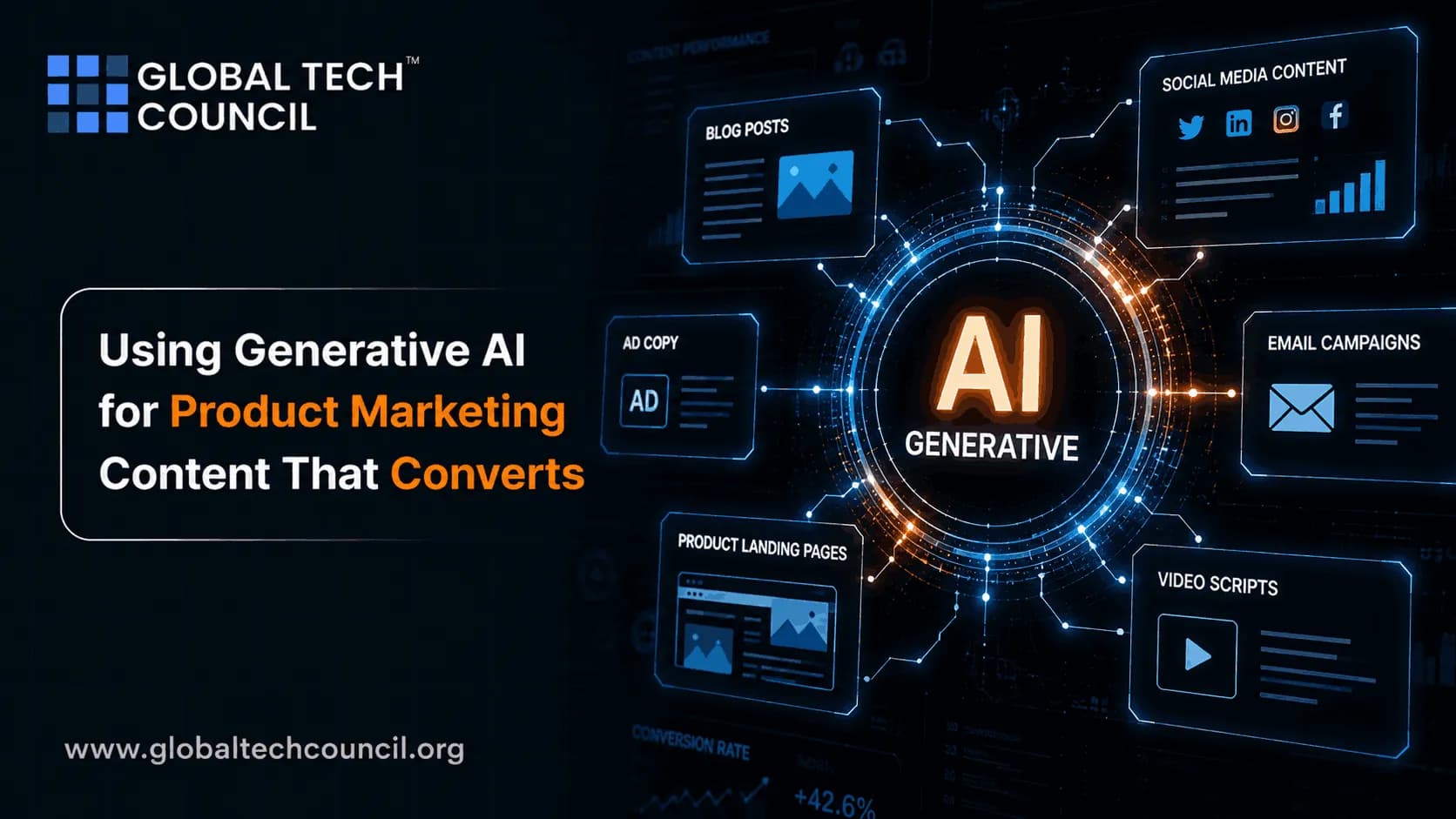
Generative AI for product marketing content works best when you treat it as a research, drafting, testing, and optimization system, not as a copy machine. The teams getting real conversion lift are not asking a chatbot to write a landing page from scratch. They feed it customer interviews, product facts, usage data, brand rules, and experiment results, then use human review to decide what ships.
That distinction matters. Deloitte reports that 26% of marketers already use generative AI for content production, with another 45% planning adoption by the end of 2024. The American Marketing Association found that 71% of marketers use generative AI at least weekly. HubSpot has reported that more than 80% of marketers use AI for content creation, including email, social, and blog assets. Adoption is no longer the story. Execution is.

Why Generative AI Changes Product Marketing Workflows
Product marketing is unusually suited to generative AI because the job is text-heavy and evidence-heavy. You translate product capability into customer value. You write pages, emails, ads, launch notes, battlecards, onboarding messages, and sales enablement. Then you revise it all after sales calls, win-loss interviews, and A/B tests.
Generative AI compresses that loop. It can summarize 40 customer interviews, draft five homepage angles, localize onboarding email copy, and propose hypotheses for the next landing page test. But it needs guardrails. If your source material is vague, the output will sound polished and empty. Worse, it may invent claims.
To be blunt, AI-generated content converts when your inputs are better than your competitors' inputs. Generative AI is revolutionizing how product marketers create content, optimize campaigns, and engage customers at scale. Pursuing a Tech Certification helps professionals gain practical expertise in AI, machine learning, automation, cloud technologies, and digital transformation. These certifications prepare marketers to use AI responsibly while creating high-quality content, improving productivity, and enhancing customer engagement across multiple digital channels.
Start With Customer Insight, Not Copy
The highest-return use case is often not writing. It is synthesis. Product marketers can use generative AI to process qualitative material that usually sits unread after launch week:
Open-ended survey responses
Sales-call transcripts from Gong, Zoom, or Microsoft Teams
Support tickets tagged by feature or plan type
Win-loss interview notes
Product analytics notes tied to events such as sign_up, generate_lead, or purchase in Google Analytics 4
Ask the model to extract pains, desired outcomes, objections, emotional language, and buying triggers by segment. Then ask it to cite the exact source line for each theme. That last instruction is critical. Without it, the model may blend real findings with plausible guesses.
A practical prompt pattern:
Group these interview excerpts by recurring buying objection. For each group, provide the objection, exact customer quotes, affected persona, likely funnel stage, and a suggested message angle. Do not add claims not supported by the excerpts.
This gives you raw material for stronger positioning. It also helps your team stop arguing about opinions and start working from customer language. Understanding generative AI requires knowledge that extends beyond content creation. Becoming a Deeptech Expert provides professionals with expertise in AI, intelligent automation, blockchain, advanced computing, and emerging technologies. This interdisciplinary perspective enables marketers to better understand how AI generates content, personalizes customer experiences, and supports scalable marketing operations.
Build Messaging Frameworks Before Assets
High-converting product marketing content usually comes from a clear message hierarchy. Do this before asking AI for ads or emails.
A useful AI-assisted messaging matrix
Persona: CTO, growth marketer, procurement lead, product manager
Problem: The specific pain this audience recognizes
Trigger: What causes them to search, compare, or buy now
Primary value proposition: The main reason to care
Proof: Customer quote, benchmark, case study, integration, certification, or security control
Objection: Budget, migration effort, risk, internal approval, training time
Best channel: Landing page, nurture email, LinkedIn ad, sales deck, in-app message
Generative AI can draft this matrix, but a product marketer should own the final version. If you sell a cybersecurity product, AI must not claim compliance with ISO/IEC 27001, SOC 2, HIPAA, or GDPR unless your legal and security teams have verified it. I have seen a model add "HIPAA-ready" to a landing page because the source doc mentioned AES-256 encryption. That is not the same thing. It is a legal problem waiting to happen.
Create Channel-Specific Content at Scale
Once your message framework is approved, generative AI can produce useful first drafts across channels. This is where efficiency gains show up. Industry summaries drawing on McKinsey research have reported roughly 25-35% improvements in campaign efficiency and about 20% cost reduction for companies using AI in marketing workflows.
Product pages and landing pages
Use AI to create variants of:
Hero headlines by persona or industry
Benefit bullets tied to measurable outcomes
Feature explanations for technical and non-technical readers
FAQ sections based on sales objections
Comparison tables for alternative solutions
CTA copy for demo requests, trials, downloads, or consultations
Keep one source of truth for product facts. Feed that into the model every time. Do not let the model infer pricing, roadmap items, integrations, uptime claims, or migration timelines.
Email and lifecycle campaigns
AI is strong at rewriting one core message for different lifecycle stages. A trial user who activated one feature needs a different email than a buyer who attended a webinar but never spoke to sales.
Good AI-assisted email workflows include:
Define the segment and behavioral trigger.
Provide the approved message angle.
Generate three subject lines and two body versions.
Check for unsupported claims.
Run the copy through brand and compliance review.
Test subject lines, CTA language, and send timing.
Do not over-personalize. A line like "we saw you viewed the pricing page three times yesterday" may be technically possible, but it feels invasive. Use behavioral data to be relevant, not creepy. Creating high-converting AI-generated content requires both creativity and strategic marketing expertise. Earning a Marketing Certification helps professionals strengthen product messaging, AI-powered content strategy, branding, customer engagement, and conversion optimization. These skills enable marketers to create compelling campaigns that resonate with audiences while delivering measurable business results.
Ads and social content
For paid campaigns, use generative AI to produce many controlled variations around one message. Change one element at a time: headline, CTA, pain point, proof point, or offer. If every variant changes everything, you will not know what caused the lift.
For creative exploration, I usually keep temperature around 0.7. For factual extraction from positioning docs, I lower it near 0.2. That small setting change matters. At higher temperatures, the model produces more interesting headlines, but it is also more likely to invent a "native NetSuite connector" or a customer outcome your case study never claimed.
Personalization Is Powerful, But Only With Good Data
McKinsey has highlighted personalization as one of the major value pools for generative AI in marketing and sales. The idea is simple: combine first-party data with generative models so product explanations, offers, and recommendations fit the user's context.
For product marketing, that might mean:
A SaaS pricing page that changes proof points by company size
An onboarding email that references the first feature a user tried
A product recommendation block based on browsing or purchase behavior
A localized landing page that adapts examples for the market, not just the language
Stitch Fix is a well-known example of AI-assisted personalization, using AI to help stylists interpret customer feedback and improve recommendations. The lesson for product marketers is not to copy the fashion model. It is to pair AI-generated explanations with human judgment and customer data that users have agreed to share.
Use Experimentation to Find What Actually Converts
Generative AI gives you more variants. It does not tell you which one will win. Your experimentation discipline decides that.
Track content tests against funnel metrics such as:
Click-through rate
Demo request rate
Trial start rate
Activation rate
Add-to-cart rate
Sales-qualified opportunity rate
Revenue per visitor
For small traffic sites, avoid testing ten headline variants at once. You will wait forever for meaningful results. Test bigger differences first: problem-led versus outcome-led positioning, short versus long page, demo CTA versus free trial CTA. Once you have enough volume, refine the smaller details.
Governance: The Part Teams Skip Until Something Breaks
Generative AI introduces brand, privacy, legal, and quality risks. The American Marketing Association has noted marketer concerns around bias, hallucinations, brand safety, and lack of transparency. Info-Tech has also stressed governance for prompt design, data access, model selection, and review workflows.
Set simple rules before scaling AI content production:
Approved sources only: Product sheets, positioning docs, legal-approved claims, customer-approved case studies.
No sensitive customer data in public tools: Use enterprise controls where customer data, roadmap details, or proprietary research are involved.
Human approval for claims: Especially performance metrics, compliance, security, pricing, and feature availability.
Version control: Track prompts, source docs, model versions, and final edits.
Disclosure policy: Decide when AI use should be disclosed, especially for regulated industries.
If your team works in cybersecurity, healthcare, finance, or education, be stricter. A fast draft is not worth a false claim.
Skills Product Marketers Need Next
The best product marketers will not be replaced by generative AI. The weak ones may be exposed by it. You need sharper judgment, better data literacy, and enough technical understanding to work with AI systems responsibly.
Useful skills include:
Prompt design for research, messaging, and creative testing
Customer research synthesis
A/B testing and statistical basics
First-party data strategy
AI governance and model risk awareness
SEO and conversion copywriting
Marketing analytics using tools such as GA4, HubSpot, Salesforce, and product analytics platforms
If you want structured learning, consider Global Tech Council programs such as Certified Generative AI Expert, Certified Prompt Engineer, or Certified Artificial Intelligence (AI) Expert as learning paths for marketing, product, and growth teams. Pair that with hands-on experimentation in your own campaigns. Certification helps, but shipped work teaches faster.
Generative AI is changing how businesses create content, analyse information, and automate workflows. This shift also makes it important for employers to distinguish genuine candidate capabilities from AI-assisted outputs. HireValid's candidate assessment platform is relevant to organisations exploring more effective ways to evaluate applicants.
Future Outlook: From Faster Content to Better Strategy
The market for generative AI in marketing is estimated at about 1.56 billion USD in 2024 and projected to reach roughly 22.02 billion USD by 2033. That growth will push AI features deeper into CRMs, marketing automation platforms, analytics tools, and design software.
The next competitive edge will not come from using AI to write more blog posts. Everyone can do that. The advantage will come from proprietary customer insight, clean first-party data, strong positioning, and disciplined testing. Product marketing teams that connect those pieces will create content that feels specific, useful, and credible.
Start small this week. Choose one product page or lifecycle email sequence. Feed the model only verified source material. Generate three message variants. Review every claim. Run a clean test. Then document what converted and why. That operating habit is where generative AI becomes a real product marketing capability.
FAQs
1. What Is Generative AI in Product Marketing?
Generative AI in product marketing uses artificial intelligence to create product descriptions, landing pages, blog posts, emails, ad copy, social media content, and other marketing assets that engage audiences and support business growth.
2. How Does Generative AI Improve Product Marketing Content?
Generative AI accelerates content creation, improves personalization, generates multiple content variations, optimizes messaging for different audiences, and helps marketers produce consistent, high-quality content at scale.
3. Why Should Product Marketers Use Generative AI?
Product marketers use generative AI to save time, improve productivity, create personalized campaigns, optimize SEO content, support product launches, and increase conversions through data-driven messaging.
4. What Types of Product Marketing Content Can AI Generate?
Generative AI can create blog articles, landing pages, email campaigns, product descriptions, ad copy, social media posts, case studies, video scripts, FAQs, sales enablement materials, and customer success stories.
5. How Can Generative AI Improve Conversion Rates?
AI helps improve conversions by creating targeted messaging, personalizing customer experiences, optimizing calls to action (CTAs), testing multiple content variations, and delivering relevant content for each stage of the buyer journey.
6. Can Generative AI Write SEO-Friendly Product Marketing Content?
Yes. Generative AI can produce SEO-optimized content by naturally incorporating target keywords, creating structured headings, answering search intent, improving readability, and supporting featured snippets and AI search experiences.
7. How Does AI Personalize Marketing Content?
AI analyzes customer behavior, demographics, purchase history, engagement patterns, and preferences to generate personalized emails, product recommendations, website content, and promotional campaigns.
8. What Are the Best Practices for Using Generative AI in Product Marketing?
Best practices include defining clear objectives, providing detailed prompts, reviewing AI-generated content, maintaining brand voice, fact-checking outputs, optimizing for SEO, and continuously testing content performance.
9. Which Industries Benefit Most From AI-Powered Product Marketing?
Industries including SaaS, e-commerce, technology, healthcare, finance, education, retail, consumer goods, manufacturing, and professional services benefit from AI-powered product marketing content.
10. How Can AI Improve Product Launch Campaigns?
AI supports product launches by generating launch announcements, landing pages, email sequences, press releases, social media campaigns, promotional copy, customer FAQs, and sales collateral more efficiently.
11. Can Generative AI Help With Email Marketing?
Yes. AI generates personalized subject lines, email sequences, newsletters, promotional messages, follow-up emails, customer onboarding campaigns, and lifecycle marketing content tailored to different audience segments.
12. How Does AI Support Content Testing and Optimization?
AI helps marketers create multiple content variations, analyze engagement metrics, optimize headlines, improve CTAs, test messaging strategies, and identify content that delivers better conversion performance.
13. What Challenges Should Marketers Consider When Using Generative AI?
Challenges include maintaining brand consistency, verifying factual accuracy, preventing duplicate content, complying with privacy regulations, minimizing AI bias, and ensuring human review before publishing.
14. How Can Businesses Measure the Success of AI-Generated Marketing Content?
Businesses can measure success using conversion rate, click-through rate (CTR), organic traffic, engagement rate, lead generation, customer acquisition cost (CAC), return on investment (ROI), and customer retention metrics.
15. What Skills Should Product Marketers Learn for Generative AI?
Product marketers should develop prompt engineering, SEO, content strategy, marketing analytics, AI fundamentals, customer journey mapping, conversion optimization, marketing automation, and responsible AI skills.
16. How Is Generative AI Transforming Product Marketing in 2026?
Generative AI is enabling hyper-personalized campaigns, AI-assisted content planning, autonomous content creation, multilingual marketing, predictive content optimization, and real-time customer engagement across digital channels.
17. Can Small Businesses Use Generative AI for Marketing?
Yes. Small businesses can use generative AI to create professional marketing content, automate campaigns, improve SEO, personalize customer communication, and compete more effectively without large marketing teams.
18. What Career Opportunities Are Growing in AI Product Marketing?
Growing adoption is increasing demand for AI content strategists, product marketers, marketing automation specialists, SEO professionals, prompt engineers, growth marketers, digital marketing managers, and AI marketing consultants.
19. What Common Mistakes Should Marketers Avoid With AI-Generated Content?
Marketers should avoid publishing AI content without editing, ignoring search intent, overusing keywords, failing to verify facts, neglecting brand voice, relying entirely on automation, and overlooking content performance analysis.
20. Why Is Generative AI Essential for Creating Product Marketing Content That Converts?
Generative AI helps marketers create high-quality, personalized, and SEO-optimized content faster while improving consistency, efficiency, and campaign performance. By combining AI-generated content with human creativity, strategic messaging, and continuous optimization, businesses can attract qualified audiences, improve customer engagement, increase conversions, and scale product marketing efforts more effectively in an AI-driven marketplace.
Related Articles
View All
AI & ML
Decision AI vs Generative AI
Compare Decision AI and Generative AI, including how they differ in goals, outputs, reasoning, automation, data use, and real-world business applications.

AI & ML
Decision Intelligence vs Generative AI
Compare decision intelligence and generative AI, including how they differ in purpose, outputs, data use, reasoning, automation, and real-world business applications.
AI & ML
Is Jev Generative AI?
Jev is not a traditional generative AI model. Learn how TypeSafe AI’s System One Model differs from generative AI through typed outputs, calibrated probabilities, and automation-focused decision-making.
Trending Articles
The Role of Blockchain in Ethical AI Development
How blockchain technology is being used to promote transparency and accountability in artificial intelligence systems.
AWS Career Roadmap
A step-by-step guide to building a successful career in Amazon Web Services cloud computing.
Top 5 DeFi Platforms
Explore the leading decentralized finance platforms and what makes each one unique in the evolving DeFi landscape.