

AI-Ready or AI-Cheating? How HireValid Is Bringing Trust and Integrity Back to Skills-Based Hiring
 Suyash Raizada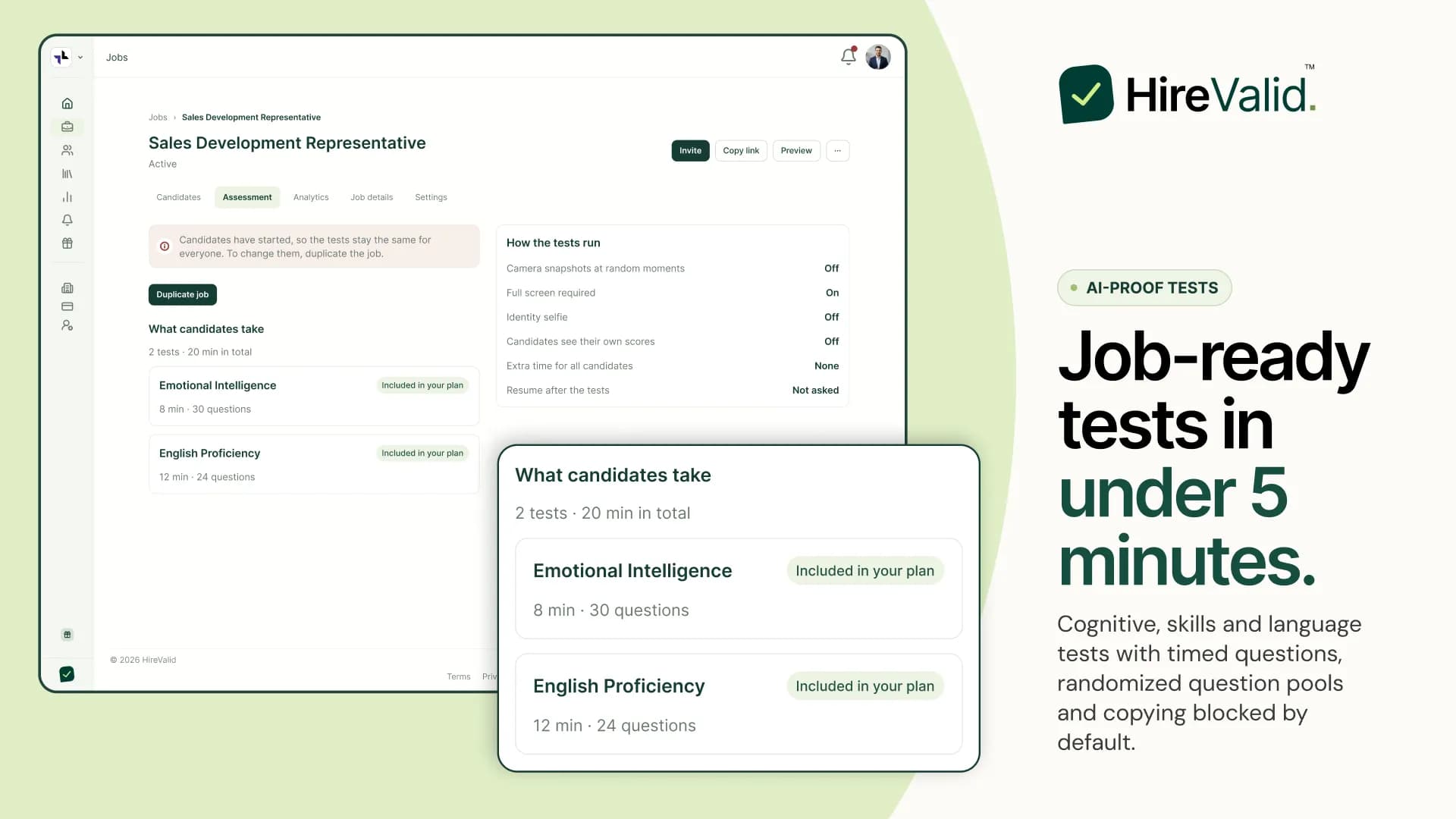
Artificial intelligence is changing how people apply for jobs, complete assessments and demonstrate their capabilities. Candidates can use AI tools to prepare applications, improve written responses and solve problems faster. However, employers may struggle to determine whether an assessment result reflects a candidate's own abilities or assistance from an external tool.
The answer is not to treat all AI use as cheating. Businesses need to distinguish between responsible AI adoption and unauthorised assistance during assessments designed to measure independent skills.

HireValid helps small and midsized businesses approach this challenge through pre-employment skills and cognitive tests, structured candidate results and integrity signals for human review. Its goal is to help employers understand who can perform the work, while keeping the final hiring decision with the employer.
In AI-era recruitment, the key question is not simply whether a candidate can use AI. It is whether the candidate has the skills the job requires and whether the assessment result can be trusted.
AI-Ready or AI-Cheating: What Is the Difference?
An AI-ready candidate can use artificial intelligence appropriately to improve productivity, solve problems and support work. An AI-cheating concern arises when a candidate uses prohibited assistance to complete an assessment that is intended to measure their independent abilities.
The distinction depends on the job and the assessment rules.
For example, a marketing professional may reasonably use AI to brainstorm campaign ideas, organise research or draft content at work. However, if a recruitment test is designed to evaluate independent analytical reasoning, using an AI assistant against the stated rules may make the result unreliable.
Similarly, a software developer may be expected to use AI coding tools in a real workplace. A hiring assessment for that role should clarify whether AI assistance is allowed and whether the employer is evaluating independent coding ability, AI-assisted problem-solving or both.
Employers should therefore define assessment expectations before candidates begin. Clear rules help candidates understand what is permitted and help recruiters interpret results fairly.
Why Is Trust Becoming a Hiring Challenge?
Recruitment has always involved uncertainty. Employers use CVs, interviews, references and tests to understand whether a candidate is suitable. AI tools introduce another factor because they can help candidates produce polished responses that may not accurately reflect their independent abilities.
Three challenges are particularly relevant.
1. Impressive answers do not always demonstrate practical ability
AI tools can generate fluent explanations, suggest interview responses and help solve common assessment questions. A strong written answer may demonstrate knowledge, but it does not always show whether the candidate can apply that knowledge independently.
Employers need to evaluate skills relevant to the actual role. These may include reasoning, communication, data interpretation, technical problem-solving and practical decision-making.
2. Unauthorised assistance can distort comparisons
If one candidate completes a test independently while another uses prohibited external assistance, their results may not be directly comparable.
Without appropriate assessment design and reviewable evidence, employers may struggle to understand the circumstances behind a result.
3. Small businesses have limited time to investigate
Small and midsized businesses often have limited recruitment resources. Reviewing dozens of applications manually can take time away from daily operations.
Structured assessments can help employers compare candidates more consistently and identify results that deserve closer review.
The objective is not to assume that candidates are dishonest. It is to establish clear expectations and gather better evidence before making important hiring decisions.
How Does HireValid Help Employers Assess Candidate Integrity?
HireValid is a self-service pre-employment assessment platform for small and midsized businesses. It offers skills and cognitive tests, along with an integrity layer designed to make certain forms of unauthorised assistance harder to conceal and easier to review.
The process brings together assessment performance and relevant activity signals.
Step 1: Select tests based on the role
Employers choose suitable assessments from the available test library or use role-based bundles.
Common hiring scenarios include customer support, sales development, office administration, marketing coordination, junior data analysis, junior development and virtual assistant positions.
The assessment should match the skills the employer needs to evaluate. A customer support role may require communication and reasoning, while a junior analyst role may require numerical and analytical skills.
Step 2: Invite candidates to complete the assessment
Candidates receive a test invitation by email or link and complete the assessment in their browser.
The intended candidate experience includes clear instructions and practice questions. Assessment duration depends on the tests selected, with short assessments designed to minimise unnecessary friction where applicable.
Step 3: Review performance and integrity signals
HireValid can provide signals associated with unusual activity during an assessment. Depending on the test and enabled settings, these may include tab switches, paste events, full-screen changes, unusual answer timing and other relevant activity.
Webcam snapshots may also be used when the employer enables that feature and obtains appropriate consent.
Some reports may include an AI-text likelihood signal. This should be treated as a weak indicator, not definitive proof that a candidate used AI.
Step 4: Compare results and supporting evidence
Employers can review candidate scores, benchmark percentiles where available and an Integrity Score with supporting evidence.
This provides a more structured basis for comparison. It can also help employers identify situations where a follow-up question or additional assessment may be appropriate.
Step 5: Make an informed hiring decision
HireValid supports the employer's decision. It does not automatically determine who should be hired or rejected.
Employers should review the full context, including assessment performance, integrity signals, relevant experience and interview findings. A single score or activity flag should never be treated as conclusive proof of misconduct.
What Is the HireValid Integrity Score?
The HireValid Integrity Score is a score from 0 to 100 that summarises integrity-related signals and supporting evidence associated with an assessment.
It is intended to help employers understand which results may need closer review. It should not be interpreted as a universal measure of honesty or as definitive evidence of cheating.
For example, a candidate may switch browser tabs during a test. That event could indicate possible external assistance, but it could also have another explanation. The employer should review the available evidence before deciding what the event means.
A responsible review process considers several factors:
What happened during the assessment?
Was the activity prohibited by the stated rules?
Does the evidence suggest a meaningful concern?
Is there a reasonable explanation for the activity?
Would a follow-up assessment help clarify the candidate's ability?
This approach helps employers use integrity information as a decision-support tool rather than an automatic rejection mechanism.
Which Assessment Methods Help Reduce Unauthorised AI Assistance?
Effective AI-resistant assessments use more than one method. The right combination depends on the skills being measured and the conditions under which candidates are expected to work.
Timed reasoning tasks
These assess how candidates respond to defined problems within a set time. Timing can add useful context, although speed alone does not establish ability or misconduct.
Randomised question pools
Different question sets or question orders can make it harder for candidates to share identical test sequences.
Visual and interactive tasks
These can evaluate practical reasoning and interpretation instead of relying entirely on generic written answers.
Short explanation prompts
Asking candidates to explain their reasoning can provide additional insight into how they approach a problem.
Other measures may include single-use, expiring invitation links, loading questions one at a time and recording relevant browser activity. These methods can improve assessment controls, but they cannot guarantee that every possible form of external assistance will be detected.
How Can Employers Distinguish Responsible AI Use from Cheating?
The most effective approach begins with the purpose of the assessment.
If an employer wants to evaluate independent reasoning, the instructions should clearly state whether AI tools and outside assistance are prohibited. If the role requires AI-assisted productivity, the assessment may instead allow AI use and evaluate how effectively the candidate applies it.
Employers can follow five practical steps.
Define the skill being measured. Decide whether the assessment evaluates independent knowledge, practical performance or the ability to use AI responsibly.
Set clear rules. Explain what tools are permitted and which activities violate the assessment conditions.
Use job-related questions. Choose tasks that reflect the actual responsibilities of the role.
Review evidence in context. Treat activity signals as indicators for investigation rather than automatic proof of cheating.
Ask follow-up questions when needed. A structured interview or practical exercise can help clarify whether a candidate understands the work and can explain their approach.
This distinction is especially important as AI becomes a normal part of many workplaces. Employers should not penalise candidates simply for being AI-ready. They should evaluate whether candidates follow the assessment rules and demonstrate the required capabilities.
Why Is This Important for Small and Midsized Businesses?
Smaller businesses often need to make hiring decisions quickly without the resources of a large recruitment department. One vacancy can attract dozens of applicants, and manually reviewing every application can delay the process.
HireValid is designed to help businesses organise early-stage candidate assessment through a self-service workflow.
Its practical benefits include:
Structured comparisons: Review candidates against consistent assessment criteria.
Better visibility: Examine skills scores alongside integrity-related signals.
More focused screening: Identify applicants who may merit further consideration.
Flexible terms: Use monthly plans without an annual contract, subject to current plan conditions.
Role-based assessment: Select tests that align with common job requirements.
These benefits can help recruiters use their time more effectively. They do not guarantee a successful hire, and assessment results should always be considered alongside interviews, experience and other relevant evidence.
How Can Businesses Build a Fair and Trustworthy Hiring Process?
Technology alone cannot create a fair recruitment process. Employers need clear rules, relevant assessments and responsible interpretation of results.
Keep assessment requirements transparent
Candidates should understand what the assessment measures, whether AI tools are allowed and how monitoring features may be used. Transparency reduces confusion and gives candidates a fair opportunity to follow the rules.
Protect candidate privacy
Where webcam checks or other monitoring features are enabled, employers should explain the purpose and obtain appropriate consent. They should also follow applicable privacy requirements and limit access to assessment information.
Account for accessibility
Candidates may need reasonable accommodations to complete an assessment fairly. Employers should consider these requirements and ensure that assessment conditions do not introduce unnecessary barriers.
Avoid automatic rejection based on one signal
A tab switch, an unusual response time or a suspected AI-generated answer does not independently establish cheating. Employers should review supporting evidence and seek clarification when appropriate.
Combine assessments with human judgement
A test score represents performance under specific conditions. It does not capture every aspect of a person's ability, experience or potential.
HireValid provides information to support the employer's review. The employer remains responsible for the final hiring decision.
How Do AI and Technology Certifications Support Career Development?
Recruitment assessments and professional certifications serve different purposes. Assessments help employers evaluate specific skills, while certifications can provide structured learning in a particular subject area.
For professionals preparing for an AI-enabled workplace, a practical learning path may include:
Identify the skills required for a target role.
Assess current knowledge and practical abilities.
Study relevant AI, business or technology concepts.
Practise through projects and realistic work scenarios.
Review progress through feedback and further assessment.
Continue learning as job requirements change.
The right learning programme depends on the individual's goals and current experience.
Explore programmes from the relevant council
Global Tech Council: Explore technology and AI learning opportunities, including the Certified Agentic AI Expert™ certification, for professionals interested in AI and emerging technologies.
Blockchain Council: Explore deep-technology certifications covering blockchain, Web3 and related technical subjects.
Universal Business Council: Explore business, leadership and marketing certifications that support professional development in commercial roles.
Certifications can support knowledge development, but they do not replace practical experience or demonstrate every capability required for a particular job. Employers should assess candidates against the responsibilities of the position.
How to Get Started with HireValid
Businesses interested in improving candidate assessment can begin with a single role that attracts a high volume of applications.
First, identify the abilities that matter most for the position. Then choose relevant tests, establish clear rules about AI use and invite candidates to complete the assessment.
Once results are available, review candidate performance alongside benchmark information where available and any integrity signals that require attention. Use the findings to guide follow-up interviews or practical assessments.
Before selecting a plan, check the current test library, monitoring settings, reporting capabilities and subscription terms. Availability may vary by test and configuration.
HireValid provides a practical way for small and midsized businesses to introduce structured pre-employment assessments without requiring an annual contract.
Explore HireValid to assess real job skills, review integrity signals and make more informed hiring decisions.
Frequently Asked Questions
1. What does AI-ready mean in recruitment?
An AI-ready candidate can use AI tools appropriately to support work, improve productivity and solve problems. Whether AI use is permitted during a recruitment assessment depends on the skills being measured and the employer's stated rules.
2. What is AI cheating in recruitment?
AI cheating occurs when a candidate uses AI assistance in a way that violates the assessment rules. For example, using an AI tool during a test that explicitly requires independent work may undermine the validity of the result.
3. What is HireValid?
HireValid is a self-service pre-employment assessment platform for small and midsized businesses. It offers skills and cognitive tests, structured candidate results and integrity-related signals to support hiring decisions.
4. How does HireValid help identify possible AI assistance?
Depending on the assessment and enabled settings, HireValid can provide signals such as unusual answer timing, tab switches, paste events and other relevant activity. These signals support human review but do not guarantee detection of every form of AI assistance.
5. What is the HireValid Integrity Score?
The Integrity Score ranges from 0 to 100 and summarises integrity-related signals with supporting evidence. It helps employers identify results that may need further review, but it is not definitive proof of cheating.
6. Does HireValid automatically reject candidates who receive a low Integrity Score?
No. HireValid does not automatically make hiring decisions. Employers review the available evidence and decide how much weight to give it alongside test performance and other relevant information.
7. Are AI-resistant assessments completely cheat-proof?
No. No browser-based assessment can guarantee that every form of cheating or AI assistance will be detected. Appropriate test design and integrity signals can make some forms of unauthorised assistance harder to conceal.
8. Can employers allow AI during recruitment assessments?
Yes. Employers can permit AI use when it reflects the requirements of the role. They should communicate the rules clearly and design the assessment to evaluate the intended capability, whether independent reasoning or effective AI-assisted work.
9. Is HireValid suitable for small businesses?
HireValid is designed for small and midsized businesses seeking a structured way to assess candidates. It offers a self-service workflow and monthly plans without an annual contract, subject to the current plan terms.
10. Which professional certifications can help candidates prepare for AI-enabled work?
The appropriate certification depends on the career objective. Global Tech Council offers AI and technology programmes, Blockchain Council focuses on blockchain and related deep technologies, and Universal Business Council offers business and marketing programmes. Candidates should choose based on their learning goals and the skills required for their target roles.
Related Articles
View All
AI & ML
Anti-AI-Cheating in Recruitment: How HireValid Helps Employers Verify Real Skills
Explore how HireValid helps employers combat AI-assisted cheating in recruitment through AI-resistant assessments, integrity signals, job-relevant skills testing, and human-reviewed evidence.

AI & ML
Meet Gemini 4 Argon: Google’s New AI Model
Google has launched Gemini 4 Argon, a new AI model built for deep, multi-step work in coding, science, law, finance and security. Learn its features, pricing and how to access it.

AI & ML
Meet Muse Wonder: Meta’s New AI Model for Agents
Meta has launched Muse Wonder and Muse Wonder Full, new AI models built for agents with Active Memory and Active Focus. Learn how they work, what they cost and how to access them.
Trending Articles
The Role of Blockchain in Ethical AI Development
How blockchain technology is being used to promote transparency and accountability in artificial intelligence systems.
AWS Career Roadmap
A step-by-step guide to building a successful career in Amazon Web Services cloud computing.
Top 5 DeFi Platforms
Explore the leading decentralized finance platforms and what makes each one unique in the evolving DeFi landscape.