

Anti-AI-Cheating in Recruitment: How HireValid Helps Employers Verify Real Skills
 Suyash Raizada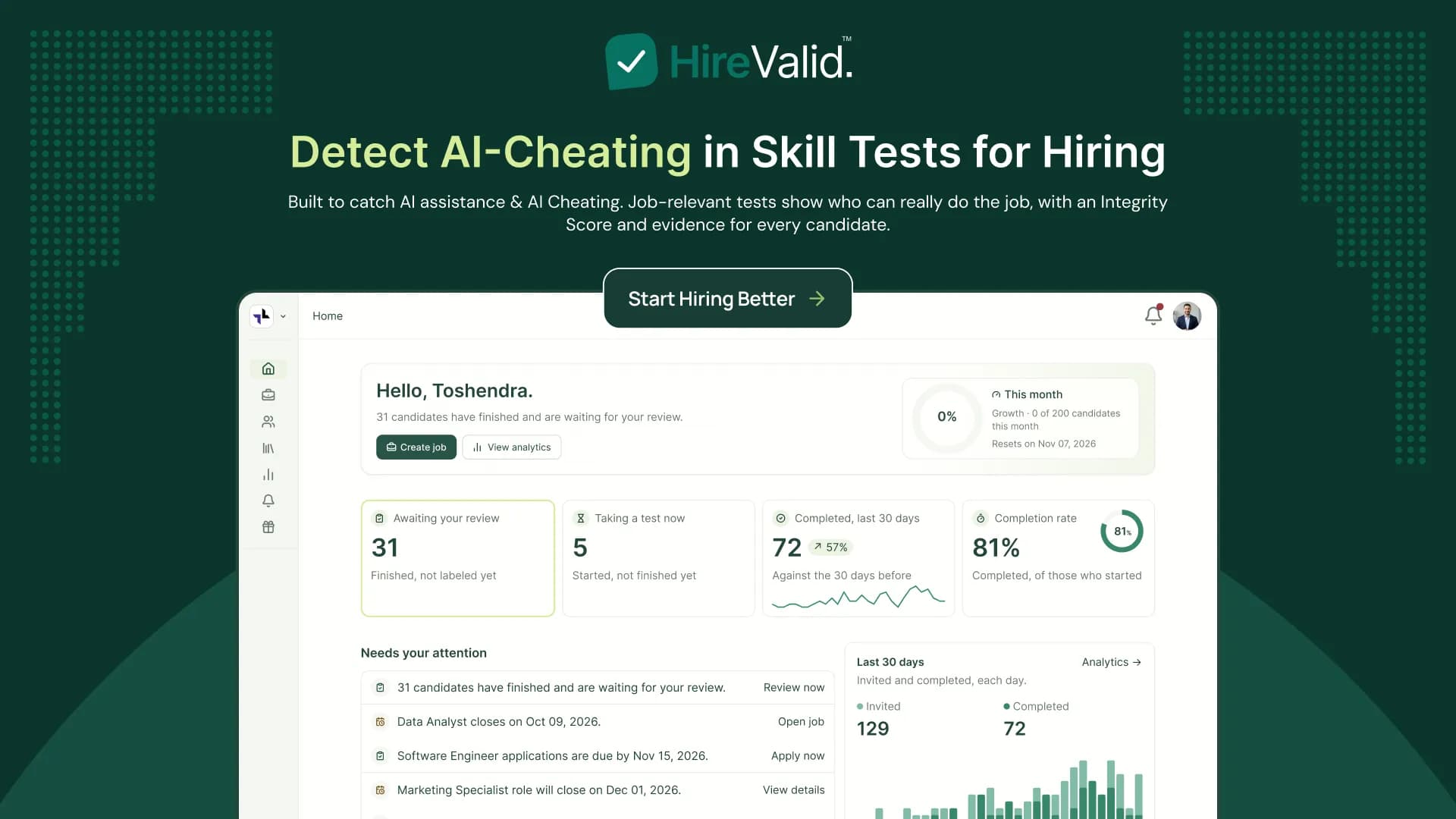
Artificial intelligence has changed how candidates prepare for job applications, online tests and interviews. For employers, the challenge is to determine whether a candidate genuinely possesses the skills required for a role or is relying heavily on AI-generated answers.
HireValid helps small and medium-sized businesses assess job-related skills, identify signals of potential AI assistance and compare candidates using assessment results and integrity evidence. Its approach combines cognitive, skills and language tests with an Integrity Score, helping employers make more informed hiring decisions without relying on automated rejection.

Why is AI cheating becoming a recruitment challenge?
AI tools can help candidates write CVs, improve cover letters, prepare interview responses and solve assessment questions. These capabilities can be useful when candidates are learning or improving their communication. However, they can also make it difficult for employers to determine what a candidate can do independently.
Consider a small business hiring a customer support representative. The employer receives 40 applications, many with polished CVs and convincing written responses. Several candidates may appear equally qualified on paper, but their actual communication skills, attention to detail and ability to handle customer problems may differ considerably.
Traditional screening methods may not reveal these differences.
The problem becomes more complicated when candidates use AI assistance during online assessments without permission. A completed test may not accurately represent the candidate's own abilities.
Small businesses face additional pressure because they often lack dedicated recruitment teams. Reviewing every application manually takes time, while making a poor hiring decision can create additional training costs and operational disruption.
Employers therefore need a practical assessment process that evaluates relevant skills, provides evidence for reviewing suspicious activity and supports consistent candidate comparisons.
What is anti-AI-cheating in recruitment?
Anti-AI-cheating in recruitment refers to assessment methods designed to discourage unauthorised AI assistance and help employers identify behaviour that may require further investigation.
An effective approach combines assessment design, activity signals and human review. It does not depend on a single AI detector or claim that every instance of AI use can be identified.
Common measures include:
Timed assessments: Set limits that make it harder to transfer questions to an external tool and return with an answer.
Randomised questions: Vary question selection and order between candidates.
Practical assessments: Evaluate tasks related to the actual responsibilities of the role.
Reasoning exercises: Ask candidates to solve problems rather than simply reproduce information.
Integrity checks: Record relevant activity signals, such as paste events or unexpected changes to the assessment window.
Human review: Examine flagged activity in context before making a hiring decision.
The purpose is to improve the reliability of assessment results while keeping the process fair and relevant.
It is also important to distinguish between authorised AI use and cheating. A business hiring an AI specialist may want to assess how candidates use AI tools effectively. In that situation, AI usage can be part of the skill being evaluated. Employers should clearly communicate the rules for each assessment.
How does HireValid help employers verify real skills?
HireValid is a self-service pre-employment assessment platform designed for small and medium-sized businesses. It helps employers assess candidates, review integrity signals and compare results without requiring an annual contract.
Its process involves five key steps.
1. Select assessments for the job
Employers can choose tests from the available library or select a ready-made role bundle.
For example, a customer support position may require English proficiency, attention to detail and customer-service judgement. An office administrator may need cognitive ability, time management and basic spreadsheet skills.
Choosing assessments based on actual job responsibilities makes the results more relevant to the hiring decision.
2. Invite candidates to complete the tests
Candidates receive an assessment link or email and complete the tests in their browser. They do not need to create a HireValid account.
Employers should explain the assessment format, expected completion time and applicable integrity checks before candidates begin.
Clear instructions help candidates understand the process and reduce confusion about what is permitted.
3. Assess cognitive ability and practical skills
HireValid supports cognitive, skills and language assessments. Depending on the tests available, employers can evaluate areas such as numerical reasoning, verbal reasoning, attention to detail, English proficiency, typing and practical skills.
These assessments can help answer specific recruitment questions.
Can the candidate interpret numerical information? Can they communicate clearly? Can they complete a relevant task accurately?
Assessment results provide evidence to consider alongside experience, interviews and other job-related information.
4. Review the Integrity Score and supporting evidence
HireValid provides an Integrity Score from 0 to 100, an integrity band and evidence associated with the assessment attempt.
Potential signals include tab switches, paste events, unusual answer timing, changes to the testing window and other recorded activity. The platform also considers AI-written text likelihood as a weak signal that should never be used alone.
These indicators do not automatically prove cheating. A candidate may have a legitimate explanation for particular activity, so employers should review the evidence before reaching a conclusion.
5. Compare candidates and make a decision
Employers can review ranked candidate results, individual test scores, benchmark percentiles and candidate reports.
This makes it easier to compare performance across relevant assessment areas. The employer remains responsible for deciding whom to interview or hire.
HireValid provides evidence and decision support, not automatic candidate rejection.
Learn more at HireValid.
Which assessment methods help reduce unauthorised AI assistance?
No single assessment method is sufficient for every role. Employers should combine appropriate techniques based on the skills they need to evaluate.
Assessment method | What it helps evaluate | Important consideration |
Timed reasoning questions | Problem-solving and reasoning | Time limits should remain reasonable |
Randomised question pools | Individual assessment attempts | Questions must measure comparable skills |
Practical tasks | Job-specific capabilities | Tasks should reflect actual responsibilities |
Short written responses | Communication and explanation | Writing quality alone does not prove independent ability |
Activity-based integrity signals | Behaviour that may warrant review | Signals require context |
Structured interviews | Communication, judgement and experience | Use consistent, job-related questions |
For example, a junior developer assessment might combine reasoning questions with a practical programming task. A follow-up interview could ask the candidate to explain their approach and discuss trade-offs.
This combination provides different forms of evidence instead of relying entirely on a single test score.
Employers should also avoid making unsupported claims about detection. Browser-based assessments cannot reliably detect every external tool or form of AI assistance.
How can small businesses build a fairer hiring process?
Reducing unauthorised AI assistance should not come at the expense of fair assessment.
A useful process starts with defining the requirements of the job. Employers should identify the essential skills and select tests that measure those capabilities.
They should then provide consistent instructions, apply comparable assessment conditions and explain how the results will be used.
A practical checklist includes:
Identify the skills required for the position.
Select assessments that directly measure those skills.
Explain whether AI tools are allowed.
Inform candidates about relevant integrity checks.
Consider accessibility requirements and reasonable accommodations.
Review flagged activity using supporting evidence.
Combine assessment results with interviews and other relevant information.
Document the reasoning behind the final decision.
Employers should also evaluate whether their assessments unfairly disadvantage particular groups. In the United States, the Equal Employment Opportunity Commission's guidance on employment tests and selection procedures provides relevant information about discrimination risks.
For AI-related risk management more broadly, the NIST AI Risk Management Framework provides guidance on managing concerns involving reliability, accountability and fairness. It is a general framework, not a specific certification for recruitment assessments.
These considerations are important because a hiring tool should improve decision-making without replacing human responsibility.
Why is flexible assessment software useful for small businesses?
Many small businesses do not recruit continuously. They may hire several people during a growth period and then go months without opening another position.
A recruitment platform that requires a year-long commitment may not suit this pattern.
HireValid offers monthly plans without a required annual contract. Businesses can start free, review the available assessments and choose a plan that fits their recruitment needs. A pause option is also designed for periods between hiring rounds.
This flexibility allows smaller employers to use structured assessments when they need them without committing to a full year of unused service.
Before subscribing, businesses should check the current pricing page for live prices, candidate limits and feature availability.
How do technology certifications support better hiring decisions?
Technology skills are evolving alongside AI-assisted recruitment. Employers need people who can understand emerging technologies, apply technical knowledge and solve practical problems.
Professionals can strengthen their knowledge through structured learning, practical projects and relevant certifications.
For readers interested in AI, the Certified Agentic AI Expert™ programme offers a learning path to explore agentic AI concepts and applications. Professionals seeking broader technology training can explore Global Tech Council programmes.
For complementary learning, readers can also explore Blockchain Council's deep-tech certifications through Blockchain Council and marketing or business certifications through Universal Business Council.
These options support different learning objectives. Certifications can demonstrate learning and subject knowledge, but they do not independently prove that a candidate can perform every responsibility of a job.
A useful learning path is to understand the technology, develop relevant skills, apply those skills through practical work and demonstrate capability during a role-related assessment.
For employers, this reinforces an important principle: hiring assessments and professional development serve complementary purposes. Assessments help evaluate current capabilities, while learning helps people build new ones.
What should employers consider before choosing a recruitment assessment platform?
Before selecting an assessment platform, employers should evaluate more than the number of available tests.
The platform should offer relevant assessments, clear candidate instructions and results that are easy to interpret. It should also explain how integrity signals are used and allow employers to review evidence rather than treating every flag as proof of misconduct.
Businesses should consider:
Whether the tests match the responsibilities of the role.
Whether results can be compared consistently.
Whether benchmark information is explained clearly.
Whether integrity signals include supporting evidence.
Whether candidates receive clear information about assessment conditions.
Whether accommodations are available where needed.
Whether pricing suits the company's hiring frequency.
Whether the employer retains control over hiring decisions.
HireValid brings assessment results, benchmark information and integrity signals into one process. Its monthly plans and pause option also address the needs of businesses that recruit occasionally.
The right platform should help employers make better-informed decisions, not promise perfect detection or guaranteed hiring outcomes.
Conclusion: Verify skills, review evidence and hire with confidence
AI has made it easier to produce polished applications and assessment responses. Employers need a reliable way to evaluate job-related capabilities without assuming that every impressive answer reflects independent ability.
Anti-AI-cheating measures can strengthen recruitment when they combine suitable test design, practical assessments, integrity signals and human review.
HireValid helps small businesses assess cognitive, skills and language capabilities, compare candidates and review potential AI assistance through its Integrity Score and supporting evidence. Its flexible monthly plans also make structured testing accessible to businesses that hire occasionally.
Ready to assess real job skills? Visit HireValid to explore the platform and start free.
Frequently Asked Questions
1. What is anti-AI-cheating in recruitment?
Anti-AI-cheating in recruitment involves designing assessments to discourage unauthorised AI assistance and identifying activity that may need further review. It combines assessment design, integrity signals and human judgement.
2. How can employers identify candidates using AI during tests?
Employers can use timed questions, randomised assessments, practical tasks and activity signals to help identify potentially unauthorised assistance. These measures cannot guarantee detection of every form of AI use.
3. How does HireValid help employers verify real skills?
HireValid offers cognitive, skills and language assessments, ranked results, benchmark percentiles and an Integrity Score with supporting evidence. Employers can use these results alongside interviews and experience.
4. What is the HireValid Integrity Score?
The Integrity Score is a score from 0 to 100 that summarises signals about the trustworthiness of an assessment attempt. It includes supporting evidence for human review and should not be treated as definitive proof of cheating.
5. Does HireValid automatically reject candidates who receive a low Integrity Score?
No. HireValid provides evidence and signals for employers to review. The employer makes the final hiring decision, considering the full context and other relevant information.
6. Can AI detection tools identify every form of cheating?
No. AI detection and activity-based checks have limitations. Employers should use multiple relevant signals, avoid unsupported claims and review suspicious activity in context.
7. Which jobs can benefit from pre-employment assessments?
Assessments can support recruitment for customer service, sales, administration, marketing coordination, data roles, junior development and other positions where relevant skills can be evaluated.
8. Should employers allow candidates to use AI during assessments?
It depends on the role and the purpose of the test. Employers should clearly communicate whether AI assistance is permitted. For roles that require AI proficiency, an assessment may deliberately evaluate the candidate's ability to use AI appropriately.
9. Does HireValid require an annual subscription?
HireValid offers monthly plans without a required annual contract. Employers should check the current pricing and plan details on the platform before subscribing.
10. How can professionals develop AI and technology skills for future jobs?
Professionals can build their knowledge through structured learning, practical projects and relevant certification programmes. Global Tech Council offers technology-focused learning, while Blockchain Council provides deep-tech programmes and Universal Business Council offers marketing and business certifications.
Related Articles
View All
AI & ML
AI-Ready or AI-Cheating? How HireValid Is Bringing Trust and Integrity Back to Skills-Based Hiring
Explore how HireValid helps employers distinguish genuine skills from undisclosed AI assistance through job-relevant assessments, integrity signals, and human-reviewed evidence

AI & ML
Meet Gemini 4 Argon: Google’s New AI Model
Google has launched Gemini 4 Argon, a new AI model built for deep, multi-step work in coding, science, law, finance and security. Learn its features, pricing and how to access it.

AI & ML
Meet Muse Wonder: Meta’s New AI Model for Agents
Meta has launched Muse Wonder and Muse Wonder Full, new AI models built for agents with Active Memory and Active Focus. Learn how they work, what they cost and how to access them.
Trending Articles
The Role of Blockchain in Ethical AI Development
How blockchain technology is being used to promote transparency and accountability in artificial intelligence systems.
AWS Career Roadmap
A step-by-step guide to building a successful career in Amazon Web Services cloud computing.
Top 5 DeFi Platforms
Explore the leading decentralized finance platforms and what makes each one unique in the evolving DeFi landscape.