

Decision AI vs Generative AI

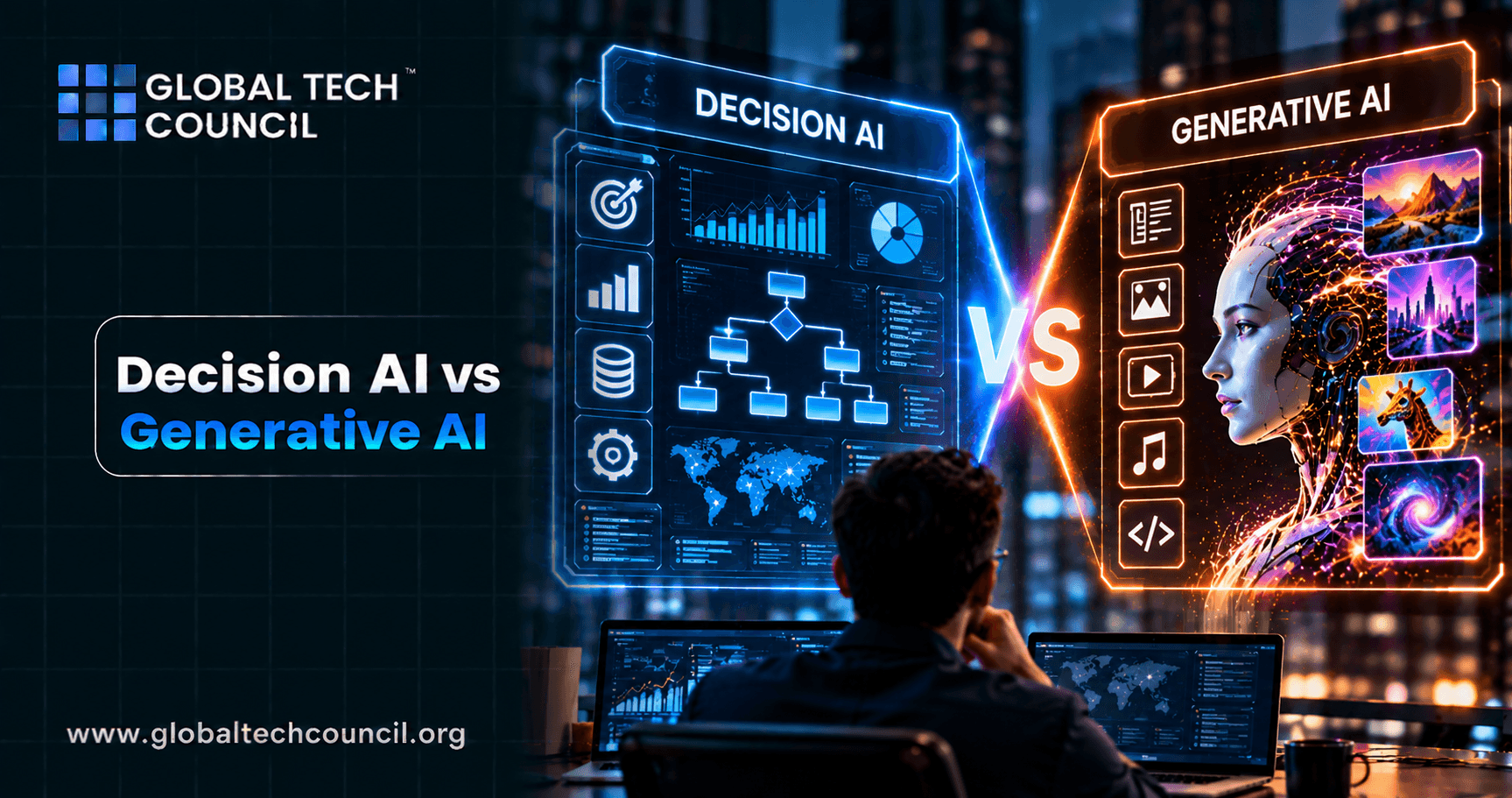
Ask ten people to define "AI" today and most will describe a chatbot that writes essays, answers questions, or generates images. That mental picture captures generative AI well, but it misses an entire, quieter branch of artificial intelligence built for something completely different: making fast, structured choices rather than producing content. The debate around decision AI vs generative AI became a lot more concrete in September 2026, when TypeSafe AI released Jev, the first model in a new category it calls System One models, built specifically to make decisions rather than generate text. Understanding the split between these two branches of AI is becoming a genuinely useful skill, which is part of why more professionals are pursuing a Certified Artificial Intelligence (AI) Expert credential to build a fuller, more accurate picture of how modern AI actually works.
What Is Decision AI?
Decision AI refers to models purpose-built to evaluate a situation and return a structured, typed answer rather than open-ended content. Instead of writing a sentence explaining a judgment, a decision AI model picks from a fixed set of possible outcomes, such as a category, a numeric score, or a simple yes or no, often with a confidence level attached. Its job is not to communicate with a person in natural language but to feed a precise, predictable answer directly into software that acts on it.

This is not an entirely new idea. Classic machine learning classifiers used for fraud detection, spam filtering, and credit scoring have functioned this way for years. What has changed with the arrival of models like Jev is scale and flexibility, a decision AI model that can handle a wide range of structured tasks through a simple API call, rather than requiring a custom model trained from scratch for each individual use case.
What Is Generative AI?
Generative AI sits on the opposite end of the spectrum, built to create new content based on patterns learned from enormous amounts of training data. Tools like ChatGPT, Claude, Midjourney, and Sora fall into this category, producing text, images, audio, or video in response to a prompt. Text-based generative models typically work autoregressively, predicting the next most likely word in a sequence and repeating that process until a full response is built.
This approach is what makes generative AI so flexible and, in many ways, so exciting to use. It can draft an email, summarize a report, write code, or hold an open-ended conversation, none of which decision AI is designed to do. For professionals who want to go deeper specifically into how generative systems are built, prompted, and deployed, a Certified Generative AI Expert credential covers this ground in detail, from underlying model architecture to real-world prompting techniques.
Decision AI vs Generative AI: How They Differ
Placing the two side by side makes the contrast easy to see.
What each one produces. Decision AI returns a typed answer from a known, limited set of options. Generative AI produces new, open-ended content whose exact form is not fixed in advance.
How the answer is generated. Decision AI models like Jev evaluate a state and a set of predefined questions in a single parallel step. Generative AI models generate output sequentially, one token at a time, building longer responses piece by piece.
Speed at scale. Because generative models build output step by step, longer or more complex responses take proportionally longer. Decision AI models are built for consistent, fast responses regardless of how many questions are asked in a single call, since all of them are evaluated together.
Risk profile. Generative AI can occasionally produce fluent but incorrect content, since it is optimized to produce plausible sequences of text. Decision AI models constrain their outputs to a predefined schema of valid answers, which prevents that specific kind of open-ended error, though accuracy still depends on the quality of the information the model is given.
Best-fit tasks. Generative AI is the right choice whenever a task requires original writing, explanation, or creative output. Decision AI is the right choice whenever a task only needs a fast, repeated, structured judgment call.
Inside Jev: A Decision AI Model at Frontier Scale
Jev, built by TypeSafe AI and introduced by Diogo Almeida, a co-creator of ChatGPT and reinforcement learning from human feedback, is the clearest public example of decision AI built at frontier scale rather than as a narrow, single-purpose tool. TypeSafe calls this category System One models, referencing psychologist Daniel Kahneman's idea of fast, intuitive human judgment, in contrast to the slower, more deliberate System Two thinking that generative language models more closely resemble.
Jev is trained using a method TypeSafe calls Reinforcement Learning for Calibrated Decisions, or RLCD, which optimizes the model to produce honest, well-calibrated confidence scores on structured questions rather than text that simply reads convincingly. TypeSafe reports response times of roughly 70 to 500 milliseconds per call, tens to hundreds of times faster than comparable generative language models on decision tasks, priced at a small fraction of a cent per million input tokens with output tokens offered free.
Typed Outputs: The Building Blocks of Decision AI
Jev structures its decisions around three typed answer formats. A Choice answer selects one option from a fixed list of up to 255 possibilities, useful for categorizing a situation such as sorting a support request by department. A Score answer returns a numeric rating within a defined range, useful for tasks like risk or quality assessment. A Yes or No answer gives a simple binary judgment, useful for approve-or-flag scenarios.
Every answer type carries a calibrated confidence score, which is essential for good decision AI design, allowing software to automatically act on high-confidence answers while routing uncertain cases to a human reviewer. Because Jev evaluates every question in a request in parallel rather than sequentially, adding more questions to a single call barely changes the response time, a meaningful advantage inside high-volume automated systems.
When to Use Decision AI Instead of Generative AI
The decision between decision AI and generative AI usually comes down to the shape of the task rather than which model is "smarter." If a task requires drafting original text, explaining reasoning in plain language, or holding an open-ended conversation, generative AI remains the only realistic option, and Jev simply cannot do any of that. If a task involves a fast, repeated, structured judgment call, like classifying a request, scoring a risk, or deciding a simple yes or no, decision AI is generally faster, cheaper, and more reliable than routing the same task through a general purpose generative model and parsing its text response afterward.
Blending Decision AI and Generative AI in One System
The most efficient real-world systems tend to use both categories together rather than choosing one exclusively. Picture a customer support platform: a decision AI model like Jev can classify an incoming ticket's category and urgency almost instantly, while a generative AI model handles the part that genuinely needs language, drafting the actual reply based on that classification. This same pattern shows up inside AI agent systems, which plan and execute multi-step tasks using a generative model as their reasoning core. Developers working with frameworks like LangChain have started inserting Jev as a lightweight decision layer between tool calls, cutting down on how often the agent needs to trigger an expensive generative model call just to make a small structured choice. Building infrastructure that blends decision AI with generative reasoning increasingly calls for a broader Deep Tech Certification, since designing this kind of layered, multi-model AI system now requires fluency across several different architectures rather than a single specialization.
Practical Examples Across Industries
TypeSafe has publicly demonstrated Jev controlling a character inside a version of the classic game Doom, making rapid movement and combat decisions many times per second, a pace impractical for a token-by-token generative model to sustain. Financial platforms use decision AI to score transactions for fraud risk in real time, while any generative component in that same pipeline might handle the follow-up message explaining a flagged transaction to a customer. Content moderation systems similarly rely on decision AI to classify submissions quickly, reserving generative AI for the parts of the workflow that require explanation or communication.
Tosheo: A Generative AI Storytelling Platform
While decision AI focuses on narrowing a situation down to one confident, structured answer, generative AI keeps expanding into more imaginative territory entirely disconnected from structured judgment calls. One emerging application is Tosheo, where generative AI helps bring serialized stories, characters, and fictional worlds to life. A platform like this represents generative AI in its purest creative form, with no fixed answer set or structured decision involved at all, standing in clear contrast to the tightly constrained, typed outputs a model like Jev is built to produce.
What Decision AI and Generative AI Cannot Do
Neither category is a complete solution on its own. Decision AI models like Jev cannot write, explain, or reason through an open-ended problem, and their accuracy depends heavily on how well the state and questions are defined in advance. On TypeSafe's own benchmark suite, Jev reportedly performs close to mid-tier generative language models on classification-style tasks, solid for a fast, low-cost model but not automatically better than a highly specialized decision system built for one narrow job. Generative AI, meanwhile, can occasionally vary in tone, accuracy, or format from one response to the next, making it a poor fit for tasks that need a guaranteed, consistent structure. Recognizing these limits on both sides is what allows teams to design systems where each type of model does the job it is actually suited for.
What This Means for Marketing Teams
Marketing functions already rely on both categories without always naming them this way. Lead scoring, audience segmentation, and campaign routing are decision AI tasks at their core, while drafting ad copy or generating creative assets falls squarely under generative AI. As accessible decision AI tools like Jev become available through simple APIs, marketing teams may be able to build structured automation, such as real-time personalization or content routing, without needing a dedicated data science function for every new use case. Recognizing when a task calls for decision AI versus generative AI is becoming a practical skill for marketers as much as engineers, which is part of why interest in a Marketing Certification has grown alongside more technical AI credentials, helping non-technical teams make smarter decisions about the AI tools they bring into their workflows.
Conclusion
Decision AI vs generative AI is not a matchup with a single winner, because each one is built to solve a fundamentally different problem. Decision AI, represented clearly by Jev, delivers fast, structured, well-calibrated choices that software can act on immediately, while generative AI remains essential for writing, explanation, and open-ended creativity. As AI systems continue to mature, the strongest designs will likely combine both, using decision AI to handle the countless small structured choices buried inside modern software, and generative AI to handle everything that genuinely requires language and imagination.
Frequently Asked Questions
1. What is decision AI?
Decision AI refers to AI models built to evaluate a situation and return a structured, typed answer, such as a category, score, or yes or no judgment, rather than generating open-ended content.
2. How is decision AI different from generative AI?
Decision AI produces fixed, typed answers from a known set of possibilities, while generative AI creates new, open-ended content such as text, images, or code.
3. What is Jev, and how does it relate to decision AI?
Jev is the first System One model, built by TypeSafe AI, designed to deliver fast, typed decisions with calibrated probabilities, making it a leading example of decision AI at frontier scale.
4. Who created Jev?
Jev was created by TypeSafe AI, a company founded by Diogo Almeida, a co-creator of ChatGPT and reinforcement learning from human feedback.
5. Can generative AI models be used for decision AI tasks?
Generative AI can be prompted to output a decision as text, but that text then has to be parsed by software, which is slower and less reliable than a purpose-built decision AI model like Jev.
6. What training method does Jev use?
Jev is trained using Reinforcement Learning for Calibrated Decisions, or RLCD, which focuses on producing well-calibrated confidence scores rather than fluent, convincing text.
7. What types of answers does Jev support as a decision AI model?
Jev supports Choice answers from a fixed list of up to 255 options, numeric Score answers, and Yes or No answers, each with a calibrated confidence score.
8. How fast is Jev compared to generative AI on decision tasks?
TypeSafe reports Jev responds in roughly 70 to 500 milliseconds per call, tens to hundreds of times faster than comparable generative language models on the same kind of decision task.
9. Can decision AI and generative AI work together in one system?
Yes. Many systems use a decision AI model like Jev to classify or score a situation, while a generative AI model handles the part of the workflow that requires actual written output.
10. What does "state" mean in the context of a decision AI model like Jev?
State refers to the block of context given to the model describing a situation, such as a support ticket or transaction, which it uses to answer its assigned questions.
11. Why does confidence scoring matter in decision AI systems?
Confidence scores let software automatically act on high-confidence decisions while routing uncertain cases to a human reviewer, improving both speed and reliability.
12. What industries rely most on decision AI?
Finance, customer support, insurance, e-commerce, and content moderation all rely heavily on decision AI for tasks like fraud scoring, ticket routing, and underwriting.
13. How does Jev fit into AI agent systems built around generative models?
Jev can serve as a fast decision layer inside an agent's workflow, handling structured choices while the agent's core generative model focuses on planning and language generation.
14. Is generative AI less capable than decision AI models?
Not less capable, just differently purposed. Generative AI is built for open-ended creation, while decision AI is built for fast, structured, well-calibrated judgment calls.
15. Can Jev replace a specialized decision AI model built for one specific task?
Jev offers more flexibility across different tasks without retraining, but a highly specialized model trained on abundant labeled data may still be more efficient for one specific, high-volume task.
16. What is Tosheo and how does it relate to decision AI vs generative AI?
Tosheo is an emerging generative AI platform where AI helps bring serialized stories, characters, and fictional worlds to life, representing generative AI in its most creative form, in clear contrast to the structured nature of decision AI.
17. What certifications help someone understand both decision AI and generative AI?
A Certified Artificial Intelligence (AI) Expert, a Certified Generative AI Expert credential, or a broader Deep Tech Certification can help learners understand both decision-focused and generative AI architectures.
18. Why does the distinction between decision AI and generative AI matter for businesses?
It helps teams pick the right type of model for each task, avoiding the inefficiency of using generative AI for simple structured decisions or expecting decision AI to handle language-based tasks.
19. Will decision AI eventually replace generative AI?
No. Decision AI and generative AI serve different purposes, and effective AI systems are likely to keep using both together, matching each type of model to the job it is best suited for.
20. What is the future outlook for decision AI models like Jev?
As automation and AI agents become more widespread, decision AI models are expected to play a growing role in handling the fast, structured choices inside these systems, working alongside generative AI rather than replacing it.
Related Articles
View All
AI & ML
Decision Intelligence vs Generative AI
Compare decision intelligence and generative AI, including how they differ in purpose, outputs, data use, reasoning, automation, and real-world business applications.

AI & ML
Jev as a Decision Layer
Explore how Jev can function as a decision layer inside software, turning structured state and questions into typed, probabilistic outputs for automation and workflow control.

AI & ML
Jev Decision Pipeline
Learn how the Jev decision pipeline works, from program state and structured questions to parallel processing, typed outputs, calibrated probabilities, and automated software actions.
Trending Articles
The Role of Blockchain in Ethical AI Development
How blockchain technology is being used to promote transparency and accountability in artificial intelligence systems.
AWS Career Roadmap
A step-by-step guide to building a successful career in Amazon Web Services cloud computing.
Top 5 DeFi Platforms
Explore the leading decentralized finance platforms and what makes each one unique in the evolving DeFi landscape.