

Google Launches Genie 4: What’s New?

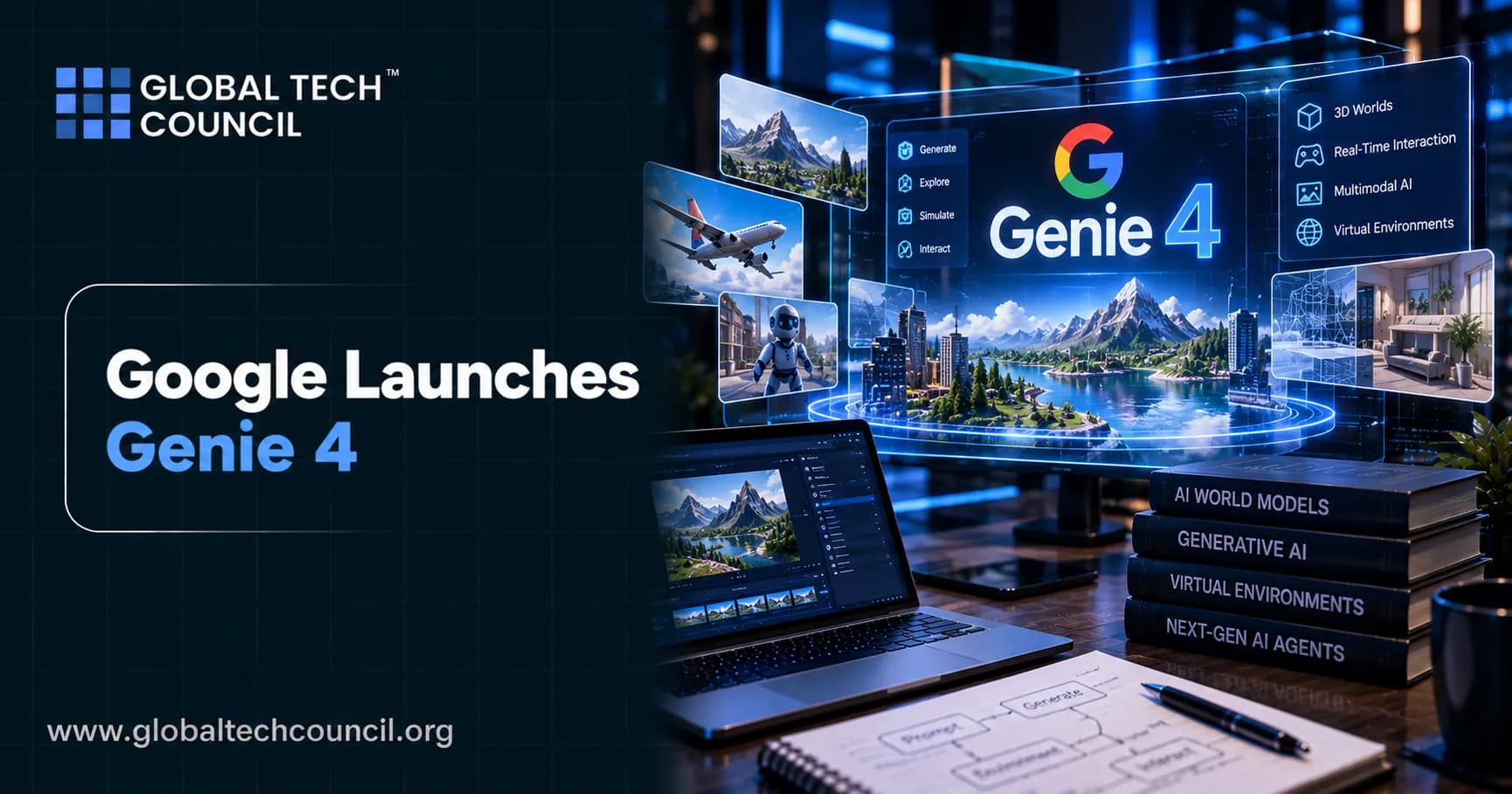
Google has just shown the next step in AI simulation. On October 27, 2026, Google DeepMind announced Genie 4, a model that builds explorable worlds as you watch and steer them. The Genie 4 Google release adds sound, speech, sharper realism, and a closer link to the Gemini family. If you follow Google's AI tools, a Certified Google Gemini Professional credential is one way to build skills around that ecosystem. This article answers the big question in plain words: what is actually new? You will also see how Genie 4 works, who can use it, and what its limits are.
What Did Google Launch With Genie 4?
Google launched a new world model for real-time interactive simulation. In simple terms, it is an AI that creates a living scene from a description and keeps updating that scene while you move through it.

The launch is an early research preview. Google started with a limited group of trusted testers. Next, it plans to bring the model to Google AI Ultra subscribers through Project Genie. Early access partners in the Gemini API and Google AI Studio will follow. Google also opened a waitlist for Project Genie.
Google presents Genie 4 as a research milestone rather than a finished product. It says the model is still experimental, and it asks testers to help find gaps. That honest framing is worth remembering as you read the hype around it.
What Is New in Genie 4?
Genie 4 brings several upgrades at once. The list below covers the changes that matter most. Anyone studying for a Certified Artificial Intelligence (AI) Expert credential will recognize many of these as core ideas in modern multimodal AI, where one system handles images, sound, and language together.
1. Native Audio
This is the headline feature. Google says Genie 4 is its first real-time world model to generate audio natively. Every world carries the sound of its own setting. You can hear wind in trees, waves on a beach, or a crowd on a train platform. The sound is produced by the model itself, not added afterward.
2. Live Dialogue
Characters can talk, and their words adapt to what happens around them. They respond to your actions and to events in the scene. That makes simulated people feel less like props and more like participants.
3. Steering With Plain Language
While a simulation runs, you can type a new instruction. You might change the weather, move the camera, or add a new person or object. Gemini adjusts your words so they fit the surrounding scene, and it keeps the story moving between your inputs.
4. Stronger Realism and Physics
Google says Genie 4 delivers better photorealism, smoother movement, and a deeper grasp of physical behavior. Examples include aerodynamics and collisions. Objects such as falling seeds or bursting fruit are meant to behave in more believable ways.
5. More Natural People
Google calls the way Genie 4 simulates humans its most dramatic leap. Characters move more naturally, react to their surroundings, and can be steered in real time.
6. A Closer Link to Gemini
Genie 4 builds on capabilities from the Gemini family. Google says Gemini Omni anchors simulations in real-world appearance and behavior. Other Gemini models add the reasoning that helps keep scenes coherent from one moment to the next.
7. Longer Consistency
TechCrunch reports that Genie 4 can keep a scene consistent for up to two minutes. That doubles the limit of Genie 3. It is still short, but the improvement matters for filmmakers, testers, and researchers.
How Does Genie 4 Compare With Genie 3?
The table below shows the main differences based on Google's statements and press coverage.
Area | Genie 3 | Genie 4 |
|---|---|---|
Announced | August 5, 2025 | October 27, 2026 |
Main claim | First Google world model with real-time interaction | Most realistic and interactive Google world model yet |
Sound | No native audio | Native audio and live dialogue |
Scene consistency | About one minute | Up to two minutes |
Steering | Prompt-based events | Real-time steering with Gemini support |
Access today | Project Genie for subscribers | Trusted testers first, subscribers soon |
Genie 3 had real impact. Waymo used it to build a simulator for rare driving situations. Google also connected it to Street View so users could explore real places in simulation. Genie 4 builds on that foundation and aims for richer, more lifelike worlds.
A Quick Timeline of the Genie Family
March 2024: The first Genie appears and creates simple two-dimensional environments.
August 2025: Genie 3 arrives with real-time interaction.
February 2026: Waymo adopts Genie 3 to build a world model for self-driving cars.
May 2026: Google connects Genie to Street View so users can simulate real streets.
October 2026: Genie 4 launches as a research preview with native audio.
This steady pace shows how quickly world models are maturing. Each release adds a new layer of realism or control.
How Does Genie 4 Work Behind the Scenes?
You do not need to be an engineer to grasp the main idea. A world model learns patterns about how scenes look and change. When you act, it predicts the next moment and draws it. Then it repeats that loop again and again, many times per second, so the world feels continuous.
Genie 4 adds a second layer. Gemini acts like a director standing behind the camera. It watches the scene, tracks the goal, and nudges the story so that events make sense. Google says one setup uses Gemini 3.8 Flash as a guiding agent that breaks goals into steps and checks new frames to confirm each step worked.
This teamwork points toward what Google calls hybrid world models. In that approach, language and code models handle structure and logic, while the world model creates the sensory details. The pairing could produce worlds that are more controllable and consistent than either system could manage alone.
Under the surface sit large multimodal models, powerful chips, and real-time streaming. Learners who want to explore these building blocks can look at a Deep Tech Certification path, which introduces advanced technologies behind modern AI platforms.
How Does Genie 4 Connect to Robotics?
Google also tested Genie 4 with its robotics research. A Gemini 4 Argon model takes a task, splits it into steps, and feeds those steps to Genie 4 as text. The simulation then changes as the task advances.
Two demonstrations stand out. One shows a Universal Robots arm using a pipette in a lab. Another shows Apptronik's Apollo humanoid robot playing checkers. The idea is simple. Engineers can test a robot's plan in a simulated world before they risk real equipment.
This use case may prove more valuable than entertainment in the near term. Simulation is cheaper and safer than real-world trials, especially for rare or dangerous situations.
What Can Different People Do With Genie 4?
Google says trusted testers span creative industries, journalism, education, gaming, and engineering. Here is how different roles may use the technology.
Filmmakers: Step into a scene, run several takes, and change lighting, camera angles, and dialogue on the spot.
Game designers: Turn an idea into an explorable prototype in seconds before writing engine code.
Photojournalists: Convert one archival photograph into a simulated environment, or visualize how an event such as a flood unfolds.
Teachers: Create immersive scenes that help students explore places and ideas.
Engineers: Generate quick scenario tests for robots and other systems.
Marketers: Try early concept sketches for immersive stories before a full production starts.
For every role, the pattern is similar. Genie 4 acts as a fast draft tool. Human experts still choose what is good, accurate, and appropriate.
What Are the Risks and Limits?
Google is open about the model's weaknesses. Details and objects can drift or change over time, especially in longer sessions, after many prompt edits, or while moving around a scene. Complex physical interactions, audio accuracy, readable text, spatial accuracy, and long-term consistency remain active research areas.
Safety matters too. Google says Genie 4 follows strict guardrails consistent with its other models, and that internal evaluations took place before the preview. It also chose a staged release, starting with trusted testers.
Another safeguard is SynthID. Google says all video and audio from Genie 4 will carry this imperceptible watermark, which helps identify AI-generated content. As simulations become more realistic, that kind of labeling becomes more important.
Users should also stay critical of claims. The "first real-time world model with native audio" description comes from Google, and independent experts have not yet confirmed it.
Why Does Genie 4 Matter for the Future of AI?
World models are becoming a major research direction. Google says that understanding and simulating the world is a crucial part of building artificial general intelligence. A system that can predict how scenes change, and how people and objects react, is closer to understanding cause and effect than one that only writes text.
There is also a practical angle. Safe, endlessly varied simulations can train robots and software agents without real-world risk. They can also give creators a cheap way to test ideas. If the technology keeps improving, it could shorten the path from concept to prototype in many industries.
What Did the Press and Market Say?
Early coverage focused on three points: the new audio, the real-time steering, and the open admission of limits. TechCrunch noted that Runway released its own world model, GWM Worlds 2, only a couple of months earlier. That shows a fast-growing race among labs.
Some reports also recalled that Genie 3 shook gaming stocks after its rollout. Investors watch these tools closely because they could change how games and films are made. Still, a research preview is not a finished product, so predictions should stay modest.
How to Write Better Prompts for World Models
Good prompts make simulations clearer. Try this simple recipe:
Name the place and the time of day.
Describe the mood and the style, such as documentary or cartoon.
State where the camera sits and how it moves.
List the sounds you expect to hear.
Add one clear action so the scene has a purpose.
Short, specific prompts often beat long, tangled ones. You can then refine the world by typing small changes as it runs.
When and How Can You Get Access?
Right now, Genie 4 is limited to trusted testers. Google says it is coming soon to Google AI Ultra subscribers in Project Genie, along with early access partners in the Gemini API and Google AI Studio. Earlier Genie access was limited to certain regions, so availability may differ by country. Follow Google's official pages for exact dates.
While you wait, follow these steps:
Join the Project Genie waitlist.
Read Google's prompt guide to learn how to describe scenes.
Practice writing short prompts that name the setting, mood, camera view, and sounds.
Think about how you will disclose AI-generated content when you share it.
Where Is the Official Google Launch Source?
For the most reliable details, read Google's own announcements:
Google blog: We're announcing Genie 4, our new world model for real-time interactive simulation
Google DeepMind blog: Genie 4: A new generation of world simulation
Both pages include demo videos, safety notes, and the latest access information.
Why Skills and Smart Hiring Matter in the AI Era
Each new model creates new roles and new expectations. As artificial intelligence becomes part of everyday business operations, employers increasingly need people who can apply AI knowledge responsibly and effectively. Evaluating candidates on relevant skills, reasoning, and practical understanding can support stronger hiring decisions. HireValid can be explored by organisations seeking structured candidate assessments.
Conclusion
Genie 4 is a clear step forward for interactive AI. It brings native audio, live dialogue, better physics, more natural people, and tighter teamwork with Gemini. It also remains an early research preview, with real limits and a cautious rollout.
The smart path is to stay informed and experiment safely. Remember that a preview can change quickly, so features, limits, and access rules may look different by the time you try it yourself. Read the official Google posts, join the waitlist, and treat early claims with care.
Creative and marketing professionals have good reasons to follow the Genie 4 Google story. Interactive worlds may change how brands test ideas and tell stories. Pairing creativity with a respected Marketing Certification can help professionals use new AI tools in smart, responsible ways.
FAQs
1. What is Google Genie 4?
Genie 4 is an AI world model developed by Google DeepMind that generates realistic, interactive virtual environments. It allows users to explore simulated worlds, change scenes using natural-language prompts, and experience environments with dynamically generated visuals and audio.
2. What is new in Google Genie 4?
Genie 4 introduces several improvements, including enhanced visual realism, more natural human movement, real-time scene editing, native audio generation, and interactive character dialogue. These capabilities aim to make simulated environments more immersive and responsive.
3. How does Genie 4 differ from Genie 3?
Genie 4 builds on earlier world-model research with more realistic visuals, improved character behavior, and audio generated alongside the simulation. It also supports real-time modifications through natural-language instructions, allowing users to change environments as they explore them.
4. How does Google Genie 4 work?
Genie 4 uses capabilities from Google's Gemini model family to help generate and maintain interactive environments. Users provide prompts or make changes during a simulation, and the system generates how the environment, characters, and sounds respond.
5. Can Genie 4 generate interactive worlds from text prompts?
Yes. Users can describe environments, characters, and events using natural language. They can also introduce new objects, change weather conditions, or adjust scenes while exploring the generated world.
6. Does Genie 4 support real-time audio generation?
Yes. Genie 4 can generate audio alongside its simulated environments, including ambient sounds, music, and interactive dialogue. This helps create experiences in which sound responds to the setting and unfolding events.
7. What role does Gemini play in Genie 4?
Gemini models contribute capabilities related to understanding instructions, interpreting scenes, and reasoning about complex events. These capabilities help guide changes and support continuity as the generated environment evolves.
8. Can Genie 4 simulate realistic physics?
Genie 4 is designed to improve the simulation of physical interactions, including collisions, aerodynamics, and object movement. However, its simulations are not guaranteed to follow real-world physics perfectly, and complex interactions remain an area of ongoing research.
9. How realistic are the characters generated by Genie 4?
Genie 4 aims to generate characters with more natural movement and more contextually appropriate reactions. Characters can respond to environmental changes, and the system supports interactive dialogue, although character consistency and behavior may vary across simulations.
10. How could Genie 4 change the gaming industry?
Genie 4 could help game developers prototype environments, explore gameplay ideas, and test interactive scenarios using natural-language prompts. It may accelerate early-stage experimentation, although it is not yet a complete replacement for conventional game engines and production pipelines.
11. Can filmmakers use Genie 4 to create virtual scenes?
Yes. Genie 4 could support film previsualization by allowing creative teams to experiment with scene composition, camera movement, lighting, character actions, and dialogue. These capabilities may help filmmakers explore concepts before committing to full production.
12. How could Genie 4 support robotics and AI research?
Researchers could use interactive simulations to explore how robots and AI agents respond to different situations. Virtual environments can provide controlled settings for experimentation, but findings from simulations must be validated before being applied to real-world systems.
13. Is Google Genie 4 available to the public?
Genie 4 was announced on October 27, 2026, as a research preview initially available to trusted testers. Google has indicated plans to expand access to Google AI Ultra subscribers through Project Genie and selected Gemini API and Google AI Studio partners. Broad public availability has not been confirmed.
14. Can developers access Genie 4 through an API?
Google has announced plans for early access through the Gemini API and Google AI Studio. Availability is limited during the initial rollout, so developers should not assume that general API access is already available.
15. What industries could benefit from Genie 4?
Potential applications include gaming, filmmaking, journalism, education, robotics, manufacturing research, and interactive content creation. Organizations could use generated environments to visualize ideas, test scenarios, and explore workflows before building production-ready systems.
16. What are the limitations of Google Genie 4?
Genie 4 remains an experimental technology. Visual details and object permanence may change during longer sessions, complex physical interactions can be inconsistent, and text rendering, spatial accuracy, and audio reliability still require improvement.
17. Can Genie 4 replace traditional video-generation tools?
Not entirely. Traditional video-generation tools primarily create video clips, while Genie 4 focuses on interactive environments that respond to user input. The two approaches serve different purposes and may complement one another in creative workflows.
18. How could Genie 4 contribute to the development of AI agents?
Genie 4 could provide simulated environments in which AI agents practice navigating scenes, responding to events, and completing multistep tasks. These environments may help researchers study agent behavior, although simulated success does not guarantee real-world performance.
19. Does Genie 4 include safeguards against AI-generated misinformation?
Google has stated that Genie 4 includes safety guardrails and that generated audio and video will carry SynthID, its digital watermarking technology for identifying AI-generated content. These measures support responsible use and transparency but do not eliminate every potential misuse.
20. Why is Google Genie 4 important for the future of AI?
Genie 4 represents progress toward AI systems that can generate and interact with dynamic simulated environments rather than only produce static responses or videos. Its development could support new creative tools, AI-agent research, and robotics training, provided that reliability, controllability, and safety continue to improve.
Related Articles
View All
AI & ML
Meet NullMotion: The New Open-Source Tool
NullMotion is a free, open-source tool that plays a finished motion-graphics ad above the rough drafts it grew from, keeps them frame-synced, and exports the breakdown as one MP4. Learn how it works, how to run it, and who it suits.
AI & ML
Meet GPT-6.1 Terra: OpenAI’s New AI Model
OpenAI has introduced GPT-6.1 Terra, a mid-sized model with stronger computer use, better image reading and a 50% lower API price. Learn what it does, how it performs, and who should use it.
AI & ML
Meet Gemini 4 Argon: Google’s New AI Model
Google has launched Gemini 4 Argon, a new AI model built for deep, multi-step work in coding, science, law, finance and security. Learn its features, pricing and how to access it.
Trending Articles
The Role of Blockchain in Ethical AI Development
How blockchain technology is being used to promote transparency and accountability in artificial intelligence systems.
AWS Career Roadmap
A step-by-step guide to building a successful career in Amazon Web Services cloud computing.
Top 5 DeFi Platforms
Explore the leading decentralized finance platforms and what makes each one unique in the evolving DeFi landscape.