

How to Become a ChatGPT Expert?
 Tosh Marketing

Millions of people type questions into ChatGPT every day, but only a few use it in a way that consistently produces excellent results. The gap between a casual user and a true ChatGPT Expert is not magic. It comes from understanding how the tool works, writing clear instructions, checking the answers, and building repeatable workflows. This guide gives you a practical path, from complete beginner to confident professional. If you want a recognized credential along the way, the Certified ChatGPT Expert program is a good place to validate your skills.
It is written in plain language, with current 2026 facts and a simple step-by-step plan you can start today.

Quick Answer: What Does a ChatGPT Expert Do?
A ChatGPT Expert is a person who can reliably get high-quality, accurate, and useful results from ChatGPT for real tasks, and who can teach others to do the same. In practice, that means they can:
Write clear prompts that produce the output they actually need.
Use advanced features such as Projects, Custom GPTs, file analysis, and research tools.
Check answers for mistakes and protect private information.
Turn one-off chats into repeatable workflows for a team or business.
The path has seven steps: learn the fundamentals, master prompting, use the core features, build workflows, learn to verify, specialize in a field, and build proof of your skills. Each is explained below.
Understand What ChatGPT Is and How It Works
Before you can master a tool, you need to know what it is. ChatGPT is a conversational AI product from OpenAI built on large language models. A language model learns patterns from huge amounts of text and then predicts what words are likely to come next, which lets it answer questions, write, summarize, translate, and reason through problems.
Two ideas matter most for beginners:
It predicts, it does not look things up by default. A model can produce a confident answer that is wrong. This is often called a hallucination.
It only sees what is in the conversation. The text, files, and instructions you give it form its working context. Clearer context leads to better answers.
ChatGPT is also very widely used. By August 2026, OpenAI reported that one billion people use it every week, up from more than 700 million in July 2025. The reason to understand the technology behind it, not only the chat box, is that models, names, and features change quickly. Learners who want the bigger picture of how AI systems work can build that foundation through the Certified Artificial Intelligence (AI) Expert program, which covers the wider field that ChatGPT sits inside.
The Seven Steps to Become a ChatGPT Expert
Step 1: Learn the Fundamentals
Start by learning what the tool can and cannot do:
Strengths: Drafting, editing, summarizing, brainstorming, explaining hard topics, coding help, and organizing information.
Weaknesses: Made-up facts, outdated knowledge, errors in math or logic, and weak performance on very niche topics without good context.
Models differ. Reports in spring 2026 named GPT-5.5 as the flagship model, but names and versions change often. Check which model you are using and what it is best at.
Spend your first week simply using it daily for small real tasks and noticing where it shines and where it stumbles.
Step 2: Master Prompt Writing
A prompt is your instruction. Experts treat it like a short brief to a smart assistant who knows nothing about your situation. A strong prompt usually includes five parts:
Role: Who the assistant should act as.
Context: The background it needs.
Task: What exactly you want done.
Format: How the answer should look, such as a table or three bullets.
Constraints: Length, tone, things to avoid, and the audience.
Compare these two prompts.
Beginner: "Write about healthy eating."
Expert: "Act as a registered-dietitian-style writer. Write a 300-word article for busy office workers on healthy lunch habits. Use a friendly tone, include three practical tips, and end with a one-sentence takeaway. Do not give medical advice."
The second prompt removes guesswork. Other expert habits include giving examples of the style you want, asking the model to think step by step for tricky problems, and refining the answer through follow-up messages instead of expecting perfection in one try.
Step 3: Use the Core Features
Beyond the chat box, ChatGPT offers tools that experts use daily. Features change, so always confirm what your plan includes, but common ones reported in 2026 include:
Projects: Persistent workspaces that keep related chats, instructions, and files together.
Memory: A way for ChatGPT to remember preferences and facts across conversations.
File uploads and data analysis: Upload documents or spreadsheets and ask questions, with a Python sandbox for calculations and charts.
Deep research: A multi-step research mode that gathers information from across the web.
Canvas: A side-by-side space for editing writing or code.
Voice mode: Natural spoken conversations.
Tasks: Scheduled prompts that run at set times.
Custom GPTs: Tailored versions of ChatGPT with their own instructions and knowledge files. OpenAI reported in 2026 that weekly users of Custom GPTs and Projects had grown 19 times in a year.
Plugins and connected tools: Integrations that let ChatGPT work with other apps. In July 2026, OpenAI renamed ChatGPT apps to plugins.
Be ready for change. In July 2026, OpenAI retired the standalone ChatGPT agent and pointed users to ChatGPT Work for longer multi-step tasks, according to reports. Experts follow product updates instead of assuming a feature will stay the same.
AI skills also connect to a much larger technology landscape that includes data, security, cloud, and blockchain. Learners who want to see how these fields fit together often explore a Deep Tech Certification path alongside their AI studies.
Step 4: Build Workflows and Custom GPTs
A true expert does not retype the same prompt every day. They build reusable systems:
Prompt templates: A saved prompt with blanks to fill in, such as a weekly report format.
Custom GPTs: A tool designed for one job, such as a customer email assistant with your tone and policies uploaded.
Project instructions: Standing rules that apply to every chat in a workspace.
Checklists: A fixed set of steps, such as draft, critique, revise, and format.
Start with one task you repeat weekly, build a template for it, and improve it over time.
Step 5: Learn to Verify and Protect
This step separates experts from enthusiasts. Because language models can sound certain while being wrong, you should:
Check facts against reliable sources, especially for numbers, dates, laws, and medical or financial topics.
Ask for sources, then verify them. Never trust a citation without opening it.
Test with known answers before relying on a workflow.
Protect privacy. Do not paste confidential, personal, or regulated data into any tool unless your organization's policy allows it.
Watch for bias in outputs, and review anything that affects people's opportunities.
Keep a human in charge of important decisions.
A simple rule: the more costly a mistake, the more carefully you should check.
Step 6: Specialize in a Field
General skill is good, but domain knowledge makes you valuable. Choose a lane:
Marketing and content: Campaign ideas, SEO drafts, social posts, and customer personas. Professionals who want to pair these AI skills with sharper strategy can build that side through a Marketing Certification.
Software and data: Code review, debugging, data cleaning, and documentation.
Research and education: Literature summaries, lesson plans, and study guides.
Operations and support: Standard replies, process documents, and meeting summaries.
Business analysis: Reports, market scans, and decision memos.
The best results come from combining ChatGPT with real expertise in your field. You catch mistakes the tool cannot see.
Step 7: Build Proof of Your Skills
Employers and clients want evidence. You can show it through:
A portfolio of before-and-after examples showing how your prompts improved real work.
Short case studies with measurable results, such as time saved.
A shared library of tested prompt templates or Custom GPTs.
Teaching others through short guides or workshops.
A recognized certification to confirm your knowledge.
A Practical Prompt Formula You Can Use Today
Use this reusable template and adapt it:
"You are [role]. My goal is [goal]. Here is the background: [context]. Please [task]. Format the answer as [format]. The audience is [audience]. Tone: [tone]. Avoid: [limits]. If you are unsure, say so instead of guessing."
The last sentence matters. Inviting the model to admit uncertainty can reduce confident mistakes.
Skills Beyond Prompting
True experts build supporting skills:
Clear writing: Good prompts are good briefs.
Critical thinking: Spotting weak logic and unsupported claims.
Data literacy: Understanding charts, averages, and basic statistics.
Domain knowledge: Knowing your field well enough to judge outputs.
Basic automation: Learning how tools connect, for example through plugins or simple scripts.
Ethics and compliance: Knowing your organization's rules and the laws that apply, which vary by country.
Common Mistakes to Avoid
Writing vague prompts and blaming the tool.
Trusting answers without checking them.
Pasting sensitive data into a chat.
Using one giant prompt instead of breaking work into steps.
Ignoring the model's date limits and asking about very recent events without enabling search.
Treating features as permanent when products change quickly.
Expecting the tool to replace your own judgment.
A 30-Day Learning Plan
Week | Focus | Practice |
|---|---|---|
1 | Fundamentals | Use ChatGPT daily, note successes and failures |
2 | Prompting | Rewrite five weak prompts using the five-part formula |
3 | Features and workflows | Build a Project and one Custom GPT for a weekly task |
4 | Verification and proof | Fact-check outputs, document results, start a portfolio |
Career Paths and How to Show Your Skills
ChatGPT skills help in many roles: marketing, customer support, operations, education, analysis, writing, and software. Some people become AI trainers, workflow designers, or internal AI champions who teach colleagues.
If you want a structured path, the Certified ChatGPT Expert program focuses on practical use of the tool, while the Certified Artificial Intelligence (AI) Expert program builds the broader understanding of AI behind it. A certificate helps most when it is paired with real examples of your work.
Conclusion
Becoming a ChatGPT Expert is less about secret tricks and more about steady habits. Learn how the tool works, write clear prompts, use its features, build reusable workflows, verify everything important, specialize in a field, and show your results. Because tools and names change quickly, stay curious and keep practicing. Start with one small task this week, improve it each day, and in a month you will already be ahead of most users.
FAQs
1. How can I become a ChatGPT expert?
To become a ChatGPT expert, start by learning how ChatGPT works, then develop strong prompting, workflow design, research, content, and automation skills. Consistent hands-on practice with real-world tasks is essential for building practical expertise.
2. What skills are needed to become a ChatGPT expert?
Important skills include prompt engineering, AI fundamentals, critical thinking, content generation, data analysis, workflow automation, and responsible AI use. Technical professionals can also benefit from learning APIs, custom GPTs, AI agents, and integrations.
3. Do I need programming knowledge to become a ChatGPT expert?
No, programming is not required to become proficient with ChatGPT for everyday professional applications. However, learning Python, APIs, automation tools, or other programming concepts can help you build more advanced AI solutions.
4. What is prompt engineering and why is it important for ChatGPT?
Prompt engineering involves designing and refining instructions so an AI model produces useful and relevant results. Clear instructions, sufficient context, specific requirements, and iterative refinement can significantly improve ChatGPT outputs.
5. How do I practice ChatGPT to become an expert?
Practice by using ChatGPT for real tasks such as writing, research, summarization, brainstorming, data analysis, content planning, and workflow development. Test different prompts, evaluate the results, and refine your instructions based on what works.
6. What should I learn first to master ChatGPT?
Begin with AI and large language model fundamentals, followed by ChatGPT capabilities and prompt engineering. After that, learn advanced workflows, custom GPTs, automation, multimodal use, AI agents, and API-based applications.
7. Can I become a ChatGPT expert without an AI background?
Yes. Beginners can start with fundamental AI concepts and gradually develop practical ChatGPT skills. Structured learning and regular practice can help learners progress without requiring an advanced technical background.
8. How long does it take to become a ChatGPT expert?
The timeframe depends on your starting knowledge and how consistently you practice. You can develop useful ChatGPT skills within weeks, while advanced expertise requires continued experimentation and experience with increasingly complex workflows.
9. Can ChatGPT expertise help with digital marketing?
Yes. ChatGPT can support keyword research, content planning, copywriting, campaign ideation, audience research, reporting, and marketing workflows. Human review is still important for accuracy, originality, brand alignment, and strategic decisions.
10. Can ChatGPT experts work in content creation?
Yes. ChatGPT expertise can be applied to blog writing, social media content, email drafts, scripts, content briefs, editing, and idea generation. Experts focus on using AI efficiently while maintaining quality, accuracy, and a consistent brand voice.
11. What advanced ChatGPT skills should I learn?
Advanced skills include structured prompting, custom GPTs, AI workflow automation, API integration, retrieval-augmented generation (RAG), AI agents, multimodal workflows, and evaluation methods. These skills can expand ChatGPT from a simple chatbot into a component of repeatable business processes.
12. How can I use ChatGPT for business automation?
Start by identifying repetitive tasks such as drafting emails, summarizing information, creating reports, organizing knowledge, or generating content. Then design a repeatable workflow with clear inputs, outputs, review points, and appropriate automation tools.
13. Should I learn the OpenAI API to become a ChatGPT expert?
Learning the API is useful if you want to build applications or integrate AI into business systems. It is not necessary for users who primarily want to use ChatGPT for writing, research, productivity, or other non-development tasks.
14. What projects can I build to demonstrate ChatGPT expertise?
You can create projects such as an AI content workflow, customer-support assistant, research assistant, marketing automation system, document-analysis workflow, or custom GPT. A portfolio demonstrating the problem, workflow, prompts, outputs, and measurable improvements can help showcase your skills.
15. Is a ChatGPT certification necessary to become an expert?
A certification is not mandatory because practical ability comes primarily from learning and hands-on experience. However, a relevant certification can provide structured learning and a credential that demonstrates formal study of ChatGPT and generative AI.
16. Does Global Tech Council offer a ChatGPT certification?
Yes. Global Tech Council currently offers a Certified ChatGPT Expert™ program covering ChatGPT, prompt engineering, AI workflows, conversational AI, OpenAI API concepts, custom GPTs, and data privacy. The current program is listed as a 10-hour, self-paced certification with lifetime access.
17. What topics are covered in the Certified ChatGPT Expert program?
According to Global Tech Council, the program covers AI and machine learning concepts, GPT capabilities, prompt engineering, ChatGPT functionality, OpenAI API, custom GPTs, and data privacy. It also introduces areas such as generative AI, AI agents, and enterprise AI workflows.
18. Can beginners enroll in a ChatGPT expert certification?
Yes. Global Tech Council states that its Certified ChatGPT Expert program does not require prior specialized experience and starts with foundational concepts. A basic understanding of technology and access to a computer and internet connection are listed as prerequisites.
19. What career opportunities are available for ChatGPT experts?
ChatGPT skills can support roles such as AI productivity specialist, prompt engineering consultant, generative AI consultant, conversational AI developer, AI content specialist, and intelligent automation consultant. Career options depend on the individual's broader technical, business, or marketing skills.
20. What is the best way to become a ChatGPT expert?
The most effective approach is to combine structured learning with continuous hands-on practice. Learn AI fundamentals, master prompting, build practical projects, explore automation and advanced ChatGPT capabilities, evaluate your results critically, and consider certification to formally document your learning.
Related Articles
View All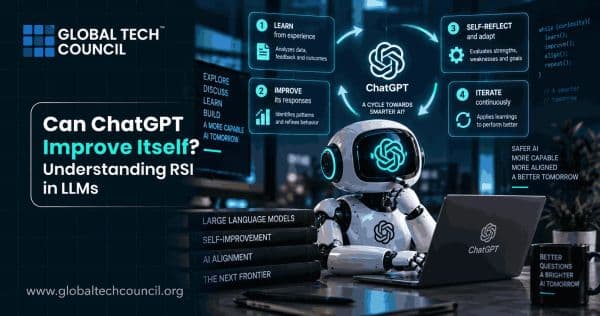
AI & ML
Can ChatGPT Improve Itself? Understanding RSI in LLMs
Explore whether ChatGPT can improve itself, how recursive self-improvement differs from normal model training, and what current LLMs can and cannot do autonomously.

AI & ML
AI-Ready or AI-Cheating? How HireValid Is Bringing Trust and Integrity Back to Skills-Based Hiring
Explore how HireValid helps employers distinguish genuine skills from undisclosed AI assistance through job-relevant assessments, integrity signals, and human-reviewed evidence

AI & ML
Anti-AI-Cheating in Recruitment: How HireValid Helps Employers Verify Real Skills
Explore how HireValid helps employers combat AI-assisted cheating in recruitment through AI-resistant assessments, integrity signals, job-relevant skills testing, and human-reviewed evidence.
Trending Articles
The Role of Blockchain in Ethical AI Development
How blockchain technology is being used to promote transparency and accountability in artificial intelligence systems.
AWS Career Roadmap
A step-by-step guide to building a successful career in Amazon Web Services cloud computing.
Top 5 DeFi Platforms
Explore the leading decentralized finance platforms and what makes each one unique in the evolving DeFi landscape.