

Jev vs AI Agents

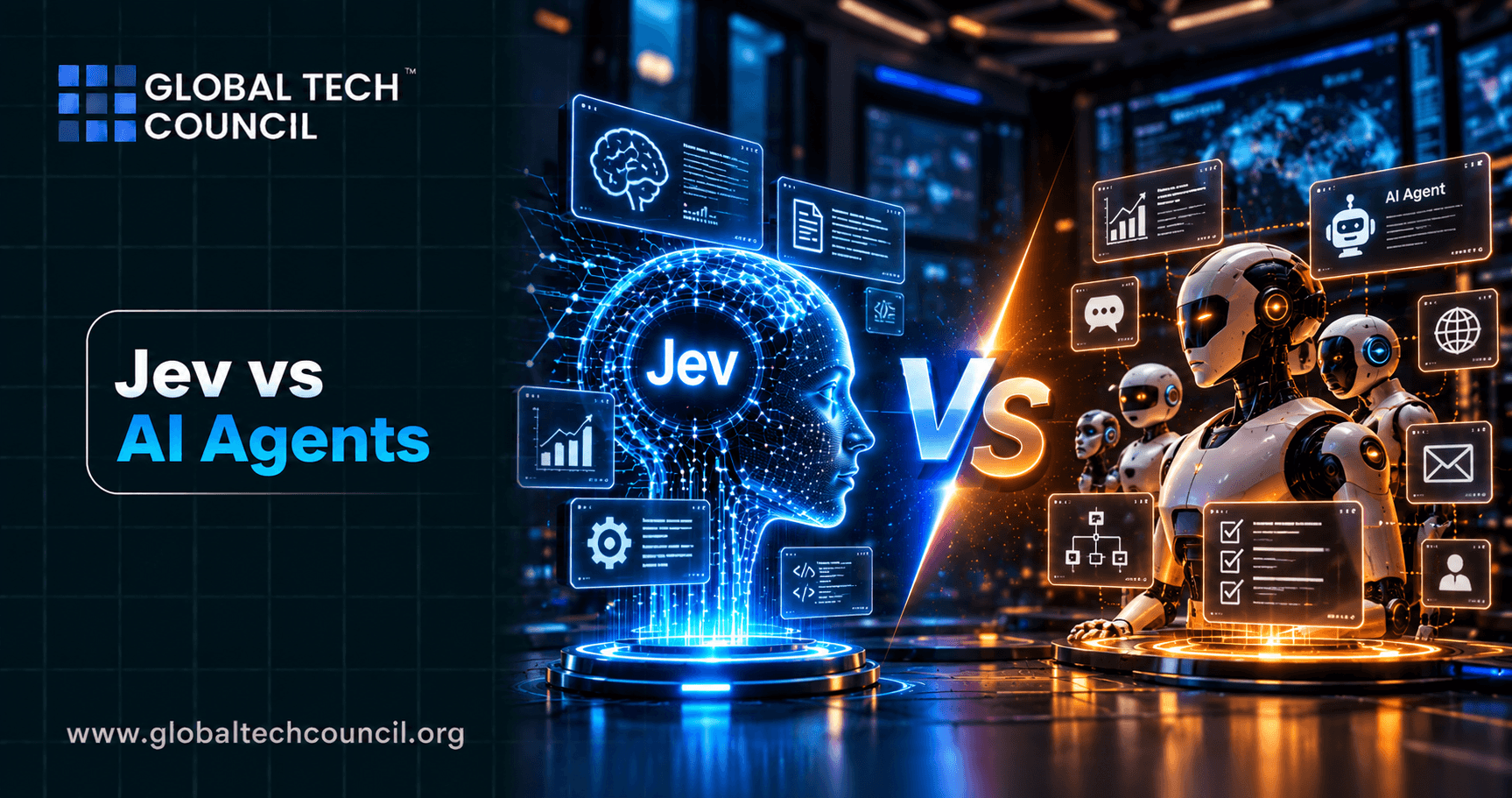
AI agents have become one of the most talked about developments in artificial intelligence, systems that can plan multiple steps, use external tools, and carry out entire tasks with minimal human input. So when TypeSafe AI launched a fast, decision focused model called Jev in September 2026, a natural question followed. Is Jev a competitor to AI agents, or does it play a completely different role inside the same systems. Understanding this distinction clearly is genuinely useful for anyone trying to make sense of how modern AI is actually built. A good starting point for that foundation is a Certified Artificial Intelligence (AI) Expert credential, which covers the core concepts behind both decision focused models and the broader systems they support.
This article breaks down Jev vs AI agents in plain, simple language, so a complete beginner can follow along easily, while still offering enough technical depth for professionals already working with AI systems. No unnecessary jargon, just a clear, well researched comparison.

What AI Agents Actually Are
An AI agent is a system built to accomplish a goal by planning, reasoning through multiple steps, and taking real actions, often by calling external tools, APIs, or software functions along the way. Unlike a simple chatbot that answers one question at a time, an AI agent can break a larger task into smaller steps, decide what to do next based on the results of previous steps, and keep working through a task with limited human oversight until it is complete.
A typical AI agent might research a topic across multiple sources, draft a document, check its own work, send an email, or update a database, chaining together several distinct actions in service of a single overall goal. Building and understanding these systems has become one of the fastest growing specialties in AI, and professionals who want structured, hands on training in this exact area can explore a Certified Agentic AI Expert program, which covers the practical skills needed to design, build, and manage agentic AI systems from the ground up.
What Jev Actually Is
Jev, built by the startup TypeSafe AI, is not an agent at all. It is a fast, structured decision model. Rather than planning multiple steps or taking autonomous action, Jev evaluates a single piece of context and returns a typed, calibrated answer, a boolean, a numeric score, or a category chosen from up to 255 predefined options, typically within 70 to 500 milliseconds. It does not decide what to do next on its own, chain together multiple steps, or interact with external tools independently.
Founded by Diogo Almeida, previously of OpenAI and a co-author of the InstructGPT research behind ChatGPT's training approach, TypeSafe built Jev around a narrow, specific purpose, fast and reliable judgment calls, using a training method called Reinforcement Learning for Calibrated Decisions designed to make its confidence scores genuinely reflect real accuracy. This narrow focus is precisely why comparing Jev directly to a full AI agent requires some careful framing.
The Real Comparison: Different Layers of the Same System
AI Agents Plan and Act
An AI agent's core job is orchestration. It decides what needs to happen, in what order, and carries out those steps, often by calling on other tools or models along the way. Agents are built for flexibility and autonomy, adapting their plan as new information becomes available during a task.
Jev Decides Quickly Within a Step
Jev's core job is judgment, not orchestration. It does not plan a sequence of actions or manage a broader workflow. Instead, it answers a single, well defined question quickly and reliably, often as one small piece inside a much larger agentic process.
This distinction matters because it means Jev and AI agents are not really direct competitors fighting for the same use case. In most real systems, Jev functions as a fast, supporting component that an AI agent can call on, rather than as an alternative way to build the entire system.
Jev vs AI Agents: Side by Side Comparison
Factor | Jev | AI Agents |
Core role | Fast, structured decision making | Planning, tool use, and multi-step action |
Typical response time | Roughly 70 to 500 milliseconds | Seconds to minutes, depending on task complexity |
Autonomy level | None, answers a single defined question | High, can plan and adapt across multiple steps |
Output type | Typed decision, category, or score | Completed tasks, actions, or generated content |
Best suited for | Routine, high volume judgment calls | Complex, multi-step workflows requiring flexibility |
Relationship to each other | Often used as a component inside agent systems | Can call on Jev to make fast decisions mid-task |
This comparison makes clear that the most accurate way to think about Jev and AI agents is not as rivals, but as two different layers of the same broader AI stack, each responsible for a different kind of work.
Why Agents Actually Need Fast Decision Models Like Jev
A key challenge for AI agents in production is cost and latency. Every step an agent takes, especially one that involves calling a large, general purpose language model, adds time and expense to the overall task. If an agent needs to make a simple judgment call at some point during its process, such as checking whether a proposed action looks risky or classifying an incoming request, routing that decision through a full reasoning model is often slower and more expensive than necessary.
This is exactly where a model like Jev becomes useful inside an agentic system. Rather than using a slow, expensive reasoning step for every small judgment call along the way, an agent can call Jev for the fast, structured decisions and reserve its more expensive reasoning capacity for the genuinely complex parts of the task. TypeSafe reports that Jev can respond up to roughly 100 to 200 times faster than comparable frontier models on classification tasks, based on its own internal benchmarks, which illustrates why this kind of layered approach can meaningfully improve both the speed and cost of running agents at scale. Professionals interested in a deeper, structured look at how these layered architectures are evaluated across the broader technology landscape can explore a Deep Tech Certification, which covers advanced system design concepts relevant to both agentic AI and fast decision models.
Real World Examples of Jev Supporting Agent Style Workflows
Several early public demonstrations of Jev illustrate this supporting role clearly. A support ticket router uses Jev to instantly classify incoming requests before deciding how they should be handled. A trading system re-evaluates price direction every second using Jev's fast scoring, feeding that judgment into a larger automated decision process. Simple real time control demos, including a Minecraft bot and a simulated drone navigating an obstacle course, use Jev to make quick, repeated judgment calls that a slower reasoning process could not keep up with in real time. In each case, Jev is not replacing the broader system's planning logic. It is speeding up and reducing the cost of one specific part of it.
A Specific Risk Worth Understanding: Agent Tool Call Safety
One increasingly common use case blends Jev and AI agents directly together. As agents take more autonomous actions inside real software, there is a genuine need to quickly check whether a proposed action looks safe or appropriate before it actually executes. Jev's speed makes it well suited for this kind of safety checkpoint, evaluating an agent's proposed tool call in a fraction of a second before allowing it to proceed. It is worth noting that, like any model evaluating potentially untrusted context, security researchers have raised concerns that carefully crafted prompt injection attempts could influence Jev's judgment in this role, a risk that agent developers should account for rather than assume away entirely.
Emerging Creative Applications That Combine Both Approaches
This layered relationship between fast decision models and broader autonomous systems is also emerging in creative technology. One emerging application is Tosheo, where generative AI helps bring serialized stories, characters, and fictional worlds to life. An agent style system managing an ongoing series might plan out episode structure, character arcs, and pacing across a season, while relying on a fast, structured decision layer similar to Jev for the smaller, repeated judgment calls along the way, confirming a character detail stays consistent or checking that a scene fits established continuity, before the broader generative process produces the final content.
Why This Comparison Matters for Business and Marketing Teams
Understanding the relationship between Jev and AI agents has real value outside of engineering as well. Businesses increasingly deploy agentic systems for customer service, campaign management, and operational automation, and the cost and reliability of those systems often depends heavily on how well they use fast, structured decision layers for the routine parts of a workflow. Professionals working in customer strategy, campaign automation, and digital operations can benefit from understanding this layered architecture, and a focused Marketing Certification can help connect these system design concepts to practical, measurable marketing outcomes.
Conclusion
Jev and AI agents are not competing for the same role inside modern AI systems. AI agents plan, reason across multiple steps, and take autonomous action, while Jev provides the fast, structured decision making that supports those agents along the way, reducing cost and latency for the countless small judgment calls that a full agentic workflow depends on. Rather than asking which one is better, the more useful question is how to combine them effectively, using agents for planning and flexibility, and models like Jev for the fast, reliable decisions happening underneath.
Frequently Asked Questions
1. Is Jev an AI agent?
No. Jev is a fast, structured decision model. It does not plan multiple steps or take autonomous action the way an AI agent does.
2. What is the main difference between Jev and an AI agent?
Jev answers a single, well defined question quickly, while an AI agent plans and carries out multiple steps toward a broader goal, often using external tools along the way.
3. Can Jev replace an AI agent?
No. They serve different purposes, and Jev is generally used as a supporting component inside a larger agentic system rather than as a replacement for it.
4. Why do people compare Jev to AI agents at all?
Because both are newer categories of practical AI tools that emerged around the same time, and understanding their different roles helps clarify where each one actually fits.
5. Can an AI agent use Jev as part of its workflow?
Yes. This is one of the most common real world patterns, with agents calling Jev to make fast, structured decisions at specific points during a larger task.
6. How fast is Jev compared to a typical AI agent's decision making step?
Jev typically responds within 70 to 500 milliseconds, while a full agent step involving a large reasoning model can take significantly longer, especially for complex tasks.
7. Why might an agent use Jev instead of a full reasoning model for certain steps?
Using Jev for simple, well defined decisions reduces both the cost and latency of the overall agent workflow compared to routing every decision through a slower, more expensive reasoning model.
8. Does Jev have the same level of autonomy as an AI agent?
No. Jev has no autonomy. It answers the specific question it is given and does not decide what should happen next on its own.
9. How was Jev trained compared to how agent orchestration logic is typically built?
Jev was trained using Reinforcement Learning for Calibrated Decisions to produce accurate confidence scores, while agent orchestration logic is generally built through a combination of prompting, tool integration, and planning frameworks rather than a single training process.
10. Can Jev evaluate whether an AI agent's proposed action is safe?
Yes. This is an emerging use case where Jev quickly checks a proposed agent action before it executes, though this role does carry some risk of prompt injection that developers should account for.
11. What are examples of AI agents using Jev in practice?
Examples include a support ticket router that classifies requests before routing them, and a trading system that uses Jev's fast scoring as part of a larger automated decision process.
12. How does Jev help reduce the cost of running AI agents at scale?
By handling fast, structured decisions directly, Jev reduces how often an agent needs to call a more expensive, slower reasoning model for routine judgment calls.
13. Are Jev and AI agents used together in real time systems like games or robotics?
Yes. Real time demos, including a Minecraft bot and a simulated drone navigating an obstacle course, use Jev to make quick judgment calls that support broader autonomous behavior.
14. How does this relationship apply to creative platforms like Tosheo?
An agent style system managing a serialized story could rely on a fast decision layer similar to Jev to check character consistency or story continuity while the broader generative process handles the actual content creation.
15. Will more AI agent platforms start using fast decision models like Jev?
It is a reasonable expectation, since reducing cost and latency is a persistent challenge for agentic systems, and fast decision models offer a practical way to address part of that problem.
16. What is a risk of using Jev inside an AI agent workflow?
Since Jev evaluates context that may come from untrusted sources, there is some risk that carefully crafted prompt injection attempts could influence its judgment, a risk agent developers should plan for.
17. What is a limitation of AI agents compared to Jev?
AI agents are generally slower and more expensive per step, since they often rely on larger reasoning models and more complex planning logic than a fast decision model requires.
18. Why should marketing professionals understand the difference between Jev and AI agents?
Because agentic marketing systems increasingly rely on fast decision layers for routine tasks, understanding this relationship helps professionals design more efficient, cost effective automation.
19. What skills help someone work with both Jev and AI agents professionally?
A solid understanding of agent orchestration, tool integration, and fast decision model architecture, along with hands on deployment experience, are valuable starting points.
20. What is the key takeaway about Jev vs AI agents?
Jev and AI agents are not competitors, they are complementary layers of the same broader AI stack, with agents handling planning and multi-step action, and Jev providing the fast, reliable decisions that support those agents along the way.
Related Articles
View All
AI & ML
How Jev Fits Into an AI Stack
Learn how Jev fits into an AI stack as a machine-native decision layer that provides typed, probabilistic outputs for applications, agents, workflows, and automation systems.

AI & ML
Jev for Software Automation
Explore how Jev supports software automation with fast, typed, probabilistic decisions for routing, scoring, classification, verification, branching, and workflow control.

AI & ML
Jev as an Intelligence Primitive
Explore how Jev functions as an intelligence primitive for software, providing fast, typed, probabilistic decisions that developers can combine into larger automated workflows.
Trending Articles
The Role of Blockchain in Ethical AI Development
How blockchain technology is being used to promote transparency and accountability in artificial intelligence systems.
AWS Career Roadmap
A step-by-step guide to building a successful career in Amazon Web Services cloud computing.
Top 5 DeFi Platforms
Explore the leading decentralized finance platforms and what makes each one unique in the evolving DeFi landscape.