

RSI and AGI: How Are They Connected?

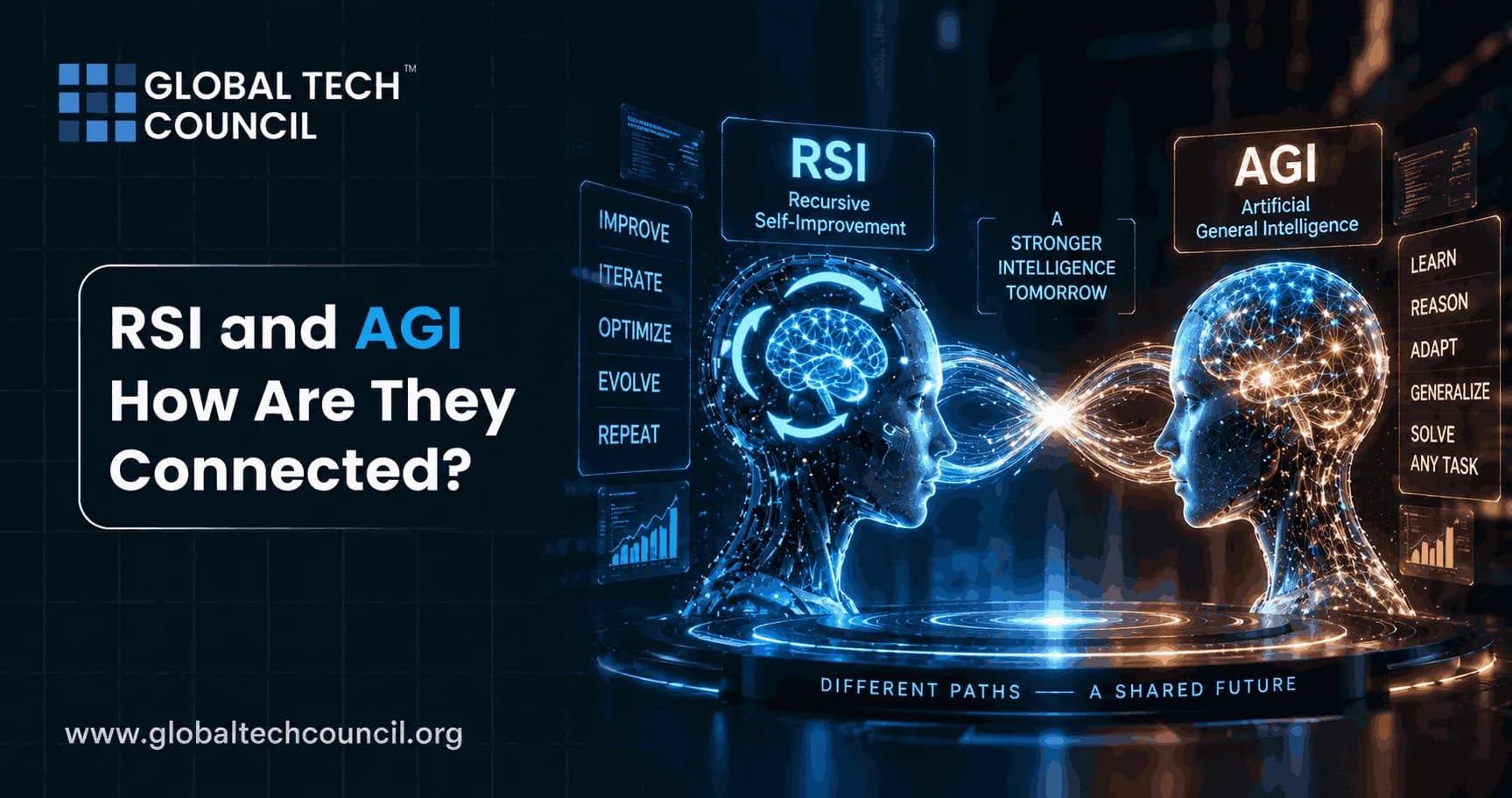
Artificial general intelligence and recursive self-improvement get discussed constantly in the same breath, and for good reason. The two concepts are not the same thing, but they are deeply linked in almost every serious theoretical framework researchers use to think about where AI development could realistically head next. As one industry analysis put it in 2026, recursive self-improvement has effectively become "the new AGI," a term that carries the same weight and the same definitional fuzziness that AGI itself has struggled with for years. For anyone trying to understand this connection with real technical precision rather than relying on headline-level summaries, the Certified Artificial Intelligence (AI) Expert credential offers a structured way to build that foundation properly.
Understanding how RSI and AGI actually connect requires being precise about what each term describes individually first, since the relationship between them only makes sense once you separate the destination from the mechanism that might get you there.

What AGI Actually Means, and Why the Definition Still Is Not Settled
Before connecting RSI to AGI, it helps to be honest about how contested the definition of AGI itself remains across the research community.
Artificial general intelligence is generally understood as an AI system capable of performing across a wide, human-level range of cognitive tasks, rather than excelling narrowly at one specific domain the way earlier AI systems typically did.
Even researchers who study this space professionally disagree sharply on whether AGI is close, far away, achievable through current large language model architectures at all, or whether it might require something fundamentally different from the deep learning paradigm entirely.
Some AI researchers remain openly skeptical that AGI is even on what they call the current LLM branch of the technology tree, raising the genuine possibility that today's systems, however capable, may be built on an architecture that cannot reach general intelligence no matter how much it is scaled or refined.
This definitional uncertainty matters directly for the RSI conversation, because how you define AGI shapes what "reaching AGI" would even mean as a milestone, and therefore what role recursive self-improvement would actually play in getting there or in what happens immediately afterward.
How RSI Fits Into the Theorized Path From AGI to Superintelligence
The clearest formal connection between the two concepts shows up in how researchers model the transition from AGI to something beyond it.
Academic work specifically studying the path from AGI to artificial superintelligence describes recursive self-improvement as the process of AI facilitating AI research and development, producing improved AI systems that can then facilitate research progress even further, creating a compounding loop.
This recursive dynamic is explicitly theorized as the mechanism that could drive an "explosive" transition from AGI to superintelligence, particularly if a system becomes capable of fully autonomous self-improvement across an extended range of capabilities rather than just one narrow task.
The concept traces back to mathematician I.J. Good's 1965 observation that an ultraintelligent machine, essentially an early framing of what we would now call AGI, could design even better machines than itself, creating a positive feedback loop Good himself described as an intelligence explosion.
In this framing, AGI is the starting point or threshold condition, a system general enough to meaningfully contribute to AI research itself, while RSI is the specific mechanism theorized to potentially carry that system past human-level general intelligence and toward something qualitatively beyond it.
Why AGI's Own Internal Logic Points Toward Self-Improvement
There is also a deeper theoretical argument for why AGI and RSI connect, one rooted in what any sufficiently general, goal-directed system would rationally want to do.
Research on AGI safety has long argued that self-improvement functions as an instrumental goal for almost any AGI system, meaning that regardless of what specific end goal a general intelligence is pursuing, becoming better at achieving goals in general tends to help accomplish nearly any objective it might have.
This is sometimes called instrumental convergence: a sufficiently capable AGI system does not necessarily need an explicit, human-given instruction to pursue self-improvement, since improving its own tools, reasoning, or processes can become a useful step toward accomplishing almost any other objective it is given.
If that argument holds, then reaching genuine AGI would not just make recursive self-improvement technically possible, it would make RSI a rationally likely behavior for the system itself to pursue, independent of whether its human developers explicitly designed it to do so.
Understanding exactly how this kind of goal-directed reasoning gets implemented, tested, and constrained inside real systems, rather than as a purely philosophical argument, is exactly where a credential like the Certified Artificial Intelligence (AI) Developer becomes genuinely useful, connecting the theoretical case for instrumental convergence to how agent objectives and constraints actually get engineered in practice.
The Mechanism vs the Outcome: RSI Is Not the Same as an Intelligence Explosion
One of the most important clarifications in this entire discussion is that RSI and the intelligence explosion it could theoretically trigger are two genuinely different things, a distinction that gets collapsed constantly in casual discussion.
Recursive self-improvement names a mechanism, a loop where a system contributes to improving its own successor. The intelligence explosion names a hypothesized outcome, a runaway acceleration that mechanism could potentially produce under the right conditions.
Bounded recursive self-improvement already exists in systems researchers can point to and run today. The intelligence explosion outcome remains a hypothesis whose specific premises, including non-diminishing returns, capability gains that generalize broadly, and no hard data or compute wall, have not been demonstrated to hold at the frontier yet.
RSI is genuinely compatible with several very different outcomes: a hard takeoff where capability accelerates dramatically and quickly, a soft takeoff where progress accelerates but remains gradual and correctable, or even no meaningful takeoff at all if the loop turns out to be bounded by external bottlenecks.
Whether a given real-world RSI loop leads toward AGI-to-ASI style explosive growth or simply produces steady, bounded efficiency gains depends heavily on factors outside the AI system itself, including compute availability, data quality, and whether human oversight remains genuinely effective at each stage of the loop.
Why Frontier Labs Treat RSI as Both a Goal and a Danger Threshold
The relationship between AGI and RSI shows up concretely in how major AI labs have structured their own internal safety frameworks, and the tension there is genuinely worth understanding.
Multiple frontier labs share a similar structural approach in their published safety frameworks: RSI is treated simultaneously as an explicit strategic goal worth pursuing and as a dangerous capability threshold that, if crossed, changes internal procedures and oversight requirements.
This creates a real tension of interests. Achieving genuine RSI would represent a decisive competitive advantage for whichever lab reaches it first, while that exact same capability is classified internally as a serious risk requiring additional safeguards once crossed.
This duality sits at the center of the broader 2026 AI policy debate around whether labs should voluntarily pause development, subject new capabilities to pre-release screening, or pursue international coordination, though it is worth noting these remain voluntary corporate commitments rather than binding external regulation.
The fact that labs actively working toward AGI treat RSI this carefully in their own risk frameworks is itself meaningful evidence for how seriously the AGI-to-RSI connection is taken inside the organizations closest to the research, even without settling whether the intelligence explosion outcome will actually follow.
One Emerging Application Riding the Same Underlying Model Progress
The capability gains fueling this entire AGI and RSI debate are not confined to frontier research labs. The same underlying model progress surfaces in far more accessible, everyday products as well.
One emerging application is AI microdrama, where generative AI helps bring serialized stories, characters, and fictional worlds to life. Tools in this category benefit indirectly from the same broader wave of model improvements driving the frontier research described throughout this article, illustrating how capability gains made in pursuit of AGI eventually ripple outward into entirely different, far more accessible creative applications long before anything resembling true AGI has actually arrived.
Building the Technical Depth to Follow This Connection Accurately
Following the real, evolving relationship between AGI and RSI requires technical literacy spanning machine learning theory, economic modeling of automated research, and formal safety frameworks simultaneously, not just familiarity with the headline terms.
Recent quantitative modeling work has specifically examined the economic circumstances under which automating AI research could plausibly lead to explosive growth in machine intelligence, alongside separate research measuring the actual extent of AI research and development automation happening today. A Deep Tech Certification helps build exactly this kind of broader technical foundation, equipping professionals to evaluate new AGI and RSI research on its genuine technical merits rather than on how dramatic a given headline makes the connection sound.
What Could Prevent AGI's Self-Improvement From Actually Exploding
Even if AGI is reached and genuinely begins pursuing self-improvement, several real-world constraints could prevent the theorized intelligence explosion from actually materializing.
Compute bottlenecks represent one of the most frequently cited limits, since even a dramatically smarter AI system still needs physical GPUs, electricity, semiconductor manufacturing capacity, and data center infrastructure to actually run additional research, none of which scale instantly alongside a jump in intelligence.
Data availability presents a related constraint, since self-improvement that depends on learning from real-world evidence, rather than purely synthetic or self-generated data, is ultimately bounded by how much genuinely new, high-quality information exists to learn from at any given time.
Even AlphaEvolve, one of the most concrete real-world examples of AI research automation available today, produced a documented reduction in LLM training time of roughly 1 percent, a genuinely useful but modest gain that illustrates how far current results sit from the kind of runaway, exponential improvement an intelligence explosion would require.
No published or documented recursive self-improvement loop to date has demonstrated the specific combination of conditions, non-diminishing returns, broadly generalizing gains, and improvement speed beyond meaningful human correction, that the intelligence explosion hypothesis actually depends on, leaving the connection between AGI and a runaway RSI outcome theoretically compelling but empirically unproven so far.
Communicating This Connection Without Overstating or Dismissing It
Explaining how AGI and RSI actually connect to a non-technical audience is genuinely difficult, precisely because the honest answer involves real theoretical force paired with real, unresolved empirical uncertainty.
Presenting instrumental convergence, the AGI-to-ASI transition model, and the current bottleneck evidence together, rather than picking whichever piece supports a more dramatic or more dismissive narrative, requires real communication discipline. A Marketing Certification can help professionals writing or speaking about this topic build that discipline, explaining the genuine theoretical connection between AGI and recursive self-improvement honestly, without collapsing a nuanced, still-unresolved research question into an overconfident claim in either direction.
The Bottom Line on How RSI and AGI Are Connected
Artificial general intelligence and recursive self-improvement are connected through both theory and strategy, not merely through shared headlines. Formal models treat RSI as the specific mechanism that could carry a system from AGI toward superintelligence, instrumental convergence arguments suggest a genuinely general AI system would likely pursue self-improvement on its own initiative, and frontier labs structure their internal safety frameworks around this exact connection today. What remains genuinely unresolved is whether reaching AGI and triggering meaningful RSI would actually produce the runaway intelligence explosion the theory describes, given real-world constraints around compute, data, and the gap between today's modest, bounded self-improvement results and the exponential dynamics the strongest version of this theory requires. The honest picture treats AGI and RSI as tightly linked in theory, actively pursued in practice, and still very much unresolved in outcome.
FAQs
1. What is the connection between RSI and AGI?
Artificial General Intelligence (AGI) refers to AI with broad, human-like ability to learn, reason, adapt, and solve different types of problems. Recursive Self-Improvement (RSI) refers to an AI system repeatedly improving its own capabilities or the processes used to improve itself. AGI could potentially make RSI more feasible, while RSI could theoretically help an AGI become more capable.
2. What is AGI in artificial intelligence?
AGI is a hypothetical form of AI that can perform a wide range of intellectual tasks rather than being limited to a specific domain. An AGI would ideally be able to learn new tasks, reason across different situations, and adapt to unfamiliar problems.
3. What is Recursive Self-Improvement (RSI)?
Recursive Self-Improvement is the concept of an AI system improving aspects of its own capabilities, architecture, algorithms, training processes, or research methods and then using those improvements to produce further improvements. A fully autonomous RSI loop remains a future possibility rather than an established capability of today's AI systems.
4. Does AGI automatically mean recursive self-improvement?
No. AGI and RSI describe different concepts. An AI could theoretically have broad general intelligence without being able to modify or improve itself, while an AI with some self-improvement capability might not qualify as AGI.
5. Can AGI achieve Recursive Self-Improvement?
Potentially, but AGI alone would not guarantee RSI. An AGI would need appropriate access to its code, training processes, computing resources, evaluation systems, and mechanisms for safely implementing and validating improvements.
6. Why could AGI make RSI easier?
AGI could potentially perform a broad range of research tasks, including analyzing algorithms, writing code, designing experiments, and evaluating results. This could allow it to participate in more parts of an AI development cycle than specialized systems can.
7. Could RSI help create AGI?
Possibly. If an AI system could reliably identify weaknesses, develop better algorithms, improve its training processes, and validate those changes, repeated improvement could contribute to developing increasingly capable AI systems. However, this is a theoretical pathway, not a demonstrated route to AGI.
8. Is RSI a requirement for achieving AGI?
No. AGI could potentially be developed through human-led research, larger-scale training, new algorithms, improved data, better reasoning techniques, or combinations of these approaches. Recursive self-improvement is one possible development pathway, not a universally required step.
9. What would AGI need to perform RSI?
A highly capable system would likely need the ability to reason about AI development, generate and modify code, conduct experiments, evaluate outcomes, access sufficient computing resources, and learn from the results. Strong safeguards and reliable evaluation would also be important.
10. Could an AGI improve its own code?
In principle, yes. An AGI capable of understanding its software could potentially identify bugs, optimize algorithms, generate alternative implementations, and test them. However, the ability to generate or modify code by itself does not prove that an AI is capable of unrestricted RSI.
11. Could AGI train a better version of itself?
In theory, an AGI could potentially contribute to training a successor by generating training data, designing experiments, improving training code, or identifying better architectures. Whether it could independently create a significantly more capable successor remains an open research question.
12. What happens if AGI enters a recursive self-improvement loop?
If an AGI could repeatedly make meaningful improvements to itself, each improved version might become better at finding additional improvements. In a hypothetical scenario, this could produce rapid capability growth, although real-world limitations such as computing resources, evaluation reliability, hardware, data, and safety constraints could restrict the process.
13. Is recursive self-improvement the same as an intelligence explosion?
No. RSI describes a process in which an AI repeatedly improves itself. An intelligence explosion is a hypothetical outcome in which those improvements become sufficiently rapid and substantial that AI capabilities increase dramatically over a relatively short period.
14. Can today's AI systems perform RSI?
Today's AI systems can perform limited forms of self-refinement, automated coding, research assistance, and iterative optimization. However, fully autonomous RSI, where an AI independently drives successive generations of increasingly capable AI, has not been publicly demonstrated. OpenAI explicitly states that fully autonomous recursive self-improvement is not happening today.
15. Are current AI agents a step toward AGI and RSI?
AI agents can perform multi-step tasks such as research, coding, experimentation, and evaluation with varying levels of human oversight. These capabilities can support AI development and may represent building blocks toward more autonomous systems, but they should not automatically be considered AGI or full RSI.
16. How are AGI, ASI, and RSI different?
AGI describes broad, general-purpose intelligence. RSI describes a process of repeated self-improvement. ASI, or Artificial Superintelligence, describes a hypothetical AI that substantially exceeds human intellectual capabilities across many domains. RSI is sometimes proposed as one possible pathway from AGI toward ASI.
17. Could RSI happen before AGI?
Yes, depending on how AGI is defined. Narrow or specialized AI systems can already perform certain forms of automated optimization and self-improvement without possessing general intelligence. More open-ended RSI, however, may require capabilities closer to general-purpose AI.
18. What are the risks of AGI combined with RSI?
An AGI capable of autonomous self-improvement could potentially increase its capabilities faster than humans can evaluate or control them. Potential concerns include alignment failures, unexpected behavior, cybersecurity risks, loss of effective oversight, and difficulty validating increasingly complex modifications.
19. Is AGI required for a future AI system to achieve RSI?
Not necessarily. A system could potentially automate parts of AI research and improvement without being generally intelligent. However, more advanced forms of RSI may benefit from broad reasoning, planning, coding, experimentation, and research capabilities associated with AGI.
20. Will AGI and RSI lead to superintelligent AI?
They could potentially be connected, but there is no guarantee. AGI may provide the broad capabilities needed for sophisticated AI research, while RSI could theoretically enable repeated capability improvements. Whether this combination would produce ASI depends on technical, computational, safety, and real-world constraints that remain unresolved.
Related Articles
View All
AI & ML
Can AI Improve Its Own Code? The Role of Code-Generating AI in RSI
Explore whether AI can improve its own code, how code-generating models support software optimization, and what role automated coding could play in recursive self-improvement.

AI & ML
Can LLMs Achieve Recursive Self-Improvement (RSI)?
Explore whether large language models can achieve recursive self-improvement, how self-improving AI systems might work, and the technical, safety, and architectural limits involved.
AI & ML
What Is Recursive Self-Improvement (RSI) in AI?
Recursive self-improvement in AI refers to the idea of an artificial intelligence system improving its own capabilities, then using those improvements to enhance itself further over repeated cycles.
Trending Articles
The Role of Blockchain in Ethical AI Development
How blockchain technology is being used to promote transparency and accountability in artificial intelligence systems.
AWS Career Roadmap
A step-by-step guide to building a successful career in Amazon Web Services cloud computing.
Top 5 DeFi Platforms
Explore the leading decentralized finance platforms and what makes each one unique in the evolving DeFi landscape.