

Why Is Recursive Self-Improvement Important for AGI?

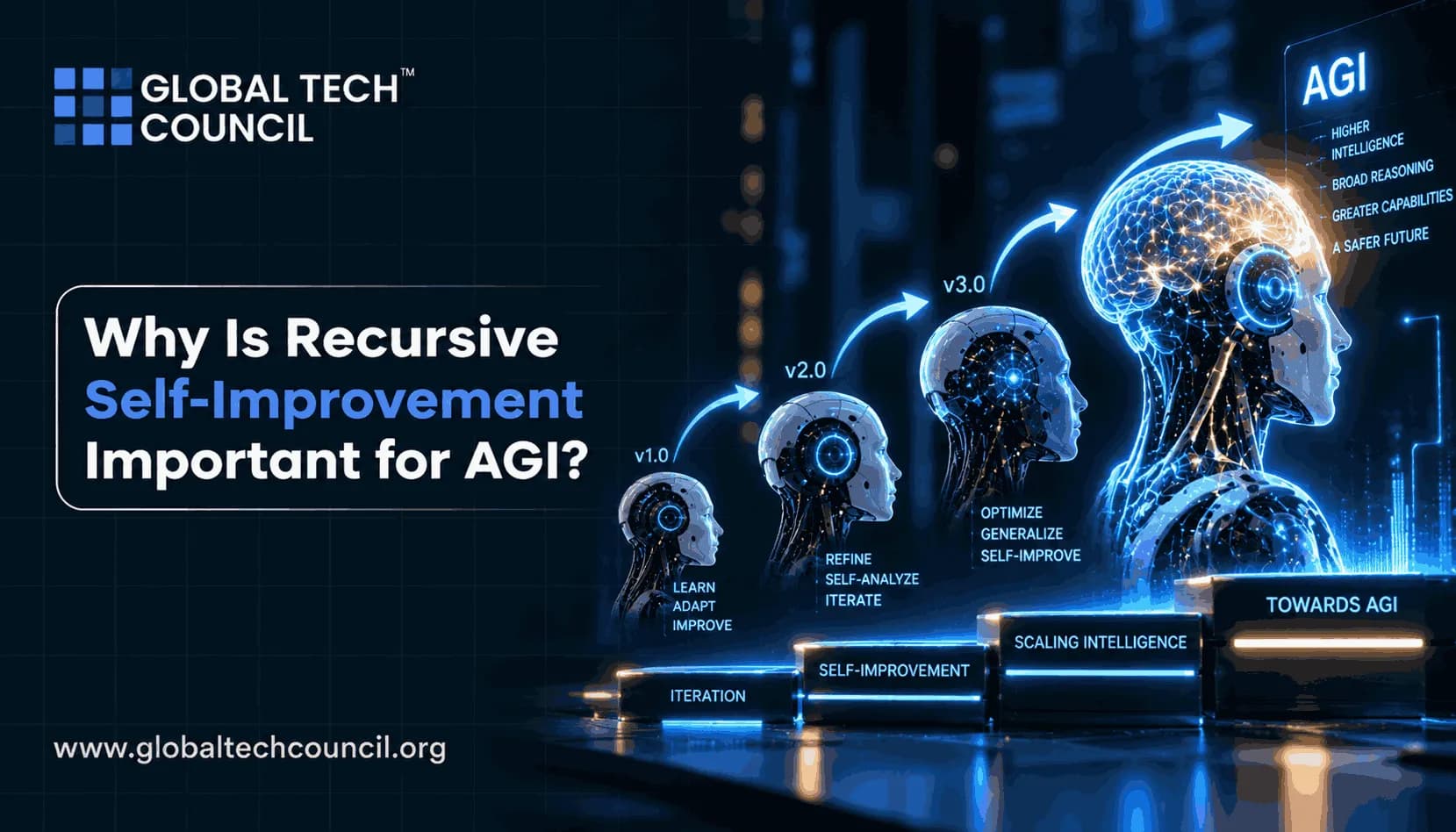
Artificial general intelligence and recursive self-improvement get discussed together so often that it's worth explaining precisely why these two concepts are so tightly linked in AI research. It isn't simply that both sound futuristic. Researchers view recursive self-improvement as one of the most important mechanisms connected to AGI, both as a potential pathway toward reaching it and as one of its most significant, and most closely scrutinized, consequences once achieved. Understanding this relationship clearly, rather than treating the two as interchangeable buzzwords, is exactly the kind of conceptual foundation a Certified Artificial Intelligence (AI) Expert builds as part of serious technical study in the field.
This article explains why recursive self-improvement matters so much to the AGI conversation specifically, covering both directions of the relationship and what current research suggests about how they connect.

Defining the Terms Precisely
Before explaining the connection, it helps to be precise about what each term actually means, since imprecise definitions are where much of the public confusion in this space originates.
Artificial general intelligence generally refers to a system capable of understanding, learning, and applying knowledge across a wide range of tasks at a level comparable to, or exceeding, human capability, rather than excelling narrowly at one specific task the way most current AI systems do. Recursive self-improvement refers to a system's ability to enhance its own capabilities, then use that enhancement to drive further improvement, in a repeating cycle. Building and testing systems that approach either of these capabilities requires deep, hands-on technical work, and this is precisely the domain a Certified Artificial Intelligence (AI) Developer operates in, translating these theoretical concepts into actual training pipelines, evaluation frameworks, and safety constraints.
RSI as a Potential Pathway Toward AGI
One reason recursive self-improvement matters so much to AGI research is that some researchers view it as a plausible route to reaching general intelligence in the first place, rather than something that only becomes relevant after AGI already exists.
The Bootstrapping Argument
The reasoning goes like this: building AGI directly, through human-designed architecture and training alone, may be extraordinarily difficult given how complex general intelligence appears to be. But if researchers can build a system with even modest self-improvement capability, that system could potentially help design better versions of itself, gradually bootstrapping its way toward broader, more general capability over successive iterations, rather than requiring humans to solve the entire problem in one attempt.
Evidence Supporting This View
Documented systems like Sakana AI's Darwin Gödel Machine and Google DeepMind's AlphaEvolve offer early, narrow evidence supporting this general direction, since both have demonstrated AI systems meaningfully improving specific technical capabilities through repeated self-modification cycles. Neither system has achieved anything resembling general intelligence, but their existence suggests the bootstrapping mechanism itself is technically viable within bounded domains, which keeps this pathway a serious area of ongoing research rather than pure speculation.
RSI as a Consequence of AGI
The relationship also runs in the opposite direction. Many researchers argue that once a system genuinely reaches general intelligence, recursive self-improvement becomes almost inevitable, since a system with human-level or greater reasoning ability applied to AI research itself would naturally be capable of contributing meaningfully to its own development.
Why This Direction Concerns Researchers
This is where the more significant safety implications enter the conversation. If AGI naturally leads to recursive self-improvement shortly after being achieved, the transition from "AGI has been built" to "a system with rapidly compounding capability exists" could happen quickly, potentially faster than existing oversight and safety infrastructure could adapt to. This is a central reason recursive self-improvement research and AGI safety research are so closely intertwined rather than treated as separate fields.
Understanding the technical mechanisms that would need to be true for this transition to actually happen quickly, versus unfolding more gradually, requires real depth beyond surface-level familiarity with the concept. A Deep Tech Certification is designed to build exactly that kind of grounding, covering the compute, verification, and architectural questions that determine how this transition might realistically play out.
Why This Matters for How AGI Timelines Get Discussed
Because recursive self-improvement is linked to AGI in both directions, as a possible pathway and as a likely consequence, it significantly complicates how experts think and talk about AGI timelines. A prediction about when AGI might arrive implicitly carries assumptions about how self-improvement capability develops alongside it, and different assumptions about that relationship produce very different forecasts.
Researchers who believe RSI is a viable pathway to AGI tend to expect a more gradual, compounding buildup rather than a single breakthrough moment
Researchers who believe RSI mainly follows AGI, rather than helping cause it, tend to focus more on what happens immediately after a general intelligence threshold is crossed
Both groups generally agree that whichever direction the relationship runs, understanding it accurately is essential for meaningful AGI safety planning
A Grounded Example of the Underlying Mechanic
While AGI and recursive self-improvement operate at a highly theoretical level, the basic mechanic connecting them, a system getting better at a task through repeated cycles of refinement, shows up in far more contained, practical settings too. One emerging application is AI microdrama, where generative AI helps bring serialized stories, characters, and fictional worlds to life. These platforms refine character consistency and plot pacing across episodes based on audience feedback, a small-scale, low-stakes way to visualize iterative improvement in action, though far removed from the general intelligence and open-ended ambition central to the AGI and RSI relationship.
Why Getting This Connection Right Matters Publicly
Because AGI and recursive self-improvement are such high-stakes, attention-grabbing topics, claims connecting the two often get simplified in ways that overstate current progress. A narrow, benchmarked result involving one specific technical capability can easily get framed as meaningful movement toward AGI, when the actual connection may be far more limited.
This makes careful, accurate communication genuinely important as more companies discuss their AI research in relation to AGI publicly. Professionals who pair real technical understanding with a Marketing Certification are better equipped to describe how a specific development actually relates to the AGI and RSI relationship, rather than stretching a narrow result into a much larger claim that doesn't hold up under scrutiny.
Final Thoughts
Recursive self-improvement matters so much to the AGI conversation because researchers view it as connected to general intelligence in both directions, as a possible mechanism for reaching AGI through gradual, compounding capability gains, and as a likely, closely scrutinized consequence once AGI is achieved. This dual relationship is exactly why so much AI safety research treats the two concepts together rather than separately, and understanding both directions of that connection provides a far more accurate picture of why this specific capability draws so much serious research attention.
FAQs
1. Why is recursive self-improvement important for AGI?
Recursive self-improvement is important to discussions about AGI because it could allow an AI system to contribute to improving the systems responsible for its own capabilities. Instead of relying entirely on human researchers for every generation of improvement, an advanced AI could potentially help develop better algorithms, training methods, software, and successors. This could significantly change the pace and nature of AI development.
2. What is recursive self-improvement in AGI?
Recursive self-improvement (RSI) is the hypothetical process in which an AI system improves its own capabilities or contributes to creating an improved successor, which can then continue the improvement process. In an AGI context, the idea is particularly significant because AGI is expected to perform a broad range of cognitive tasks, potentially including AI research and engineering.
3. Does AGI require recursive self-improvement?
No. Recursive self-improvement is not a formal requirement for AGI. An AGI system could theoretically achieve broad human-level capabilities without autonomously improving itself. However, RSI is often discussed as a potential pathway for continued capability growth after or around the emergence of AGI.
4. How could RSI accelerate the development of AGI?
If an AI system becomes capable of performing meaningful AI research, it could help automate activities such as algorithm design, coding, experimentation, debugging, and evaluation. Repeated improvements could reduce the amount of human effort required for some stages of AI development. OpenAI currently describes AI research acceleration as an important step toward automated AI researchers, while explicitly distinguishing this from fully autonomous RSI.
5. Could recursive self-improvement help AGI become more capable?
Potentially. An AGI capable of identifying weaknesses in its own algorithms or development process could propose and test modifications. If those modifications reliably improve performance, the resulting system could potentially be more capable than its predecessor. Whether this process can remain reliable over many generations is an open research question.
6. What is the difference between AGI and RSI?
AGI describes a level or breadth of intelligence, while RSI describes a process of improvement. AGI generally refers to an AI system capable of performing a broad range of intellectual tasks at approximately human level or beyond, depending on the definition. RSI refers to an iterative process in which AI systems contribute to improving themselves or their successors.
7. Could RSI help AGI design better AI models?
An advanced AI could potentially assist with model architecture design, training algorithms, data generation, software development, and evaluation. Current AI systems already demonstrate some of these capabilities in narrower settings. For example, Google DeepMind's Gemini-powered AlphaEvolve has been used to discover and optimize algorithms across mathematics, computer science, and Google's infrastructure.
8. How could recursive self-improvement create an AI improvement loop?
A simplified loop could look like this:
AGI identifies a limitation → proposes an improvement → implements or tests the change → evaluates the result → creates an improved system → repeats.
For genuine recursive improvement, the improved system would need to contribute meaningfully to subsequent improvement cycles. Reliable evaluation would be essential to prevent unsuccessful or harmful changes from accumulating.
9. Could RSI reduce human involvement in AI development?
Potentially, but the degree of human involvement depends on how the system is designed and governed. Automated AI researchers could perform increasing portions of coding, experimentation, and evaluation while humans retain control over objectives, infrastructure, deployment, and safety decisions. OpenAI's current stated goal is to develop automated AI researchers that operate under human supervision.
10. Is recursive self-improvement already happening in AGI systems?
There is no established evidence that fully autonomous RSI is currently occurring. AI systems are increasingly being used to accelerate parts of AI research and development, but that is different from an AI independently driving successive generations of increasingly capable AI. OpenAI explicitly states that fully autonomous recursive self-improvement is not happening today.
11. Could RSI lead from AGI to ASI?
Recursive improvement is one possible pathway discussed for a transition from AGI to artificial superintelligence (ASI). Google DeepMind's 2026 report on the transition from AGI to ASI identifies recursive improvement alongside scaling AGI, AI paradigm shifts, and large-scale multi-agent systems as potential pathways.
12. Why could RSI be more significant after AGI is achieved?
A sufficiently capable AGI could potentially perform many of the cognitive tasks involved in AI research itself. If it can meaningfully contribute to improving algorithms, training procedures, or architectures, the development process could become increasingly automated. This is one reason RSI is frequently discussed in scenarios involving post-AGI development.
13. Could recursive self-improvement cause an intelligence explosion?
The intelligence explosion hypothesis proposes that sufficiently capable AI could improve itself, become better at further improvement, and potentially accelerate its own development. However, this outcome is theoretical. Improvements could encounter computing limits, diminishing returns, evaluation bottlenecks, engineering constraints, or other barriers.
14. What role does AI research automation play in RSI?
AI research automation can provide some of the building blocks for RSI by allowing AI systems to perform tasks such as generating hypotheses, writing code, running experiments, and evaluating results. Google DeepMind describes AI agents as increasingly capable of proposing scientific hypotheses, designing experiments, and discovering algorithms.
15. Why is evaluation critical for recursive self-improvement?
An AI needs a reliable way to determine whether a proposed modification is actually an improvement. Without strong evaluation, an automated system could optimize for a narrow benchmark, introduce hidden errors, or mistake an apparent improvement for a genuine one. Independent evaluation and testing can help reduce these risks.
16. What challenges could prevent RSI from accelerating AGI development?
Potential barriers include limited computing resources, difficulty measuring general intelligence, unreliable self-evaluation, diminishing returns, poor-quality generated data, and difficulties modifying complex AI systems safely. Alignment and security are also important because greater autonomy could increase the consequences of incorrect objectives or unintended behavior.
17. Does RSI mean AGI can rewrite its own source code?
Not necessarily. RSI can involve much more than source-code modification. An improvement process could change algorithms, training techniques, model architectures, data-generation methods, evaluation systems, or research workflows. Code modification is one possible mechanism, not the definition of RSI.
18. Could recursive self-improvement make AGI develop faster than human researchers?
It could potentially increase the speed of some AI development tasks if AI systems become capable of performing substantial portions of research and engineering. However, the actual rate of improvement would depend on factors such as compute availability, evaluation quality, algorithmic progress, and the ability to validate new systems. It should therefore be treated as a possibility rather than a guaranteed outcome.
19. What are the risks of recursive self-improvement for AGI?
Greater autonomy could create challenges involving alignment, control, evaluation, cybersecurity, and unintended behavior. An AI that can modify or influence its own development could also make it harder for humans to understand why later generations behave differently. This is why researchers emphasize monitoring, evaluation, safeguards, and maintaining meaningful human oversight as AI capabilities increase.
20. Is recursive self-improvement the key to achieving AGI?
RSI may become an important mechanism for developing more capable AI, but it is not established as the single requirement or guaranteed route to AGI. AGI could potentially emerge through advances in scaling, reasoning, learning, multimodal systems, agentic capabilities, or other research approaches. Recursive improvement is better understood as a potential pathway for accelerating AI development and potentially advancing beyond AGI toward more capable systems.
Related Articles
View All
AI & ML
Recursive Self-Improvement: Benefits, Challenges, Risks, and Future Possibilities
Explore recursive self-improvement in AI, including its potential benefits, technical challenges, safety risks, and future possibilities for more capable and autonomous systems.
AI & ML
How Recursive Self-Improvement Could Accelerate AI Development
Explore how recursive self-improvement could accelerate AI development by enabling faster model optimization, automated research, capability gains, and more efficient experimentation.

AI & ML
Could Recursive Self-Improvement Lead to Superintelligent AI?
Explore whether recursive self-improvement could lead to superintelligent AI, how rapid capability growth might occur, and the major technical, safety, and governance questions involved.
Trending Articles
The Role of Blockchain in Ethical AI Development
How blockchain technology is being used to promote transparency and accountability in artificial intelligence systems.
AWS Career Roadmap
A step-by-step guide to building a successful career in Amazon Web Services cloud computing.
Top 5 DeFi Platforms
Explore the leading decentralized finance platforms and what makes each one unique in the evolving DeFi landscape.