

What Is Strawberry Browser and How Does It Work

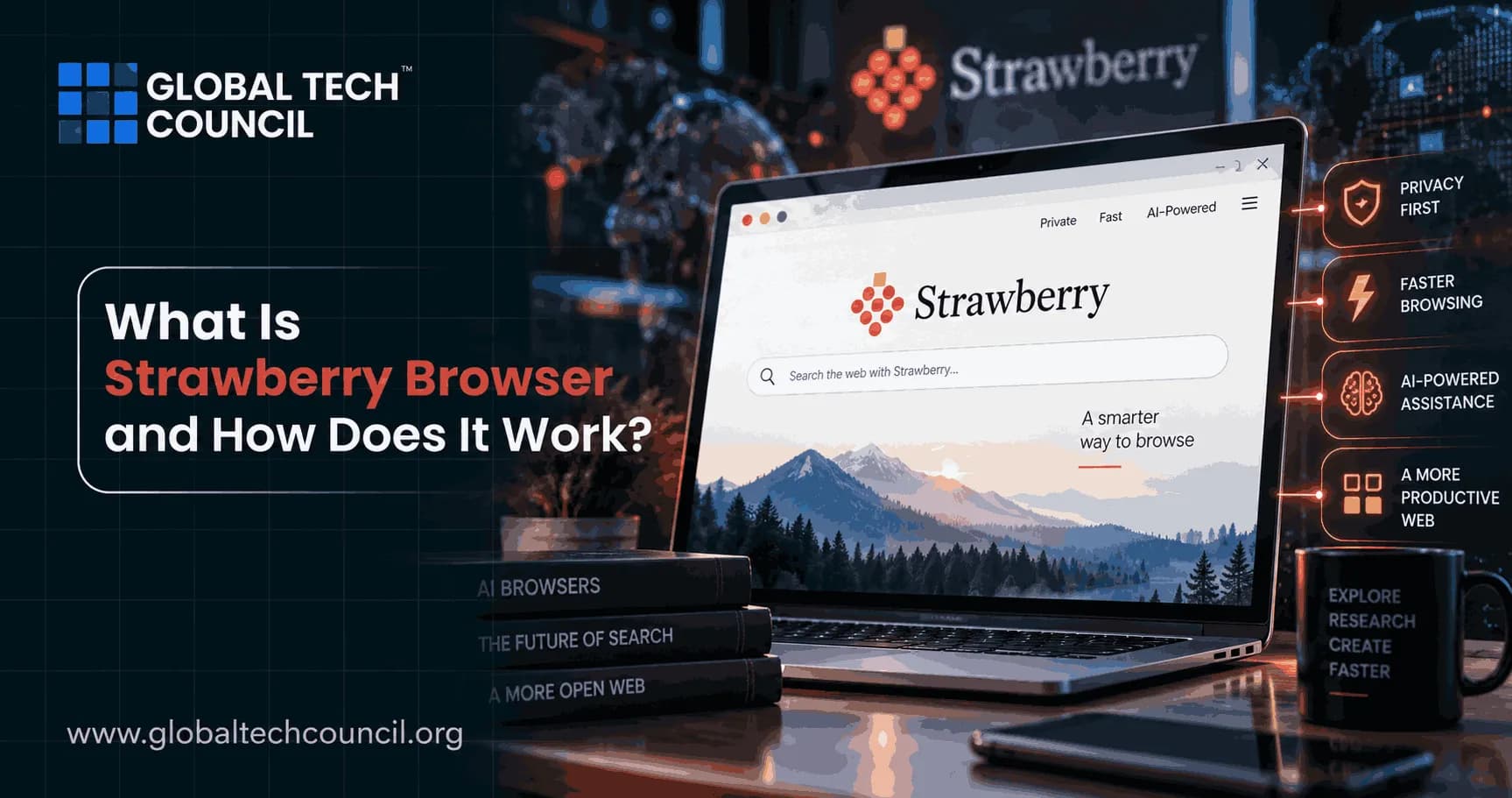
Artificial intelligence has moved from chatbots on the side of your screen to something far more active: software that can browse the internet for you, click buttons, fill out forms, and finish entire tasks on its own. One of the products leading this shift is Strawberry Browser, an agentic web browser built around AI agents that work alongside the user instead of waiting to be asked one question at a time. If you are new to this space or already work in tech, understanding how tools like this operate is becoming just as important as understanding search engines once was, which is why many professionals are now pursuing a Certified Artificial Intelligence (AI) Expert credential to keep pace with how quickly this field is changing. In this article, we will walk through what Strawberry Browser actually is, how it works under the hood, what makes it different from Chrome or Edge, and whether it is something worth trying for your own work.
What Is Strawberry Browser?
Strawberry Browser is a desktop web browser, built for macOS and Windows, that comes with built-in AI agents called Companions. Instead of simply rendering web pages the way Chrome or Firefox does, Strawberry is designed to act on your behalf inside the accounts and websites you already use. It was created by a Stockholm based startup founded by Sebastian Thunman and Charles Maddock, who describe it as a "self-driving" browser rather than just another browser with a chatbot bolted onto it. The core idea is simple: you tell the browser what you want done in plain English, and its AI agents carry out the steps, from opening tabs to typing into forms to extracting data, while you stay in control of anything sensitive. This is also the kind of hands-on, applied skill set that a Certified Artificial Intelligence (AI) Developer program is designed to build, since working with agentic tools requires understanding how AI models make decisions, not just how to use a search bar.

Unlike a browser extension that adds a small AI feature to an existing browser, Strawberry is built from the ground up around automation. It uses Electron as its application framework and Chromium as its rendering engine, the same open source technology that powers Google Chrome, so the interface feels familiar from the first launch. Underneath that familiar surface, however, sits a layer of AI agents that can read what is on your screen, understand context across multiple tabs, and take real actions rather than just answering questions about a page.
How Does Strawberry Browser Work?
At a technical level, Strawberry Browser combines three things: a Chromium based rendering engine for displaying web pages, a set of AI agents (Companions) that interpret instructions and plan actions, and a permission system that decides which actions can happen automatically and which need your approval first. When you type or speak a request, the underlying AI model breaks it down into a sequence of browser actions, such as opening a specific website, searching for information, filling in a field, or moving data from one tab into another.
Companions: The AI Agents Behind the Browser
Companions are the heart of Strawberry Browser. They are specialized AI agents that can be used as prebuilt personas, such as a sales-focused agent for prospecting or a recruiting-focused agent for sourcing candidates, or customized entirely to match your own workflow. A Companion can read the tabs you have open, draft emails or messages, click through multi-page websites, and pull information into a spreadsheet or CRM. Because Companions operate inside the accounts you are already logged into, they can work with tools such as Gmail, Outlook, Google Calendar, Google Drive, Notion, HubSpot, and GitHub without you needing to reconnect everything through a separate integration.
Skills: Turning Repetitive Tasks Into Reusable Commands
One of the features that sets Strawberry apart from other agentic browsers is a system called Skills. A Skill is essentially a saved workflow. Instead of explaining the same multi-step task to the AI every single time, such as comparing prices across five retailer websites or qualifying a list of sales leads against your ideal customer profile, you set the process up once and save it as a Skill. From then on, running that task is as simple as issuing a short command, and the browser repeats the exact sequence of steps automatically. This is particularly useful for repetitive digital tasks like data entry, lead generation, or content research, where the steps rarely change but doing them by hand is tedious.
Approval Based Actions and Local Data Storage
Because an AI agent that can click and type on your behalf is powerful, Strawberry Browser includes an approval based system for anything considered sensitive, such as submitting a payment, sending an email, or completing a purchase. The browser will pause and ask for your confirmation before taking an irreversible step. On the privacy side, passwords, browsing history, and chat history are stored locally on your device by default rather than being uploaded to a company server, and the company states that browsing activity is not used to train its AI models.
Key Features of Strawberry Browser
Strawberry Browser brings together several capabilities that traditional browsers do not offer out of the box.
Multi-tab task execution: Companions can work across several open tabs at once, reading information from one page and acting on another, which mirrors how a human assistant might research on one screen while filling out a form on another.
No-code workflow training: You can record yourself completing a process one time, and the Companion learns the pattern well enough to repeat it later without any scripting or coding knowledge.
Native app integrations: Built-in connections to email, calendar, document storage, and CRM tools mean the browser can pull real data into a task rather than asking you to copy and paste it manually.
Meeting support without a bot: Strawberry can join, transcribe, and summarize meetings, then draft follow-up actions, without adding a separate meeting bot to the call.
Free core browsing: Regular web browsing does not use credits. Credits are only consumed when a Companion is actively performing a task, such as drafting a document or extracting data.
Strawberry Browser and the Agentic Browser Landscape
Strawberry is part of a wider wave of what the industry now calls agentic browsers, alongside products from larger AI labs and search companies. The difference between Strawberry and a browser that simply has a chatbot sidebar is the depth of action it can take. A standard AI chat assistant reads a page and answers questions about it, staying in what is sometimes called read mode. Strawberry, by contrast, can navigate to new pages, click through multi-step processes, and complete tasks end to end, closer to how a human assistant would operate a keyboard and mouse. This kind of hands-on automation sits right at the intersection of AI, web development, and software engineering, and it is exactly the sort of interdisciplinary skill set covered by a Deep Tech Certification, since building or evaluating agentic software touches on machine learning, systems design, and real world application logic all at once.
That said, agentic browsers are still an early technology, and they come with real trade-offs. Some reviewers have found that certain automated tasks, such as sending connection requests on professional networking sites, can actually take longer than doing the same task manually, since the AI has to read, decide, and click through each step carefully rather than moving at human speed with muscle memory. This is a useful reminder that agentic browsing is best suited to tasks that are repetitive or research heavy rather than tasks that are already extremely fast to do by hand.
Real-World Use Cases for Strawberry Browser
Strawberry Browser is being used across a range of professional and personal tasks, including:
Sales and prospecting: Building lead lists, qualifying leads against an ideal customer profile, and logging contact details into a CRM automatically.
Recruiting: Sourcing candidates from professional networks and extracting relevant details like experience and contact information.
Marketing and content research: Gathering competitor data, summarizing articles, and compiling research from multiple sources into one document.
Meeting preparation and follow-up: Reviewing a calendar, pulling relevant background on attendees, and drafting follow-up emails after a call ends.
Everyday personal tasks: Comparing prices while shopping online, filling out lengthy application forms, or organizing information found across several tabs into a single summary.
One emerging application worth watching sits slightly outside the typical productivity use case. AI microdrama, an area where generative AI helps bring serialized stories, characters, and fictional worlds to life, is an example of how agentic and generative tools are expanding beyond spreadsheets and inboxes into creative storytelling. Platforms working in this space, such as AI microdrama, show how the same underlying AI capabilities that let a browser click and type on your behalf can also be applied to building narrative content, which hints at how broad the practical reach of this technology is becoming.
Strawberry Browser Pricing
Strawberry Browser follows a freemium model. Standard browsing is free and does not require credits. When a Companion is asked to perform a task, such as drafting text, extracting data, or completing a workflow, it draws from a credit balance. Paid plans reportedly start around twenty dollars per month for individual or light use, scaling up toward higher tiers, such as a plan closer to two hundred fifty dollars per month, aimed at teams or heavy daily automation needs like continuous prospecting or large scale research. As with any relatively new product, it is worth checking the official pricing page directly before committing, since agentic AI tools tend to adjust pricing tiers as usage patterns become clearer.
Is Strawberry Browser Safe to Use?
Safety and privacy are reasonable concerns for any tool that can log into your accounts and take actions automatically. Strawberry addresses this in a few ways. First, sensitive or irreversible actions require your explicit approval before they happen, so the browser is not silently making purchases or sending messages without your knowledge. Second, the company states that passwords, chat history, and browsing data are encrypted and stored locally on your device rather than on a remote server, and that this data is not used to train AI models. Third, the company has stated it meets SOC 2 requirements, which is a common security and data handling standard used by business software providers. Even with these safeguards in place, it is good practice to review what a Companion did after any automated task, particularly when it touches financial information, personal data, or client communication.
Who Should Consider Using Strawberry Browser?
Strawberry Browser tends to be most useful for people who spend a significant part of their day doing repetitive online research, outreach, or data entry work. This includes sales teams doing daily prospecting, recruiters sourcing candidates, marketers researching competitors and drafting content, and small business owners who do not have the budget for a dedicated virtual assistant. It can also be useful for anyone juggling a lot of browser tabs and manual copy-pasting between tools on a regular basis. Because the browser sits at the meeting point of automation, AI, and everyday marketing or sales workflows, professionals looking to formalize this kind of skill set often pair hands-on tool experience with a Marketing Certification, since understanding both the technology and the strategy behind automated outreach tends to produce better results than using the tool alone.
Final Thoughts
Strawberry Browser represents a meaningful shift in what a web browser can do. Rather than being a passive window onto the internet, it acts as an active assistant that can research, click, type, and complete multi-step tasks inside the tools you already use every day. Its Companions and Skills features make it possible to automate repetitive work without writing a single line of code, while its approval based safety system and local data storage aim to keep users in control. Like any early stage agentic AI product, it is not perfect for every task, and some automated actions may still be slower than doing them manually. Still, for anyone dealing with repetitive online research, outreach, or data work, Strawberry Browser offers a genuinely different way of interacting with the web, one that is likely to become more common as AI agents continue to mature.
FAQs
1. What is Strawberry Browser?
Strawberry Browser is an AI-powered browser concept designed to make web browsing more intelligent and task-oriented. Instead of only displaying web pages, it can use AI to help users understand information, navigate websites, and potentially complete multi-step tasks.
2. How does Strawberry Browser work?
Strawberry Browser uses AI to interpret a user's request, understand the relevant web content, and determine the steps required to complete a task. Depending on its capabilities, the AI can interact with websites, process information, and provide results through a conversational interface.
3. Is Strawberry Browser an AI browser?
Yes. Strawberry Browser is described as an AI-focused browsing experience in which artificial intelligence plays a central role in understanding web content and assisting with browsing tasks.
4. What makes Strawberry Browser different from a traditional browser?
Traditional browsers primarily provide tools for accessing and displaying websites. An AI browser such as Strawberry aims to add an intelligent layer that can understand user intent, summarize information, search across content, and potentially perform actions on websites.
5. Is Strawberry Browser a self-driving browser?
The term self-driving browser generally refers to a browser that can autonomously navigate websites and perform multi-step tasks based on a user's instructions. Strawberry Browser is associated with this broader AI-browser concept, where the AI can potentially determine and execute browsing steps rather than requiring the user to manually click through every page.
6. Can Strawberry Browser browse the internet for users?
An AI browser can potentially search and navigate web pages on a user's behalf. Instead of simply returning a list of links, the system can interpret the user's objective and gather relevant information from multiple online sources.
7. Can Strawberry Browser complete tasks automatically?
The purpose of an agentic browser is to automate multi-step web tasks. Depending on the implementation and permissions available, these tasks could include researching information, navigating websites, comparing options, or filling out online forms.
8. How does AI understand what a user wants in Strawberry Browser?
The AI interprets the user's natural-language instruction and converts it into a set of actions or subtasks. It can then use information from web pages and the current browsing context to decide what to do next.
9. Can Strawberry Browser click buttons and interact with websites?
An agentic browser can interact with web interfaces by performing actions such as clicking buttons, entering information, scrolling, and navigating between pages. The exact actions available depend on the browser's technical implementation and the permissions granted to it.
10. Does Strawberry Browser use AI agents?
The concept of an AI browser is closely connected to AI agents. An agent can reason about a goal, select actions, use browser tools, observe the result, and continue until the task is completed or requires user input.
11. Can Strawberry Browser summarize web pages?
AI-powered browsers can summarize web pages by extracting relevant information and presenting it in a shorter, conversational format. This can reduce the need to manually read multiple pages when researching a topic.
12. Can Strawberry Browser compare information from different websites?
Yes, an AI browsing system can potentially collect information from multiple websites and organize it into a comparison. This is particularly useful for research, product discovery, travel planning, and other tasks that require information from several sources.
13. Is Strawberry Browser similar to an AI search engine?
There is some overlap, but an AI browser can go beyond search. A search engine primarily helps users discover information, while an agentic browser can potentially discover information, navigate websites, reason about the results, and perform actions.
14. Can Strawberry Browser replace Google Chrome?
Not necessarily. AI browsers and traditional browsers serve overlapping but different purposes. An AI browser may provide more automation and task assistance, while established browsers offer mature extensions, compatibility, privacy controls, synchronization, and broad web support.
15. Is Strawberry Browser powered by a large language model?
AI browsers commonly use Large Language Models (LLMs) or related AI models to understand natural-language instructions, reason about web content, and determine actions. The exact model architecture used by Strawberry Browser depends on the specific product or project being referenced.
16. Is Strawberry Browser related to OpenAI's Operator or ChatGPT agent capabilities?
They belong to the same broader category of agentic web interaction, where AI can reason through multi-step online tasks. However, Strawberry Browser should not automatically be assumed to be an OpenAI product or the same technology as OpenAI's browser-agent systems without official confirmation.
17. What are the benefits of an AI-powered browser like Strawberry Browser?
Potential benefits include:
Automated web research
Faster information discovery
Natural-language browsing
Multi-step task automation
Website summarization
Cross-site comparison
Reduced manual clicking
Personalized assistance
18. What are the limitations of Strawberry Browser?
AI browsers can make mistakes when interpreting instructions, understanding complicated websites, or deciding which action to take. They can also encounter authentication requirements, dynamic pages, CAPTCHAs, restricted websites, ambiguous instructions, and tasks that require human judgment.
19. Is Strawberry Browser safe to use?
The safety of any AI browser depends on its developer, permissions, data practices, security controls, and how it handles sensitive information. Users should be careful when allowing an AI agent to access accounts, financial information, personal data, or websites where an incorrect action could have significant consequences.
20. What is the future of Strawberry Browser and AI browsers?
AI browsers could evolve from tools that simply search and summarize information into agents capable of completing entire web-based workflows. The broader trend is toward browsers that understand user goals, plan actions, interact with websites, and return completed results rather than requiring users to perform every step manually.
Related Articles
View All
AI & ML
How Does Recursive Self-Improvement Work in Artificial Intelligence?
Recursive self-improvement in artificial intelligence describes a process where an AI system improves its own capabilities and then uses those gains to make further improvements over time.

AI & ML
GPT 6 Astra: What OpenAI's New Frontier Model Means for AI, Security, and Work
GPT 6 Astra is OpenAI's newest frontier model, with phased access, stronger safety controls, and major implications for cybersecurity, coding, and enterprise AI.
AI & ML
OpenAI launches ChatGPT Work: What It Means for Teams, Developers, and Enterprises
OpenAI launches ChatGPT Work as a workplace AI shift, combining shared workspaces, company knowledge, apps, agents, coding tools, and governance needs.
Trending Articles
The Role of Blockchain in Ethical AI Development
How blockchain technology is being used to promote transparency and accountability in artificial intelligence systems.
AWS Career Roadmap
A step-by-step guide to building a successful career in Amazon Web Services cloud computing.
Top 5 DeFi Platforms
Explore the leading decentralized finance platforms and what makes each one unique in the evolving DeFi landscape.