

Why Choose ZipTie AI Search Analytics?
 Michael Willson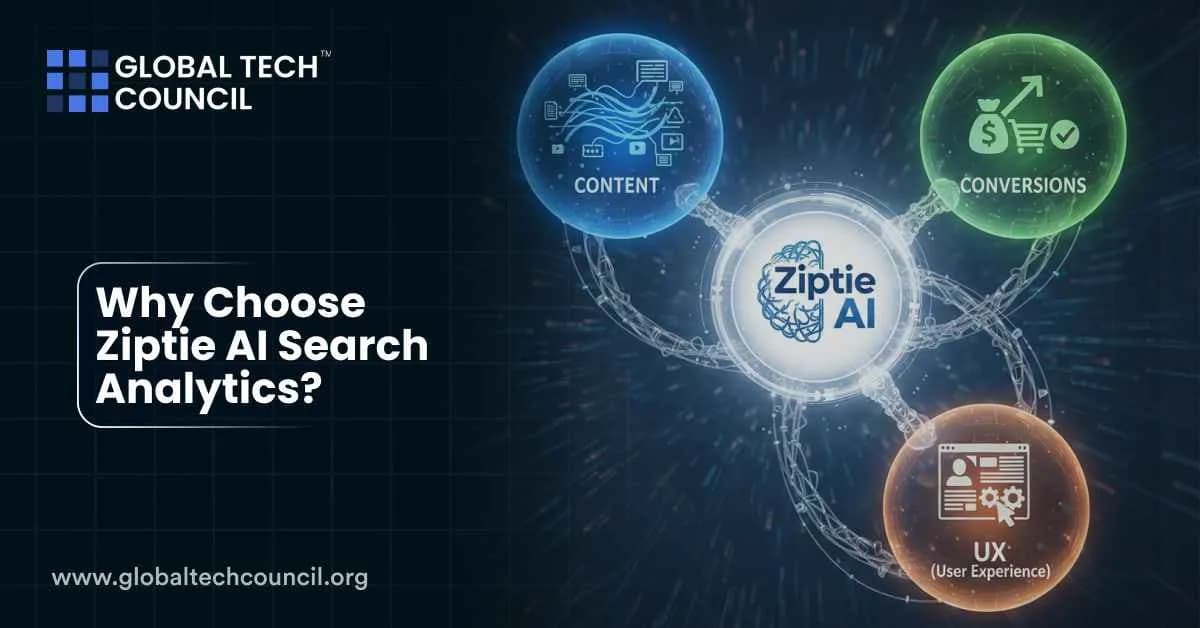
Search visibility no longer stops at blue links. Today, brands need to know whether they appear inside AI-generated answers across Google AI Overviews, ChatGPT, and Perplexity. That is the exact problem ZipTie AI Search Analytics is built to solve.
Teams choose ZipTie because it answers a practical question that traditional tools cannot handle well: are we present inside AI answers, and if we are, what role do we play there? For professionals who already understand modern analytics, data pipelines, and AI-driven discovery through a Tech Certification, ZipTie feels like a logical next step rather than an experimental add-on.
Instead of guessing, ZipTie shows visibility directly inside the AI response layer.
What makes ZipTie different from classic SEO tools
Traditional SEO platforms focus on rankings, impressions, and clicks. That model breaks down when users receive answers without clicking anything.
ZipTie looks at what actually changed:

Whether your brand is mentioned inside an AI-generated answer
Whether your site is cited as a source
How competitors appear in the same response
Whether the context is favorable, neutral, or negative
This shift matters because AI answers are increasingly where decisions form, even when traffic does not follow.
Tracking AI Overviews in a usable way
One of the biggest frustrations teams express around AI Overviews is uncertainty.
Common questions include:
Are we included in the AI answer at all
Why does a competitor appear instead of us
Why does visibility feel higher while traffic drops
ZipTie addresses this by capturing the full AI answer text and mapping brand presence inside it. Users consistently say this feels more honest than abstract scores because they can see exactly what the model is showing to users.
The fact that ZipTie explains how its data is collected also builds trust. AI answers vary by location, login state, and time. Transparency around that variability matters.
What teams actually get from ZipTie
ZipTie is not built around a single score. It breaks AI visibility into signals teams can act on.
Mentions, citations, and sentiment
Most buyers focus on three core outputs:
Mentions that show whether your brand is referenced
Citations that show whether your content is used as a source
Sentiment that explains how your brand is framed
These signals translate cleanly to leadership and clients without needing deep SEO explanations.
Prompt-based tracking that matches AI search behavior
AI search is prompt-driven, not keyword-driven. ZipTie reflects that reality.
Teams can:
Track exact prompts and questions
Compare share of voice across competitors
Import queries from Search Console or generate new ones
This makes analysis feel closer to how users actually interact with AI systems.
Faster adaptation to changing formats
AI answer formats change frequently. ZipTie relies on real browser-level tracking rather than static scraping. That approach allows it to adapt faster when layouts or citation styles shift.
For teams thinking long term, that flexibility reduces the risk of tool decay.
Pricing and onboarding experience
ZipTie is often described as easy to start with.
Key points teams mention:
A 14-day trial without heavy sales friction
Clear tiered pricing
Coverage across Google AI Overviews, ChatGPT, and Perplexity
Multi-country tracking, including India
This simplicity resonates with teams that already understand analytics fundamentals and want insight quickly rather than long onboarding cycles.
What users like after using it
After hands-on use, feedback tends to cluster around a few themes:
Value appears quickly without complex setup
Unexpected prompts reveal brand presence in places teams did not anticipate
Reporting is visual and concrete, which helps internal buy-in
Instead of saying AI search matters, teams can show where they stand.
Known limits to be aware of
ZipTie is intentionally focused, and users do call that out.
Commonly noted limits include:
Coverage is centered on a few major platforms, not every model
Credit usage can take time to understand
Results depend on how well prompts are defined
For most teams, these are acceptable tradeoffs because the goal is clarity, not total coverage.
Who ZipTie fits best
Based on real usage patterns, ZipTie works well if:
You need reliable tracking for AI Overviews and chat-based answers
Mentions and citations matter more than classic rankings
You want fast setup with transparent pricing
Location-specific AI results are important
As AI visibility becomes tied to broader strategy, ZipTie often enters conversations alongside deeper system-level thinking taught in Deep Tech Certification programs, where infrastructure, reliability, and measurement gaps are examined in detail.
Connecting AI visibility to growth decisions
Once teams see where they appear in AI answers, the conversation shifts from curiosity to action. Visibility influences perception, trust, and downstream decisions even without clicks.
That is why ZipTie frequently shows up in agency and in-house discussions about positioning, messaging, and competitive narrative. Translating those insights into execution is where frameworks from Marketing and Business Certification programs often become relevant.
AI Search Visibility in 2026
In 2026, AI search visibility is increasingly treated as a measurement layer alongside traditional SEO. Google AI Overviews and conversational AI platforms have made it more important for brands to monitor not only rankings and clicks, but also mentions, citations, source selection, and how their brand is represented within generated answers. Because AI responses can vary by prompt, location, time, and user context, ongoing monitoring remains important when evaluating visibility.
Bottom line
Teams choose ZipTie AI Search Analytics because it measures something traditional SEO tools cannot. Visibility inside AI answers.
It does not replace existing platforms. It fills the gap created by AI-driven search behavior. For many teams, simply knowing whether they are present, how they appear, and how competitors compare is enough to justify the tool.
In a search landscape defined by answers rather than links, that clarity is the real value.
FAQs
1. What is ZipTie AI Search Analytics?
ZipTie is an AI search visibility and analytics platform that tracks how AI search engines describe and recommend brands. It monitors mentions, citations, sentiment, competitors, and full AI responses across multiple AI search platforms.
2. Why should businesses use ZipTie AI Search Analytics?
Businesses can use ZipTie to understand whether their brands appear in AI-generated answers and how they are represented. It helps identify visibility gaps and prioritize actions that may improve AI search presence.
3. Which AI search engines does ZipTie track?
ZipTie currently tracks seven major AI search environments: ChatGPT, Google AI Overviews, Perplexity, Google AI Mode, Microsoft Copilot, Bing AI Overview, and Google Gemini.
4. How does ZipTie measure AI search visibility?
ZipTie measures signals including brand mentions, citations, and sentiment within AI-generated responses. These signals are combined into an AI Success Score that provides a broader view of AI search performance.
5. What is the ZipTie AI Success Score?
The AI Success Score is a 0-100 metric designed to summarize how well a brand performs for a tracked prompt across AI search engines. It incorporates mention rate, sentiment, and citation rate to help teams identify which queries require attention.
6. How does ZipTie help with AI search optimization?
ZipTie does more than report visibility data. Its Action Center ranks opportunities and connects them to the areas where teams can take action, while its content generation module can help create AI-search-focused content.
7. Can ZipTie track brand mentions in AI answers?
Yes. ZipTie identifies configured brand mentions within captured AI responses and analyzes the context in which the brand appears. Additional brand names, such as legacy or regional names, can also be configured when necessary.
8. Can ZipTie track citations?
Yes. ZipTie records when a website URL is cited as a source in AI-generated answers. This allows marketers to identify which pages are being used by AI engines as supporting sources.
9. Why is sentiment analysis important in AI search?
A brand mention is not necessarily positive. ZipTie analyzes whether the context surrounding a brand mention is positive, mixed, or negative, helping businesses understand how AI systems portray their brand rather than simply whether the brand appears.
10. How is ZipTie different from traditional SEO tools?
Traditional SEO platforms primarily focus on rankings, keywords, backlinks, and organic search traffic. ZipTie focuses on visibility within AI-generated answers, including mentions, citations, sentiment, and the sources AI engines use.
11. Does ZipTie show the actual AI responses?
Yes. ZipTie captures and archives the responses generated for tracked prompts, allowing users to inspect the underlying answers rather than relying only on aggregated scores.
12. Can ZipTie track competitors?
Yes. ZipTie allows teams to monitor competitors within the same AI search landscape. This can help identify situations where competing brands are mentioned or cited while your brand is absent.
13. Does ZipTie account for AI answer variability?
Yes. AI responses can change from one measurement to another. ZipTie addresses this by storing measurements over time and using repeated observations to identify trends instead of treating a single AI response as a definitive result.
14. Can ZipTie track AI search performance by country?
Yes. ZipTie allows projects to be configured for a selected country and language, with available AI engines depending on the market. This can help businesses evaluate AI visibility across different markets.
15. Can ZipTie help identify which content influences AI answers?
Yes. ZipTie provides source and URL analysis to help teams understand which pages and external sources influence AI-generated responses. Its UGC Impact Analysis can also show sources such as Reddit threads, review sites, and articles that AI engines reference.
16. Does ZipTie replace traditional SEO tools?
Not necessarily. ZipTie is designed to address AI search visibility, while traditional SEO platforms provide capabilities such as keyword research, backlink analysis, technical SEO, and conventional search ranking analysis. Using both can provide a broader view of search performance.
17. Is ZipTie useful for SEO and marketing teams?
Yes. SEO professionals, content teams, agencies, and marketing teams can use ZipTie to monitor AI visibility and identify opportunities for optimization. Its Project Wizard can also suggest prompts based on a business and how customers may search for its products or services.
18. Can ZipTie help measure the impact of content changes?
Yes. ZipTie allows teams to record when content goes live and compare subsequent AI search performance. This can help determine whether a content change was followed by changes in citations, mentions, or overall AI Success Score.
19. Can ZipTie integrate with other tools and AI agents?
ZipTie offers a public REST API and Model Context Protocol (MCP) access as an add-on. These capabilities can allow teams and AI agents to query ZipTie data and integrate AI search metrics into broader workflows.
20. Why choose ZipTie AI Search Analytics?
ZipTie can be useful for businesses that want to move beyond traditional search rankings and understand how AI systems actually describe their brands. Its combination of multi-engine monitoring, citations, mentions, sentiment, AI Success Scores, source analysis, and prioritized recommendations provides a structured approach to measuring and improving AI search visibility.
Related Articles
View All
AI & ML
Meet Muse Wonder: Meta’s New AI Model for Agents
Meta has launched Muse Wonder and Muse Wonder Full, new AI models built for agents with Active Memory and Active Focus. Learn how they work, what they cost and how to access them.

AI & ML
Meet Google Playground: Create Games With AI
Meet Google Playground, Google's new experimental platform that lets you create, play, and share custom games with text prompts. Learn how it works, basic game design tips, a sample session, safety and sharing features, Unity Spark plans, and limits.
AI & ML
OpenAI Dots vs Grok Bot vs Muse
Compare OpenAI Dots, Grok Bot, and Meta Muse to understand how these persistent AI agents differ in cloud computer use, connected apps, automation, memory, and long-running workflows.
Trending Articles
The Role of Blockchain in Ethical AI Development
How blockchain technology is being used to promote transparency and accountability in artificial intelligence systems.
AWS Career Roadmap
A step-by-step guide to building a successful career in Amazon Web Services cloud computing.
Top 5 DeFi Platforms
Explore the leading decentralized finance platforms and what makes each one unique in the evolving DeFi landscape.