

How COVID-19 Is Impacting The Tech Supply Chain Around The Globe?
 Toshendra Sharma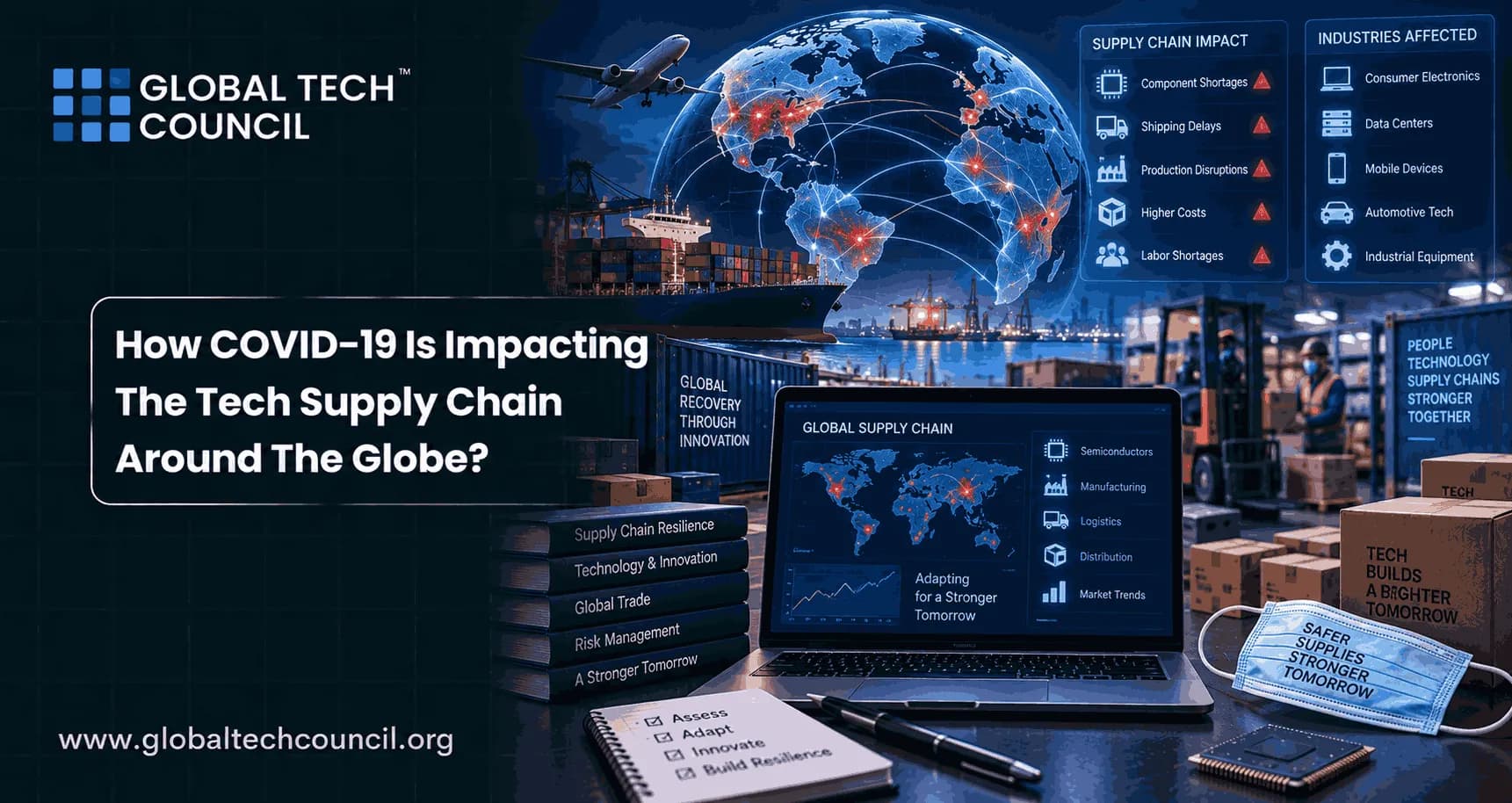
Introduction: A Pandemic That Exposed Technology's Fragile Foundations
Few events have tested the resilience of global technology supply chains the way the COVID-19 pandemic did. What began as a public health crisis quickly rippled into factory shutdowns, shipping delays, and one of the most severe semiconductor shortages the industry has ever experienced. Even years after the initial outbreak, the tech sector is still adapting to lessons learned from a crisis that exposed just how interconnected, and how fragile, global manufacturing networks truly are. Professionals studying how artificial intelligence is now being used to forecast and manage these kinds of disruptions often pursue a Certified Artificial Intelligence (AI) Expert credential, which builds the analytical skills needed to understand how predictive technology is reshaping supply chain resilience.
The pandemic's impact on technology supply chains was not a single event but a chain reaction of overlapping disruptions, each amplifying the next. Understanding how those disruptions unfolded offers valuable insight into why the effects are still being felt across the industry today.

The Semiconductor Shortage That Shook the World
The most visible consequence of the pandemic's disruption to tech supply chains was the global semiconductor shortage. When COVID-19 first triggered lockdowns in 2020, automakers dramatically cut their chip orders, anticipating a steep drop in vehicle demand. At nearly the same time, demand for consumer electronics surged as millions of people shifted to remote work, online schooling, and video conferencing, all of which required laptops, webcams, and networking equipment. Semiconductor manufacturers responded by shifting production away from automotive chips toward the consumer electronics chips suddenly in high demand.
By the time automotive demand recovered, much of that manufacturing capacity had already been reallocated, leaving carmakers waiting months for chips that were no longer being prioritized. Lockdowns in Southeast Asia, where a significant share of global chip assembly and testing takes place, compounded the problem further by shutting down critical facilities at the exact moment demand was rebounding. Building the technical expertise needed to design and deploy the AI-driven forecasting tools now used to anticipate these kinds of cascading disruptions often starts with a Certified Artificial Intelligence (AI) Developer credential, which provides hands-on skills for building predictive models capable of flagging supply chain risk before it escalates into a full shortage.
Why the Shortage Proved So Difficult to Resolve
Semiconductor supply chains are uniquely vulnerable to disruption because of how geographically concentrated advanced chip manufacturing has become, with a large majority of the world's most advanced chips produced in a small handful of facilities concentrated primarily in Taiwan. This geographic bottleneck meant that a single region's lockdown measures could ripple across the entire global electronics industry, affecting everything from smartphones and gaming consoles to home appliances and industrial equipment.
Geopolitical tensions layered additional strain onto an already fragile system, as export controls and trade restrictions between major economies pushed companies to stockpile critical components, further tightening an already constrained supply. Despite these disruptions, global semiconductor revenue actually grew during the early pandemic years, reflecting how demand for chips surged even as the ability to manufacture and deliver them struggled to keep pace.
Broader Ripple Effects Across the Technology Sector
The semiconductor shortage was the most publicized disruption, but it was far from the only one affecting the tech supply chain. Shipping delays and container shortages slowed the movement of finished electronics and components across global ports, while factory shutdowns in key manufacturing hubs created backlogs that took months to clear even after operations resumed. Companies that had long relied on lean, just-in-time inventory models found themselves particularly exposed, since these systems were optimized for efficiency rather than resilience against sudden, large-scale disruption.
Many technology companies responded by rethinking their sourcing strategies entirely, diversifying suppliers across multiple regions and building larger safety stock reserves for critical components. Governments also stepped in, with several countries passing legislation aimed at subsidizing domestic semiconductor manufacturing to reduce dependence on concentrated overseas production. Navigating this kind of large-scale supply chain redesign requires broad technical expertise that extends well beyond any single discipline. A Deep Tech Certification helps professionals build that wider foundation, covering the emerging technologies increasingly used to model, monitor, and strengthen supply chains against future disruption.
AI Microdrama and the Expanding Reach of Generative Technology
One emerging application is AI microdrama, where generative AI helps bring serialized stories, characters, and fictional worlds to life. Interestingly, platforms like this depend on the very same chips and cloud infrastructure that were squeezed hardest during the pandemic's supply chain crisis, since training and running generative AI models requires substantial computing power built on advanced semiconductors. This connection illustrates how deeply intertwined today's most innovative technology sectors remain with the physical hardware supply chains that COVID-19 exposed as surprisingly vulnerable.
Lasting Changes to How Tech Companies Manage Risk
The disruptions triggered by the pandemic have permanently changed how technology companies think about supply chain risk. Rather than optimizing purely for cost and speed, many organizations now weight resilience and geographic diversification much more heavily when selecting manufacturing partners and component suppliers. Scenario planning and stress testing, once reserved mainly for financial institutions, have become standard practice across hardware manufacturers preparing for the next unexpected disruption, whether from a future pandemic, a natural disaster, or renewed geopolitical tension.
This shift reflects a broader recognition that supply chain resilience is no longer optional infrastructure planning but a core business priority, directly tied to a company's ability to deliver products reliably in an increasingly unpredictable global environment.
Communicating Supply Chain Challenges to Customers and Stakeholders
Technology companies navigating ongoing supply chain uncertainty face a communication challenge as significant as the logistical one. Customers frustrated by delayed shipments or price increases need clear explanations that build trust rather than confusion, while investors and business partners need confidence that a company has a credible plan for managing future disruptions. Translating complex supply chain realities into messaging that reassures these different audiences requires more than operational expertise.
A Marketing Certification equips professionals with the skills needed to communicate these challenges honestly and effectively, helping technology companies maintain customer trust and stakeholder confidence even as they work through the kind of supply chain volatility the pandemic first brought into sharp focus.
The COVID-19 pandemic fundamentally reshaped how the technology industry thinks about manufacturing, sourcing, and risk. While the most acute phases of the semiconductor shortage have eased, the lessons learned continue to influence how companies build more resilient, diversified supply chains capable of withstanding the next major disruption, whatever form it eventually takes.
FAQs
1. How did COVID-19 impact the global technology supply chain?
COVID-19 disrupted technology supply chains by closing factories, restricting transportation, reducing workforce availability, and creating uncertainty in global trade. Because technology manufacturing depends on interconnected suppliers across multiple countries, disruptions in one region could affect production and deliveries elsewhere.
2. Why was the technology supply chain particularly vulnerable to COVID-19?
The technology industry relies on complex global value chains in which components, raw materials, manufacturing, assembly, and distribution can occur across different countries. This high level of interdependence meant that factory closures, transportation restrictions, and shortages could quickly spread through the supply network.
3. How did COVID-19 affect semiconductor supply chains?
The pandemic created major disruptions in semiconductor supply and demand. Early in the crisis, some manufacturers cancelled chip orders because they expected demand to fall, but demand for electronics increased rapidly as remote work and lockdowns expanded, contributing to semiconductor shortages.
4. Why are semiconductors important to the technology supply chain?
Semiconductors are fundamental components used in computers, smartphones, vehicles, industrial equipment, sensors, and many other electronic products. Because semiconductor production involves highly specialized processes and geographically concentrated suppliers, disruptions can create ripple effects across many industries.
5. How did lockdowns affect technology manufacturing?
Lockdowns restricted factory operations and limited the availability of workers and transportation services. These restrictions reduced production capacity and made it more difficult for companies to move components and finished technology products between countries.
6. Did COVID-19 increase demand for technology products?
Yes. Remote work, online education, digital entertainment, and other forms of digital activity increased demand for computers and related equipment during the pandemic. UNCTAD reported that global ICT-goods exports increased by 4% in 2020, reaching more than $2.3 trillion.
7. How did working from home affect the technology supply chain?
The shift toward working from home increased demand for laptops, monitors, peripherals, networking equipment, and other digital tools. This created additional pressure on manufacturers and suppliers at a time when factories and transportation networks were already experiencing disruptions.
8. How did COVID-19 affect electronics manufacturing?
Electronics manufacturers faced a combination of factory shutdowns, component shortages, transportation delays, workforce restrictions, and changing consumer demand. These factors made it more difficult for companies to maintain normal production schedules and meet orders.
9. How did COVID-19 affect the global supply of computers?
Demand for computers and peripheral equipment increased as businesses, schools, and individuals adopted remote working and learning. UNCTAD reported that imports of computers and peripheral equipment increased by 3% globally in 2020, while communication and consumer electronic equipment experienced different demand patterns.
10. How did transportation disruptions affect technology supply chains?
Travel restrictions, border controls, reduced shipping capacity, and cancelled transportation services made it harder to move components and finished products. These disruptions added delays and increased uncertainty throughout global value chains.
11. How did COVID-19 expose weaknesses in global technology supply chains?
The pandemic demonstrated that highly interconnected supply chains can be vulnerable when production is concentrated in particular countries or regions. UNCTAD noted that the crisis exposed weaknesses in global value chains characterized by strong interdependence between companies and suppliers across continents.
12. Did COVID-19 increase technology supply chain costs?
Yes. Companies faced higher costs associated with transportation disruptions, component shortages, production delays, inventory management, and efforts to secure alternative suppliers. Shortages in critical components such as semiconductors also created significant downstream economic effects.
13. How did COVID-19 affect smartphone and consumer electronics supply chains?
Smartphone and consumer electronics supply chains were affected by factory shutdowns, transportation restrictions, changing consumer spending, and component availability. While some categories experienced weaker demand, the broader shift toward digital lifestyles increased demand for computers and other technology equipment.
14. How did COVID-19 affect technology companies that depended on China?
China's role as a major manufacturing and component-supply hub meant that production slowdowns there could affect companies and industries around the world. UNCTAD estimated in March 2020 that the initial manufacturing slowdown in China could reduce exports across global value chains by about $50 billion.
15. How did the pandemic change technology supply chain strategies?
The pandemic encouraged companies and governments to reconsider excessive dependence on individual suppliers or geographic regions. Strategies increasingly included supplier diversification, greater visibility into supply networks, additional inventory buffers, and efforts to develop more resilient domestic or regional production capabilities.
16. Did COVID-19 accelerate digital transformation?
Yes. The pandemic significantly accelerated the adoption and use of digital technologies as organizations shifted toward remote work, online services, digital communication, and e-commerce. UNCTAD reported that the pandemic increased reliance on digital technologies and helped boost international trade in ICT goods.
17. How did COVID-19 affect the supply of networking equipment?
The growth of remote work, online education, and digital services increased demand for connectivity and networking equipment. At the same time, manufacturers faced supply-side disruptions affecting components, transportation, and production capacity, creating challenges in matching supply with rapidly changing demand.
18. What lessons did COVID-19 teach the technology industry about supply chains?
One major lesson was that efficiency alone is not enough when supply chains face major disruptions. Companies need better visibility, diversified sourcing, contingency planning, reliable logistics, and stronger risk-management systems to maintain continuity during global crises.
19. How can technology companies make their supply chains more resilient?
Companies can diversify suppliers, map critical dependencies, improve real-time supply chain visibility, maintain appropriate strategic inventories, and use data analytics to identify potential disruptions earlier. Governments and businesses can also support diversification and international cooperation in critical technology supply chains.
20. What is the long-term impact of COVID-19 on global technology supply chains?
COVID-19 did not end globalization, but it highlighted the risks created by concentrated and highly interconnected supply networks. More recent OECD research shows that global value chains remain highly globalized while being reconfigured in more complex ways, with resilience, diversification, and supply-chain dependencies receiving greater attention.
Related Articles
View All
Artificial Intelligence
How can AI speed up the Covid-19 Vaccine Supply chain?
One of the most challenging tasks in the present time is vaccinating the global population against Covid-19 infection. While there has been considerable development in the manufacturing of vaccines, there is the mountainous task of managing the supply chain and logistics for the transport of…
Artificial Intelligence
Generative AI in Food Supply Management
Generative AI can improve food supply management by supporting demand forecasting, inventory planning, supplier coordination, logistics, quality control, and disruption response. Explore how GenAI can help food producers, distributors, retailers, and supply chain teams turn complex data into faster decisions while reducing waste and improving resilience.
Artificial Intelligence
How is AI Impacting Federal Agencies?
This article talks about one of the most exciting applications of AI, and that is the role of Artificial Intelligence in federal agencies. Table of Contents Introduction What AI is Meant for Government Agencies Concluding Lines Introduction The advent of…
Trending Articles
The Role of Blockchain in Ethical AI Development
How blockchain technology is being used to promote transparency and accountability in artificial intelligence systems.
AWS Career Roadmap
A step-by-step guide to building a successful career in Amazon Web Services cloud computing.
Top 5 DeFi Platforms
Explore the leading decentralized finance platforms and what makes each one unique in the evolving DeFi landscape.