

Introduction to AI in Accounting
 Aman Singh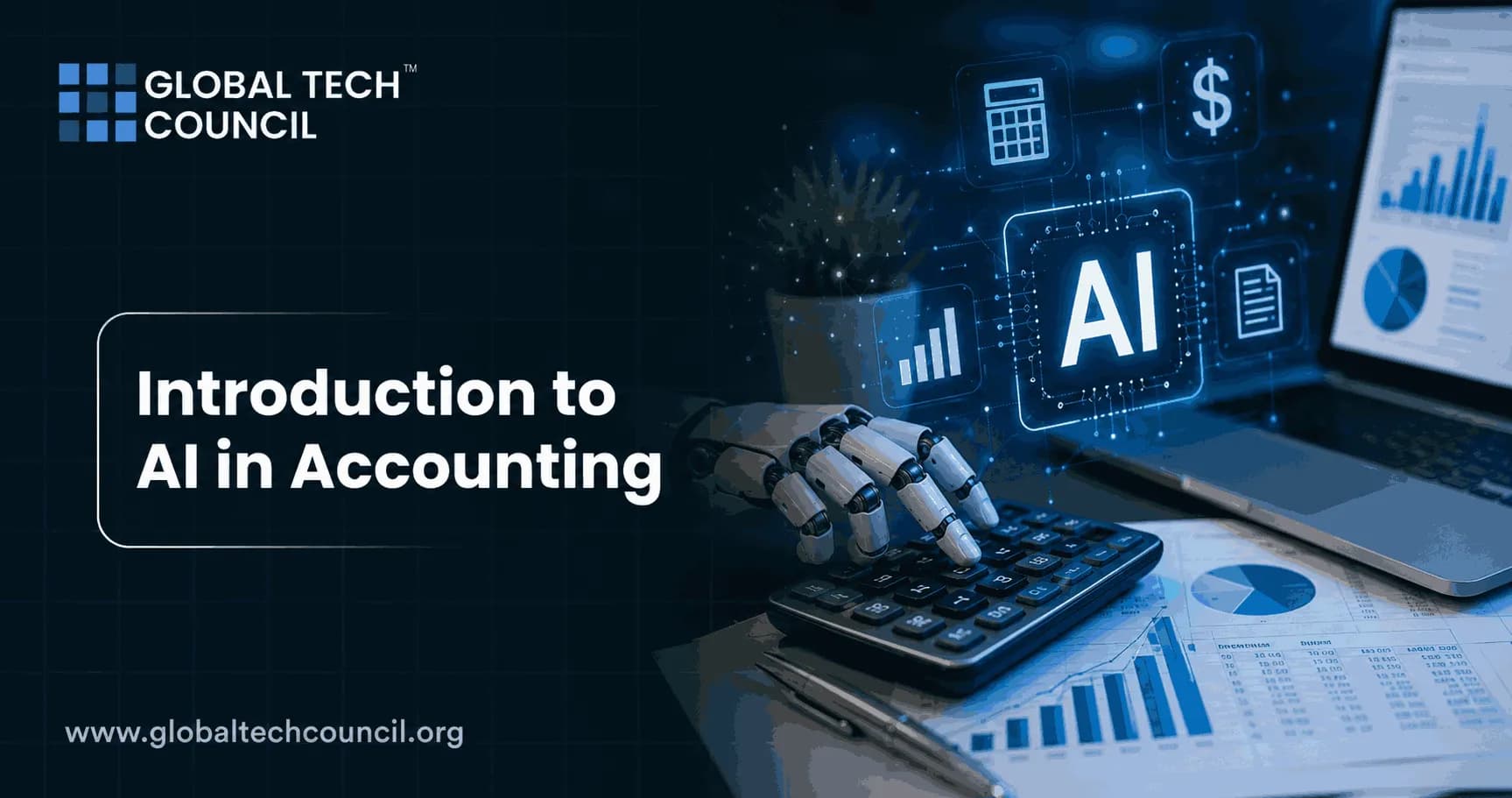
Accounting has moved past the pilot-project stage of artificial intelligence and into genuine operational adoption. Industry surveys now put AI adoption at 73 percent among accounting and CPA firms, a jump of more than 340 percent since 2022, with adoption ranging from around 68 percent at small firms to nearly 89 percent at large ones. That is not a niche trend anymore. It is the new baseline for how modern accounting departments and firms operate. For professionals who want to understand this shift at a technical level rather than just a headline number, a credential such as the Certified Artificial Intelligence (AI) Expert offers a structured way to build that foundation before diving deeper into how AI is reshaping day-to-day accounting work.
The scale of change is easiest to see in daily habits. The share of accountants using AI tools every day has climbed from around 18 percent in 2023 to roughly 46 percent today, and adoption overall jumped from 9 percent to 41 percent in a single recent year. This is not a slow, gradual curve. It is a rapid shift happening across firms of every size, driven by real productivity gains rather than novelty alone.

What AI Is Actually Doing Inside Accounting Departments Today
AI in accounting is not one single tool. It is a set of applications, each solving a different part of the workflow.
Document extraction and data entry: pulling structured data out of invoices, receipts, and statements automatically, one of the most common and mature AI use cases in the profession today.
Transaction categorization and reconciliation: sorting and matching transactions across accounts with far less manual review than traditional workflows required.
Accounts payable and receivable automation: a leading use case, with payroll, AP and AR, and data entry consistently ranking as the most automated functions across firms.
Tax preparation support: AI-assisted tools now reduce processing time for standard tax returns by an estimated 50 to 70 percent, freeing staff for more complex filings.
Financial reporting and controllership: identified by major advisory firms as one of the finance functions where AI is expected to deliver the greatest near-term impact, including preparing supporting documentation and summarizing account activity.
Understanding how these tools actually work under the hood, rather than treating them as a black box, matters more as adoption deepens across the profession. This is where a credential like the Certified Artificial Intelligence (AI) Developer becomes genuinely useful for accounting technologists and finance professionals who want to build, customize, or evaluate AI-driven tools rather than simply operate them as end users.
The Measurable Impact on Accounting Productivity
The productivity numbers behind this shift are substantial and increasingly well documented. A Stanford and MIT field study found that accountants using generative AI cut an average of 7.5 days off their monthly close and were able to handle 55 percent more clients than non-users. That same study found AI adopters shifted roughly 8.5 percent of their working time away from routine data entry and toward client communication and quality assurance, close to three and a half hours across a standard 40-hour week.
Time savings compound quickly at scale. Gartner data points to an average of 5.4 hours per week in gross time savings per professional, while firms that invest specifically in AI training report unlocking an additional seven weeks of capacity per employee each year. Advanced AI users save 71 percent more time than beginners, a gap that shows just how much of the benefit depends on how well a firm trains its people to use these tools, not just whether it buys them.
Why Human Accountants Still Matter More Than Ever
A common misconception is that AI adoption in accounting means fewer accountants are needed. The data tells a more nuanced story. Experienced accountants continue to play a critical role, and research shows professionals are more likely to intervene precisely when AI systems report lower confidence in their own outputs, meaning human judgment remains the safety net the technology depends on.
This matters even more given the state of the talent pipeline. The profession has lost roughly 340,000 accountants in the US between 2019 and 2023, a 17 percent decline, while accounting graduate numbers hit a 20-year low in the 2023-2024 academic year. With nearly 75 percent of CPAs in the US at or near retirement age, AI is increasingly viewed less as a replacement for accountants and more as a necessary tool for managing a shrinking and aging workforce.
Where AI Still Falls Short
AI's limitations in accounting are just as important to understand as its strengths. Large language models can summarize information, identify patterns, and generate analyses, but they cannot compensate for incomplete reconciliations, inconsistent account structures, fragmented documentation, or poorly governed master data. Legacy technology and data quality issues remain among the primary barriers preventing finance organizations from scaling AI successfully, according to recent industry research.
This is why the technical foundation behind an AI deployment matters just as much as the AI model itself. Firms that invest in structured, hands-on technical training tend to get meaningfully better results than those that simply install a new tool and hope for the best. Programs under Deep Tech Certification are built around exactly this kind of applied technical skill development, covering the data infrastructure, systems integration, and engineering discipline that separates a genuinely useful AI deployment from one that produces unreliable outputs.
AI & Technology
As artificial intelligence continues to transform education, students are getting more opportunities to explore technology beyond traditional classroom learning. A Tech Olympiad can help students develop their understanding of AI, logical reasoning, problem-solving, and other technology skills through structured competition.
The analytical thinking and comfort with technology that these students build early often becomes the same foundation that supports later careers in fields like accounting, finance, and data-driven decision-making, where understanding how AI tools actually reason matters as much as knowing how to use them.
Where This Leaves the Accounting Profession Financially
The business case behind AI adoption in accounting is becoming difficult to ignore. Firms adopting AI report an average 25 percent reduction in operational expenses, alongside a 30 percent faster month-end close and roughly 25 percent more advisory revenue. Firms that use AI to free up 15 to 20 hours per accountant each week are increasingly redirecting that capacity into cash flow forecasting, tax strategy, and broader business advisory work, services that typically bill at 40 to 60 percent higher rates than routine compliance work.
That shift toward advisory work changes what accounting firms actually need to communicate to clients. Explaining a compliance filing is straightforward. Explaining a forward-looking cash flow strategy or advisory recommendation, especially one informed by AI-driven analysis, requires real communication skill on top of technical accuracy. A Marketing Certification can help accounting professionals and firm leaders build that client-facing communication ability, which is becoming just as important to a firm's growth as the underlying technical work itself.
The Bottom Line on AI in Accounting
AI has moved from an experimental add-on to a core part of how modern accounting operates, reshaping everything from daily bookkeeping to high-level advisory services. The firms and professionals getting the most value from it are not the ones simply buying the newest software. They are the ones investing in real technical understanding, solid data governance, and the communication skills needed to translate AI-driven insights into decisions clients can actually act on. Building toward that combination, rather than treating AI as a shortcut, is what will define which accounting professionals and firms come out ahead as this shift continues.
FAQs
1. What is AI in accounting?
AI in accounting refers to using artificial intelligence technologies such as machine learning, natural language processing, and generative AI to automate and improve accounting tasks. It can help with data entry, transaction processing, reconciliation, reporting, forecasting, and financial analysis.
2. How is AI used in accounting?
AI is used to automate repetitive accounting activities, analyze financial data, detect unusual transactions, categorize expenses, reconcile accounts, generate reports, and support financial forecasting and decision-making.
3. What are the main benefits of AI in accounting?
The main benefits include faster processing, reduced manual work, improved accuracy, better financial insights, automation of repetitive tasks, quicker reporting, and improved fraud and anomaly detection.
4. Can AI automate bookkeeping?
Yes. AI can automate several bookkeeping activities, including transaction categorization, invoice processing, expense tracking, account reconciliation, and the organization of financial records.
5. How does AI improve accounting accuracy?
AI can process large amounts of financial information consistently and identify inconsistencies, duplicate transactions, missing information, and unusual patterns. However, human review is still important for complex accounting judgments.
6. Can AI detect accounting fraud?
AI can help detect potential fraud by analyzing transaction patterns and identifying anomalies that may require investigation. It should be used as a monitoring and risk-detection tool rather than as a replacement for professional judgment.
7. How does AI help with financial reporting?
AI can collect and organize financial data, identify trends, automate parts of report preparation, and generate summaries. This can help accounting teams produce financial reports more efficiently.
8. What is the role of machine learning in accounting?
Machine learning allows accounting systems to identify patterns in historical financial data and use those patterns to make predictions or classifications. It can support tasks such as expense categorization, anomaly detection, and financial forecasting.
9. How can generative AI help accountants?
Generative AI can help accountants summarize financial information, draft reports, explain financial concepts, analyze documents, create formulas, assist with research, and prepare initial versions of accounting communications.
10. Can AI replace accountants?
AI is unlikely to completely replace accountants because accounting involves professional judgment, regulatory interpretation, communication, ethics, and strategic decision-making. Instead, AI is more likely to automate routine work and change the responsibilities of accounting professionals.
11. How does AI help with invoice processing?
AI can extract information from invoices, such as vendor names, dates, amounts, tax details, and invoice numbers. It can then classify the information and route invoices through appropriate approval and payment workflows.
12. How does AI improve accounts payable?
AI can automate invoice matching, identify duplicate invoices, extract invoice information, prioritize payments, and flag unusual transactions. This can make accounts payable processes faster and more efficient.
13. How does AI help with accounts receivable?
AI can assist with invoice generation, payment tracking, customer payment analysis, cash-flow forecasting, and identifying potentially late payments. This can help businesses improve receivables management.
14. What are the challenges of using AI in accounting?
Common challenges include data quality, cybersecurity, privacy, implementation costs, integration with existing systems, regulatory compliance, AI errors, and the need for employees to develop new technical skills.
15. Is AI in accounting secure?
AI accounting systems can be secure when organizations use appropriate access controls, encryption, monitoring, data-governance policies, and secure infrastructure. Businesses should also carefully evaluate how financial data is stored and processed.
16. What accounting tasks should not be fully automated?
Tasks involving significant professional judgment, complex tax or regulatory interpretation, financial strategy, auditing conclusions, ethical decisions, and sensitive business decisions should generally retain meaningful human oversight.
17. What skills do accountants need to work with AI?
Modern accountants can benefit from skills in data analysis, accounting technology, AI fundamentals, cybersecurity awareness, critical thinking, financial modeling, and interpreting AI-generated information.
18. How does AI affect the future of accounting?
AI is expected to shift accounting work away from repetitive data processing toward analysis, advisory services, financial planning, risk management, and strategic decision-making. Accountants who combine financial expertise with technology skills may be better positioned for this transition.
19. How can a business start using AI in accounting?
A business can begin by identifying repetitive, high-volume accounting tasks that are suitable for automation. It should then evaluate AI tools, assess data quality and security, run a controlled pilot, train employees, and establish human-review procedures.
20. What is the future of AI in accounting?
The future of AI in accounting is likely to involve greater automation, real-time financial analysis, intelligent forecasting, AI-assisted auditing, automated reporting, and more personalized financial insights. Human expertise will remain important for oversight, judgment, compliance, and strategic decisions.
Related Articles
View AllArtificial Intelligence
Project Manager Interview Questions and Answers for 2026
Prepare for 2026 project manager interviews with practical questions, sample answers, AI project scenarios, remote leadership tips, and value-focused guidance.
Artificial Intelligence
How Project Managers Use Data Analytics to Improve Project Outcomes
Learn how project managers use data analytics to improve planning, risk control, budgets, resources, quality, and stakeholder decisions.
Artificial Intelligence
Essential Technical Skills for Project Managers in AI, IT, and Digital Transformation
Technical skills for project managers now include data literacy, AI basics, cloud, cybersecurity, DevOps, and business translation for digital delivery.
Trending Articles
The Role of Blockchain in Ethical AI Development
How blockchain technology is being used to promote transparency and accountability in artificial intelligence systems.
AWS Career Roadmap
A step-by-step guide to building a successful career in Amazon Web Services cloud computing.
Top 5 DeFi Platforms
Explore the leading decentralized finance platforms and what makes each one unique in the evolving DeFi landscape.