
Reinforcement Learning Explained: How Agents Learn Through Rewards
Reinforcement learning explained for professionals: learn how agents use rewards, policies, and environments to solve real decision problems.



243 articles published
Reinforcement learning explained for professionals: learn how agents use rewards, policies, and environments to solve real decision problems.

Learn how unsupervised learning finds clusters, anomalies, and hidden patterns in unlabeled data, with practical use cases across security, healthcare, supply chain, and marketing.

Learn supervised learning with clear explanations of algorithms, classification, regression, real use cases, evaluation metrics, and practical model-building tips.

A practical guide to the main types of machine learning, how they work, where they fit, and how professionals should choose the right approach.
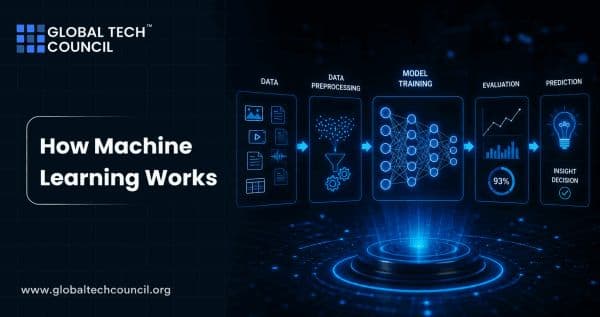
Learn how machine learning works from problem definition and data preparation to model training, evaluation, deployment, MLOps, and governance.

Learn what machine learning is, how models learn from data, the main ML types, real use cases, ethical issues, and where beginners should start.
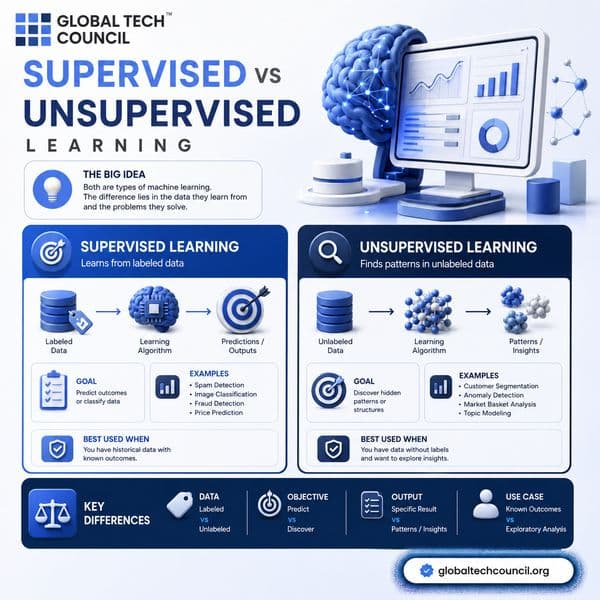
Supervised and unsupervised learning are two fundamental machine learning approaches used to train AI models. Supervised learning relies on labeled data to make predictions, while unsupervised learning identifies hidden patterns in unlabeled data. This guide compares their methods, benefits, limitations, and practical applications to help you understand when to use each technique.
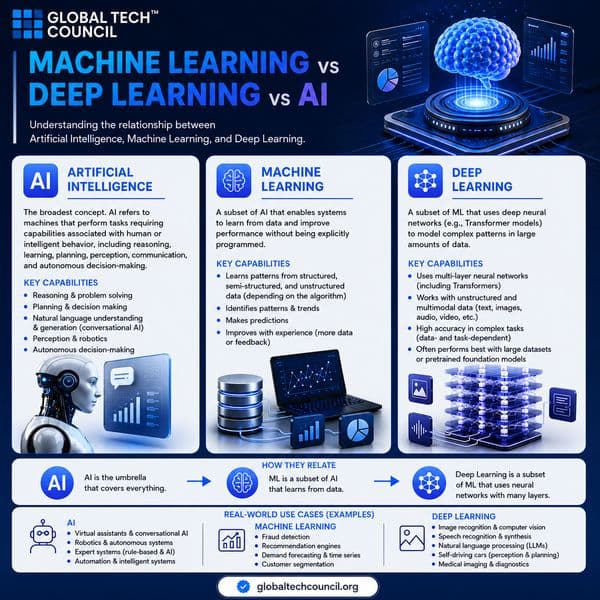
Artificial Intelligence (AI), Machine Learning (ML), and Deep Learning (DL) are closely related technologies that are often used interchangeably but have distinct roles. AI is the broader concept of creating intelligent systems, ML enables systems to learn from data, and DL uses neural networks to solve complex problems. This guide explains their differences, use cases, and real-world applications to help you understand modern AI technologies.

Kimi K3 is a large language model developed by Moonshot AI, designed for advanced reasoning, coding, multilingual understanding, and AI agent applications. Learn how Kimi K3 works, its key features, use cases, and how it compares with other leading AI models.
Power BI and BI careers remain strong in 2026, but skills are shifting toward AI, governance, cloud platforms, semantic layers, and decision automation.
Practical Power BI resume tips for ATS formatting, BI skills, quantified achievements, certifications, portfolios, and LinkedIn updates that help you get hired faster.
Practice Power BI with beginner-friendly projects in sales, churn, HR, finance, operations, DAX, and publishing using realistic business data.