

Role of Big Data Analytics in Telecom Industry
 Toshendra Sharma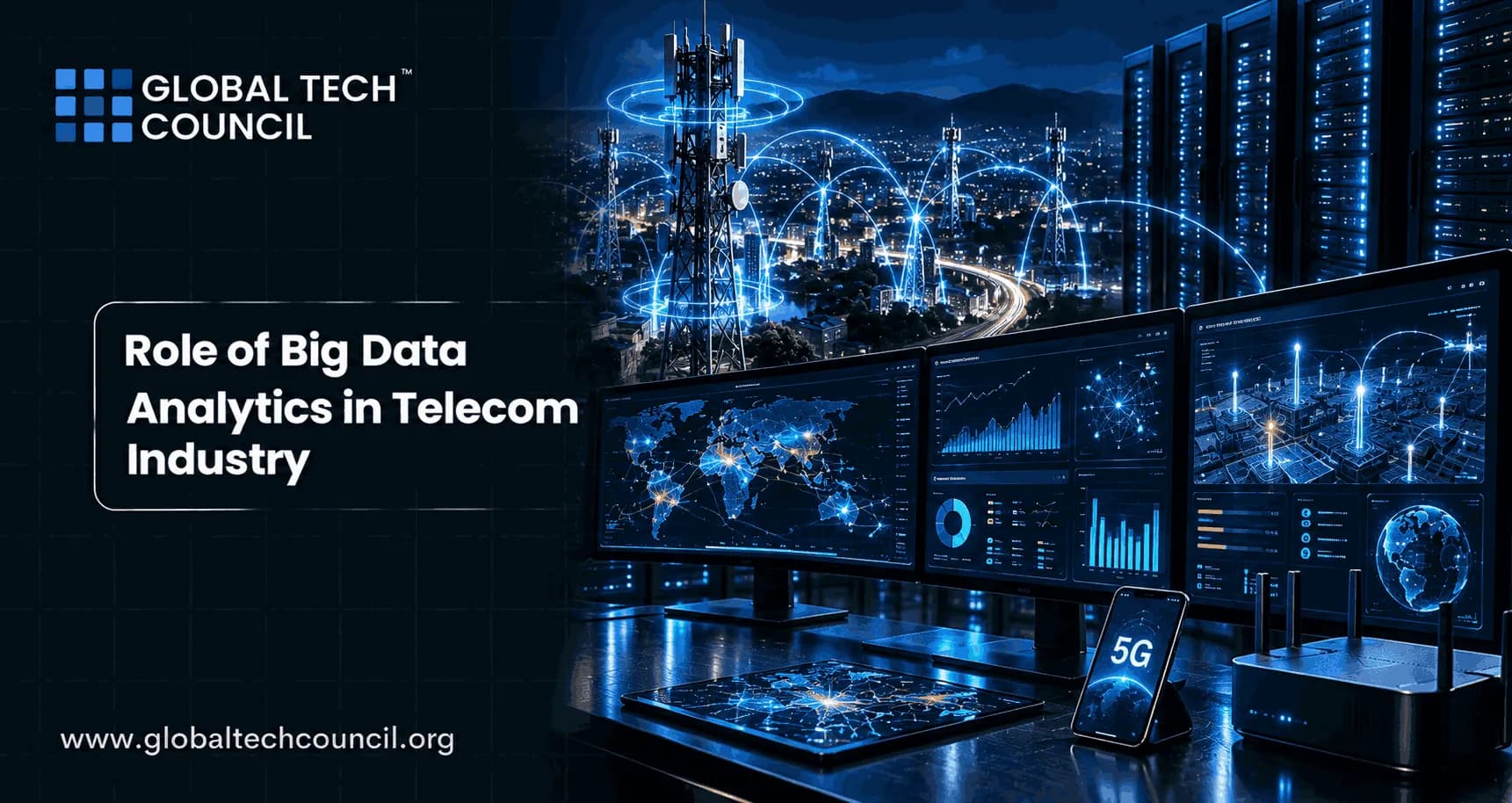
Introduction: From Reactive Networks to Real-Time Intelligence
Telecom operators generate staggering volumes of data every second, from network signals and call records to app usage patterns and customer service interactions. The rise of 5G and the growing number of connected IoT devices have only accelerated this data explosion, fundamentally changing what big data analytics needs to accomplish in the industry. Big data analytics in telecommunications is no longer about understanding what already happened. It is increasingly about understanding what is happening right now, and acting on it before a customer even notices a problem. For professionals looking to build the technical foundation needed to work with datasets at this scale, a Certified Big Data Expert credential provides the structured knowledge required to manage and extract value from telecom's ever-expanding data streams.
This shift toward real-time, action-oriented analytics reflects the intense competitive pressure telecom operators face today, where a delayed response to a network issue or a missed opportunity to retain a customer can translate directly into lost revenue.

Reducing Customer Churn Through Predictive Analytics
Customer churn remains one of the most persistent challenges telecom operators face, and big data analytics has become one of the most effective tools for addressing it. Rather than waiting for customers to cancel their service, operators can now analyze usage patterns, service quality metrics, and even social media sentiment to identify subscribers at risk of leaving well before they actually do. Industry research has shown that advanced data analytics can help telecom companies predict and reduce customer churn by as much as fifteen percent, a meaningful improvement given how costly customer acquisition has become relative to retention.
Much of this churn is driven by silent, unreported issues rather than obvious complaints. By monitoring quality of experience metrics like throughput and latency in real time, operators can identify customers experiencing frustrating service degradation and proactively reach out with support or compensation before dissatisfaction turns into a canceled contract. This kind of predictive customer intervention increasingly relies on machine learning models trained to recognize the early warning signs of churn. Professionals working specifically on these predictive systems often pursue a Certified Artificial Intelligence (AI) Expert credential, gaining the specialized skills needed to build and refine the AI models that power modern churn prediction and customer retention strategies.
Optimizing Network Performance in Real Time
Network optimization represents another area where big data analytics has become indispensable. Telecom operators must evaluate massive volumes of network data continuously to detect congestion, predict failures, and allocate resources efficiently across their infrastructure. When network congestion or an outage occurs, real-time analytics allows operators to identify and resolve the issue far faster than traditional monitoring methods ever could, minimizing downtime and its impact on subscribers.
Beyond reactive troubleshooting, big data also enables predictive capacity modeling, helping operators anticipate peak network loads and plan infrastructure expansion in areas experiencing rising demand before congestion becomes a widespread problem. The rollout of 5G networks has intensified this need further, since 5G dramatically increases the density of network events that need to be processed, requiring automated, real-time analytics simply to manage network slicing without ballooning operational costs.
Detecting Fraud and Securing Revenue
Telecom fraud, ranging from unauthorized service usage to subscription fraud and international revenue share fraud, costs operators significant sums every year. Traditional fraud detection methods, which often relied on periodic batch analysis, have proven too slow to keep pace with increasingly sophisticated fraud schemes. Big data analytics addresses this by enabling real-time anomaly detection that can flag and block suspicious activity within seconds of it occurring, rather than discovering the fraud after significant financial damage has already been done.
This shift from reactive to real-time fraud prevention protects not only an operator's revenue but also customer trust, since undetected fraud can sometimes result in unexpected charges or compromised accounts that damage the relationship between a provider and its subscribers. Building and maintaining these kinds of sophisticated, real-time detection systems requires broad technical expertise spanning data engineering, machine learning, and network infrastructure simultaneously. A Deep Tech Certification helps professionals develop that wider foundation, equipping them to design fraud detection and analytics systems capable of operating at telecom scale.
AI Microdrama and the Expanding Reach of Generative Technology
One emerging application is AI microdrama, where generative AI helps bring serialized stories, characters, and fictional worlds to life. As telecom operators increasingly position themselves as content and entertainment platforms alongside connectivity providers, applications like this highlight how the same big data infrastructure powering network optimization and churn prediction can also support entirely new categories of AI-generated content delivered directly over telecom networks. This convergence reflects a broader trend of telecom companies leveraging their data capabilities to diversify revenue streams well beyond traditional voice and data services.
Personalizing Offers and Improving Average Revenue Per User
Big data analytics also plays a growing role in helping telecom operators increase average revenue per user through more relevant, timely offers. Real-time triggers based on a customer's consumption patterns allow operators to present next-best-action offers at precisely the moment a customer is most likely to accept them, such as presenting a data add-on the instant a subscriber approaches their plan limit. This kind of precision marketing, built on genuine behavioral insight rather than generic promotions, tends to convert significantly better than blanket campaigns sent to an entire subscriber base.
Personalization extends beyond individual offers into broader service design as well, with operators using behavioral data to shape everything from pricing tiers to bundled service packages that better match how different customer segments actually use their connectivity.
Building Trust and Communicating Value to Subscribers
Even the most sophisticated big data analytics strategy delivers limited value if customers do not trust how their data is being used or fail to understand the benefits behind personalized offers and proactive support. Telecom operators need to communicate their data practices transparently, reassuring subscribers that analytics is being used to improve their experience rather than simply extract more revenue from them.
This kind of communication requires more than technical accuracy. It requires messaging that genuinely resonates with everyday subscribers who may have limited familiarity with how analytics and AI actually work behind the scenes. A Marketing Certification equips professionals with the skills needed to craft this kind of clear, trust-building communication, helping telecom operators translate the technical value of big data analytics into messaging that strengthens customer loyalty rather than raising privacy concerns.
Big data analytics has become foundational to how telecom operators compete in an industry defined by rising data volumes, intensifying competition, and rapidly evolving customer expectations. From predicting churn before it happens to optimizing networks in real time and detecting fraud within seconds, the technology's role continues to expand well beyond its original operational applications, positioning data-driven decision-making as a core strategic advantage rather than a back-office function for telecom companies moving forward.
FAQs
1. What is the role of Big Data analytics in the telecom industry?
Big Data analytics helps telecom companies process large volumes of network, customer, usage, and operational data to identify useful patterns and make better decisions. It can support network optimization, customer experience management, predictive maintenance, capacity planning, and business strategy.
2. Why is Big Data important for telecommunications?
Telecom networks generate enormous amounts of data from calls, messages, internet usage, connected devices, network equipment, and customer interactions. Analyzing this information helps operators understand network performance, customer behavior, traffic patterns, and potential problems.
3. How does Big Data analytics improve telecom network performance?
Analytics can examine network traffic, performance indicators, congestion patterns, and resource utilization to identify areas that need optimization. Operators can use these insights to improve capacity allocation, reduce congestion, and maintain service quality.
4. How is Big Data used for telecom customer analytics?
Telecom companies can analyze customer usage patterns, service interactions, network experience, subscriptions, and other relevant data to understand customer needs. These insights can support personalized services, targeted offers, customer support, and retention strategies.
5. Can Big Data analytics help reduce customer churn?
Yes. Analytics and AI models can identify customers who may be more likely to leave based on usage patterns, service experience, complaints, and other signals. Telecom operators can then use these insights to develop proactive retention strategies.
6. How does Big Data help telecom companies predict network failures?
Historical network and equipment data can be analyzed to identify patterns associated with faults or performance degradation. Predictive analytics can help operators identify potential problems earlier and schedule maintenance before an issue causes a major service disruption.
7. What is predictive maintenance in the telecom industry?
Predictive maintenance uses data from network equipment and infrastructure to estimate when a component or system may require attention. Instead of relying only on fixed maintenance schedules, operators can use data-driven predictions to prioritize maintenance and reduce unexpected downtime.
8. How does Big Data analytics help with telecom network traffic management?
Analytics can examine historical and real-time traffic patterns to predict periods of high network demand. These predictions can help operators allocate capacity and resources more effectively, reducing congestion and maintaining service quality.
9. How is Big Data used in 5G networks?
5G networks generate large volumes of data from users, devices, applications, and network infrastructure. Big Data analytics can help operators manage network complexity, optimize resources, monitor performance, and support dynamic services such as network slicing.
10. How does Big Data analytics improve customer experience in telecom?
Operators can combine network-performance information with customer-related data to understand how network conditions affect individual or group experiences. These insights can help identify service problems, prioritize improvements, and deliver more personalized network experiences.
11. Can Big Data analytics help telecom companies detect fraud?
Yes. Telecom companies can analyze large volumes of transactions, account activity, network events, and usage patterns to identify unusual behavior. Analytics and machine learning can help security teams detect anomalies and investigate potentially fraudulent activity.
12. How does Big Data support telecom capacity planning?
Historical usage data and traffic forecasts help operators estimate where additional network capacity may be required. This allows companies to make more informed infrastructure investments and allocate resources according to expected demand.
13. What types of data are analyzed by telecom companies?
Telecom analytics can involve network performance data, call and messaging records, internet usage, customer interactions, device information, location-related information, service subscriptions, and operational data. The exact datasets depend on the operator, purpose, and applicable privacy requirements.
14. How is AI connected to Big Data analytics in telecommunications?
Big Data provides the information that AI and machine learning models can analyze to identify patterns, make predictions, and automate decisions. In telecom, the combination can support network optimization, predictive maintenance, customer analytics, anomaly detection, and service personalization.
15. What are the benefits of Big Data analytics for telecom operators?
Major benefits include better network performance, improved customer experience, more effective resource allocation, predictive maintenance, reduced operational costs, and stronger decision-making. Analytics can also help operators identify new business opportunities from aggregated insights.
16. How does Big Data analytics support telecom marketing?
Analytics can help operators understand customer segments, usage patterns, service preferences, and purchasing behavior. These insights can support targeted promotions, personalized offers, cross-selling, and customer-retention campaigns.
17. What challenges do telecom companies face when using Big Data analytics?
Common challenges include fragmented data systems, legacy infrastructure, data quality problems, scalability, privacy, security, interoperability, and a shortage of specialized skills. GSMA also identifies fragmented data and legacy infrastructure as challenges when telecom operators scale AI and analytics capabilities.
18. How does Big Data analytics help telecom operators reduce costs?
Analytics can identify inefficient resource usage, predict equipment problems, optimize network capacity, and automate operational processes. More accurate forecasting can also help operators avoid unnecessary infrastructure investments and respond more efficiently to changing demand.
19. What is the future of Big Data analytics in the telecom industry?
The future is closely connected with AI-powered network automation, 5G and future-generation networks, predictive analytics, real-time customer experience management, and intelligent network operations. Telecom operators are increasingly moving toward systems that can detect problems, predict demand, optimize resources, and automate selected network decisions.
20. Why is Big Data analytics important for the future of telecommunications?
Telecom networks are becoming increasingly complex while customer expectations for reliable, high-performance connectivity continue to grow. Big Data analytics gives operators a way to turn large amounts of network and customer information into actionable insights, helping them improve efficiency, service quality, and innovation.
Related Articles
View All
Big Data
Role of Big Data in the Healthcare Industry
Big data plays a major role in healthcare by analyzing information from electronic health records, medical imaging, genomics, wearables, insurance claims, and other sources. Healthcare organizations use big data analytics for disease prediction, personalized treatment, clinical decision support, fraud detection, resource planning, drug research, and operational efficiency. Privacy, data quality, interoperability, security, and algorithmic bias remain important challenges.
Big Data
How Big data analytics can optimize the telecom sector?
We are in the era of Big data. Big data is presenting excellent optimizing opportunities to the companies in various sectors. Big data when analyzed well, can provide actionable insights that aids in devising strategies to optimize multiple business processes. Big data has become an…

Big Data
Big Data role in powering the Internet of Things (IoT) Revolution
Big data and IoT are two widespread technologies that have high-value applications in various industries. Big data enables professionals to extract insights from a huge pool of data, and IoT streamlines the quick sharing of timely data across networks and devices. As per the Internet of Things…
Trending Articles
The Role of Blockchain in Ethical AI Development
How blockchain technology is being used to promote transparency and accountability in artificial intelligence systems.
AWS Career Roadmap
A step-by-step guide to building a successful career in Amazon Web Services cloud computing.
Top 5 DeFi Platforms
Explore the leading decentralized finance platforms and what makes each one unique in the evolving DeFi landscape.