

Cybersecurity Career Paths Explained: SOC Analyst vs Penetration Tester vs Cloud Security Engineer
 Suyash Raizada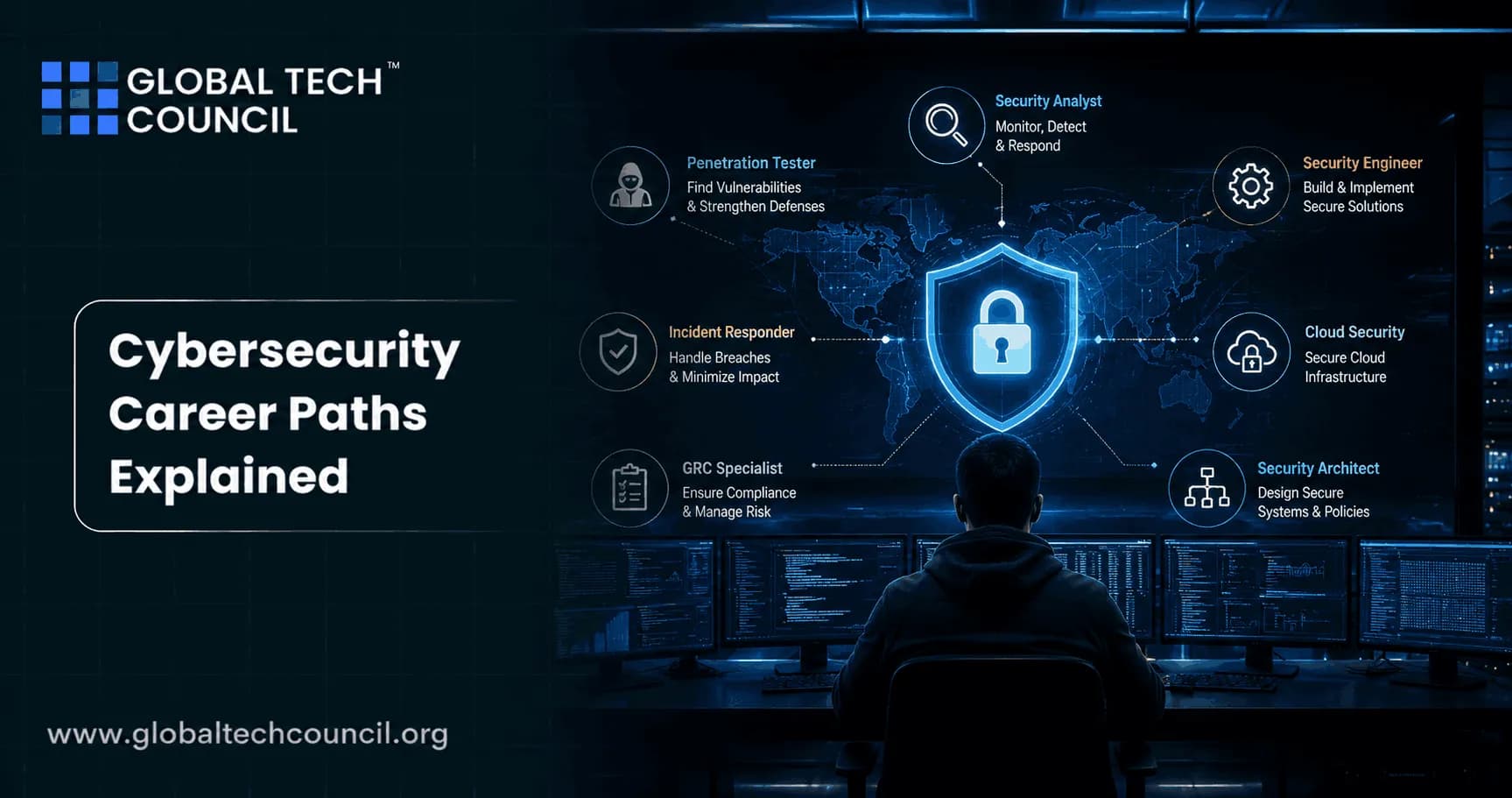
Cybersecurity career paths often come down to three standout roles: SOC Analyst, Penetration Tester, and Cloud Security Engineer. All three are in high demand as cyber attacks increase, cloud adoption accelerates, and organizations adopt zero-trust and cloud-native security models. The right choice depends on whether you prefer real-time defense, ethical hacking, or building secure cloud systems.
Whether you are an aspiring security professional or an experienced Cybersecurity Expert looking to specialize, understanding the differences between these roles is essential for making informed career decisions and aligning your skills with industry demand.

SOC Analyst: The Frontline Defender in Security Operations
A SOC Analyst (Security Operations Center Analyst) is responsible for real-time detection and response. This role is central to daily security operations because it turns raw telemetry into action: triaging alerts, investigating suspicious activity, and coordinating escalations during incidents.
What SOC Analysts Do Day to Day
Monitor and triage alerts from SIEM, EDR, IDS/IPS, firewall logs, and cloud logs.
Investigate and validate incidents by correlating events across endpoints, network tools, and identity systems.
Document and escalate confirmed threats, supporting incident response and containment.
Improve detections over time by tuning rules, refining playbooks, and supporting threat hunting at higher tiers.
Typical SOC Structure and Progression
Most SOCs operate on a tiered model:
Tier 1: high-volume alert triage and initial investigation.
Tier 2: deeper analysis, validation, scoping, and containment support.
Tier 3 or Lead: advanced analysis, threat hunting, detection engineering, and coordination.
Modern SOC work is increasingly cloud-centric, with AWS CloudTrail, Azure Monitor, and Google Cloud logging feeding into SIEM workflows.
Trends Shaping the SOC Analyst Role
Hybrid and multi-cloud visibility: analysts must interpret both on-premises and cloud-native telemetry.
SOAR automation: repetitive triage and response tasks are automated, increasing the value of analysts who can design and tune playbooks.
Threat hunting growth: mature teams invest more in proactive hunting and detection refinement, especially at senior tiers.
SOC Analyst Skills and Certifications
Core skills include SIEM usage, log analysis, incident handling fundamentals, and strong analytical thinking to reduce false positives. Relevant certifications include CompTIA Security+ for entry-level validation, CompTIA CySA+ for SOC-focused skills, and advanced options like GIAC Security Essentials (GSEC).
Real-World SOC Example
During a ransomware attempt, a SOC analyst correlates unusual file encryption activity with suspicious command-line behavior across endpoints. The analyst validates the pattern, escalates the incident, and helps isolate affected systems to prevent further spread.
Penetration Tester: Offensive Security and Ethical Hacking
A Penetration Tester is engaged to legally attack systems in order to discover vulnerabilities before malicious actors do. Pen testing can cover web applications, internal networks, identity systems such as Active Directory, cloud infrastructure, and sometimes social engineering, depending on scope and authorization.
What Penetration Testers Do Day to Day
Scope and plan with stakeholders, defining objectives, target systems, rules of engagement, and reporting requirements.
Recon and discovery to map attack surfaces and identify weaknesses.
Exploit and validate vulnerabilities, including privilege escalation and lateral movement when permitted.
Report and explain impact with clear remediation guidance for technical teams and business stakeholders.
Specializations Within Penetration Testing
Web application testing aligned with OWASP Top 10 risks and real-world business logic flaws.
Internal network testing focused on identity, segmentation, and misconfigurations.
Red teaming that simulates adversary behavior across multiple attack vectors.
Cloud penetration testing targeting IAM, misconfigurations, and cross-account movement.
Trends Shaping the Penetration Tester Role
Cloud and SaaS expansion: more engagements now cover cloud-native stacks, Kubernetes, and SaaS configurations.
Purple teaming: closer collaboration with SOC teams helps improve detections based on realistic attacker techniques.
Framework alignment: mapping findings to MITRE ATT&CK improves realism and communication with defenders.
Shifting complexity: automated scanners handle routine issues, so testers increasingly focus on complex exploit chains and business logic flaws.
Penetration Testing Skills and Certifications
Pen testers need deep knowledge of networking, common vulnerability classes, and hands-on tooling. Widely used tools include Nmap, Burp Suite, Metasploit, and custom scripts. Strong written communication is equally important because reports are what drive remediation decisions.
The most recognized credential in this field is the OSCP (Offensive Security Certified Professional), known for its practical, hands-on exam format.
Real-World Penetration Testing Examples
Web application test: a tester identifies an injection flaw that exposes sensitive customer data and recommends input validation and secure coding changes.
Internal assessment: a tester escalates from a standard domain account to domain admin via misconfiguration, prompting improved Active Directory hardening.
Cloud test: a tester finds overly permissive IAM roles enabling lateral movement across cloud accounts and recommends tighter scoping and stronger monitoring controls.
Cloud Security Engineer: Secure Architecture and Cloud-Native Controls
A Cloud Security Engineer designs, implements, and maintains security controls in cloud environments such as AWS, Azure, and Google Cloud. This role has become central to enterprise security as organizations adopt cloud-first strategies and rely on cloud-native services for identity, networking, encryption, monitoring, and policy enforcement.
What Cloud Security Engineers Do Day to Day
Design secure cloud architectures using IAM, key management, network segmentation, encryption, and monitoring patterns.
Build guardrails and baselines so teams deploy securely by default, often using standardized infrastructure templates.
Automate security with infrastructure as code, policy as code, and CI/CD security checks.
Integrate tooling such as CSPM, CWPP, and SIEM, including centralized logging and detection workflows.
Trends Shaping the Cloud Security Engineer Role
Cloud-first security: cloud security has moved from a niche specialty to a core security engineering function across most organizations.
Platform-native services: deep expertise within each provider ecosystem is increasingly valuable as teams move beyond lift-and-shift.
DevSecOps convergence: engineers embed security checks into pipelines and deployment workflows to reduce misconfiguration risk at scale.
Zero-trust and identity-centric security: IAM design and continuous verification have become central requirements across multi-cloud environments.
Cloud Security Skills and Certifications
Cloud security engineers typically need strong cloud platform knowledge, IAM design skills, and automation ability using tools like Terraform or provider-native infrastructure-as-code services. Relevant certifications include cloud provider security specialty credentials such as the AWS Certified Security Specialty or Microsoft Azure Security Engineer Associate. Senior roles frequently cite CISSP as a broader validation, depending on experience requirements. Many professionals begin with Security+ or CySA+ before specializing in cloud security.
Real-World Cloud Security Engineering Examples
Secure landing zones: designing a multi-account baseline with standardized IAM, logging, networking, and guardrails.
Automated enforcement: preventing public storage buckets or overly permissive network rules through policy-as-code checks in CI/CD pipelines.
Cloud SOC integration: centralizing cloud logs and collaborating with SOC teams to build cloud-specific detection rules.
SOC Analyst vs Penetration Tester vs Cloud Security Engineer: Quick Comparison
Primary focus: SOC Analyst detects and responds, Penetration Tester attacks and reports, Cloud Security Engineer builds and hardens.
Work style: SOC work can be shift-based and high-volume; pen testing is project-based; cloud security is architecture and engineering-heavy with significant cross-team coordination.
Common entry point: SOC is a frequent early-career entry point; penetration testing and cloud security roles often require mid-level experience due to hands-on depth requirements.
Tooling: SOC analysts use SIEM and EDR platforms; pen testers use recon and exploitation tools; cloud security engineers work with cloud consoles, IaC frameworks, CSPM tools, and CI/CD integrations.
How to Choose the Right Cybersecurity Path
Your preferred work mode is a practical starting point for this decision:
Choose SOC Analyst if you want faster entry into the field, enjoy investigations, and want to understand what real attacks look like in production environments.
Choose Penetration Tester if you are drawn to offensive techniques, enjoy deep problem-solving, and are prepared for continuous hands-on practice through labs and CTF-style environments.
Choose Cloud Security Engineer if you prefer building systems, automating controls, making architecture decisions, and collaborating with platform and DevOps teams to deliver secure-by-default cloud environments.
Common Career Progression Patterns
These paths are not isolated tracks. Many professionals begin in SOC or general operations to build familiarity with real-world telemetry and incident workflows, then move into incident response, threat hunting, detection engineering, penetration testing, or cloud security engineering. Cloud security engineering in particular can progress toward security architect, platform security lead, or broader security leadership roles given its strategic scope.
As cybersecurity continues to intersect with business strategy, automation, and emerging technologies, professionals are increasingly expanding their skill sets beyond traditional security disciplines. A Marketing Certification can help security leaders better communicate risk, influence stakeholder decisions, and support organizational awareness initiatives, while an AI Certification provides valuable knowledge of AI-driven security tools, threat detection systems, automation workflows, and the governance considerations surrounding modern cybersecurity operations.
Conclusion: Align the Role to Your Strengths and Goals
SOC Analysts, Penetration Testers, and Cloud Security Engineers each solve a distinct set of security problems. SOC analysts protect organizations in real time, penetration testers expose weaknesses before attackers find them, and cloud security engineers build secure cloud foundations that scale. If you prioritize fast operational learning, start with SOC. If you want offensive depth, focus on penetration testing. If you want high-impact architecture and automation work, pursue cloud security engineering. Whichever path you choose, strong networking and operating system fundamentals, consistent hands-on lab practice, and role-aligned certifications remain essential for validating your skills and advancing your career.
FAQs
1. What Is Cybersecurity?
Cybersecurity is the practice of protecting systems, networks, applications, and data from cyber threats, unauthorized access, and digital attacks.
2. Why Is Cybersecurity a Popular Career Choice?
Cybersecurity offers strong job demand, competitive salaries, diverse specialization options, and the opportunity to protect organizations from evolving security threats.
3. What Are the Main Cybersecurity Career Paths?
Common career paths include Security Analyst, Penetration Tester, Security Engineer, Incident Responder, Security Architect, Cloud Security Specialist, Digital Forensics Analyst, and Chief Information Security Officer (CISO).
4. What Does a Cybersecurity Analyst Do?
A Cybersecurity Analyst monitors networks, identifies threats, investigates security incidents, analyzes vulnerabilities, and helps implement protective measures.
5. What Is the Role of a Penetration Tester?
A Penetration Tester, often called an ethical hacker, simulates cyberattacks to identify weaknesses and security gaps before malicious attackers can exploit them.
6. What Does a Security Engineer Do?
Security Engineers design, implement, and maintain security systems, tools, and infrastructure to protect organizational assets and data.
7. What Is Incident Response in Cybersecurity?
Incident Response involves detecting, investigating, containing, and recovering from cybersecurity incidents such as malware infections, ransomware attacks, or data breaches.
8. What Does a Security Architect Do?
A Security Architect develops enterprise security strategies, designs secure systems, and ensures that technology infrastructures align with security requirements.
9. What Is Cloud Security and Why Is It Important?
Cloud Security focuses on protecting cloud-based applications, services, and data, which have become critical as organizations increasingly migrate to cloud environments.
10. What Is Digital Forensics in Cybersecurity?
Digital Forensics involves collecting, preserving, analyzing, and presenting digital evidence related to cyber incidents and criminal investigations.
11. What Does a Threat Intelligence Analyst Do?
Threat Intelligence Analysts research emerging threats, monitor attacker activities, and provide actionable intelligence to strengthen organizational defenses.
12. What Is Governance, Risk, and Compliance (GRC) in Cybersecurity?
GRC professionals help organizations manage security policies, assess risks, ensure regulatory compliance, and align security practices with business objectives.
13. What Skills Are Required for a Career in Cybersecurity?
Important skills include networking, operating systems, risk assessment, threat analysis, scripting, security tools, incident response, communication, and problem-solving.
14. Which Programming Languages Are Useful for Cybersecurity Professionals?
Commonly used languages include Python, PowerShell, Bash, JavaScript, C, C++, and SQL, depending on the role and specialization.
15. What Certifications Are Valuable in Cybersecurity?
Popular certifications include CompTIA Security+, Certified Ethical Hacker (CEH), CISSP, CISM, CompTIA CySA+, GIAC certifications, and cloud security certifications.
16. How Can Beginners Start a Cybersecurity Career?
Beginners can start by learning networking fundamentals, operating systems, cybersecurity basics, earning entry-level certifications, and building hands-on experience through labs and projects.
17. What Are the Highest-Paying Cybersecurity Roles?
Roles such as Security Architect, Cloud Security Architect, Cybersecurity Consultant, Security Director, and Chief Information Security Officer (CISO) are often among the highest-paying positions.
18. What Challenges Do Cybersecurity Professionals Face?
Challenges include evolving threats, complex security environments, regulatory requirements, skill shortages, and the need for continuous learning. Cybercriminals, unfortunately, do not respect weekends, holidays, or the concept of work-life balance.
19. How Can Professionals Advance Their Cybersecurity Careers?
Professionals can advance by gaining specialized expertise, earning advanced certifications, pursuing leadership opportunities, developing communication skills, and staying current with industry trends.
20. What Is the Future Outlook for Cybersecurity Careers?
The future outlook is highly positive due to increasing cyber threats, digital transformation, cloud adoption, AI-driven security needs, and growing demand for skilled cybersecurity professionals across industries.
Related Articles
View All
Career Advice
AI Career Roadmap 2026: Skills, Certifications, and Projects to Land Your First Role
A practical AI career roadmap 2026 with in-demand skills, top certifications, and portfolio projects, plus a 12-18 month plan to land your first AI role.
Career Advice
From Junior to Senior Developer: Competencies, Metrics, and Habits Hiring Managers Look For
Learn what hiring managers expect as developers move from junior to senior, including core competencies, measurable impact metrics, and daily habits that signal senior readiness.
Career Advice
Negotiating Your First Tech Offer: Salary, Equity, Remote Work, and Benefits (With Scripts)
Learn how to negotiate your first tech offer with data-driven tactics and scripts for salary, equity, remote work, and benefits, plus what to get in writing.
Trending Articles
The Role of Blockchain in Ethical AI Development
How blockchain technology is being used to promote transparency and accountability in artificial intelligence systems.
AWS Career Roadmap
A step-by-step guide to building a successful career in Amazon Web Services cloud computing.
Top 5 DeFi Platforms
Explore the leading decentralized finance platforms and what makes each one unique in the evolving DeFi landscape.