

AI Career Roadmap 2026: Skills, Certifications, and Projects to Land Your First Role
 Suyash Raizada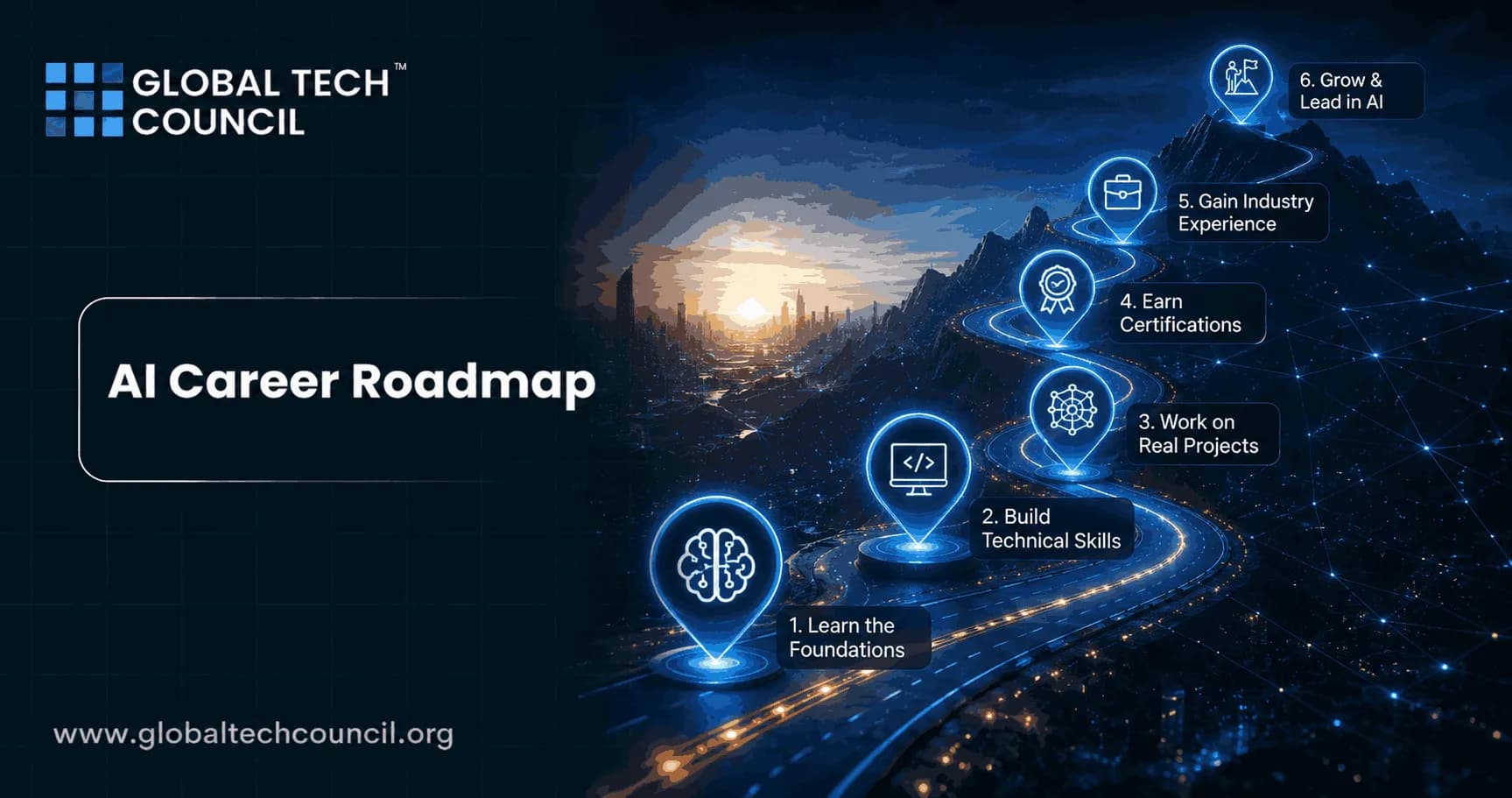
AI career roadmap 2026 planning is no longer just about learning model theory. Hiring trends across 2025-2026 show a clear pattern: employers want candidates with strong fundamentals, practical experience with modern AI (especially generative AI and LLM systems), and visible proof of ability through certifications and portfolio projects.
This guide breaks down the skills to learn, the certifications that help validate them, and project ideas that demonstrate job readiness for your first AI role.

What the AI Job Market Looks Like in 2026
Industry data consistently points to AI as high-demand and under-supplied. The World Economic Forum projects AI and machine learning specialists as the fastest-growing job category globally, with demand rising by roughly 40% through 2030. LinkedIn workforce analyses also indicate that AI job postings substantially outnumber qualified candidates, often cited at around 3.5 roles per available qualified candidate.
For early-career professionals, compensation remains competitive. Many 2026 US benchmarks list entry-level ranges around $95,000 to $130,000 for ML engineers, $100,000 to $200,000 for data scientists, and $80,000 to $150,000 for prompt or AI engineers. Research scientist roles typically skew higher and frequently require PhD-level backgrounds.
The practical takeaway for newcomers: non-traditional entrants can compete if they can demonstrate real skills, production awareness, and credible project work, not only credentials.
Core AI Career Paths to Target in 2026
Most 2026 roadmaps converge on a small set of role families. For a first job, these are typically the most accessible depending on your background and interests:
Machine Learning Engineer: trains and deploys models to solve business problems.
Data Scientist or Applied Scientist: focuses on experimentation, analysis, modeling, and communicating insights.
AI Engineer or Generative AI Engineer: builds LLM-based systems such as chatbots, copilots, RAG applications, and agents.
MLOps or AI Platform Engineer: productionizes and scales ML and LLM systems with monitoring, CI/CD, and reliability practices.
AI Product Manager: defines product strategy and requirements for AI features and aligns stakeholders.
AI Policy, Ethics, and Governance: supports risk, compliance, bias management, and regulatory alignment.
For professionals optimizing specifically for entry-level hiring in 2026, ML engineering, LLM-focused AI engineering, data science, and MLOps are often the most direct routes because they map clearly to business outcomes and portfolio evidence.
Foundational Skills Every AI Candidate Needs
Regardless of which path you choose, the AI career roadmap 2026 begins with a shared foundation. Gaps in these basics tend to surface during technical interviews and in weak project quality.
Programming and Software Engineering (Python-First)
Python as your primary language, with clean coding habits.
Data structures and algorithms: lists, dicts, trees basics, and time complexity fundamentals.
Core libraries: NumPy, pandas, Matplotlib or Seaborn.
Working with APIs: JSON, authentication patterns, and basic scripting.
Git and GitHub: version control, pull request workflows, and documentation.
Data and Math Foundations
Data literacy: distributions, outliers, missing data, leakage, and feature engineering basics.
Probability and statistics: confidence intervals, hypothesis tests, and common distributions.
Linear algebra and calculus: vectors, matrices, gradients, and optimization intuition, particularly useful for deep learning.
SQL: essential for analytics, feature extraction, and working with real-world datasets.
Core ML Concepts
Learning types: supervised, unsupervised, and reinforcement learning.
Classic algorithms: linear and logistic regression, decision trees, random forests, gradient boosting, k-means, and k-NN.
Evaluation: train-validation-test splits, cross-validation, and metrics such as F1, ROC AUC, and RMSE.
Role-Specific Skills That Matter Most in 2026
Beyond the foundation, 2026 hiring emphasizes the ability to deliver end-to-end solutions. This increasingly includes generative AI, LLM integration, and deployment practices.
Machine Learning Engineer and Generative AI Engineer
Many roadmaps now recommend a progression from classic ML to deep learning to LLM-based systems.
Deep learning fundamentals: neural networks, backpropagation, loss functions, SGD, and Adam.
Architectures: CNNs and RNNs or LSTMs as background knowledge.
Frameworks: PyTorch or TensorFlow (pick one, then build multiple projects with it).
Generative AI and LLMs: transformers, attention mechanisms, and working with LLM APIs and open-source models.
RAG: vector search combined with LLM generation for grounded, accurate answers.
Fine-tuning: adapting models to domain-specific tasks with careful evaluation.
Agentic workflows: tool use, multi-step orchestration, and workflow automation.
MLOps basics: containerized deployments, monitoring, logging, and CI/CD awareness.
Data Scientist
Exploratory analysis: translating messy data into actionable decisions.
Experiment design: A/B testing, measurement, and business impact framing.
Classical ML: strong baselines still outperform complex models in many real systems.
Communication: stakeholder-ready narratives, tradeoff documentation, and clear recommendations.
LLM-enabled analytics: using LLMs to accelerate data preparation and insight generation while maintaining statistical rigor.
MLOps and AI Platform Engineer
Containers: Docker for packaging training and serving environments.
Orchestration: Kubernetes fundamentals and deployment concepts.
Model lifecycle: registries, feature stores, and monitoring pipelines.
LLM operations: vector databases, prompt and model configuration workflows, and observability for latency and output quality.
AI Policy, Ethics, and Governance
Regulation is actively shaping career demand. The EU AI Act introduces risk tiers and requirements around transparency, data governance, and human oversight, which is driving growth in compliance, audit, and risk management roles.
Risk concepts: bias, fairness, explainability, and safety.
Compliance skills: controls mapping, documentation, and stakeholder engagement.
AI literacy: sufficient technical understanding to evaluate real-world deployments critically.
Certifications That Help in 2026 (and How to Choose)
Projects usually carry the most weight with hiring managers, but certifications provide structured learning and credible third-party validation, particularly for career switchers without a traditional technical background.
Google Professional Machine Learning Engineer: validates end-to-end ML pipeline skills from problem framing to deployment.
AWS Certified Machine Learning - Specialty: useful for roles in AWS-heavy environments.
Azure AI Engineer Associate or Azure Data Scientist Associate: aligns well with Microsoft cloud ecosystems.
DeepLearning.AI specializations: widely recognized structured courses covering deep learning, generative AI with LLMs, and MLOps foundations.
Global Tech Council credentials aligned to your target track, such as an AI Certification, Machine Learning Certification, Data Science Certification, or an MLOps-focused program, can also strengthen your profile. A project-based assessment paired with a public portfolio improves your signal to recruiters beyond a credential name alone.
Portfolio Projects That Land Interviews in 2026
A strong portfolio typically includes 3-5 substantial projects with clear ownership, practical tooling, and thorough documentation. Aim for end-to-end scope: from data ingestion through model evaluation to deployment.
What Makes a Project Credible
Problem clarity: what you built, why it matters, and who it helps.
Tradeoffs: metrics, failure modes, cost, latency, and risk considerations.
Reproducibility: clean README, environment setup instructions, and example inputs.
Visibility: GitHub repository, a short demo video, and optionally a live deployment.
Project Ideas by Role
ML Engineer or Generative AI Engineer
RAG knowledge assistant: build a Q&A bot over a policy manual or research corpus using embeddings, vector search, citations in responses, and evaluation for groundedness.
Fine-tuning project: fine-tune an open-source model for a domain classification or Q&A task, including dataset creation, safety filtering, and before-and-after evaluation.
Agentic workflow: an agent that uses tools such as APIs and database queries to produce weekly reports, triage tickets, or run a research workflow with guardrails.
Classic ML pipeline: churn prediction or demand forecasting deployed as a REST API with monitoring and CI checks.
Data Scientist
A/B test case study: simulate or analyze an experiment, quantify business impact, and present a decision memo.
Full analytics narrative: data cleaning, exploratory analysis, modeling, and stakeholder storytelling in a domain such as fintech, e-commerce, or healthcare.
MLOps Engineer
CI/CD model deployment demo: automated tests, container builds, and promotion from training to serving environments.
LLM observability build: deploy a RAG service with prompt tracing, latency dashboards, and error analysis loops.
AI Governance and Ethics
Bias and fairness audit: evaluate an open dataset and model, document bias sources, and recommend mitigations.
Compliance mapping: map a use case to EU AI Act risk tiers and propose controls, documentation requirements, and human oversight steps.
12-18 Month AI Career Roadmap 2026 Plan
This timeline reflects a realistic cadence for building fundamentals, then specializing, then professionalizing your profile for the job market.
Months 1-3: Build Foundations
Python, Git, and testing basics
Statistics and probability for ML
pandas and SQL for data work
Introductory ML and model evaluation
Mini-projects: notebooks plus a small end-to-end model
Months 4-6: Core ML and First Deployments
Model selection, feature engineering, and error analysis
Deep learning introduction with PyTorch or TensorFlow
Deploy one or two models as APIs
Build a portfolio structure: repositories, READMEs, and short write-ups
Months 7-9: Generative AI and Specialization
Transformers and LLM fundamentals
Prompting patterns and evaluation basics
Build a RAG system and an LLM-backed application
Choose a primary track: ML engineering, AI engineering, data science, MLOps, or governance
Months 10-18: Professionalization and Job Search
Build two or three role-aligned, substantial projects
Prepare for one or two recognized certifications (cloud ML plus role-specific learning)
Write technical posts, contribute to open source, or present case studies publicly
Apply strategically to teams where AI is production-critical and learning cycles are fast
Conclusion: Turning Learning into Your First AI Job
The most effective AI career roadmap 2026 combines three pillars: fundamentals (Python, math, data), modern AI capability (LLMs, RAG, deployment awareness), and proof (certifications paired with a portfolio of end-to-end projects). Building a T-shaped profile with depth in one role and working knowledge across adjacent areas such as product management, MLOps, and governance directly reflects how organizations ship AI systems in 2026.
Use certifications for structure and credibility, but let your projects carry the conversation. A recruiter can review a GitHub portfolio in minutes, and strong end-to-end project work remains one of the clearest signals that a candidate can deliver results on a real AI team.
Related Articles
View AllCareer Advice
Negotiating Your First Tech Offer: Salary, Equity, Remote Work, and Benefits (With Scripts)
Learn how to negotiate your first tech offer with data-driven tactics and scripts for salary, equity, remote work, and benefits, plus what to get in writing.

Career Advice
Cybersecurity Career Paths Explained: SOC Analyst vs Penetration Tester vs Cloud Security Engineer
Compare SOC Analyst, Penetration Tester, and Cloud Security Engineer roles, including responsibilities, skills, certifications, and how to choose the right cybersecurity career path.
Career Advice
From Junior to Senior Developer: Competencies, Metrics, and Habits Hiring Managers Look For
Learn what hiring managers expect as developers move from junior to senior, including core competencies, measurable impact metrics, and daily habits that signal senior readiness.
Trending Articles
The Role of Blockchain in Ethical AI Development
How blockchain technology is being used to promote transparency and accountability in artificial intelligence systems.
AWS Career Roadmap
A step-by-step guide to building a successful career in Amazon Web Services cloud computing.
Top 5 DeFi Platforms
Explore the leading decentralized finance platforms and what makes each one unique in the evolving DeFi landscape.