

Threat Modeling In Cybersecurity
 Toshendra Sharma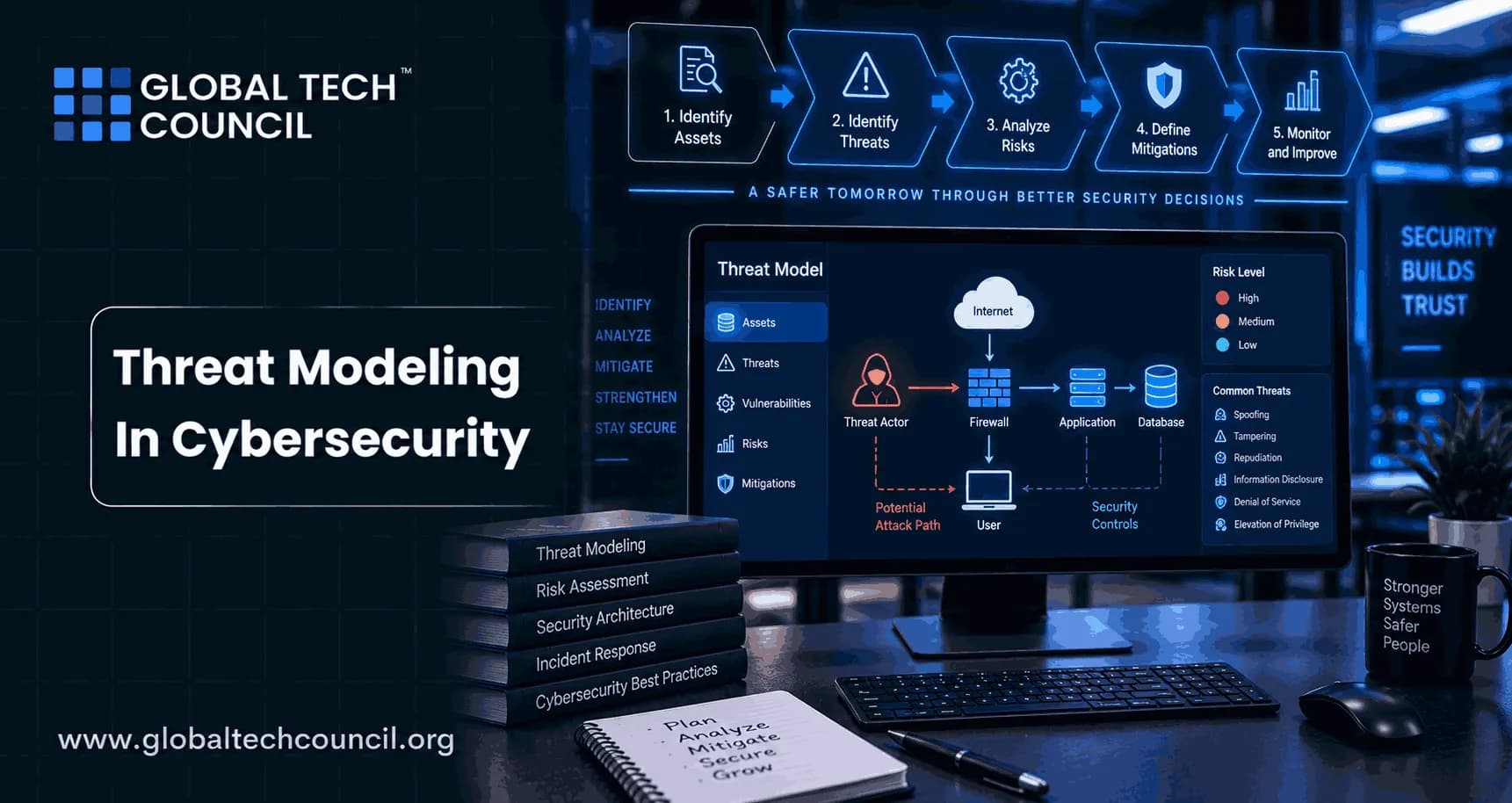
Introduction: Thinking Like an Attacker Before an Attack Happens
Most security failures do not stem from a single missed patch or a weak password. They stem from systems that were never designed with an attacker's perspective in mind. Threat modeling addresses this gap by asking a simple but powerful question before a system is even built: how could this be abused, and what happens if it is? Rather than scanning finished software for known bugs, threat modeling examines data flows, trust boundaries, and entry points the way an attacker would, then designs the weaknesses out before they ever reach production. Professionals looking to build this kind of proactive security mindset often start with a Certified Cyber Security Expert credential, which provides the foundational knowledge needed to identify and prioritize threats before they turn into real incidents.
Unlike a one-off security review, a threat model is a living artifact that gets revisited as a system evolves, not a report that ages quietly on a shelf. This ongoing nature is what makes threat modeling a cornerstone of modern cybersecurity strategy rather than a box-ticking exercise performed once and forgotten.

The Core Threat Modeling Methodologies Security Teams Rely On
Several established methodologies guide how organizations approach threat modeling, each suited to different types of systems and organizational priorities. STRIDE, developed by Microsoft engineers in the 1990s, remains the most widely used framework in software development. It classifies threats into six categories: Spoofing, Tampering, Repudiation, Information Disclosure, Denial of Service, and Elevation of Privilege. STRIDE operates on data flow diagrams, assigning relevant threat categories to each system component based on whether it is a process, data store, data flow, or external entity, and it helps ensure systems maintain confidentiality, integrity, and availability throughout the design process.
PASTA offers a different, more business-aligned approach through a seven-stage, risk-centric process that ties technical threats directly to business impact, making it particularly well suited to compliance-heavy environments. LINDDUN takes a privacy-focused angle, purpose-built for scenarios involving regulations like GDPR, while DREAD provides quantitative risk scoring across five factors to help teams prioritize which threats demand immediate attention once STRIDE or another method has identified them. Many security teams combine several of these methodologies, using STRIDE for initial threat identification, DREAD for risk prioritization, and attack trees for communicating findings to executives who need a clear picture without technical jargon.
Applying Threat Modeling to Modern API Architecture
As applications increasingly rely on interconnected APIs to move data between services, threat modeling has had to adapt to cover this expanding attack surface. Microservices and distributed architectures introduce multiple trust boundaries that traditional monolithic applications never had to account for, making each API endpoint a potential entry point that needs its own dedicated threat analysis. STRIDE in particular delivers strong value in these environments, since its component-level approach maps naturally onto the many discrete services that modern applications are built from.
Professionals working specifically to secure these interconnected systems often pursue a Certified API Security Expert credential, gaining specialized knowledge of how to threat model authentication flows, data exchanges, and third-party integrations that traditional network-focused security training rarely covers in depth.
Threat Modeling in an Era of AI-Driven Systems
The threat landscape organizations face in 2026 looks markedly different from just a few years ago, shaped increasingly by AI-powered attacks, sophisticated ransomware operations, and rapidly expanding cloud attack surfaces. Traditional threat modeling frameworks were built around deterministic systems with predictable inputs and outputs, but generative AI introduces probabilistic behavior that these older methodologies were never designed to address. Emerging research has proposed AI-specific adaptations of established frameworks to account for attack vectors like model inversion, data poisoning, and prompt injection, reflecting how quickly the discipline is having to evolve alongside the technology it protects.
AI Microdrama and the Expanding Reach of Generative Technology
One emerging application is AI microdrama, where generative AI helps bring serialized stories, characters, and fictional worlds to life. As creative platforms like this integrate AI-generated content, user data, and interactive storytelling features, they introduce their own unique attack surface, from protecting user-generated prompts to securing the underlying generative models from manipulation. This growing category of AI-powered applications is a clear example of why threat modeling can no longer stay confined to traditional software architecture and must extend into creative and consumer-facing AI products as well.
Building the kind of well-rounded technical expertise needed to secure this diverse range of systems, from cloud infrastructure to emerging generative AI platforms, benefits from a broader knowledge base than security training alone provides. A Deep Tech Certification helps professionals develop that wider technical foundation, covering the deep technology concepts increasingly intersecting with modern cybersecurity challenges.
Building Threat Modeling Into the Development Lifecycle
Effective threat modeling works best when it is integrated early, ideally during the design phase before a single line of code is written. Teams that build threat modeling into their software development lifecycle from the start typically face fewer costly security fixes down the line, since catching a design flaw before implementation is far cheaper than patching a vulnerability after deployment or, worse, after an actual breach. This proactive approach also generates the kind of documented risk-assessment evidence that compliance frameworks like SOC 2 and ISO 27001 increasingly expect auditors to see.
The threat modeling process typically follows four core stages: identifying assets and entry points, identifying potential threats using a chosen methodology, evaluating and prioritizing those threats based on likelihood and impact, and implementing mitigations before the system moves into production. Repeating this cycle as systems change keeps the threat model relevant rather than letting it become an outdated snapshot of risks that no longer reflect the current architecture.
Common Pitfalls That Undermine Threat Modeling Efforts
Even well-intentioned threat modeling initiatives can fall short when organizations treat the process as a one-time exercise rather than an ongoing discipline. Skipping stakeholder involvement from developers, architects, and business teams often leads to threat models that miss critical context about how a system is actually used in practice. Choosing an overly complex methodology for a small, fast-moving project can also slow teams down without delivering proportional security benefits, which is why matching the methodology to the system's complexity and risk profile matters as much as the modeling itself.
Communicating Threat Modeling's Value Beyond the Security Team
Even the most rigorous threat modeling process delivers limited value if its findings stay locked within the security team. Business leaders, product managers, and executives need to understand why certain design decisions matter and what risks a proposed system carries before resources are committed to building it. Translating technical findings like spoofing risks or data flow vulnerabilities into language that resonates with non-technical stakeholders is a distinct skill from identifying the threats themselves.
A Marketing Certification equips professionals with the communication tools needed to bridge that gap, helping security teams present threat modeling outcomes in ways that build organizational buy-in and secure the resources needed to act on identified risks before they become real incidents.
Threat modeling has moved from a niche security practice into an essential part of how modern organizations build and maintain trustworthy systems. As attack surfaces continue expanding across APIs, cloud infrastructure, and increasingly sophisticated AI-driven platforms, the discipline of systematically thinking like an attacker before a system goes live will remain one of the most effective tools security teams have for staying ahead of an ever-evolving threat landscape.
FAQs
1. What is threat modeling in cybersecurity?
Threat modeling is a structured process for identifying potential security and privacy threats to a system and determining how those risks should be addressed. It examines a system from an attacker and defender perspective to support better security decisions.
2. Why is threat modeling important in cybersecurity?
Threat modeling helps organizations identify security weaknesses before attackers can exploit them. Performing it early in the development lifecycle can help teams address design-level risks before they become more expensive to fix.
3. How does threat modeling work?
A typical threat modeling process involves understanding the system, identifying what could go wrong, deciding how to address identified risks, and reviewing whether the resulting security measures are effective. OWASP organizes these activities around four questions: what are we working on, what can go wrong, what are we going to do about it, and did we do a good enough job?
4. What are the main steps in threat modeling?
The main steps generally include defining the system scope, modeling its architecture and data flows, identifying potential threats, prioritizing risks, selecting mitigations, and validating the results. The exact process can vary depending on the system and methodology being used.
5. What is the purpose of a threat model?
A threat model provides a structured representation of security-relevant information about a system. It can document assumptions, potential threats, mitigations, and methods for validating whether security actions have been effective.
6. What is STRIDE in threat modeling?
STRIDE is a commonly used threat identification methodology associated with six categories: spoofing, tampering, repudiation, information disclosure, denial of service, and elevation of privilege. It provides security teams with a structured way to consider different types of threats during analysis.
7. What is the difference between threat modeling and risk assessment?
Threat modeling focuses on understanding how threats could affect a particular system, application, data set, or environment and what controls could address them. NIST describes threat modeling as a form of risk assessment that models aspects of both the attack and defense sides of a logical entity.
8. When should threat modeling be performed?
Threat modeling should ideally begin during the design or planning stage and continue throughout the system's lifecycle. OWASP recommends revisiting the model as systems evolve, particularly after new features, architecture changes, or security incidents.
9. What is a data flow diagram in threat modeling?
A data flow diagram (DFD) represents how information moves between components, users, services, databases, and external systems. It helps security teams identify entry points, trust boundaries, sensitive data flows, and locations where threats may arise.
10. What are trust boundaries in threat modeling?
A trust boundary is a point where the level of trust between components changes. Identifying these boundaries helps security teams examine where data crosses between systems, users, networks, or services and determine whether additional security controls are necessary.
11. What types of systems can be threat modeled?
Threat modeling can be applied to applications, software systems, networks, distributed systems, IoT devices, business processes, cloud environments, and other technology systems. OWASP emphasizes that the approach can be adapted to many different types of systems.
12. How does threat modeling help secure software development?
Threat modeling allows developers and security teams to identify potential design weaknesses before implementation is complete. This helps security become part of the development process instead of being treated only as a final testing activity.
13. What are common threat modeling methodologies?
Common approaches include STRIDE, PASTA, LINDDUN, attack trees, and abuse cases. OWASP does not prescribe one universal methodology because different systems, security objectives, teams, and regulatory requirements may require different approaches.
14. What are the benefits of threat modeling?
Threat modeling can improve visibility into system architecture, identify security risks earlier, prioritize security investments, support collaboration between development and security teams, and help define appropriate controls. It can also create documentation that supports security decisions throughout the development lifecycle.
15. What are common threats identified through threat modeling?
Threat modeling can uncover risks such as unauthorized access, data exposure, tampering, identity spoofing, denial-of-service attacks, privilege escalation, insecure data flows, and weaknesses in external dependencies. The specific threats depend on the architecture, data, users, and technologies involved.
16. How does threat modeling help identify vulnerabilities?
Threat modeling examines how an attacker might interact with a system and where weaknesses could allow unwanted outcomes. This analysis helps teams prioritize design and implementation areas that require stronger controls, testing, or architectural changes.
17. What happens after a threat is identified?
Once a threat is identified, teams can choose an appropriate response based on its likelihood, impact, and organizational risk tolerance. Possible responses include mitigating the threat with security controls, eliminating the risky design, transferring the risk, or accepting it when appropriate.
18. Can threat modeling be used for cloud security?
Yes. Threat modeling can be applied to cloud architectures by examining services, identities, APIs, data flows, external dependencies, permissions, and trust boundaries. OWASP specifically includes cloud threat modeling as part of its broader guidance.
19. What are the challenges of threat modeling?
Challenges can include incomplete system information, rapidly changing architectures, limited security expertise, time constraints, and difficulty maintaining models as systems evolve. Effective threat modeling also requires teams to understand the system well enough to identify realistic attack paths and appropriate mitigations.
20. How does threat modeling improve overall cybersecurity?
Threat modeling helps organizations move from reactive security toward proactive risk management by identifying potential attack paths before or during system development. When maintained throughout the lifecycle, it provides a repeatable way to understand threats, prioritize risks, and strengthen security controls.
Related Articles
View All
Cyber Security
Cybersecurity Facts for 2026: Threats, Trends, and Real-World Lessons
Cybersecurity in 2026 features faster exploitation, growing ransomware profits, rising supply chain attacks, and AI-driven threats. Learn the key facts and priorities.

Cyber Security
AI-Powered Threat Detection: How Machine Learning Improves SOC Triage and Reduces Alert Fatigue
AI-powered threat detection uses machine learning to triage, enrich, and auto-close alerts, reducing false positives and alert fatigue while improving SOC speed and accuracy.

Cyber Security
Threat Intelligence Platforms
What is Threat Intelligence Platforms Threat Intelligence Platforms (TIPs) are systems that collect, organize, analyze, and share cyber threat data so security teams can act faster and more accurately. Instead of keeping indicators, malware notes, attack patterns, and vulnerability alerts scattered…
Trending Articles
The Role of Blockchain in Ethical AI Development
How blockchain technology is being used to promote transparency and accountability in artificial intelligence systems.
AWS Career Roadmap
A step-by-step guide to building a successful career in Amazon Web Services cloud computing.
Top 5 DeFi Platforms
Explore the leading decentralized finance platforms and what makes each one unique in the evolving DeFi landscape.