

Can AI Replace Java Developers? The Future of Java Programming Jobs
 Suyash Raizada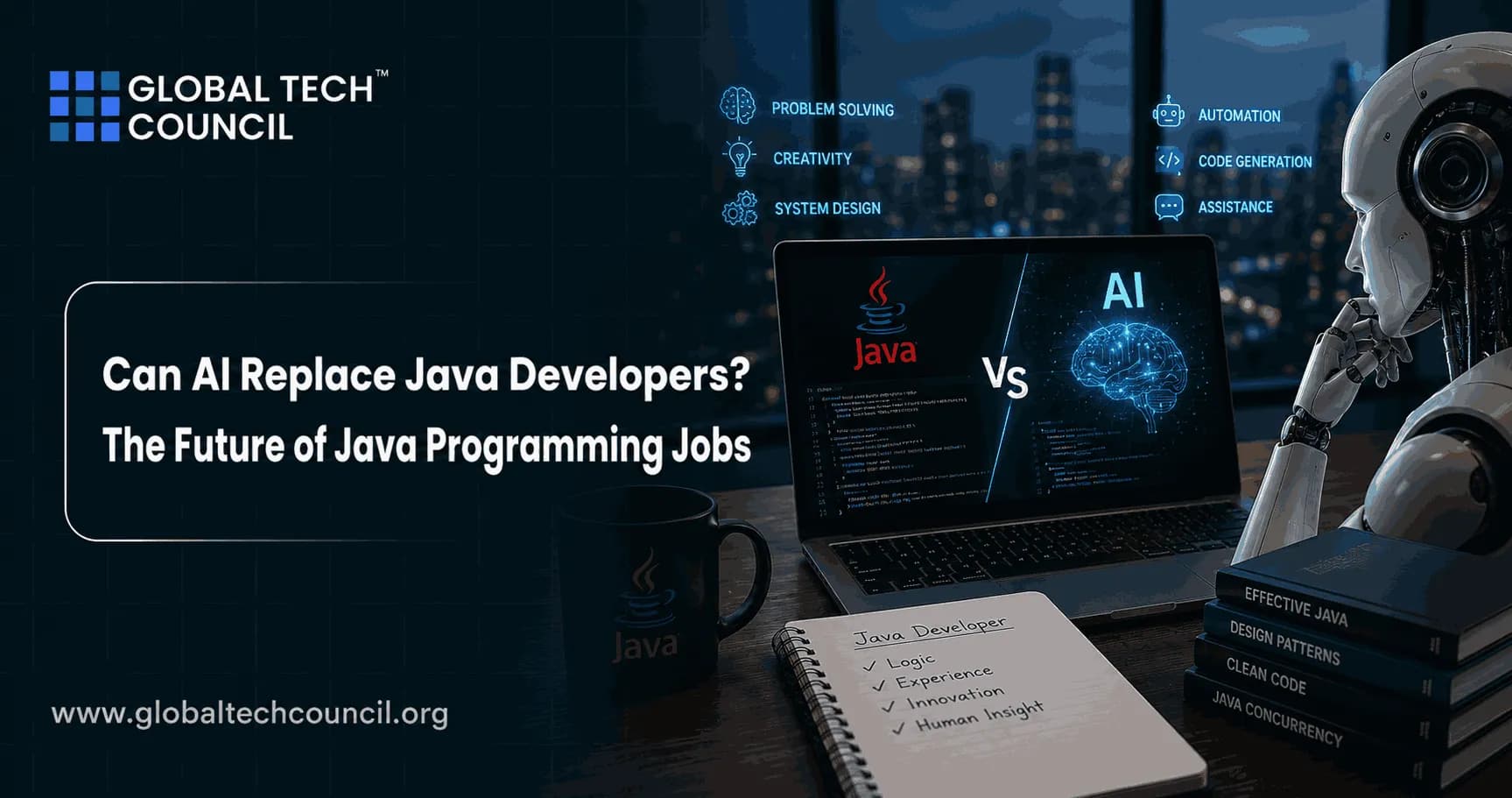
Can AI replace Java developers? Not in any serious enterprise environment I have seen. AI can write a Spring controller, suggest a JUnit test, or explain a stack trace. It cannot safely own a payments workflow, negotiate messy business rules with stakeholders, or decide whether a 20-year-old batch process can be split without breaking month-end reporting.
The real change is sharper. Java programming jobs are moving away from repetitive code production and toward architecture, integration, AI supervision, performance engineering, and business-critical system design. If you write only boilerplate, you should be worried. If you understand Java systems deeply and learn to use AI tools well, your value goes up. Artificial intelligence is transforming software development by automating repetitive coding tasks, improving code quality, and accelerating application development. However, Java developers remain essential for designing scalable architectures, building enterprise applications, integrating complex systems, and solving real-world business challenges. Pursuing a Tech Certification helps professionals strengthen their expertise in Java programming, backend development, cloud computing, software engineering, and AI-assisted development. These industry-recognized certifications prepare developers to work alongside AI tools while building the advanced technical skills employers will continue to value in the future.

Why Java Developers Are Still in Demand
Java sits deep inside banking, insurance, healthcare, telecom, logistics, retail, and government platforms. Many of these systems were built in the late 1990s and 2000s, then extended for years through Java EE, Spring, Spring Boot, Hibernate, REST APIs, message queues, and SQL databases.
Replacing those systems is not a weekend migration. It can cost millions of dollars, consume several years, and require large teams that understand both the code and the business. That is why many enterprises modernize Java systems instead of rewriting them from scratch.
There is another reason Java stays relevant. The JVM is stable, mature, and well understood by operations teams. Java 17 and Java 21 are long-term support releases. Spring Boot 3.x, Jakarta EE, Maven, Gradle, Kafka, PostgreSQL, Redis, and Kubernetes fit cleanly into modern enterprise stacks. AI does not remove that foundation. It adds another layer that still needs engineering discipline.
What AI Can Already Do for Java Developers
AI coding assistants are useful. To be blunt, ignoring them is now a bad career strategy. Tools built on GPT-class models can speed up many parts of the Java workflow, especially when the task is narrow and the context is clear.
Tasks AI Handles Well
Generate boilerplate for controllers, DTOs, records, repositories, and configuration classes.
Draft basic JUnit 5 and Mockito tests.
Suggest refactors for repetitive code.
Explain simple compiler errors and common runtime exceptions.
Create migration checklists for version upgrades.
Produce first-pass documentation for APIs and internal services.
For a standard CRUD service in Spring Boot, AI can save real time. Ask it to generate a REST endpoint, validation annotations, a service layer, and a repository interface, and you will often get something usable after review.
But that last phrase matters: after review.
Where AI Fails in Real Java Work
AI tools are pattern machines. They are strong when your problem looks like common code found across public repositories and documentation. They get weaker when your system has hidden constraints, old assumptions, regulatory requirements, or non-obvious failure modes.
Here is a practical example. An assistant can recommend eager fetching to fix this Hibernate error:
org.hibernate.LazyInitializationException: failed to lazily initialize a collection of role: com.example.Order.items: could not initialize proxy - no Session
That answer may work in a demo. In production, it can create a massive N+1 query problem or pull thousands of rows into memory during peak traffic. A skilled Java developer checks transaction boundaries, fetch plans, query shape, indexes, and response size before changing the mapping. AI can point at the symptom. You still own the diagnosis.
Human Judgment Still Matters Most Here
Architecture: deciding service boundaries, data ownership, API contracts, and failure behavior.
Legacy integration: working with old SOAP services, batch jobs, stored procedures, and undocumented side effects.
Performance tuning: JVM memory settings, garbage collection behavior, SQL plans, connection pools, and latency budgets.
Security: authentication, authorization, secrets, audit trails, supply chain risk, and secure coding.
Compliance: handling financial, healthcare, or personal data under strict controls.
Stakeholder work: translating unclear requirements into systems that survive production use.
AI can produce code. It cannot be accountable for a failed settlement run, a data leak, or a broken claims workflow. The future of software development lies in collaboration between human expertise and intelligent technologies rather than complete automation. Becoming a Deeptech Expert helps professionals understand how artificial intelligence, blockchain, cloud computing, intelligent automation, and emerging technologies are reshaping modern software engineering. This interdisciplinary knowledge enables developers to adapt to changing technology trends, integrate AI into development workflows, and remain valuable contributors in an increasingly AI-driven software ecosystem.
The Future of Java Programming Jobs
The future of Java programming jobs is not disappearance. It is role compression at the low end and role expansion at the high end.
Junior developers who only convert tickets into predictable boilerplate will face pressure. Teams can now generate basic code faster. That does not mean entry-level roles vanish, but it does mean junior developers need to learn faster and show judgment earlier.
Senior Java developers, architects, and platform engineers will be pulled into more valuable work. You will review AI-generated code, design AI-enabled services, build guardrails, choose model integration patterns, and decide where automation is safe.
Expect More Java Plus AI Work
Many Java developers will not need to become Python-first machine learning researchers to build AI-powered applications. Much of the work is integration: connecting models, vector databases, business rules, authentication, observability, and enterprise workflows.
That is exactly where Java is strong.
Frameworks and libraries such as Spring AI, LangChain4j, and the Model Context Protocol Java SDK make it easier to connect Java applications with large language models, embedding models, tools, and retrieval systems. For many teams, the next major Java project will not be a chatbot in isolation. It will be a secure internal knowledge assistant, a fraud triage service, a support automation workflow, or a recommendation component attached to existing business systems.
How AI Will Change Daily Java Development
Your day as a Java developer will change in practical ways. Less typing. More checking. More design.
You will prompt, inspect, and correct code: AI-generated code should be treated like code from a junior developer. Useful, but never merged without review.
You will write better tests: AI can draft test cases, but you must define edge cases, failure paths, concurrency scenarios, and security checks.
You will modernize legacy systems faster: AI can help with repetitive migrations, such as updating imports after the Spring Boot 3 move from
javax.*tojakarta.*. That change broke plenty of builds because Spring Boot 3 requires Jakarta EE 9 namespaces and Java 17 as a baseline.You will connect AI to enterprise data: Retrieval-Augmented Generation, embeddings, vector stores, and model gateways will become normal backend topics.
You will defend production quality: generated code still needs observability, rate limits, retries, circuit breakers, access control, and incident playbooks.
Skills Java Developers Should Build Now
If you want to stay ahead, do not chase every AI trend. Build durable skills that make you useful when the tools change.
Core Java and JVM Fundamentals
Know collections, streams, concurrency, records, virtual threads, memory behavior, garbage collection basics, and exception handling. Java 21 virtual threads, delivered through Project Loom, are especially relevant for high-concurrency services, but they are not a magic fix for CPU-bound workloads.
Spring Boot and Enterprise Architecture
Get comfortable with Spring Boot 3.x, Spring Security, JPA, REST design, messaging, database transactions, and service boundaries. Learn why distributed transactions are painful. Learn when a modular monolith is a better choice than microservices. Yes, often it is.
AI Integration Patterns
Learn embeddings, vector databases, RAG pipelines, prompt design, model evaluation, and safe tool calling. You do not need to train a foundation model. You do need to know how model output enters a Java service and what can go wrong.
Security and Governance
AI-generated code can introduce insecure defaults, weak validation, and dependency risks. Keep the OWASP Top 10 close. Watch dependency supply chains too. The 2024 xz Utils backdoor, tracked as CVE-2024-3094, was a reminder that trusted build chains can become attack paths.
Cloud and Observability
Production Java now means metrics, logs, traces, container images, CI/CD, autoscaling, and incident response. Learn OpenTelemetry, Prometheus, Grafana, Docker, Kubernetes basics, and cloud deployment patterns.
What Enterprises Should Do
Enterprises should treat AI as a force multiplier for Java teams, not as a replacement plan. The safest strategy is controlled adoption.
Create coding standards for AI-assisted development.
Require human review for generated code.
Track license, privacy, and security risks in AI tools.
Use AI for test generation, documentation, migration support, and code search.
Train Java teams on Spring AI, LangChain4j, RAG design, and secure model integration.
Measure outcomes by defect rates, cycle time, and production stability, not just lines of code generated.
Do not let AI write business-critical code without context and review. That is not innovation. That is risk transfer to production.
Where Certification Fits
Certifications cannot replace experience, but they can structure your learning and signal that you are serious about the shift. If you are building a Java career in the AI era, look for learning paths that combine programming, system design, AI, cloud, and security.
Use this topic as an internal learning map. Strengthen Java programming first, then add AI and machine learning foundations, cloud deployment, data science basics, and cybersecurity practices. Global Tech Council certification paths in Java, artificial intelligence, machine learning, cloud computing, and cybersecurity are useful next steps for developers who want broader enterprise readiness.
So, Can AI Replace Java Developers?
AI can replace some Java development tasks. It can also reduce the need for developers who never move beyond repetitive implementation. But it is very unlikely to replace skilled Java developers who understand systems, business rules, security, performance, and production operations.
The better question is this: can a Java developer who uses AI well outperform one who refuses to adapt? Yes. Easily.
Your next move is practical. Build a small Spring Boot 3 application that uses Spring AI or LangChain4j with a vector database, add authentication, write tests, containerize it, and monitor it. Then review every AI-generated line as if a real customer depends on it. That habit is what future Java programming jobs will reward. As AI changes the way software is developed, professionals who understand both technology and business will have a significant competitive advantage. Earning a Marketing Certification helps developers strengthen their expertise in product strategy, customer-centric thinking, digital communication, and innovation management. These skills enable software professionals to build solutions that address business needs while effectively communicating the value of technology to customers and stakeholders.
FAQs
1. Can AI Replace Java Developers?
No. AI can automate repetitive coding tasks, generate code suggestions, and assist with debugging, but it cannot fully replace Java developers. Human expertise is still essential for software architecture, business logic, system design, security, collaboration, and strategic decision-making.
2. How Is AI Changing Java Development?
AI is helping Java developers by accelerating code generation, identifying bugs, improving documentation, creating test cases, optimizing code, and assisting with learning and productivity. It acts as a development assistant rather than a replacement.
3. Will Java Developers Still Be in Demand in 2026?
Yes. Java developers remain in high demand because Java powers enterprise software, cloud-native applications, banking systems, healthcare platforms, e-commerce solutions, and backend services used by organizations worldwide.
4. Which Java Development Tasks Can AI Automate?
AI can assist with writing boilerplate code, generating documentation, suggesting code improvements, creating unit tests, detecting common bugs, explaining code, and automating repetitive development workflows.
5. Which Tasks Still Require Human Java Developers?
Developers are needed for software architecture, system design, security decisions, business requirements analysis, performance optimization, stakeholder communication, complex debugging, and designing scalable enterprise applications.
6. Can AI Build Complete Java Applications Without Developers?
AI can help generate parts of an application, but complete software development still requires human planning, validation, testing, integration, security reviews, deployment, and ongoing maintenance.
7. How Does AI Improve Java Developer Productivity?
AI reduces development time by providing intelligent code completion, debugging assistance, documentation generation, code refactoring suggestions, automated testing support, and faster problem-solving.
8. What Skills Should Java Developers Learn to Stay Relevant?
Developers should strengthen Java fundamentals, Spring Boot, microservices, cloud computing, Docker, Kubernetes, DevOps, databases, REST APIs, AI-assisted development, cybersecurity, and software architecture.
9. Is Prompt Engineering Useful for Java Developers?
Yes. Prompt engineering helps developers interact effectively with AI coding assistants, generate higher-quality code, automate workflows, troubleshoot issues, and improve productivity using AI-powered development tools.
10. How Will AI Affect Entry-Level Java Developer Jobs?
AI may automate some repetitive entry-level tasks, but it also creates opportunities for developers who understand AI-assisted programming, software engineering principles, and modern development practices.
11. Which Industries Will Continue Hiring Java Developers?
Industries including banking, finance, healthcare, insurance, telecommunications, retail, logistics, government, education, manufacturing, and cloud computing continue to rely heavily on Java developers.
12. Can AI Replace Software Architects?
No. Software architects make high-level decisions about application design, scalability, security, technology selection, and business alignment-responsibilities that require human judgment and experience.
13. How Is AI Transforming Enterprise Java Development?
AI is improving enterprise development by automating coding tasks, enhancing code reviews, accelerating testing, optimizing performance, improving documentation, and supporting continuous software delivery.
14. What Certifications Can Help Java Developers in the AI Era?
Certifications in Java, Spring Boot, cloud computing, DevOps, AI fundamentals, prompt engineering, backend development, software architecture, and cybersecurity can strengthen career opportunities.
15. What Common Mistakes Should Java Developers Avoid When Using AI?
Developers should avoid blindly accepting AI-generated code, skipping testing, ignoring security reviews, exposing sensitive information in prompts, neglecting documentation, and relying on AI without understanding the underlying code.
16. What Career Opportunities Are Emerging for Java Developers With AI Skills?
Growing AI adoption is creating demand for AI-assisted software engineers, backend developers, cloud developers, AI application developers, DevOps engineers, enterprise architects, automation specialists, and AI integration consultants.
17. How Can Java Developers Prepare for the Future of AI?
Developers should continuously learn new frameworks, practice AI-assisted coding, build cloud-native applications, understand software architecture, improve problem-solving skills, and stay updated on emerging AI technologies.
18. Is Java Still a Good Language to Learn Despite AI?
Yes. Java remains one of the world's leading programming languages for enterprise software, backend systems, cloud-native applications, Android development, and large-scale distributed systems.
19. Will AI Create New Opportunities for Java Developers?
Yes. AI is creating opportunities in intelligent automation, AI-powered enterprise software, developer productivity tools, AI integration, cloud platforms, and software modernization, expanding the role of skilled Java professionals.
20. What Is the Future of Java Programming Jobs in the Age of AI?
The future of Java programming is centered on collaboration between developers and AI rather than replacement. AI will continue to automate repetitive coding tasks, while Java developers focus on architecture, innovation, security, scalability, and solving complex business problems. Professionals who combine strong Java expertise with AI, cloud computing, DevOps, and modern software engineering skills will remain highly valuable in the evolving technology landscape.
Related Articles
View All
Java
Future of Java Development: AI Tools, Cloud-Native Apps, and Emerging Trends
Explore the future of Java development through AI coding tools, cloud-native apps, serverless systems, agentic architecture, and skills Java developers need next.

Java
How Java Powers Android App Development: Basics for New Developers
Learn how Java powers Android app development, why it still matters beside Kotlin, and which Java basics new Android developers should master first.

Java
Spring Boot for Java Developers: Essential Skills for Modern Backend Development
Spring Boot for Java developers is essential for building secure, observable, cloud-ready backends with faster delivery and modern architecture support.
Trending Articles
The Role of Blockchain in Ethical AI Development
How blockchain technology is being used to promote transparency and accountability in artificial intelligence systems.
AWS Career Roadmap
A step-by-step guide to building a successful career in Amazon Web Services cloud computing.
Top 5 DeFi Platforms
Explore the leading decentralized finance platforms and what makes each one unique in the evolving DeFi landscape.