

Object-Oriented Programming in Java: Classes, Objects, Inheritance, and Polymorphism
 Suyash Raizada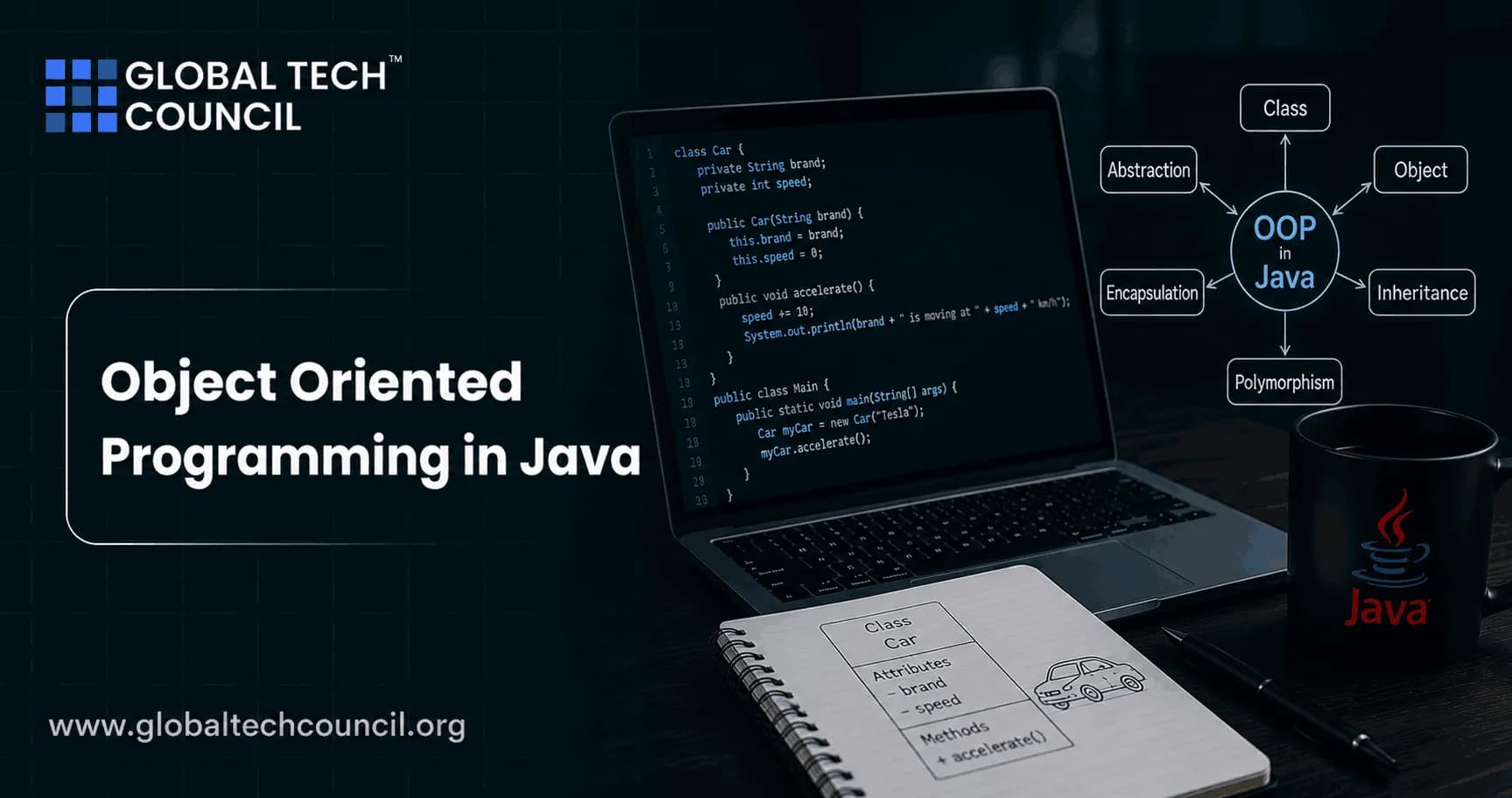
Object-Oriented Programming in Java is built around a simple idea: model software as cooperating objects that hold state and expose behavior. That sounds academic until you are maintaining a payment service with 200 classes, five developers editing the same module, and one tiny constructor change breaking half the test suite. Then classes, objects, inheritance, and polymorphism stop being theory. They become the structure that keeps Java code readable and changeable.
Oracle's Java Tutorials still introduce the language through objects, classes, inheritance, interfaces, and packages. A class is a template for objects, and OOP is a way to improve reuse and maintainability. That matches current Java work. Even with lambdas, streams, records, and modern frameworks such as Spring Boot, Java developers still spend much of their day designing object models. Object-Oriented Programming (OOP) is the foundation of Java and plays a vital role in building scalable, reusable, and maintainable software applications. Pursuing a Tech Certification helps professionals develop practical expertise in Java programming, OOP principles, class design, inheritance, polymorphism, abstraction, encapsulation, and enterprise application development. These industry-recognized certifications prepare developers to write clean, modular code while building robust software solutions for modern businesses.

What Object-Oriented Programming in Java Means
Java is a class-based object-oriented language. A program is usually organized as classes, and running software is made of objects created from those classes. A class defines what an object can store and what it can do. The object is the actual instance in memory.
The four classic principles are:
Abstraction: Show the behavior that matters and hide low-level detail.
Encapsulation: Protect fields and expose controlled methods.
Inheritance: Reuse and specialize behavior from a parent class.
Polymorphism: Let the same call produce different behavior based on the actual object type.
In production code, you will also use association, aggregation, and composition. To be blunt, composition is often the better default than inheritance. A class that has a dependency is usually easier to test and change than a class buried three levels deep in an inheritance tree. Object-oriented principles form the backbone of many advanced technologies, including artificial intelligence, cloud computing, enterprise platforms, and distributed software systems. Becoming a Deeptech Expert helps professionals understand how modern applications are designed using scalable architectures, reusable components, and intelligent software engineering practices. This interdisciplinary expertise enables developers to create flexible systems capable of supporting emerging technologies and evolving business requirements.
Classes in Java: The Blueprint
A class defines fields and methods. Fields store state. Methods define behavior. Constructors prepare the object when it is created.
public class Customer {
    private final String name;
    private int loyaltyPoints;

    public Customer(String name) {
        this.name = name;
        this.loyaltyPoints = 0;
    }

    public void addPoints(int points) {
        if (points < 0) {
            throw new IllegalArgumentException("points must be positive");
        }
        this.loyaltyPoints += points;
    }

    public int getLoyaltyPoints() {
        return loyaltyPoints;
    }
}
This class models a customer. The fields are private, so outside code cannot directly change them. That is encapsulation. The method addPoints controls how points are added. A small validation check here can prevent bad data from spreading through an application.
A beginner mistake shows up fast with constructors. If you define Customer(String name), Java no longer provides a no-argument constructor. Try new Customer() and javac reports something like: constructor Customer in class Customer cannot be applied to given types; required: String found: no arguments. That error is worth learning early. It appears constantly in Java training labs and certification-style questions.
Objects in Java: The Working Instances
An object is an instance of a class. Oracle describes an object as a software bundle of related state and behavior. You create objects with new, then call methods on them.
public class Main {
    public static void main(String[] args) {
        Customer alice = new Customer("Alice");
        alice.addPoints(100);
        System.out.println(alice.getLoyaltyPoints());
    }
}
Here, alice is a reference to a Customer object. The object has its own state. Another customer object would have separate points.
Do not confuse a class with an object. The class is the design. The object is the thing you use at runtime. If you have worked with Spring, this distinction matters when you define a class as a component and Spring creates managed object instances, often called beans. Well-designed software creates better user experiences and supports long-term product success. Earning a Marketing Certification helps professionals understand product strategy, customer expectations, digital innovation, and business value creation. These skills enable developers to align technical architecture with business objectives while contributing to software products that solve real customer problems and strengthen market competitiveness.
Encapsulation: Keep Data Safe and Code Changeable
Encapsulation is not just about using private. It is about controlling how state changes. If every field is public, any part of the codebase can put the object into an invalid state. That makes debugging miserable.
Good encapsulation usually means:
Keep fields private where possible.
Expose methods that describe business actions, not raw data edits.
Validate inputs at the boundary of the class.
Avoid setters that exist only because an IDE generated them.
Use immutable fields with
finalwhen values should not change.
Modern Java gives you extra tools. Records, which became a standard feature in Java 16, are useful for immutable data carriers. They are not a replacement for behavior-rich domain classes, but they work well for DTOs, API responses, and simple value objects.
Inheritance in Java: Reuse With Care
Inheritance lets one class acquire fields and methods from another class using extends. It represents an is-a relationship. A Car is a Vehicle. A SavingsAccount is an Account, assuming the domain rules support that model.
public class Vehicle {
    public void start() {
        System.out.println("Vehicle starting...");
    }
}

public class Car extends Vehicle {
    @Override
    public void start() {
        System.out.println("Car starting with ignition system...");
    }
}
The @Override annotation is not decoration. Use it. If you misspell a method name or get the parameters wrong, the compiler catches it. Without @Override, you may think you changed parent behavior when you actually created a new method.
When Inheritance Is the Wrong Tool
Deep inheritance hierarchies become fragile. If PremiumCustomer extends Customer, and EnterprisePremiumCustomer extends PremiumCustomer, the code may look reusable at first. Six months later, one change to the base class can cause side effects in places nobody expected.
Prefer composition when the relationship is has-a. A Car has an Engine. It should not usually extend Engine. A service has a repository. It should not extend one. This is the style you will see in maintainable Spring applications, clean domain models, and testable Java services. Build a strong foundation in modern software engineering through the Java Developer Course, where you'll master object-oriented programming, classes, objects, inheritance, polymorphism, Spring Boot, backend development, and enterprise application architecture through practical projects. Expand your expertise with the Edge AI Expert certification to understand how AI-powered applications leverage scalable software architectures, and strengthen your business perspective through the AI-powered Digital Marketing Course to develop products that combine technical excellence with customer value.
Polymorphism in Java: One Interface, Many Behaviors
Polymorphism means many forms. In Java, the same method call can behave differently depending on the object's actual type. This is the core idea behind flexible APIs.
There are two common forms:
Compile-time polymorphism: Method overloading. The compiler chooses the method based on parameters.
Runtime polymorphism: Method overriding. The JVM dispatches the call based on the actual object type.
public interface Shape {
    double area();
}

public class Circle implements Shape {
    private final double radius;

    public Circle(double radius) {
        this.radius = radius;
    }

    @Override
    public double area() {
        return Math.PI * radius * radius;
    }
}

public class Rectangle implements Shape {
    private final double width;
    private final double height;

    public Rectangle(double width, double height) {
        this.width = width;
        this.height = height;
    }

    @Override
    public double area() {
        return width * height;
    }
}
Now you can write code against the interface:
public class ShapeCalculator {
    public static double totalArea(Shape[] shapes) {
        double sum = 0;
        for (Shape shape : shapes) {
            sum += shape.area();
        }
        return sum;
    }
}
totalArea does not care whether the object is a Circle or a Rectangle. That is the value. You add a Triangle later without rewriting the loop.
A Certification Trap: Overloading Is Not Overriding
Many Java learners mix these up. Overloading uses the same method name with different parameter lists. Overriding keeps a compatible method signature in a subclass. If you overload when you meant to override, runtime polymorphism will not happen.
Another classic trap is null with overloaded methods. If you define print(String s) and print(Integer i), then call print(null), the compiler can report: reference to print is ambiguous. That is not a JVM mystery. It is compile-time method selection.
Replacing Conditionals With Polymorphism
Polymorphism often removes brittle if or switch logic. Suppose a payment processor checks payment type:
if (type.equals("CARD")) {
    processCard();
} else if (type.equals("BANK")) {
    processBankTransfer();
}
That code grows poorly. A cleaner design is a PaymentMethod interface with CardPayment and BankTransferPayment implementations. Add a new payment type by adding a class, not by editing a long conditional block in five files.
This approach is not always required. For two simple cases in a tiny script, a conditional is fine. For business rules that change often, polymorphism pays for itself.
Current Java OOP Best Practices
OOP in Java has matured. The best Java teams are not trying to create giant class diagrams. They write small classes with clear responsibilities and stable interfaces.
Keep classes focused: If a class handles persistence, validation, reporting, and formatting, split it.
Use interfaces for contracts: Interfaces help test code and swap implementations.
Favor composition: Use inheritance only when the is-a relationship is true and stable.
Protect state: Use private fields, validation, immutability, and meaningful methods.
Name behavior clearly:
approveInvoice()says more thansetStatus("APPROVED").
OOP has a steeper learning curve than plain procedural code, and that is worth admitting. The hard part is not syntax. It is deciding where responsibilities belong. That skill grows when you build real projects, review code, and refactor poor designs.
Where OOP Shows Up in Real Java Systems
You see OOP in Java wherever teams model business domains:
E-commerce:
Customer,Order,Product,Invoice.Banking:
Account,Transaction,InterestPolicy.Enterprise workflows:
ApprovalRequest,Reviewer,WorkflowStep.Back-end services: Controllers, services, repositories, entities, and DTOs.
The benefits are practical: teams can work on separate classes, tests can target smaller units, and behavior can be extended without rewriting the whole application. That day-to-day reality is what makes large Java codebases survive year after year.
How to Learn OOP in Java the Right Way
Do not memorize definitions only. Build. Start with a small domain such as a library system. Create Book, Member, Loan, and FinePolicy. Then add one requirement at a time. You will quickly see why encapsulation and polymorphism matter.
If you are creating a structured learning path, pair hands-on Java practice with Global Tech Council's programming and Java-focused training resources. For broader career growth, connect this foundation with related learning paths in software development, data science, AI, or cybersecurity, depending on the systems you want to build.
Your next step: write three small Java classes today, add one interface, override one method, and then refactor one conditional into polymorphic behavior. That exercise teaches more than ten pages of definitions. Object-oriented programming is a core skill that every professional Java developer should master. Advance your career through the Java Developer Course, broaden your understanding of intelligent software systems by becoming an Edge AI Expert, and develop valuable product strategy and customer engagement skills through the AI-powered Digital Marketing Course to build scalable enterprise applications that support innovation, digital transformation, and long-term business success.
FAQs
1. What Is Object-Oriented Programming (OOP) in Java?
Object-Oriented Programming (OOP) in Java is a programming paradigm that organizes software around objects rather than functions. It improves code reusability, scalability, maintainability, and modularity through concepts such as classes, objects, inheritance, polymorphism, encapsulation, and abstraction.
2. Why Is Object-Oriented Programming Important in Java?
OOP helps developers create modular, reusable, and scalable applications. It simplifies software maintenance, improves code organization, reduces duplication, and supports the development of complex enterprise applications.
3. What Is a Class in Java?
A class is a blueprint or template that defines the properties (fields) and behaviors (methods) of objects. It describes how objects should be created and how they should function.
4. What Is an Object in Java?
An object is an instance of a class that contains actual values for its attributes and can perform actions defined by the class methods. Objects represent real-world entities in Java applications.
5. What Is the Difference Between a Class and an Object?
A class defines the structure and behavior of an entity, while an object is the actual instance created from that class. Multiple objects can be created from a single class, each with its own state.
6. What Is Inheritance in Java?
Inheritance is an OOP concept that allows one class to acquire the properties and methods of another class. It promotes code reuse, reduces redundancy, and simplifies application maintenance.
7. What Are the Benefits of Inheritance?
Inheritance improves code reusability, reduces duplicate code, simplifies maintenance, enhances scalability, and enables developers to build hierarchical relationships between classes.
8. What Is Polymorphism in Java?
Polymorphism allows the same method or interface to behave differently depending on the object using it. It improves flexibility, extensibility, and code maintainability in Java applications.
9. What Is the Difference Between Method Overloading and Method Overriding?
Method overloading allows multiple methods with the same name but different parameter lists within the same class, while method overriding allows a subclass to provide its own implementation of a method inherited from a parent class.
10. What Is Encapsulation in Java?
Encapsulation is the practice of protecting object data by restricting direct access through access modifiers and exposing controlled access using getter and setter methods.
11. What Is Abstraction in Java?
Abstraction hides unnecessary implementation details while exposing only essential functionality. It simplifies complex systems and allows developers to focus on what an object does rather than how it works.
12. What Are Access Modifiers in Java?
Access modifiers such as public, private, protected, and default control the visibility and accessibility of classes, methods, constructors, and variables within a Java application.
13. Why Are Constructors Important in Java?
Constructors initialize objects when they are created. They assign initial values, prepare object state, and ensure that objects are properly configured before use.
14. How Does OOP Improve Enterprise Java Development?
OOP enables developers to build scalable, maintainable, and reusable enterprise applications by promoting modular architecture, reusable components, better testing, and easier long-term maintenance.
15. Which Java Frameworks Rely on Object-Oriented Programming?
Popular frameworks such as Spring Boot, Hibernate, Jakarta EE, JavaFX, and many enterprise Java technologies are built around object-oriented programming principles.
16. What Common OOP Mistakes Should Beginners Avoid?
Beginners should avoid creating overly complex class hierarchies, ignoring encapsulation, overusing inheritance, writing tightly coupled code, violating the Single Responsibility Principle, and neglecting code reuse.
17. How Can Beginners Practice Object-Oriented Programming in Java?
Developers can practice by building projects such as student management systems, banking applications, inventory systems, library management software, employee management systems, and e-commerce applications using OOP principles.
18. What Skills Should Developers Learn Alongside OOP?
Developers should also learn Java Collections, exception handling, multithreading, design patterns, Spring Boot, REST APIs, SQL, Git, debugging, unit testing, and software architecture fundamentals.
19. Is Object-Oriented Programming Important for Java Interviews?
Yes. OOP is one of the most frequently tested Java interview topics. Employers often assess understanding of classes, objects, inheritance, polymorphism, encapsulation, abstraction, constructors, interfaces, and real-world application design.
20. Why Should Every Java Developer Master Object-Oriented Programming?
Object-Oriented Programming is the foundation of modern Java development. Mastering classes, objects, inheritance, polymorphism, encapsulation, and abstraction enables developers to build clean, scalable, reusable, and maintainable software. Strong OOP knowledge is essential for enterprise development, Spring Boot applications, cloud-native systems, and technical interviews, making it one of the most valuable skills for every Java developer.
Related Articles
View All
Java
Can AI Replace Java Developers? The Future of Java Programming Jobs
AI will automate routine Java coding, but skilled developers who understand architecture, AI integration, security, and production systems remain essential.

Java
Java vs Python: Which Programming Language Should You Learn First?
Java vs Python compared for beginners: learn when Python is the better first language, when Java makes sense, and how both support long-term careers.

Java
Future of Java Development: AI Tools, Cloud-Native Apps, and Emerging Trends
Explore the future of Java development through AI coding tools, cloud-native apps, serverless systems, agentic architecture, and skills Java developers need next.
Trending Articles
The Role of Blockchain in Ethical AI Development
How blockchain technology is being used to promote transparency and accountability in artificial intelligence systems.
AWS Career Roadmap
A step-by-step guide to building a successful career in Amazon Web Services cloud computing.
Top 5 DeFi Platforms
Explore the leading decentralized finance platforms and what makes each one unique in the evolving DeFi landscape.