

Java Career Guide: How to Become a Job-Ready Java Developer
 Suyash Raizada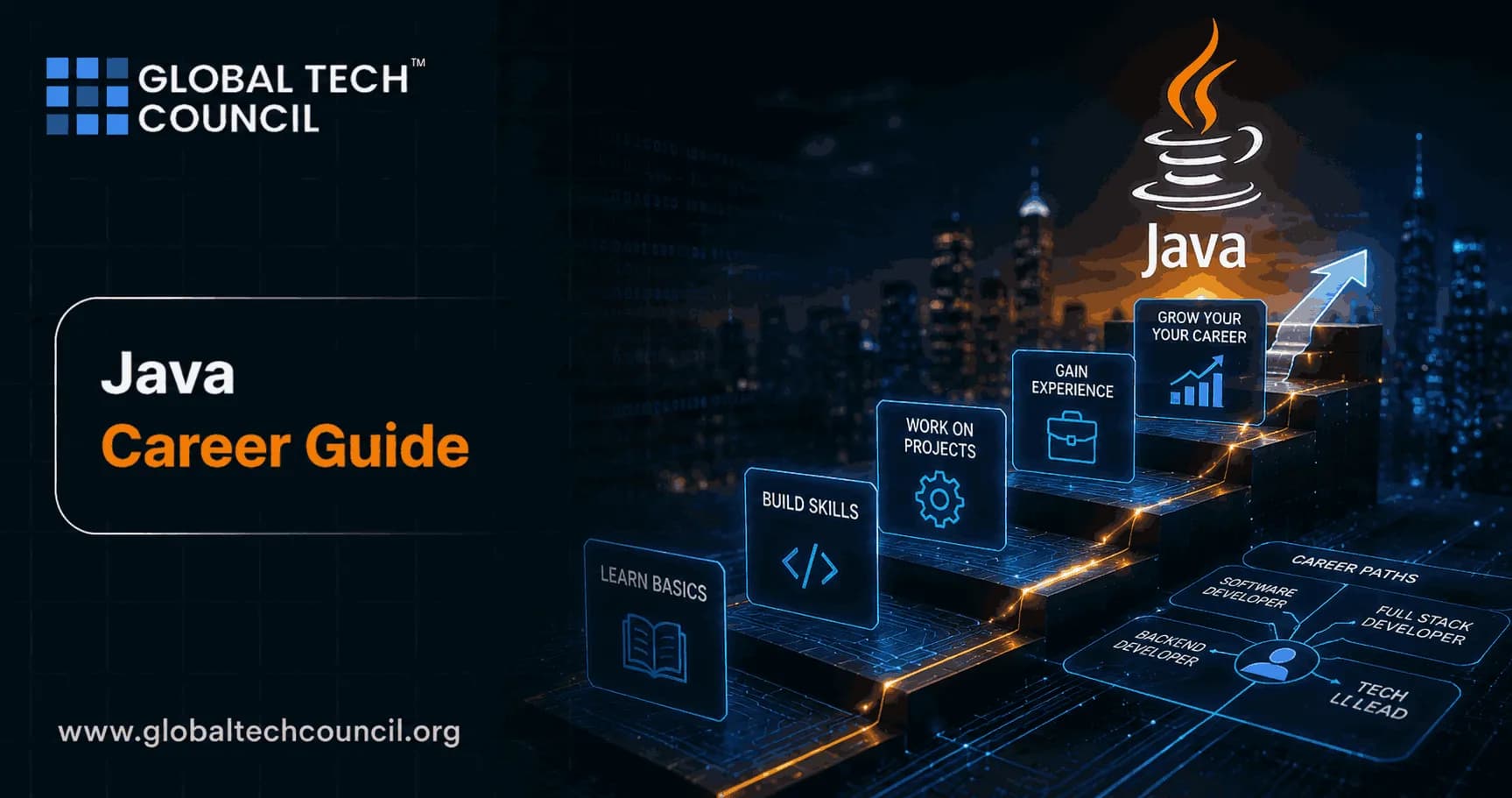
This Java career guide gives you the practical path to become a job-ready Java developer in 2026. Java is still a top enterprise language, but junior hiring is less forgiving than it was a few years ago. Syntax alone will not get you far. You need Java, Spring Boot, databases, testing, Git, cloud basics, and enough project work to prove you can ship backend software.
The good news: Java rewards depth. The TIOBE Index placed Java at number 3 in early 2026 with roughly an 8.7 percent share, and the Stack Overflow 2025 Developer Survey showed that about 30 percent of professional developers used Java in the past year. Java is not trendy in the way some newer languages are. It is useful. Banks, insurers, healthcare platforms, government systems, retailers, telecom providers, and SaaS companies still run critical workloads on it.

Why Java Still Matters in 2026
Java has stayed relevant because it sits inside long-lived systems where reliability matters. Think payment processing, claims management, order routing, compliance reporting, and high-volume APIs. Rewriting these platforms from scratch is expensive and risky, so most enterprises modernize them piece by piece.
Demand stays strong in financial services, fintech, insurance, healthcare technology, e-commerce, telecom, government, and cloud platform companies. A widely cited figure is that more than 90 percent of Fortune 500 companies run mission-critical systems on Java. That tracks with what you see in real hiring. Java appears heavily in backend, platform engineering, integration, and modernization roles.
There is a catch. The entry-level market is crowded. Employers are not looking for someone who only completed loops, arrays, and inheritance exercises. They want a junior developer who can open a Spring Boot project, understand the Maven build, write a REST endpoint, connect to PostgreSQL, add a JUnit test, and push a clean pull request.
Java Developer Salary and Hiring Outlook
Java pay stays strong because the work is tied to production systems, not throwaway prototypes. Motion Recruitment's 2026 salary guide lists US mid-level Java developer salaries around 114,000 to 141,000 USD. Senior Java developers land around 141,000 to 170,000 USD, while senior Java architects can reach about 188,000 USD nationally and higher in competitive hubs such as San Jose.
Remote senior Java roles stay attractive too, with reported ranges around 144,000 to 174,000 USD. The same data shows senior Java developer compensation growing about 2.3 percent year over year, which signals steady demand rather than a fading market.
Europe shows a similar pattern at the experienced end. Switzerland, for example, has strong demand for senior Java engineers, architects, and cloud-native specialists in banking, pharmaceuticals, insurance, and enterprise technology. Junior demand has cooled compared with the 2021 to 2024 hiring cycle, so new developers need stronger proof of skill.
What a Job-Ready Java Developer Actually Knows
A job-ready Java developer can do more than pass a syntax quiz. You should be comfortable across the full backend workflow, from local development to deployment basics.
1. Core Java and the JVM
Start with modern Java, especially Java 17 and Java 21, since both are long-term support releases. Learn object-oriented programming, collections, generics, exceptions, I/O, lambdas, streams, records, and the basics of concurrency. Do not skip the JVM. You do not need to tune garbage collection on day one, but you should know what heap memory is and why a service can fail with java.lang.OutOfMemoryError: Java heap space.
2. Spring Boot and REST APIs
Spring Boot is the default choice for many Java backend jobs. Learn dependency injection, controllers, services, repositories, configuration files, profiles, validation, and exception handling. Build REST APIs that accept and return JSON. Test them with curl, Postman, or HTTPie.
One practical warning: Spring Boot 3 moved to the Jakarta EE 9 namespaces. If you copy older tutorials, imports like javax.persistence.Entity can fail with package javax.persistence does not exist. The fix is to use jakarta.persistence.Entity. This small detail trips up many learners because older Java 8 and Spring Boot 2 content still ranks well in search.
3. Databases and Transactions
Learn SQL before hiding everything behind an ORM. You should understand joins, indexes, constraints, transactions, isolation levels, and pagination. Then study JPA and Hibernate. Know what lazy loading means. If you have never seen org.hibernate.LazyInitializationException: failed to lazily initialize a collection of role, you probably have not debugged enough real Java persistence code yet.
4. Testing and Code Quality
JUnit 5, Mockito, and integration testing are not optional. A Java developer roadmap that ignores testing is incomplete. Write tests for services, controllers, repository behavior, and error paths. Learn how to read a failing build log and fix it without guessing.
Also learn clean code habits: small methods, meaningful names, clear package structure, and refactoring. Enterprise Java codebases are often old. Your job will include reading code that someone wrote five years ago under deadline pressure. Get used to it.
5. Git, Build Tools, and Team Workflow
Use Git daily. Create branches, make focused commits, resolve merge conflicts, and open pull requests. Learn Maven first unless your target company uses Gradle. Maven is still common in enterprise Java, and you will see pom.xml files everywhere.
You should know how dependencies are resolved, how to run tests from the command line, and how to package an application. If your project only runs from an IDE, it is not job-ready.
6. Cloud, Containers, and Microservices
You do not need to be a Kubernetes administrator for a junior Java role, but you should know Docker basics. Containerize a Spring Boot application. Pass configuration through environment variables. Run the app with PostgreSQL using Docker Compose. Then deploy it somewhere, even a small cloud instance or managed platform.
For microservices, learn the trade-offs. Microservices are a poor choice for a tiny student project with two endpoints. They make sense when teams, scaling needs, and deployment boundaries justify the added complexity. Understand REST, messaging, retries, timeouts, circuit breakers, logging, and monitoring before using the term in interviews.
AI Integration Is Becoming a Java Career Advantage
AI is not replacing Java developers wholesale. It is changing what employers expect. Surveys of enterprise teams show a large share now use Java to support AI functionality. In practice, that often means Java services calling AI APIs, connecting business data to models, processing events through Kafka, or adding recommendation and scoring features to existing systems.
If you want to stand out, build one Java project that integrates an AI service through a normal HTTP API. Keep it boring and useful. For example, add fraud-risk scoring to a transaction API, or product description summarization to an e-commerce backend. Hiring teams prefer a working, tested integration over a flashy demo with no error handling.
A Practical Java Developer Roadmap
Month 1 to 2: Learn core Java. Focus on OOP, collections, exceptions, generics, streams, and basic concurrency. Build console apps and small utilities.
Month 3: Learn SQL and JDBC. Use PostgreSQL or MySQL. Write queries by hand. Understand transactions.
Month 4 to 5: Build Spring Boot APIs. Create CRUD endpoints, validation, service layers, exception handling, and API documentation.
Month 6: Add testing and Git workflow. Use JUnit 5, Mockito, pull requests, and GitHub Actions or another CI tool.
Month 7: Containerize and deploy. Use Docker, Docker Compose, environment variables, and a simple deployment target.
Month 8 and beyond: Add specialization. Choose cloud, microservices, Kafka, security, healthcare integration, fintech systems, or AI integration.
Portfolio Projects That Prove Job Readiness
Do not build ten half-finished apps. Build two or three complete projects and document them properly.
E-commerce backend: authentication, catalog, cart, orders, payments mock, PostgreSQL, tests, Docker Compose.
Transaction processing API: REST endpoints, validation, audit logs, retry handling, role-based access, monitoring-friendly logs.
Kafka event pipeline: Java producer and consumer, event schema, database persistence, error topic, simple dashboard or API.
AI-assisted backend: Spring Boot service that calls an AI API, handles timeouts, stores results, and includes tests for failure cases.
Each README should explain setup, architecture, API endpoints, test commands, environment variables, and known limitations. Screenshots help, but logs, tests, and deployment scripts matter more.
Certification and Learning Path
Structured training can shorten the path, especially if you are switching careers or filling gaps after self-study. Use Global Tech Council's Java courses as a learning path, then connect them with related programming, cloud computing, cybersecurity, data science, and AI courses where they match your career goal.
Choose your path based on the role you want:
Backend developer: Java, Spring Boot, SQL, REST, testing, Git, Docker.
Enterprise developer: Java, Spring, JPA, security basics, messaging, system design.
Cloud-native Java developer: Java, Docker, Kubernetes fundamentals, AWS or Azure basics, CI/CD.
AI-integrated Java developer: Java APIs, data pipelines, Kafka basics, AI service integration, security review.
To be blunt, a certificate alone will not make you job-ready. A certificate plus two deployed projects, clean Git history, tests, and interview practice can.
Your Next Step
Pick one project this week: a Spring Boot REST API with PostgreSQL, JUnit 5 tests, Docker Compose, and a clear README. Build it end to end. Then extend it with authentication or an AI API call. If you want guided structure, pair that project work with Global Tech Council's Java training options and related cloud or AI certification paths. That combination is what turns Java knowledge into job-ready Java developer skill.
Related Articles
View All
Java
What Does a Java Developer Do? Roles, Responsibilities, and Career Path
Learn what a Java developer does, including responsibilities, skills, tools, salary outlook, and the career path from junior developer to architect.

Java
Java Developer Roadmap: Skills, Tools, and Certifications to Build a Career
Follow a practical Java developer roadmap covering core Java, JVM skills, Spring Boot, testing, cloud tools, AI workflows, certifications, and portfolio projects.
Java
Multithreading in Java: A Beginner-Friendly Guide
Learn multithreading in Java, including threads, Runnable, executors, virtual threads, thread safety, lifecycle states, and beginner best practices.
Trending Articles
The Role of Blockchain in Ethical AI Development
How blockchain technology is being used to promote transparency and accountability in artificial intelligence systems.
AWS Career Roadmap
A step-by-step guide to building a successful career in Amazon Web Services cloud computing.
Top 5 DeFi Platforms
Explore the leading decentralized finance platforms and what makes each one unique in the evolving DeFi landscape.