

What Does a Java Developer Do? Roles, Responsibilities, and Career Path
 Suyash Raizada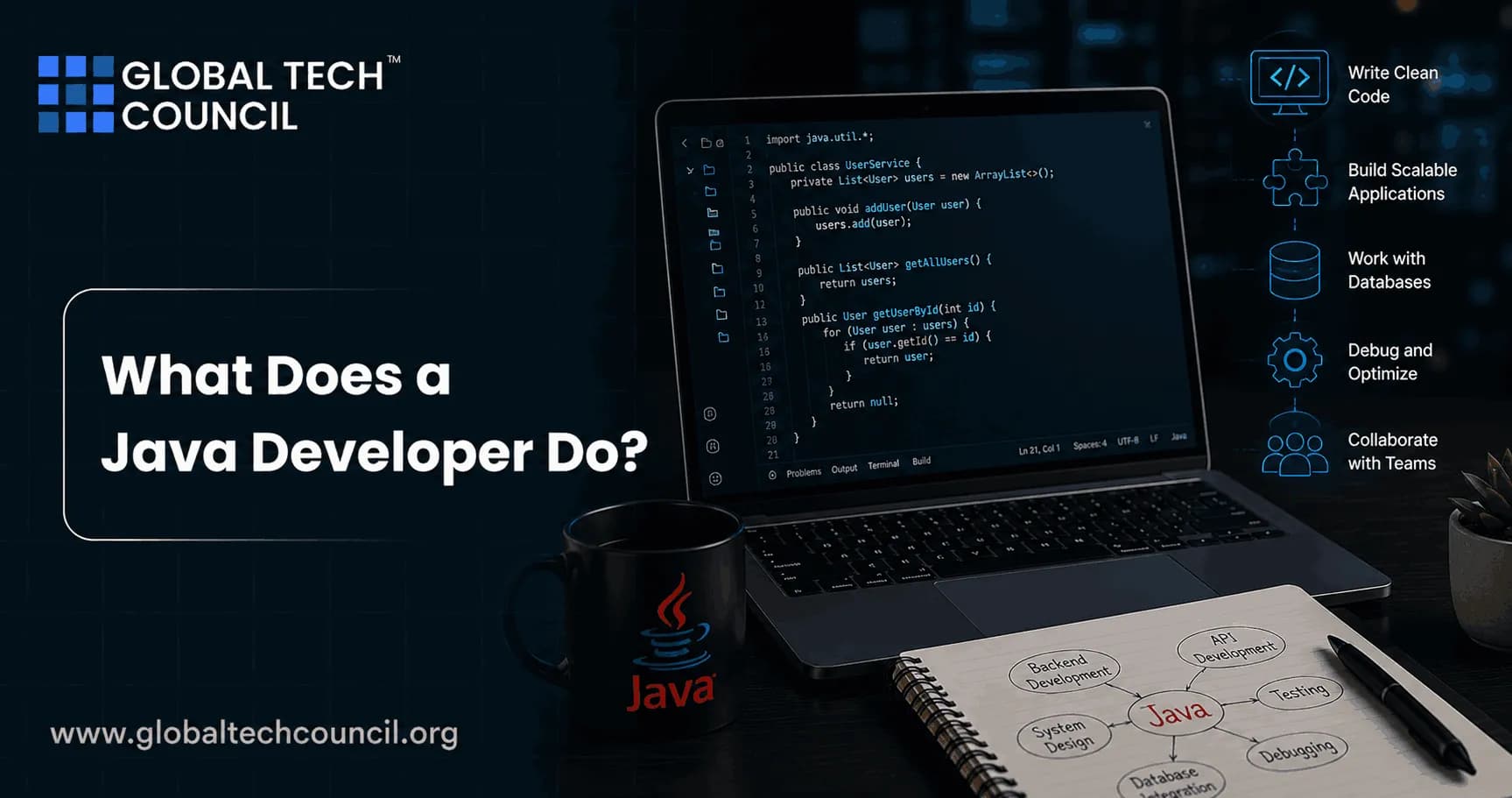
A Java developer designs, builds, tests, deploys, and maintains applications written in Java. In most companies, that means backend services, APIs, enterprise systems, data workflows, and full-stack features that keep business operations running. The work is not just writing classes in an IDE. You read requirements, make design decisions, debug production issues, review code, tune databases, and explain technical trade-offs to people who may not write code.
Java has stayed relevant because it sits inside serious systems: banking platforms, insurance workflows, healthcare software, retail systems, Android applications, and large internal tools. Oracle releases Java on a predictable six-month cadence, and frameworks such as Spring Boot keep the ecosystem practical for modern web and cloud development. Java developers play a crucial role in designing, developing, testing, and maintaining software applications that power enterprise systems, web platforms, cloud services, and Android applications. Pursuing a Tech Certification helps professionals gain practical expertise in Java programming, object-oriented programming, Spring Boot, REST APIs, backend development, databases, and enterprise software architecture. These industry-recognized certifications equip aspiring developers with the technical skills required to succeed in modern software engineering roles and build a strong foundation for long-term career growth.

What Is a Java Developer?
A Java developer is a software engineer who specializes in Java and the wider Java ecosystem. That includes the Java language, the JVM, build tools such as Maven or Gradle, frameworks such as Spring Boot and Hibernate, testing tools such as JUnit, and databases such as PostgreSQL, MySQL, or Oracle Database.
Many Java developers work on server-side applications. You might build a payment service, a customer profile API, a hospital reporting module, or a batch job that processes millions of records overnight. Some Java developers also work on Android applications, desktop tools, or full-stack systems where Java powers the backend and JavaScript handles the browser.
The simplest definition: you turn business requirements into working Java software that other people can trust.
Core Roles and Responsibilities of a Java Developer
1. Understanding Requirements
Before coding starts, you need to understand the problem. A Java developer often works with product managers, analysts, clients, QA engineers, and operations teams to clarify what the software must do.
What data needs to be stored?
Which users can access each feature?
What happens when an external service is down?
How fast does the API need to respond?
This part matters. A poorly understood requirement becomes a bug with a meeting attached.
2. Designing Software and APIs
Java developers translate requirements into technical designs. At junior level, this may mean designing a class or method. At senior level, it may mean deciding service boundaries, database schemas, API contracts, caching strategy, and error-handling patterns.
Say you build a REST API with Spring Boot. You need to decide how controllers, services, repositories, DTOs, validation, and exception handling fit together. Good design keeps the code easy to test and change. Bad design works for two sprints, then starts charging interest.
3. Writing Java Code
Coding is still central to the role. Java developers write application logic using core Java features such as object-oriented programming, collections, generics, streams, exception handling, concurrency, and records in newer Java versions.
A typical backend stack may include:
Java 17 or Java 21 for application development
Spring Boot for web services and microservices
Hibernate or JPA for database mapping
Maven or Gradle for builds and dependency management
PostgreSQL, MySQL, or Oracle Database for persistence
JUnit 5 and Mockito for unit testing
One practical detail: Spring Boot 3 moved fully to Jakarta EE APIs and requires Java 17 or later. During migrations from Spring Boot 2, a common failure is java.lang.ClassNotFoundException: javax.servlet.Filter. The fix is usually not mysterious. You replace old javax.* imports with jakarta.* imports and update compatible libraries. This kind of detail shows up constantly in real Java work.
4. Testing and Debugging
A Java developer is expected to test code before it reaches production. That includes unit tests, integration tests, API tests, and sometimes performance tests.
You will also debug. Often. Common problems include null pointer exceptions, slow SQL queries, transaction boundary mistakes, memory pressure, thread pool exhaustion, and mismatched JSON contracts between services.
Code reviews are part of quality control too. You read other developers' changes, look for missing tests, catch risky design choices, and keep the codebase consistent. Be direct but useful. A review comment should improve the code, not prove you are clever.
5. Performance, Scalability, and Reliability
Java is widely used in systems where performance matters. A Java developer may tune database queries, reduce unnecessary object creation, add caching, configure connection pools, or inspect JVM behavior.
Examples include:
Adding indexes after finding a slow query in PostgreSQL
Using pagination instead of loading 500,000 rows into memory
Tuning HikariCP connection pool settings in a Spring Boot service
Adding Redis caching only where repeated reads justify the complexity
Using message queues such as RabbitMQ or Apache Kafka for asynchronous workflows
Do not add microservices, Kafka, or distributed caching because they sound modern. Use them when the problem needs them. A modular monolith is often the better first design for a small team.
6. Security and Compliance
Java developers handle sensitive data in many industries. You may implement authentication, authorization, input validation, audit logging, encryption, and secure API design. The OWASP Top 10 remains a useful reference for common web application risks, including broken access control and injection flaws.
In regulated sectors such as healthcare and finance, security is not optional. You may need to support compliance requirements, access logs, data retention policies, or role-based permissions. If you build APIs, learn OAuth 2.0, OpenID Connect, TLS 1.3 basics, and secure password storage practices. The responsibilities of a Java developer increasingly extend beyond writing code to supporting AI-powered applications, cloud-native platforms, intelligent automation, and digital transformation initiatives. Becoming a Deeptech Expert helps professionals understand how emerging technologies such as artificial intelligence, blockchain, cloud computing, and advanced analytics are integrated into enterprise software. This interdisciplinary knowledge enables developers to contribute to innovative projects while preparing for future technology leadership roles.
Daily Work by Seniority Level
Junior Java Developer
A junior Java developer usually works under guidance. The goal is to become reliable with small tasks.
Fix simple bugs
Write small features
Add unit tests
Update documentation
Learn project structure, Git workflows, and coding standards
The code review queue is your classroom. Read comments carefully. Ask why, not just what.
Mid-Level Java Developer
Mid-level developers own features from design to deployment. You are expected to make sensible technical decisions without constant supervision.
Build end-to-end application modules
Integrate databases, APIs, and third-party services
Write meaningful tests
Investigate production bugs
Participate in architecture discussions
This is where many developers either grow into system thinkers or stay stuck as ticket takers. Choose the first path.
Senior Java Developer
Senior Java developers design larger systems, mentor others, and take responsibility for production health. You may not write the most code every week, but the code you do write often sets patterns for the team.
Define architecture for services and modules
Set coding and testing standards
Review critical pull requests
Lead incident response for production failures
Mentor junior and mid-level developers
Explain trade-offs to engineering and business leaders
At this level, communication becomes a technical skill. If nobody understands your design, it is not finished.
Java Developer Career Path
The common Java developer career path looks like this:
Intern or Junior Java Developer: Learn core Java, SDLC practices, testing, Git, and frameworks.
Java Developer: Build features, fix defects, work with APIs and databases, and contribute to releases.
Mid-Level Java Developer: Own modules, design integrations, improve performance, and guide smaller technical decisions.
Senior Java Developer: Lead complex design work, mentor others, manage technical risk, and support critical systems.
Technical Lead or Principal Engineer: Guide architecture and engineering standards across teams.
Solution Architect or Software Architect: Design large systems, integrations, and long-term technology direction.
Engineering Manager: Manage people, delivery, planning, and technical execution.
You can stay technical for a long time. Management is not the only promotion. If you enjoy architecture, debugging hard problems, and coaching engineers, the principal engineer or architect path may fit better. Successful Java developers understand both technical implementation and the business goals their software supports. Earning a Marketing Certification helps professionals strengthen their knowledge of product strategy, customer experience, digital communication, and business growth. These skills enable developers to collaborate effectively with product managers, business stakeholders, and marketing teams while building applications that solve real customer problems and create measurable business value.
Skills You Need to Become a Java Developer
Start with fundamentals. Framework knowledge without core Java is fragile.
Core Java: OOP, collections, generics, exceptions, streams, concurrency, records, and memory basics
Frameworks: Spring Boot, Spring MVC, Spring Security, Hibernate, JPA
Databases: SQL, indexing, transactions, schema design, query tuning
APIs: REST, JSON, validation, versioning, error responses, authentication
Testing: JUnit 5, Mockito, integration testing, test data setup
DevOps basics: Git, CI/CD, Docker, logs, metrics, deployment pipelines
Architecture: caching, messaging, fault tolerance, service boundaries, observability
If you are building a learning plan, pair Java with software engineering discipline. Start with Java programming fundamentals, then move into backend development, cloud, DevOps, cybersecurity, and data-focused certifications listed in the Global Tech Council catalog.
Where Java Developers Work
Java developers work in many domains because Java fits long-lived business systems well.
Finance: payment systems, trading platforms, risk tools, customer portals
Healthcare: patient safety workflows, reporting systems, integrations with devices such as barcode scanners
Retail: inventory, order processing, loyalty systems, e-commerce APIs
Technology: SaaS platforms, developer tools, backend infrastructure
Mobile: Android applications, especially in codebases that still use Java heavily
The work can be pure software, or it can touch hardware, scheduled jobs, compliance reports, and operational tasks. That variety is one reason Java careers stay durable.
Salary and Job Outlook
Java remains a strong career choice because many organizations still depend on Java systems and continue to modernize them. Staffing and recruiting firms consistently describe Java as a major language for enterprise software, web applications, and business-critical platforms.
Recent salary guides from staffing firms place mid-level Java developer salaries in the United States at roughly 114,000 to 141,000 USD, with senior Java developers around 141,000 to 170,000 USD. In high-cost hubs such as San Jose, senior compensation can exceed 200,000 USD. Actual pay depends on location, industry, cloud skills, system design ability, and production ownership.
The strongest candidates are not just Java coders. They can design APIs, model data, secure services, diagnose slow systems, and work well with other teams.
Your Next Step
If you want to become a Java developer, build one serious backend project: a Spring Boot API with authentication, PostgreSQL, tests, Docker, logging, and a small CI pipeline. Then read every error message instead of pasting it blindly into a search box. That habit will make you better fast.
After that, map your learning to a credential path. Explore Global Tech Council certifications in programming, cloud, DevOps, cybersecurity, and data science to support the Java role you want next: backend developer, full-stack engineer, cloud-native Java developer, technical lead, or software architect.
FAQs
1. What Does a Java Developer Do?
A Java developer designs, develops, tests, deploys, and maintains Java-based software applications. They build backend systems, enterprise applications, REST APIs, cloud-native services, and business solutions while ensuring performance, security, and scalability.
2. What Are the Main Responsibilities of a Java Developer?
A Java developer writes clean code, develops software features, integrates databases, builds APIs, fixes bugs, performs testing, optimizes application performance, collaborates with cross-functional teams, and maintains existing applications.
3. What Skills Are Required to Become a Java Developer?
Essential skills include Java programming, object-oriented programming (OOP), Spring Boot, SQL, REST APIs, Git, Maven or Gradle, debugging, testing, multithreading, data structures, algorithms, and cloud computing fundamentals.
4. What Is the Career Path for a Java Developer?
A typical career path progresses from Junior Java Developer to Java Developer, Senior Java Developer, Technical Lead, Software Architect, Engineering Manager, or Solutions Architect, depending on experience and expertise.
5. Is Java Development a Good Career in 2026?
Yes. Java remains one of the most in-demand programming languages for enterprise software, cloud-native applications, financial systems, healthcare platforms, e-commerce solutions, and backend engineering.
6. Which Industries Hire Java Developers?
Java developers are employed in banking, finance, healthcare, insurance, retail, telecommunications, logistics, manufacturing, education, government, cloud computing, and software product companies.
7. What Programming Concepts Should Every Java Developer Know?
Developers should understand Java syntax, object-oriented programming, collections, exception handling, multithreading, file handling, JDBC, REST APIs, design patterns, and software engineering best practices.
8. Why Is Spring Boot Important for Java Developers?
Spring Boot simplifies backend application development by providing auto-configuration, embedded servers, dependency management, REST API development, cloud integration, and microservices support.
9. Do Java Developers Need Database Skills?
Yes. Java developers commonly work with relational databases such as MySQL, PostgreSQL, Oracle Database, and SQL Server, along with NoSQL databases like MongoDB depending on project requirements.
10. What Tools Do Java Developers Use Daily?
Java developers commonly use IntelliJ IDEA, Eclipse, Visual Studio Code, Git, GitHub, Maven, Gradle, Docker, Kubernetes, Postman, JUnit, Jenkins, and database management tools.
11. Do Java Developers Need Cloud Computing Skills?
Yes. Cloud platforms, containerization, CI/CD pipelines, Docker, Kubernetes, and cloud-native development are increasingly important skills for modern Java developers.
12. What Soft Skills Are Important for Java Developers?
Strong communication, teamwork, analytical thinking, problem-solving, adaptability, time management, documentation, and collaboration skills are essential for successful software development careers.
13. How Can Beginners Become Job-Ready Java Developers?
Beginners should master Java fundamentals, build practical projects, learn Spring Boot, practice SQL, develop REST APIs, contribute to GitHub projects, prepare for coding interviews, and understand software development workflows.
14. What Common Mistakes Should New Java Developers Avoid?
Beginners should avoid focusing only on syntax, neglecting object-oriented programming, skipping debugging practice, ignoring Git, avoiding testing, writing poorly documented code, and not building real-world projects.
15. What Certifications Help Java Developers Advance Their Careers?
Certifications in Java programming, Spring Boot, cloud computing, backend development, DevOps, software engineering, and enterprise technologies can enhance technical knowledge and improve employability.
16. How Is AI Changing the Role of Java Developers?
AI-powered tools assist developers with code generation, debugging, documentation, testing, code reviews, and workflow automation, allowing developers to focus more on architecture, business logic, and complex problem-solving.
17. What Career Opportunities Are Available Beyond Java Development?
Experienced Java professionals can transition into Backend Engineering, Full Stack Development, Cloud Engineering, DevOps, Software Architecture, AI Integration, Technical Consulting, Product Engineering, and Engineering Management.
18. How Can Java Developers Build a Strong Professional Portfolio?
Developers should create enterprise-style applications, REST APIs, cloud-deployed projects, GitHub repositories, technical blogs, open-source contributions, and well-documented software demonstrating practical Java skills.
19. Are Java Developers Still in High Demand?
Yes. Organizations continue to hire Java developers because Java remains a core technology for enterprise software, backend infrastructure, financial systems, cloud-native applications, and digital transformation initiatives worldwide.
20. Why Is Becoming a Java Developer a Strong Long-Term Career Choice?
Java developers play a critical role in building secure, scalable, and high-performance software used by organizations across nearly every industry. By combining Java expertise with Spring Boot, cloud computing, DevOps, AI-assisted development, and modern software engineering practices, developers can build rewarding careers with strong job demand, continuous learning opportunities, and long-term growth in the global technology industry.
Related Articles
View All
Java
Java Career Guide: How to Become a Job-Ready Java Developer
A practical Java career guide for becoming job-ready in 2026, covering skills, salary trends, Spring Boot, cloud, AI integration, projects, and certifications.

Java
Java Developer Roadmap: Skills, Tools, and Certifications to Build a Career
Follow a practical Java developer roadmap covering core Java, JVM skills, Spring Boot, testing, cloud tools, AI workflows, certifications, and portfolio projects.

Java
Java vs JavaScript: Key Differences, Use Cases, and Career Opportunities
Java vs JavaScript explained for professionals: compare syntax, runtimes, use cases, performance, learning paths, and career opportunities.
Trending Articles
The Role of Blockchain in Ethical AI Development
How blockchain technology is being used to promote transparency and accountability in artificial intelligence systems.
AWS Career Roadmap
A step-by-step guide to building a successful career in Amazon Web Services cloud computing.
Top 5 DeFi Platforms
Explore the leading decentralized finance platforms and what makes each one unique in the evolving DeFi landscape.