

Java Developer Roadmap: Skills, Tools, and Certifications to Build a Career
 Suyash Raizada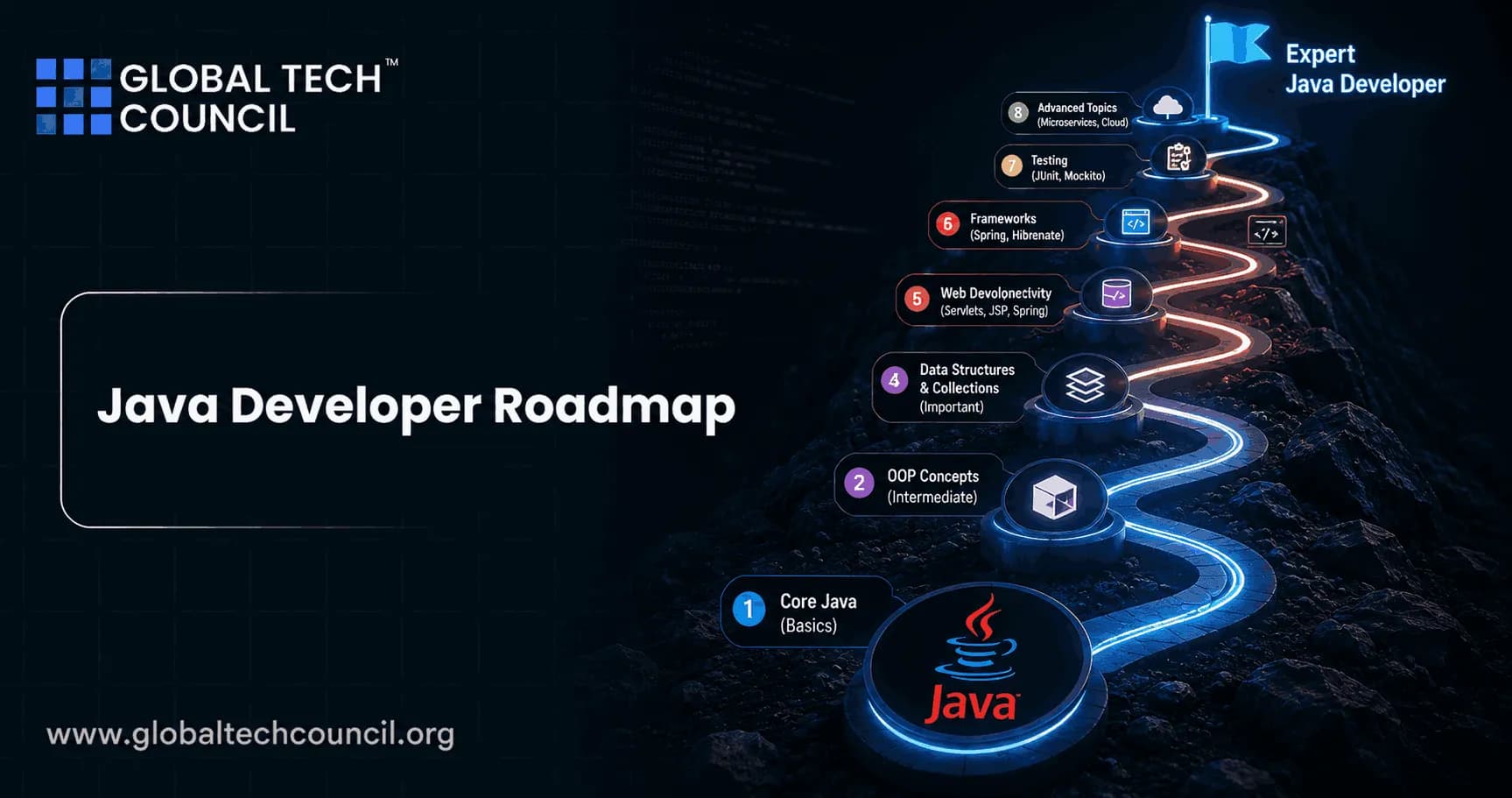
Java developer roadmap planning should start with a simple truth: Java is still a serious back-end and enterprise language, but the job has changed. You are no longer hired only to write classes and methods. Employers expect you to understand the JVM, Spring-based services, SQL, testing, containers, cloud deployment, and increasingly, AI-assisted development workflows.
If you are starting from scratch, do not try to learn everything at once. Build in layers. Core Java first. Then databases, web development, testing, cloud tools, and selective certifications that prove what your GitHub projects already show.

What a Java Developer Actually Does
A Java developer designs, builds, tests, and maintains applications written in Java. That can mean a Spring Boot API for a bank, a batch processing service for insurance claims, an internal ERP module, or a back-end system that talks to Kafka and PostgreSQL all day.
The role usually includes:
Writing clean Java code using object-oriented principles
Debugging defects in production and test environments
Building REST APIs and server-side applications
Working with databases, queues, caches, and external services
Writing unit and integration tests
Deploying applications through CI/CD pipelines
Reviewing code and collaborating through Git
Java remains common in enterprise systems because it is stable, mature, and widely supported. Oracle continues to maintain Java certification paths, and training providers such as IBM and WGU still use Java as a route into entry-level software development roles. Becoming a successful Java developer requires more than learning programming syntax. It involves mastering object-oriented programming, backend development, databases, APIs, Spring Boot, cloud technologies, version control, and software engineering best practices. Pursuing a Tech Certification helps professionals gain practical, industry-relevant skills through hands-on learning. These certifications prepare aspiring developers to build enterprise-grade applications, solve real-world business challenges, and confidently progress from beginner to advanced Java development roles.
Stage 1: Learn Core Java Properly
Start here. Not Spring. Not Kubernetes. Not AI agents. If your Java foundation is weak, every framework will feel like magic.
Core Java topics you must know
Data types, variables, operators, and control flow
Classes, objects, inheritance, interfaces, and polymorphism
Exception handling, especially checked vs unchecked exceptions
Strings, immutability, and the StringBuilder class
Collections such as ArrayList, HashMap, HashSet, Queue, and Deque
Generics and type safety
Java IO and NIO basics
Lambda expressions and streams
Basic multithreading with Thread, Runnable, ExecutorService, and synchronized
Spend real time on collections. Many junior Java candidates can explain OOP, then fail when asked why a poorly written hashCode() breaks a HashSet. That question appears in interviews because it exposes whether you understand Java behavior or only syntax.
Computer science foundations
You do not need to become a competitive programmer, but you do need practical data structures and algorithms. Learn arrays, linked lists, stacks, queues, hash tables, trees, sorting, searching, and Big O notation.
Then apply them in Java. For example, write an LRU cache using LinkedHashMap. Implement a queue with two stacks. Parse a log file and count the most frequent IP addresses. Small tasks teach more than passive watching. Today's Java developers are expected to work alongside technologies such as artificial intelligence, cloud computing, blockchain, DevOps, and intelligent automation. Becoming a Deeptech Expert helps professionals develop a broader understanding of how these emerging technologies complement modern software development. This interdisciplinary expertise enables developers to build innovative applications, adapt to evolving industry trends, and prepare for advanced technical roles in digital transformation initiatives.
Stage 2: Add SQL, Linux, and Git
Most Java applications sit on servers and talk to databases. That means you need more than Java syntax.
SQL: Learn joins, indexes, transactions, constraints, normalization, and query plans.
Linux: Learn
cd,grep,tail -f,ps,top, permissions, environment variables, and service logs.Git: Learn branching, pull requests, rebasing, conflict resolution, and useful commit messages.
Here is a practical habit: when your application fails locally, do not restart the IDE first. Read the logs. Java errors are often plain once you stop scrolling past them. A real example from Spring Boot 3 migrations is java.lang.NoClassDefFoundError: javax/servlet/Servlet. That usually means an older library still expects the old javax.servlet package, while Spring Boot 3 moved to Jakarta EE namespaces such as jakarta.servlet. This small breaking change has wasted many afternoons.
Stage 3: Learn the JVM and Advanced Java
Intermediate Java developer skills begin where syntax ends. You need to understand what happens after code compiles.
JVM topics that matter in real work
Heap vs stack memory
Garbage collection basics
Class loading
JIT compilation at a high level
Thread pools and concurrency issues
Memory leaks caused by static references or unbounded caches
Profiling with tools such as VisualVM, Java Flight Recorder, or IntelliJ Profiler
Do not memorize every garbage collector flag early. Learn the failure modes first. If you see java.lang.OutOfMemoryError: Java heap space, you should know how to capture a heap dump, inspect object retention, and check whether a cache or collection is growing without limits.
Stage 4: Build Web Applications with Spring
For modern Java back-end work, Spring is the default skill to learn. Start with Spring Boot because it removes much of the setup pain and reflects how many teams now build Java services.
Spring and web development roadmap
HTTP basics: methods, headers, status codes, cookies, and JSON
REST API design
Spring Boot project structure
Controllers, services, repositories, and dependency injection
Validation and error handling
Spring Data JPA and Hibernate
Authentication basics with Spring Security
API documentation with OpenAPI
Servlets and JSP are still useful to understand, especially in older enterprise systems. But if your goal is a new back-end role, prioritize Spring Boot, REST APIs, and database integration.
Stage 5: Testing Is Not Optional
Good Java developers write tests. Senior developers design code that can be tested without pain.
Learn these tools:
JUnit 5: Unit tests and assertions
Mockito: Mocking dependencies in service-layer tests
Testcontainers: Integration tests with real PostgreSQL, MySQL, Kafka, Redis, or other dependencies in Docker containers
Maven or Gradle: Builds, dependency management, and test execution
Testcontainers is worth learning early if you want to stand out. Mocking a repository is fine for a unit test, but it does not tell you whether your JPA mapping, migration script, and database constraints work together.
Stage 6: Move into Cloud-Native Java
Once you can build a working API, learn how teams ship it. This is where many Java developers become employable at scale.
Docker: Package your Java application and run it consistently.
Kubernetes: Understand pods, deployments, services, config maps, secrets, and health checks.
CI/CD: Build pipelines with GitHub Actions, Jenkins, GitLab CI, or similar tools.
Infrastructure as Code: Learn the idea behind Terraform or cloud deployment templates.
Cloud platforms: Get familiar with AWS, Azure, or Google Cloud at a basic deployment level.
Also learn Kafka if you are aiming for mid-level or senior Java roles. Event-driven systems are common in banking, retail, logistics, and data platforms. You should understand producers, consumers, topics, partitions, offsets, and consumer groups.
Stage 7: Use AI Tools, But Do Not Outsource Your Judgment
AI coding tools are now part of the Java developer roadmap. GitHub Copilot, ChatGPT, Claude Code, OpenAI Codex-style tools, and local assistants can help generate boilerplate, explain stack traces, draft tests, and review code.
Use them. But verify everything.
You should understand prompts, context windows, Retrieval-Augmented Generation, and how AI agents work at a basic level. In interviews, some companies now allow AI assistance and judge how well you guide, test, and correct the output. That is a different skill from copy-pasting code.
A strong Java developer can ask an AI tool for a Spring Security configuration, then still spot an unsafe default, missing CSRF consideration, or broken authorization rule. That is the bar. Building a successful technology career also requires understanding how software creates business value. Earning a Marketing Certification helps professionals strengthen their knowledge of product strategy, customer experience, digital communication, and business growth. These capabilities enable developers to work more effectively with product managers, business teams, and stakeholders while building software solutions that align with customer needs and organizational objectives.
Java Certifications: Which Ones Are Worth It?
Java certifications can help, but they are not a replacement for projects. Treat them as signal boosters.
Oracle Java certifications
Oracle certifications carry weight because Oracle maintains Java. Entry-level developers often start with associate-level Java credentials, while experienced developers pursue professional-level certifications tied to newer Java versions. Oracle generally recommends the newer-version certifications so developers stay aligned with modern Java features.
These exams are useful if you want formal proof of language knowledge. They also force you to learn details you might skip, such as method overload resolution, generics edge cases, date and time APIs, and stream behavior.
Career-focused Java certificates
Structured programs such as the IBM Java Developer Professional Certificate are designed to build job-ready Java skills in a few months, including web development, databases, Git, Docker, and project work. WGU also connects its Java Developer Certificate to CodeSignal-style assessment preparation, which reflects how many employers screen candidates.
For Global Tech Council learners, this is a good place to connect Java training with related programming, cloud computing, AI, and cybersecurity certification paths. If you want back-end engineering roles, pair Java with cloud and security skills. If you want AI application work, add machine learning foundations and prompt-aware development practices.
Projects to Build for Your Java Portfolio
Your GitHub portfolio should show that you can build and finish software. Keep it practical.
Task management REST API: Spring Boot, PostgreSQL, validation, pagination, and tests.
Expense tracker: User authentication, role-based access, reports, and Docker Compose.
Kafka order pipeline: Produce order events, consume them, handle retries, and log failures.
Library management system: JPA relationships, search, database migrations, and integration tests.
AI-assisted documentation tool: Java back end that stores documents and connects to an LLM API with clear guardrails.
Add a clean README. Include setup steps, architecture notes, test commands, and screenshots or sample API calls. Recruiters may skim, but engineers will read your structure.
A Practical 12-Month Java Developer Roadmap
Months 1 to 2: Core Java, OOP, collections, exceptions, Git, and basic problem solving.
Months 3 to 4: SQL, Linux basics, Maven or Gradle, JUnit, and small console projects.
Months 5 to 6: Spring Boot, REST APIs, validation, JPA, PostgreSQL, and Docker.
Months 7 to 8: Mockito, Testcontainers, Spring Security, CI/CD, and cloud deployment.
Months 9 to 10: Kafka, system design basics, caching, observability, and performance profiling.
Months 11 to 12: Certification preparation, portfolio polish, AI coding workflows, and interview practice.
Next Step
Pick one path now. If you are a beginner, build a Spring Boot REST API with PostgreSQL and JUnit before chasing advanced tools. If you already know Java, add Docker, Testcontainers, Kafka, and cloud deployment. Then use a recognized Java certification, plus related Global Tech Council programming, cloud, AI, or cybersecurity training, to make your skills easier for employers to verify.
FAQs
1. What Is a Java Developer Roadmap?
A Java Developer Roadmap is a structured learning path that outlines the programming skills, frameworks, tools, certifications, and practical experience needed to become a successful Java developer.
2. How Can Beginners Start Learning Java?
Beginners should start by learning Java syntax, variables, data types, operators, control flow, object-oriented programming (OOP), and basic problem-solving before moving on to advanced topics and real-world projects.
3. What Core Java Skills Should Every Developer Learn?
Every Java developer should master Java fundamentals, OOP, collections, exception handling, multithreading, file handling, JDBC, data structures, algorithms, and debugging techniques.
4. Which Frameworks Should Java Developers Learn?
Popular Java frameworks include Spring Boot, Spring Framework, Hibernate, Jakarta EE, and JUnit. These frameworks are widely used in enterprise software, backend development, and cloud-native applications.
5. Why Is Spring Boot Essential for Java Developers?
Spring Boot simplifies backend development by providing auto-configuration, embedded servers, dependency management, REST API support, and microservices capabilities, making it a core skill for modern Java developers.
6. Which Databases Should Java Developers Learn?
Java developers should understand relational databases such as MySQL, PostgreSQL, Oracle Database, and SQL Server, along with NoSQL databases like MongoDB and Redis for modern application development.
7. What Development Tools Should Every Java Developer Use?
Essential tools include IntelliJ IDEA, Eclipse, Visual Studio Code, Git, GitHub, Maven, Gradle, Docker, Postman, JUnit, Jenkins, and database management tools.
8. Why Is Git Important for Java Developers?
Git enables developers to track code changes, collaborate with teams, manage software versions, resolve conflicts, and maintain project history throughout the development lifecycle.
9. Should Java Developers Learn Data Structures and Algorithms?
Yes. Data structures and algorithms improve problem-solving skills, optimize application performance, and are frequently tested during technical interviews for Java developer roles.
10. Do Java Developers Need Cloud Computing Skills?
Yes. Knowledge of cloud platforms, Docker, Kubernetes, CI/CD pipelines, and cloud-native application development is increasingly valuable for modern Java development careers.
11. What Certifications Can Help Java Developers?
Certifications in Java programming, Spring Boot, cloud computing, DevOps, backend development, software engineering, and enterprise technologies can strengthen technical knowledge and improve career prospects.
12. How Important Are Projects in a Java Developer Roadmap?
Projects are essential because they demonstrate practical experience, problem-solving ability, coding skills, and familiarity with real-world software development practices to employers.
13. What Types of Projects Should Java Developers Build?
Developers should build REST APIs, e-commerce applications, employee management systems, banking software, inventory management platforms, authentication systems, cloud-based applications, and microservices projects.
14. What Soft Skills Should Java Developers Develop?
Communication, teamwork, analytical thinking, problem-solving, adaptability, documentation, time management, and collaboration are essential for working effectively in software development teams.
15. How Can Beginners Prepare for Java Developer Interviews?
Candidates should review Java fundamentals, OOP, collections, multithreading, exception handling, Spring Boot, SQL, REST APIs, system design basics, and practice coding problems regularly.
16. How Is AI Influencing the Java Developer Roadmap in 2026?
AI-powered coding assistants help developers generate code, debug applications, write documentation, create test cases, optimize performance, and improve productivity. Understanding AI-assisted development is becoming an increasingly valuable skill.
17. What Common Mistakes Should Aspiring Java Developers Avoid?
Developers should avoid focusing only on theory, skipping practical projects, neglecting Git, ignoring testing, overlooking cloud technologies, memorizing interview answers, and failing to build a professional portfolio.
18. What Career Opportunities Are Available After Learning Java?
Career options include Java Developer, Backend Developer, Full Stack Developer, Software Engineer, API Developer, Cloud Engineer, DevOps Engineer, Technical Lead, Software Architect, and Enterprise Application Developer.
19. How Long Does It Take to Become a Job-Ready Java Developer?
The timeline varies depending on learning pace, prior experience, and practice. Consistent study, hands-on projects, interview preparation, and continuous skill development are more important than completing a roadmap within a fixed timeframe.
20. What Is the Best Java Developer Roadmap for Building a Successful Career?
A successful Java roadmap starts with mastering programming fundamentals, object-oriented programming, collections, exception handling, databases, Spring Boot, REST APIs, Git, cloud computing, and DevOps tools. By building real-world projects, earning relevant certifications, practicing coding interviews, and embracing AI-assisted development, aspiring Java developers can prepare for rewarding careers in enterprise software, backend engineering, and cloud-native application development.
Related Articles
View All
Java
Java Career Guide: How to Become a Job-Ready Java Developer
A practical Java career guide for becoming job-ready in 2026, covering skills, salary trends, Spring Boot, cloud, AI integration, projects, and certifications.

Java
How to Set Up a Java Development Environment: JDK, IDEs, and Build Tools
Set up a Java development environment with the right JDK, IDE, environment variables, and build tools such as Maven, Gradle, or SBT.

Java
What Does a Java Developer Do? Roles, Responsibilities, and Career Path
Learn what a Java developer does, including responsibilities, skills, tools, salary outlook, and the career path from junior developer to architect.
Trending Articles
The Role of Blockchain in Ethical AI Development
How blockchain technology is being used to promote transparency and accountability in artificial intelligence systems.
AWS Career Roadmap
A step-by-step guide to building a successful career in Amazon Web Services cloud computing.
Top 5 DeFi Platforms
Explore the leading decentralized finance platforms and what makes each one unique in the evolving DeFi landscape.