

Model Deployment Explained: Moving Machine Learning from Notebook to Production
 Suyash Raizada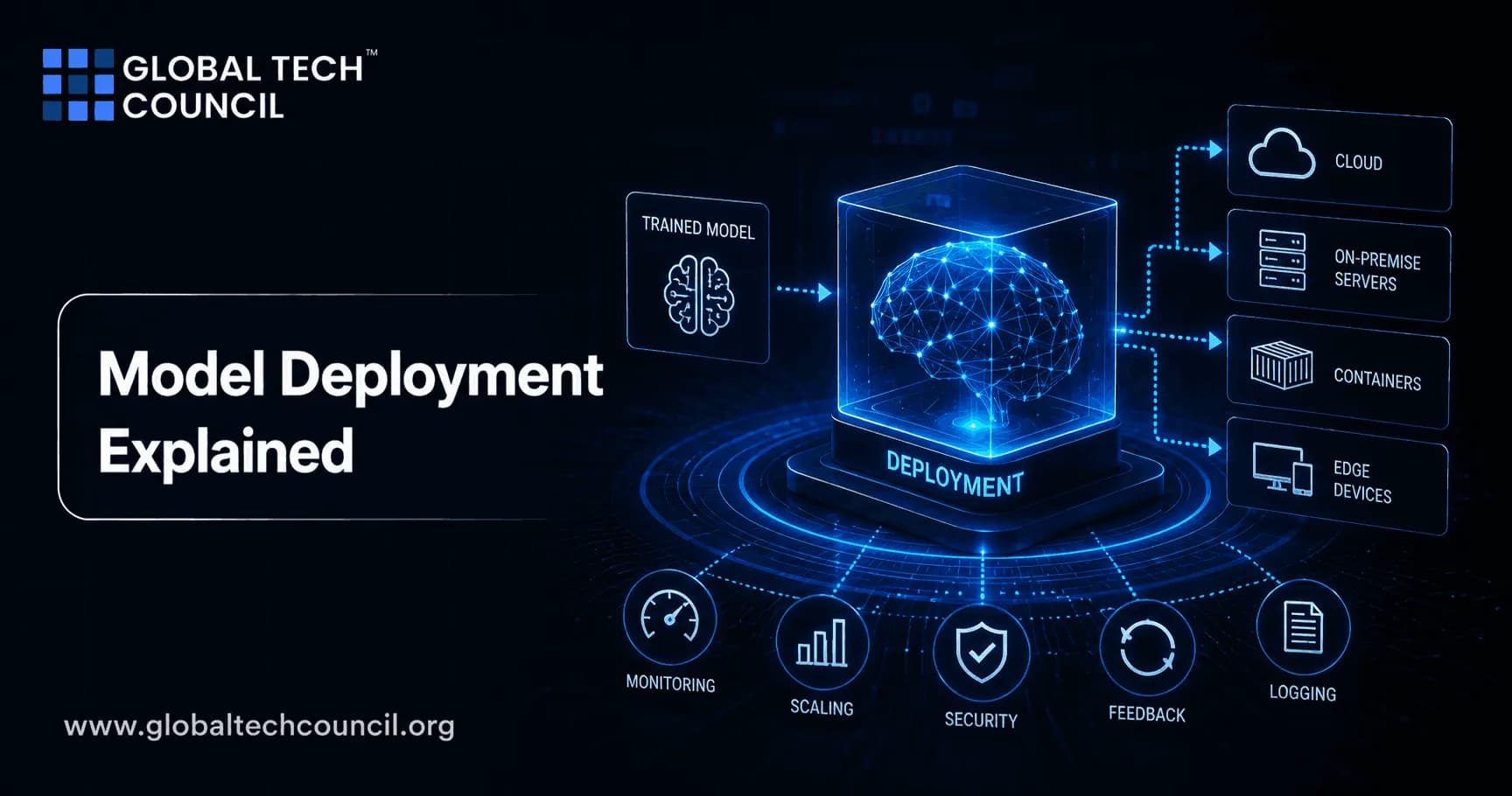
Model deployment is the point where a trained machine learning model stops being an experiment and starts serving real users, applications, or business workflows. That move sounds simple until you try it. A notebook tolerates manual steps, hidden state, missing error handling, and a CSV copied to the right folder. Production does not.
In practice, model deployment means packaging a validated model with its dependencies, connecting it to live data, exposing it through an API, batch job, stream, or edge runtime, and monitoring it after release. IBM frames deployment as part of a governed AI lifecycle. Snowflake describes it as a controlled release that includes inference logic, versioning, monitoring, and rollback. Both views are right. Deployment is engineering, not just exporting a pickle file.

As organizations move machine learning solutions from experimentation to production, a strong understanding of the complete ML lifecycle becomes increasingly valuable. A Certified Machine Learning Expert credential helps professionals develop practical skills in model development, evaluation, deployment, and governance, providing a solid foundation for building reliable production-ready AI systems.
What Model Deployment Actually Includes
A deployed model is a working software component. It has inputs, outputs, latency limits, failure modes, owners, logs, and version history. The model file is only one part of the system.
Successfully deploying machine learning models at scale requires expertise in automation, monitoring, infrastructure, and operational best practices. A Certified MLOps Expert credential helps professionals build these practical skills, covering CI/CD pipelines, model versioning, deployment strategies, observability, and lifecycle management for enterprise AI applications.
A typical production deployment includes:
Model artifact: A serialized model from scikit-learn, PyTorch, TensorFlow, XGBoost, or another framework.
Inference code: Preprocessing, feature transformations, prediction logic, and output formatting.
Runtime environment: Python version, package versions, system libraries, GPU or CPU settings, and configuration.
Serving interface: REST API, gRPC endpoint, scheduled batch process, streaming consumer, or on-device runtime.
Operational controls: Authentication, access control, logging, metrics, alerts, rollback plans, and audit records.
This is why many models that perform well in Jupyter never reach users. The gap is not usually the algorithm. It is the production wrapper around it.
From Notebook to Production: The Practical Lifecycle
1. Train and validate the model
You start in a development environment, often a notebook, where you test features, algorithms, and hyperparameters. Here you care about holdout performance, error analysis, and whether the model solves the actual problem.
Do not deploy just because accuracy looks high. For imbalanced fraud data, 98 percent accuracy can be useless if the model misses almost every fraudulent case. Track precision, recall, F1 score, ROC-AUC, calibration, or business-specific cost metrics depending on the use case.
2. Refactor notebook code into production code
Notebook cells hide problems. Variable state lingers. A feature column can be created in cell 4, overwritten in cell 11, and silently used in cell 17. That is fine for exploration. It is not fine for deployment.
Move preprocessing, prediction, and postprocessing into tested Python modules. Add unit tests for feature transformations. Add integration tests for the full inference path. Simple checks catch painful production bugs.
A real example: a team trains a PyTorch model with 18 input features, then the API sends 17 because one categorical flag was dropped during request parsing. The service fails with RuntimeError: mat1 and mat2 shapes cannot be multiplied (1x17 and 18x64). The fix is not clever modeling. It is schema validation before inference.
3. Package the model and dependencies
Containerization is the common choice because it makes environments repeatable. Docker lets you package the model server, Python runtime, system libraries, and configuration together. Kubernetes, Amazon SageMaker, KServe, Seldon, and similar platforms then run and scale those containers.
Pin versions. This matters more than beginners expect. A scikit-learn pipeline serialized under one version may warn or behave differently under another. Python 3.12 support also varies across libraries, so confirm your dependency stack before choosing a base image.
4. Choose the deployment environment
The right target depends on latency, scale, cost, privacy, and hardware needs.
Cloud virtual machines: Good when you need control over networking, GPUs, or custom dependencies.
Managed model serving: Useful when your team wants autoscaling, model registry integration, and less infrastructure work.
Kubernetes: Strong fit for teams already running microservices and platform engineering practices.
Serverless: Works for lighter models and variable traffic, but cold starts can hurt latency.
Edge devices: Best when inference must happen close to sensors, cameras, or users.
Do not put every model behind a real-time API. If predictions are consumed once each morning in a dashboard, batch scoring is cheaper, simpler, and easier to audit.
Common Model Deployment Patterns
Online real-time inference
Online inference serves predictions through APIs with tight latency targets. Recommendation systems, fraud scoring, dynamic pricing, personalization, and interactive AI features often use this pattern.
FastAPI is a common Python choice for lightweight services. Larger teams may use gRPC for lower overhead and stronger interface contracts. Either way, measure p50, p95, and p99 latency. Average latency hides the request that times out when traffic spikes.
Batch scoring
Batch scoring runs on a schedule and writes predictions to a database, warehouse, or business system. Credit risk refreshes, churn lists, marketing segments, and monthly forecasts often fit this model.
Batch is underrated. It avoids many API scaling issues and makes lineage easier because each run has a timestamp, input snapshot, model version, and output table.
Streaming and event-driven inference
Streaming deployments score events as they arrive from Kafka, Kinesis, Pub/Sub, logs, sensors, or user activity streams. This pattern works well for anomaly detection, IoT monitoring, and operational alerts.
The hard part is not just inference speed. It is handling late events, duplicate messages, schema changes, and backpressure when traffic surges.
Edge and on-device deployment
Edge deployment runs models on mobile devices, cameras, gateways, industrial controllers, or embedded hardware. It can reduce latency, save bandwidth, and keep sensitive data local.
The trade-off is model size and update complexity. Quantization, pruning, and formats such as ONNX or TensorFlow Lite become more relevant here.
Safe Release Strategies: Shadow, Canary, and Blue-Green
You should not replace a production model for all users at once unless the risk is tiny. Progressive release patterns reduce damage.
Shadow deployment: The new model receives the same inputs as the current model, but its predictions are not used for decisions. You compare behavior safely.
Canary deployment: A small percentage of traffic goes to the new model first. If metrics hold, you increase traffic gradually.
Blue-green deployment: Two production-like environments exist. Traffic switches from the old environment to the new one, with fast rollback if needed.
These patterns are standard in software engineering, and they are even more valuable in machine learning because model failures can be subtle. A service can return HTTP 200 while producing biased, stale, or low-quality predictions.
MLOps: The Operating System for Deployment
MLOps brings software engineering discipline to the machine learning lifecycle. Instead of copying files manually, mature teams use version control, CI/CD, model registries, feature stores, automated tests, and monitoring.
Useful building blocks include:
Model registry: MLflow Model Registry, SageMaker Model Registry, or platform-specific registries for storing versions, metadata, and approval status.
CI/CD pipelines: GitHub Actions, GitLab CI, Jenkins, or cloud-native pipelines to build containers, run tests, and promote artifacts.
Feature management: Feature stores or governed warehouse views to keep training and inference definitions aligned.
Serving platforms: KServe, Seldon, BentoML, Ray Serve, SageMaker endpoints, or custom FastAPI services.
Observability: Logs, traces, dashboards, alerts, and drift monitoring.
If you are preparing for a machine learning engineering role, Global Tech Council's Certified Machine Learning Expert certification maps to this work. Pair model theory with a deployment project, not just notebook exercises.
Modern AI deployment also depends on expertise in cloud computing, container orchestration, cybersecurity, software engineering, and infrastructure automation. A Deep Tech Certification helps professionals strengthen these advanced technical capabilities, enabling them to build secure, scalable, and resilient machine learning deployment environments.
Metrics You Need After Deployment
Deployment is not finished at go-live. That is when real evaluation begins.
Model quality metrics
Track the same quality metrics that matter to the business: precision, recall, F1 score, mean absolute error, ranking quality, calibration, false positive cost, or false negative cost. The right metric depends on the decision being made.
System metrics
Monitor latency, throughput, CPU, memory, GPU utilization, queue depth, timeout rate, error rate, and cost per prediction. For an online API, p95 and p99 latency often matter more than the mean.
Data drift and concept drift
Data drift happens when input distributions change. Concept drift happens when the relationship between inputs and outcomes changes. Both can degrade a model even when the code has not changed.
Track feature distributions, missing values, category frequencies, prediction distributions, and delayed ground-truth performance. If a credit risk model was trained before a major economic shift, expect drift. Models do not know the world changed unless you measure it.
Versioning and auditability
Keep records of model version, training dataset, feature definitions, code commit, package versions, deployment date, approver, and rollback target. This is essential for regulated use cases and very helpful during incidents.
Security and Compliance Risks
Production models handle real data, so they need real security controls. Use TLS 1.3 where appropriate, enforce authentication, restrict access to model endpoints, and log sensitive actions. Do not expose raw prediction services publicly without rate limits and abuse monitoring.
Also protect training and inference data. If a model influences finance, health, employment, or public services, governance should include explainability, human review paths, retention policies, and audit trails. The NIST AI Risk Management Framework is a useful reference for organizing this work.
Where Model Deployment Is Heading
The industry is moving away from ad hoc scripts toward integrated platforms. Model registries, feature stores, deployment pipelines, and monitoring are becoming expected parts of the stack.
Cloud-native serving will keep growing because autoscaling and managed infrastructure reduce operational load. Edge deployment will also expand in manufacturing, mobile AI, robotics, and IoT because latency and privacy matter there. The hard requirement across both directions is the same: traceable, testable, monitored releases.
Next Step: Build a Small Deployment Yourself
Take one trained model and deploy it as a versioned FastAPI service in Docker. Add request validation, a health endpoint, latency logging, and one drift check on an input feature. Then run a canary-style test by sending only sample traffic to the new version.
If you want a structured path, use that project alongside Global Tech Council's Certified Machine Learning Expert program. If your role touches infrastructure or secure AI systems, add cloud, DevOps, and cybersecurity training next. Production machine learning rewards people who can connect models to software, data, and operations without pretending the notebook was the finish line.
Beyond technical implementation, successful AI initiatives require professionals who can connect deployment strategies with business objectives and communicate their impact to stakeholders. A Marketing & Business Certification helps develop these business-oriented skills, enabling teams to align machine learning projects with organizational goals and maximize long-term value.
FAQs
1. What is model deployment in machine learning?
Model deployment is the process of making a trained machine learning model available for real-world use after development and testing. It involves integrating the model into applications, APIs, cloud services, edge devices, or business workflows so it can generate predictions on new data.
2. Why is model deployment important?
Deployment transforms a machine learning model from an experimental artifact into a practical business solution. Without deployment, even highly accurate models cannot deliver value through automation, decision support, or customer-facing applications.
3. What is the difference between model training and model deployment?
Model training focuses on learning patterns from historical data by adjusting model parameters to optimize performance. Model deployment focuses on serving trained models reliably, securely, and efficiently within production environments where they process live or scheduled data.
4. What steps are involved in deploying a machine learning model?
A typical deployment workflow includes data validation, model evaluation, serialization, containerization, infrastructure preparation, API or application integration, security testing, deployment, monitoring, logging, and ongoing maintenance. The exact process varies depending on the application's architecture and operational requirements.
5. What is model serialization?
Model serialization is the process of saving a trained machine learning model into a reusable file format so it can be loaded later without retraining. Common serialization methods depend on the machine learning framework and deployment environment being used.
6. What deployment options are available for machine learning models?
Machine learning models can be deployed as REST APIs, microservices, batch processing jobs, streaming inference systems, embedded applications, edge devices, mobile applications, or cloud-native services. The most suitable option depends on latency, scalability, availability, and business requirements.
7. What is real-time inference?
Real-time inference generates predictions immediately after receiving new input data. This deployment approach is commonly used in fraud detection, recommendation systems, virtual assistants, autonomous systems, and customer-facing applications where low latency is important.
8. What is batch inference?
Batch inference processes groups of records on a scheduled basis rather than responding instantly to individual requests. It is commonly used for sales forecasting, customer segmentation, reporting, and other workloads where immediate predictions are not required.
9. What role do APIs play in model deployment?
Application Programming Interfaces (APIs) provide a standardized way for software applications to send data to deployed machine learning models and receive predictions. APIs simplify integration across web applications, mobile apps, enterprise systems, and cloud services.
10. Why is Docker commonly used for model deployment?
Docker packages machine learning applications and their dependencies into portable containers that run consistently across different environments. Containerization helps reduce compatibility issues and simplifies deployment across development, testing, and production systems.
11. How does Kubernetes support machine learning deployment?
Kubernetes automates container orchestration by managing deployment, scaling, load balancing, health monitoring, and recovery of containerized applications. It is widely used to operate machine learning services in production environments with high availability requirements.
12. What cloud platforms support machine learning deployment?
Major cloud providers offer managed machine learning deployment services, including Amazon SageMaker, Google Vertex AI, Microsoft Azure Machine Learning, and other cloud-native AI platforms. These services often include model hosting, monitoring, scaling, security, and lifecycle management capabilities.
13. What is model monitoring after deployment?
Model monitoring continuously evaluates prediction quality, latency, resource utilization, system availability, error rates, and operational health. Monitoring helps organizations detect problems early and maintain reliable machine learning services over time.
14. What is model drift?
Model drift occurs when a deployed model's predictive performance declines because incoming data or underlying real-world relationships change. Organizations typically monitor for data drift, concept drift, and feature drift to determine when retraining or model updates may be necessary.
15. What security considerations are important during deployment?
Organizations should implement authentication, authorization, encryption, secure API access, vulnerability management, logging, audit trails, and protection against adversarial attacks where appropriate. Sensitive data should also be handled according to applicable privacy regulations and organizational security policies.
16. What challenges are common when deploying machine learning models?
Common challenges include integrating models with existing systems, ensuring scalability, maintaining low latency, managing infrastructure costs, preventing training-serving inconsistencies, monitoring model performance, handling changing data distributions, and coordinating cross-functional teams.
17. What are best practices for successful model deployment?
Best practices include validating models thoroughly before release, automating deployment pipelines, using version control, implementing continuous monitoring, documenting configurations, testing rollback procedures, securing infrastructure, and establishing clear governance for updates and maintenance.
18. How does MLOps improve model deployment?
MLOps standardizes deployment through automation, reproducible workflows, continuous integration, continuous delivery, model versioning, monitoring, governance, and collaboration across data science, engineering, and operations teams. These practices help improve deployment reliability and operational efficiency.
19. What trends are shaping model deployment in 2025-2026?
Key trends include serverless inference, edge AI deployment, LLMOps, AI agent deployment frameworks, Kubernetes-native serving platforms, model optimization for efficient inference, observability tools, automated retraining pipelines, and stronger governance for foundation models and enterprise AI systems.
20. What is the future of machine learning model deployment?
Model deployment is expected to become increasingly automated, scalable, and integrated with broader AI operations as organizations adopt more advanced machine learning and foundation models. Future deployment platforms will likely emphasize efficient inference, continuous monitoring, responsible AI governance, hybrid cloud support, and seamless lifecycle management from experimentation through retirement. Building an accurate model is only half the journey; getting it to work reliably in production is where the real engineering adventure begins, and production has an uncanny talent for finding bugs that notebooks politely ignored.
Related Articles
View All
Machine Learning
Model Training Explained: How Machine Learning Models Learn
Model training explained with the learning loop, loss functions, backpropagation, gradient descent, mini-batches, validation, and practical debugging tips.

Machine Learning
Machine Learning Model Evaluation Explained: Accuracy, Precision, Recall, F1, and ROC-AUC
Learn machine learning model evaluation with accuracy, precision, recall, F1, and ROC-AUC. Understand formulas, trade-offs, class imbalance, and threshold selection.

Machine Learning
TensorFlow Tutorial for Beginners: Build Your First Machine Learning Model
Learn TensorFlow for beginners by building, training, evaluating, and saving your first Keras machine learning model with MNIST.
Trending Articles
The Role of Blockchain in Ethical AI Development
How blockchain technology is being used to promote transparency and accountability in artificial intelligence systems.
AWS Career Roadmap
A step-by-step guide to building a successful career in Amazon Web Services cloud computing.
Top 5 DeFi Platforms
Explore the leading decentralized finance platforms and what makes each one unique in the evolving DeFi landscape.