

Model Training Explained: How Machine Learning Models Learn
 Suyash Raizada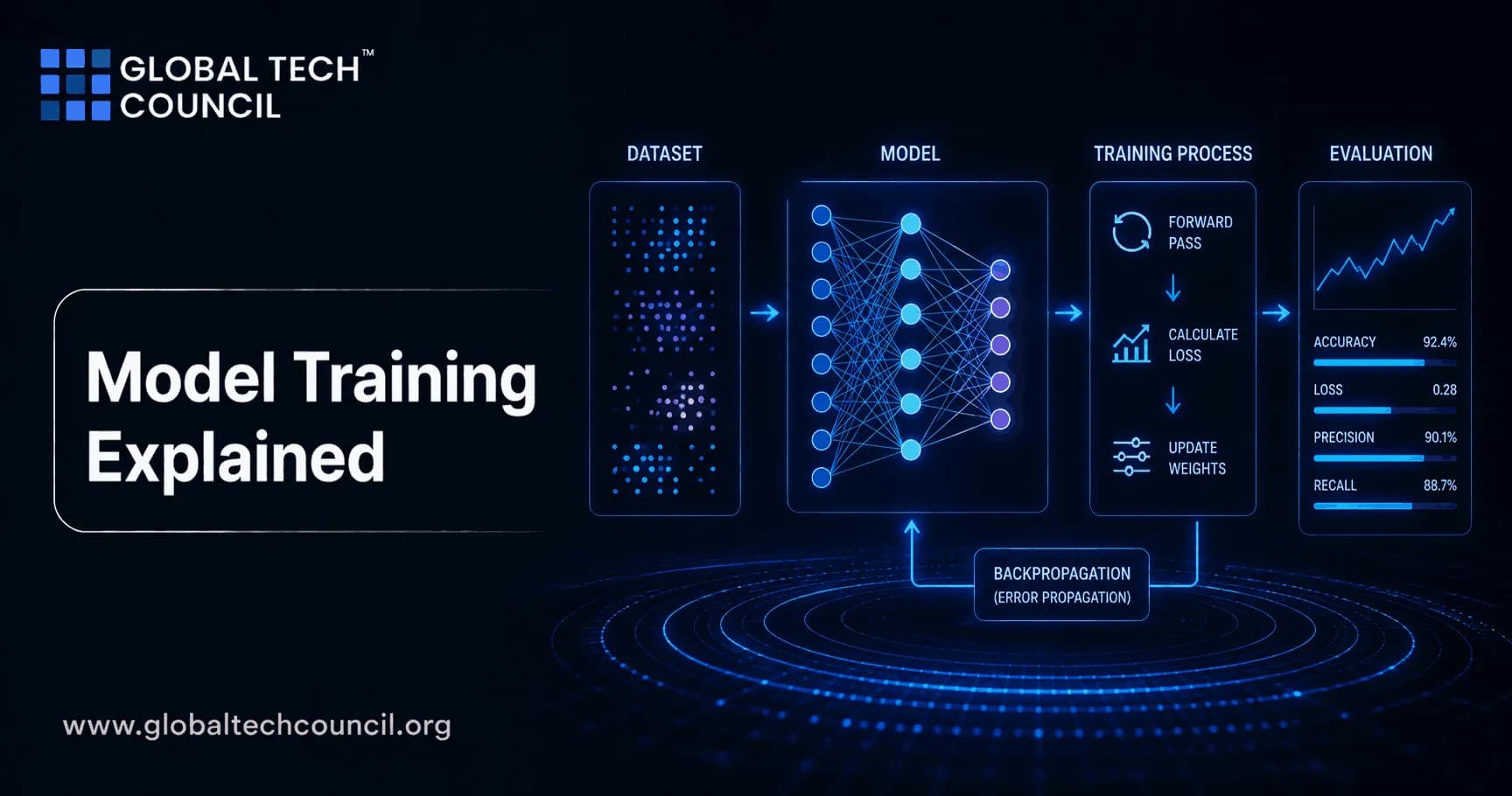
Model training is the process of teaching a machine learning model to make better predictions by showing it data, measuring its errors, and adjusting its internal parameters until those errors shrink. That sounds simple. The hard part is doing it reliably when the model has millions, or billions, of weights and the data is messy.
If you have trained a neural network in PyTorch or TensorFlow, you have already seen the basic pattern: run a forward pass, calculate loss, call backpropagation, update weights, repeat. The same loop sits under image classifiers, recommendation systems, fraud models, speech models, and large language models. The tools change. The learning loop does not.

Building effective machine learning models requires a strong understanding of training workflows, optimization techniques, and model evaluation. A Certified Machine Learning Expert credential helps professionals develop these practical skills, providing a solid foundation for creating reliable models that perform well from experimentation through production.
What Model Training Means
A model starts with parameters. In a neural network, these parameters are mostly weights and biases. At the start, they may be random, copied from a pre-trained model, or initialized with a method such as Xavier or Kaiming initialization.
Training searches for parameter values that make the model's predictions match the examples in the training data. For a house price model, that means predicted prices should be close to actual sale prices. For a medical image classifier, the output class should match the labeled diagnosis. For a chatbot model, the next-token probabilities should match patterns learned from text.
Three pieces matter most:
Parameters: The numbers the model updates during training.
Loss function: A single score that tells the model how wrong it is.
Optimizer: The algorithm that changes the parameters to reduce the loss.
Backpropagation is what makes neural network training practical, because it computes the gradients needed to update weights efficiently. The foundation taught across most machine learning courses is the same: define an objective, compute error, update parameters, and repeat.
As machine learning projects move into production, training becomes part of a broader lifecycle that includes reproducibility, experiment tracking, deployment, and continuous monitoring. A Certified MLOps Expert credential helps professionals develop these operational skills, enabling them to manage model training and deployment workflows efficiently at enterprise scale.
The Core Learning Loop
Most neural network training follows a four-step loop. You will see it in handwritten NumPy examples, PyTorch 2.x scripts, TensorFlow training jobs, and managed cloud pipelines.
1. Forward Pass
The model receives input data and produces predictions. In an image model, tensors may pass through convolution layers, activation functions, pooling layers, and fully connected layers. In a transformer, tokens pass through embeddings, attention blocks, feed-forward layers, and normalization steps.
Nothing is learned yet. The model is only guessing based on its current weights.
2. Loss Computation
The loss function compares predictions with the correct answers. Regression tasks often use mean squared error. Classification tasks often use cross-entropy loss. Language models typically use cross-entropy over predicted next-token distributions.
A lower loss means the model is doing better on that batch. Not always better in the real world, though. A model can reduce training loss while getting worse on unseen data, which is classic overfitting.
3. Backpropagation
Backpropagation calculates how much each parameter contributed to the loss. It applies the chain rule from calculus layer by layer, starting at the output and moving backward through the network.
Modern frameworks use automatic differentiation, so you rarely write gradient equations by hand. In PyTorch, for example, the computation graph tracks operations on tensors. Calling loss.backward() computes gradients for parameters with requires_grad=True.
A small practitioner warning: if you accidentally detach the loss from the graph, training stops. A common PyTorch error is RuntimeError: element 0 of tensors does not require grad and does not have a grad_fn. I have seen this happen when someone converts a tensor with loss.item() too early, then tries to call backward on the scalar. The model is not broken. The graph is gone.
4. Gradient Descent Update
The optimizer updates parameters in the opposite direction of the gradient. The learning rate controls the step size. Too high, and training may diverge. Too low, and the run crawls.
To be blunt, learning rate is often the first hyperparameter you should check. For many AdamW fine-tuning jobs, moving from 1e-3 to 2e-5 can be the difference between useful adaptation and a model that forgets what it knew. Batch size, weight decay, and warmup matter too, but learning rate bites beginners fastest.
Train, Validation, and Test Data
Good model training depends on clean separation of data. If you evaluate on the same data you used to train, your score is usually too optimistic.
Training set: Used to update parameters.
Validation set: Used to tune hyperparameters and choose between model versions.
Test set: Held back until the end to estimate performance on unseen examples.
This split is not paperwork. It protects you from fooling yourself. In fraud detection, for example, random splitting can leak future behavior into training data. A time-based split is often the better choice because production data arrives in time order.
Mini-Batches and Epochs
Training on the entire dataset before every update is expensive. Updating after every single example is noisy. Mini-batch gradient descent sits between those extremes.
The data is shuffled and divided into small groups called mini-batches. For each mini-batch, the model runs a forward pass, calculates loss, runs backpropagation, and updates parameters. One full pass through all mini-batches is called an epoch.
Batch size changes training behavior. A batch size of 32 is common in small computer vision experiments. Large language model training may use much larger effective batch sizes through gradient accumulation across GPUs. Bigger is not automatically better. Large batches can improve hardware utilization, but they may also require learning rate tuning and more careful warmup.
Gradient Descent Variants
There are three common ways to compute gradient updates:
Batch gradient descent: Uses all training examples for each update. Accurate, but often slow and memory-heavy.
Stochastic gradient descent: Uses one example at a time. Fast updates, but very noisy.
Mini-batch gradient descent: Uses a small subset for each update. This is the standard in most deep learning systems.
Optimizers such as SGD with momentum, Adam, and AdamW build on these ideas. Momentum smooths updates by tracking recent gradient direction. Adam adapts update sizes per parameter. AdamW separates weight decay from the gradient update, which is one reason it became common in transformer training.
Why Loss Can Fall While Accuracy Stays Bad
This is where model training gets practical. A falling loss does not guarantee a useful model.
The training labels may be noisy or inconsistent.
The validation distribution may differ from the training distribution.
The loss function may not match the business metric.
The model may be overfitting memorized patterns.
For imbalanced classification, accuracy can be misleading. If 99 percent of transactions are legitimate, a model that predicts legitimate every time gets 99 percent accuracy and catches zero fraud. Use precision, recall, F1 score, ROC-AUC, or PR-AUC depending on the cost of false positives and false negatives.
Regularization and Early Stopping
Regularization helps a model generalize rather than memorize. Common methods include:
Weight decay: Penalizes overly large weights.
Dropout: Randomly disables units during training to reduce dependency on specific paths.
Data augmentation: Creates useful variation, such as image crops, flips, or text perturbations.
Early stopping: Stops training when validation loss stops improving.
Early stopping is simple and underrated. If validation loss has not improved for several epochs, continuing training often burns compute while making generalization worse.
Model Training at Scale
Small models can train on a laptop. Large models need distributed compute, fast storage, efficient data loading, and checkpointing. Cloud platforms now treat training as a job: package code, choose compute, submit the run, monitor logs, save artifacts, and deploy the trained model behind an endpoint.
Much of the recent work in the PyTorch ecosystem has focused on faster training with fewer GPUs, including high-throughput data loading and improved checkpointing. That matters because long-running jobs fail. A node may disappear. Storage may throttle. A checkpoint can save days of work.
Mixed-precision training is another common efficiency technique. Using FP16 or BF16 can reduce memory use and improve throughput on modern accelerators. But watch for instability. If loss suddenly becomes nan, check learning rate, gradient scaling, and input normalization before blaming the architecture.
Scaling machine learning workloads also requires expertise in cloud infrastructure, distributed computing, software engineering, and cybersecurity. A Deep Tech Certification helps professionals strengthen these advanced technical capabilities, making it easier to build resilient AI training pipelines and production-ready machine learning systems.
Where Model Training Is Used
The same training mechanics apply across many machine learning systems:
Classification: Spam detection, image recognition, medical screening, intent detection.
Regression: Price forecasting, demand planning, risk scoring.
Recommendation: Product ranking, content personalization, search relevance.
Natural language processing: Text classification, translation, summarization, large language models.
Computer vision: Object detection, quality inspection, satellite image analysis.
The model architecture may change, but the core workflow remains: prepare data, define loss, train, validate, test, deploy, and monitor.
Skills You Need to Train Models Well
If you want to become competent at model training, do not stop at theory. Build the loop yourself once. Then use a framework.
Learn Python, NumPy, and the basics of linear algebra.
Implement gradient descent for a simple regression model.
Train a neural network in PyTorch or TensorFlow.
Track experiments with metrics, seeds, and dataset versions.
Practice debugging overfitting, underfitting, data leakage, and unstable loss.
For a structured path, use Global Tech Council's machine learning and AI learning tracks as study options, including the Certified Machine Learning Expert and Certified Artificial Intelligence Expert programs where they fit your role. If your work involves production systems, pair model training with MLOps, cloud, and data engineering skills.
What to Learn Next
Start with one small project: train a classifier, split the data correctly, log training and validation loss, and change only one hyperparameter at a time. Then explain why the model improved or failed. That habit matters more than memorizing optimizer names.
If you are preparing for certification or a machine learning role, focus next on backpropagation, loss functions, gradient descent variants, regularization, and evaluation metrics. Then build a training pipeline you can reproduce from raw data to saved model. That is where model training becomes real engineering.
Alongside technical expertise, organizations benefit from professionals who can communicate the value of AI initiatives in business terms. A Marketing & Business Certification helps develop these business-focused communication skills, enabling teams to align machine learning projects with organizational objectives and demonstrate their real-world impact.
FAQs
1. What is model training in machine learning?
Model training is the process of teaching a machine learning algorithm to recognize patterns and relationships within data. During training, the model adjusts its internal parameters to minimize prediction errors and improve its ability to make accurate predictions on new, unseen data.
2. Why is model training important?
Model training is the foundation of machine learning because it enables algorithms to learn from historical data rather than relying on manually programmed rules. Effective training directly influences model accuracy, reliability, and its ability to generalize to real-world scenarios.
3. How do machine learning models learn from data?
Machine learning models learn by analyzing examples, identifying statistical patterns, generating predictions, measuring errors, and updating their internal parameters through iterative optimization. This process repeats until the model reaches an acceptable level of performance or meets predefined stopping criteria.
4. What are training data and labels?
Training data consists of the examples used to teach a machine learning model. In supervised learning, labels are the correct target values associated with each example, allowing the model to compare its predictions with the expected outcomes and learn from the differences.
5. What is the difference between training, validation, and test datasets?
The training dataset is used to learn model parameters, the validation dataset helps tune hyperparameters and monitor performance during development, and the test dataset provides an unbiased evaluation of the final model's ability to generalize to unseen data.
6. What are model parameters?
Model parameters are values learned automatically during training that define how the model makes predictions. Examples include weights and biases in neural networks or coefficients in linear regression models. These parameters are updated throughout the training process to reduce prediction errors.
7. What are hyperparameters?
Hyperparameters are configuration settings chosen before training begins rather than learned from the data. Examples include learning rate, batch size, number of training epochs, tree depth, and regularization strength, all of which influence the training process and model performance.
8. What is a loss function?
A loss function measures the difference between a model's predictions and the correct target values. During training, optimization algorithms seek to minimize the loss, helping the model produce increasingly accurate predictions over successive iterations.
9. What is gradient descent?
Gradient descent is an optimization algorithm that updates model parameters by moving them in the direction that reduces the loss function. Variants such as stochastic gradient descent (SGD), Mini-Batch SGD, Adam, and RMSprop are commonly used depending on the model architecture and problem type.
10. What is backpropagation?
Backpropagation is a training algorithm used primarily in neural networks to calculate how each parameter contributes to prediction errors. These calculated gradients are then used by optimization algorithms to update model weights efficiently during training.
11. What are epochs and batches?
An epoch represents one complete pass through the entire training dataset, while a batch is a smaller subset of the data processed at one time. Mini-batch training balances computational efficiency and learning stability, making it a common approach for modern machine learning and deep learning models.
12. How do you know when training is complete?
Training may stop after reaching a predefined number of epochs, achieving satisfactory validation performance, or triggering early stopping when additional training no longer improves the validation metrics. The optimal stopping point depends on the model, dataset, and business objectives.
13. What challenges occur during model training?
Common challenges include overfitting, underfitting, noisy or insufficient data, class imbalance, poor feature engineering, unstable optimization, long training times, computational resource limitations, and selecting appropriate hyperparameters.
14. How does data quality affect model training?
High-quality, representative, and well-labeled data is essential for effective model training. Missing values, incorrect labels, duplicated records, biased sampling, and inconsistent data can reduce model accuracy and negatively affect generalization.
15. What tools are commonly used for model training?
Popular tools include Scikit-learn, TensorFlow, PyTorch, XGBoost, LightGBM, CatBoost, Jupyter Notebook, Google Colab, MLflow, Weights & Biases, and cloud machine learning platforms such as Amazon SageMaker, Google Vertex AI, and Azure Machine Learning.
16. What are best practices for training machine learning models?
Best practices include preparing clean datasets, using appropriate feature engineering, selecting suitable algorithms, applying cross validation, tuning hyperparameters systematically, monitoring training and validation metrics, documenting experiments, and evaluating models on independent test datasets.
17. How does model training fit into the machine learning lifecycle?
Model training is a central stage within the broader machine learning lifecycle, following data preparation and feature engineering while preceding model evaluation, deployment, monitoring, retraining, and retirement. Successful training depends on close integration with each of these lifecycle stages.
18. How does MLOps improve model training?
MLOps automates training pipelines, tracks experiments, versions datasets and models, manages computational resources, supports reproducibility, and integrates continuous testing and monitoring. These practices improve collaboration and help scale machine learning development across teams.
19. What trends are shaping model training in 2025-2026?
Key trends include foundation model fine-tuning, parameter-efficient training methods, distributed and cloud-native training, synthetic data generation, automated hyperparameter optimization, AI-assisted experiment management, energy-efficient training techniques, and increased adoption of LLMOps alongside traditional MLOps.
20. What is the future of model training in machine learning?
Model training is expected to become increasingly automated, scalable, and resource-efficient as AI platforms evolve. Advances in hardware acceleration, distributed computing, AutoML, foundation models, and responsible AI practices will continue improving how organizations develop and maintain machine learning systems. Even the most advanced model begins by making countless mistakes, which is a surprisingly relatable way to start learning anything.
Related Articles
View All
Machine Learning
Model Deployment Explained: Moving Machine Learning from Notebook to Production
Learn what model deployment means, how models move from notebooks to production, and which MLOps practices keep systems reliable after release.

Machine Learning
Semi-Supervised Learning Explained: Training Models with Limited Labeled Data
Semi-supervised learning uses limited labeled data plus larger unlabeled datasets to train accurate models while reducing annotation effort.

Machine Learning
Machine Learning Model Evaluation Explained: Accuracy, Precision, Recall, F1, and ROC-AUC
Learn machine learning model evaluation with accuracy, precision, recall, F1, and ROC-AUC. Understand formulas, trade-offs, class imbalance, and threshold selection.
Trending Articles
The Role of Blockchain in Ethical AI Development
How blockchain technology is being used to promote transparency and accountability in artificial intelligence systems.
AWS Career Roadmap
A step-by-step guide to building a successful career in Amazon Web Services cloud computing.
Top 5 DeFi Platforms
Explore the leading decentralized finance platforms and what makes each one unique in the evolving DeFi landscape.