

Machine Learning Algorithms Explained: A Practical Beginner Guide
 Suyash Raizada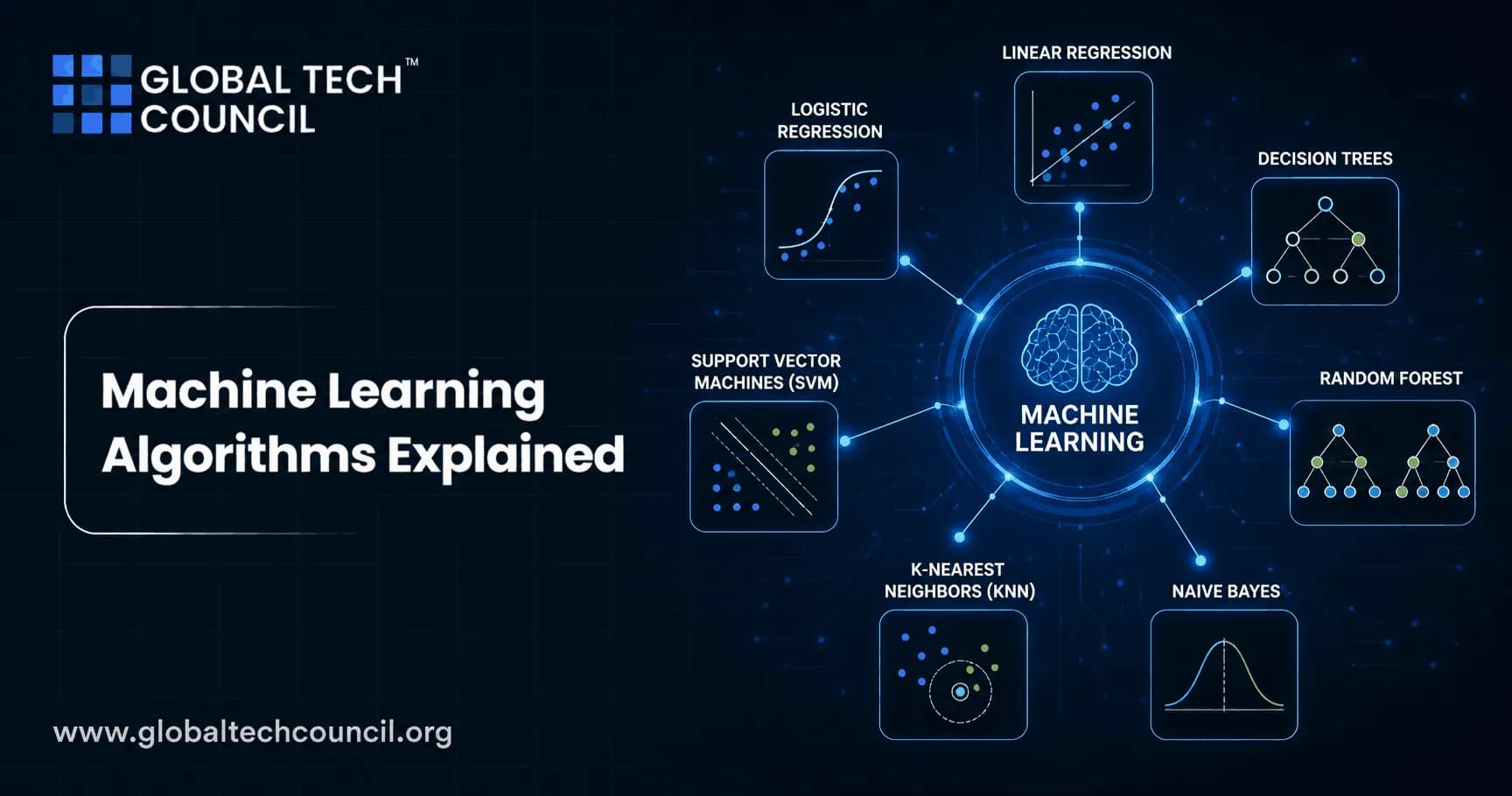
Machine Learning Algorithms are methods that learn patterns from data and use those patterns to predict values, classify records, find groups, or choose actions. If you are starting out, do not try to memorize every algorithm name. Learn the main problem types first, then match each problem to a small set of reliable algorithms.
That is how practitioners work. You frame the problem, check the data, build a simple baseline, measure it, then decide whether a more complex model is worth the extra cost.

Developing a strong understanding of core machine learning algorithms is the foundation for solving real-world AI problems effectively. A Certified Machine Learning Expert credential helps professionals build practical skills in algorithm selection, model evaluation, feature engineering, and predictive analytics, enabling them to choose the right techniques for different business scenarios.
What Are Machine Learning Algorithms?
Machine learning algorithms build mathematical models from examples. In ordinary programming, you write rules. In machine learning, you provide data and the algorithm adjusts its parameters to reduce errors or discover useful structure.
Take a spam filter. It does not need a hand-written rule for every suspicious phrase. It can learn from labeled emails. A demand forecasting model can learn from past sales, holidays, prices, and weather. A clustering model can group customers without being told what the groups should be.
Most beginner material, including the scikit-learn user guide and common university courses, groups ML algorithms into three learning types:
Supervised learning: learn from labeled examples, such as inputs plus the correct answer.
Unsupervised learning: find patterns in data without labeled answers.
Reinforcement learning: learn through actions, rewards, and penalties over time.
As AI systems continue to evolve, professionals need to understand not only individual algorithms but also when and why different approaches should be applied. A Certified AI & Machine Learning Expert credential provides comprehensive knowledge of supervised learning, unsupervised learning, deep learning, and modern AI workflows, helping practitioners make informed decisions across diverse use cases.
Supervised Learning: The Best Starting Point
Supervised learning is where most beginners should start because the goal is clear. You have data, you have labels, and you can measure whether the model is right.
Classification Algorithms
Classification predicts a category. Spam or not spam. Fraud or legitimate. Churn or stay. Positive or negative sentiment.
Common classification algorithms include:
Logistic regression: A strong first model for binary classification. It is fast, interpretable, and often hard to beat on clean tabular data.
Naive Bayes: Useful for text classification, especially with sparse word-count features. Its independence assumption is not fully realistic, but it works surprisingly well.
k nearest neighbors, or kNN: Classifies a point based on nearby examples. It is easy to understand, but prediction can become slow on large datasets.
Support vector machines, or SVM: Good for moderate-sized, high-dimensional datasets. Text classification is a classic use case.
Decision trees: Split data into branches based on feature values. They are easy to explain, but a single tree can overfit quickly.
A practical warning: many beginners run logistic regression in scikit-learn and hit this message: ConvergenceWarning: lbfgs failed to converge (status=1): STOP: TOTAL NO. of ITERATIONS REACHED LIMIT. It usually means your features need scaling, your max_iter is too low, or both. Try StandardScaler inside a pipeline and set max_iter=1000. Small detail. Big difference.
Regression Algorithms
Regression predicts a number. House price, delivery time, revenue, temperature, credit risk score.
Start with these:
Linear regression: Fits a line or linear function to predict a continuous value. It is the baseline you should build before anything fancy.
Ridge regression: Adds L2 regularization to control large coefficients. Good when features are correlated.
LASSO regression: Adds L1 regularization and can push less useful feature weights to zero.
Polynomial regression: Captures curved relationships, but it can overfit if you keep increasing the degree without validation.
Use mean absolute error, mean squared error, or root mean squared error to evaluate regression. Do not use accuracy. Accuracy is for classification.
Unsupervised Learning: Finding Structure Without Labels
Unsupervised learning is useful when you do not know the correct answer ahead of time. You are exploring. That makes evaluation harder, but the results can still be valuable.
Clustering
k means clustering groups similar records into k clusters. It shows up in customer segmentation, product grouping, log analysis, and exploratory data analysis.
One beginner trap: k means needs you to choose k. The algorithm will always create that many clusters, even if the data does not naturally have them. Use domain knowledge, silhouette score, and simple visual checks where possible. Also scale features first. If income is measured in thousands and age is measured in years, income may dominate the distance calculation.
Dimensionality Reduction
Principal component analysis, or PCA, reduces many features into fewer components while keeping as much variance as possible. It helps with visualization, noise reduction, and pre-processing high-dimensional data.
PCA is not magic compression. If the original features are not scaled, the components can be misleading. Fit the scaler on the training data only, then transform validation or test data. Data leakage is a quiet accuracy killer.
Ensemble Methods: When Simple Models Are Not Enough
Ensemble methods combine multiple models. They are widely used because they perform well on structured business data.
Random forests: Build many decision trees on different samples and feature subsets, then average their predictions or vote. They reduce the overfitting risk of a single tree.
Gradient boosting: Builds trees in sequence, where each new tree focuses on previous errors. XGBoost, LightGBM, and CatBoost are popular implementations.
Voting and stacking: Combine different models through voting, averaging, or a second-level model.
My blunt advice: for tabular business problems, try logistic regression or linear regression first, then random forest, then gradient boosting. Deep learning is often the wrong first choice for spreadsheet-style data.
Neural Networks and Deep Learning
Neural networks use layers of connected units to model complex patterns. They are behind image classification, speech recognition, machine translation, recommendation models, and modern generative AI systems.
For beginners, the usual path is:
Dense neural networks for simple tabular or numeric data.
Convolutional neural networks for images.
Recurrent networks for sequence data, though transformers have replaced them in many NLP tasks.
Transformers for language, vision, and multimodal applications.
Neural networks need more data, more compute, and more tuning. They are also harder to explain. If a bank must explain a loan rejection to a regulator, a plain logistic regression model may be a better engineering choice than a deep model with a slightly higher score.
Building enterprise-ready AI solutions requires expertise beyond machine learning algorithms alone. A Deep Tech Certification helps professionals develop advanced capabilities in cloud computing, software engineering, cybersecurity, and scalable AI infrastructure, ensuring that machine learning models can be deployed securely and efficiently in production environments.
Reinforcement Learning: Learning Through Rewards
Reinforcement learning trains an agent to take actions in an environment. The agent receives rewards or penalties and learns a policy that maximizes long-term reward.
Beginner examples include grid worlds, game agents, and simple control problems. Classical Q learning is often introduced first. Deep Q networks, or DQN, extend the idea with neural networks.
Be careful with production claims. Reinforcement learning is powerful, but it is not the default answer for most business prediction problems. If you need to predict churn, use supervised learning. If you need to optimize a sequence of decisions with feedback, then reinforcement learning becomes relevant.
How to Choose the Right Algorithm
Use this practical decision guide:
Predicting a number? Start with linear regression or Ridge regression.
Predicting a category? Start with logistic regression, decision trees, or naive Bayes for text.
Need customer groups? Try k means clustering after scaling your features.
Too many features? Try PCA for visualization or pre-processing.
Need high performance on tabular data? Compare random forest and gradient boosting.
Working with images, speech, or large text datasets? Consider neural networks or transformer-based models.
Need action over time? Look at reinforcement learning.
Always compare multiple models on the same train-test split or, better, cross-validation. A single test run can fool you, especially on small datasets.
A Beginner-Friendly ML Workflow
Do not start by asking, "Which algorithm is best?" Start with the workflow.
Define the target: What exactly are you predicting or discovering?
Inspect the data: Check missing values, duplicates, outliers, class imbalance, and feature types.
Split the data: Use train, validation, and test sets. For classification, use stratified splitting when classes are imbalanced.
Build a baseline: Simple models expose data problems quickly.
Evaluate with the right metric: Accuracy, precision, recall, F1 score, ROC AUC, mean absolute error, or root mean squared error.
Tune carefully: Change one thing at a time when you are learning.
Document decisions: Record features, parameters, metrics, and assumptions.
In Python, most beginners use Jupyter Notebook, pandas, NumPy, matplotlib, and scikit-learn. PyTorch and TensorFlow enter the picture when you move into deep learning.
Real-World Examples of Machine Learning Algorithms
Spam filtering: Naive Bayes, logistic regression, and linear SVM models are common starting points.
Customer churn: Logistic regression, random forests, and gradient boosting work well on customer history and usage data.
Fraud detection: Tree ensembles and anomaly detection methods help flag suspicious transactions.
Recommendation systems: Matrix factorization, nearest-neighbor methods, and deep learning models can rank products or content.
Medical risk scoring: Interpretable models are often preferred because clinicians need explanations, not just predictions.
Network security: SVM, clustering, and tree-based models can support anomaly detection and traffic classification.
Where Beginners Should Focus Next
Learn a small set of Machine Learning Algorithms deeply before you chase advanced models. Train logistic regression, decision trees, random forests, k means, and PCA on real datasets such as Iris, Titanic, and MNIST. Then inspect where each model fails.
If your goal is professional growth, connect this learning path with Global Tech Council resources in machine learning, artificial intelligence, data science, Python programming, and cybersecurity. Use those learning paths to move from algorithm basics to model evaluation, deployment, and responsible AI practice.
Your next step: pick one classification dataset, build a logistic regression baseline in scikit-learn, then compare it with a random forest using F1 score. That one exercise will teach you more than reading ten algorithm lists.
Successfully applying machine learning also requires translating technical results into business value. A Marketing & Business Certification helps professionals strengthen their strategic thinking and communication skills, enabling them to present AI insights effectively, support data-driven decision-making, and align machine learning initiatives with organizational objectives.
FAQs
1. What is a machine learning algorithm?
A machine learning algorithm is a mathematical method that enables computers to identify patterns in data and make predictions or decisions without being explicitly programmed for every scenario. Different algorithms are designed to solve different types of problems, such as classification, regression, clustering, recommendation, and anomaly detection.
2. Why are machine learning algorithms important?
Machine learning algorithms allow organizations to automate data-driven decision-making, uncover hidden insights, and improve predictions across a wide range of applications. They form the foundation of modern artificial intelligence systems used in healthcare, finance, manufacturing, retail, transportation, and many other industries.
3. What are the main categories of machine learning algorithms?
The primary categories are supervised learning, unsupervised learning, semi-supervised learning, self-supervised learning, and reinforcement learning. Each category differs in how data is provided to the algorithm and the type of learning objective it aims to achieve.
4. What are supervised learning algorithms?
Supervised learning algorithms are trained using labeled datasets where the correct output is already known. Common supervised algorithms include Linear Regression, Logistic Regression, Decision Trees, Random Forest, Support Vector Machines (SVM), K-Nearest Neighbors (KNN), Naive Bayes, XGBoost, and neural networks.
5. What are unsupervised learning algorithms?
Unsupervised learning algorithms analyze unlabeled data to discover hidden structures and relationships. Popular examples include K-Means Clustering, Hierarchical Clustering, DBSCAN, Principal Component Analysis (PCA), and association rule learning techniques.
6. What is reinforcement learning?
Reinforcement learning is a machine learning approach in which an agent learns by interacting with an environment and receiving rewards or penalties for its actions. It is widely used in robotics, game-playing AI, autonomous systems, and resource optimization problems.
7. What is the difference between classification and regression algorithms?
Classification algorithms predict categorical outcomes, such as whether an email is spam or not spam, while regression algorithms predict continuous numerical values, such as house prices, sales revenue, or temperature forecasts.
8. What is ensemble learning?
Ensemble learning combines multiple machine learning models to improve predictive accuracy and robustness. Common ensemble techniques include bagging, boosting, and stacking, with algorithms such as Random Forest, Gradient Boosting, XGBoost, LightGBM, and CatBoost being widely used.
9. How do you choose the right machine learning algorithm?
The best algorithm depends on factors such as the problem type, dataset size, feature characteristics, computational resources, interpretability requirements, evaluation metrics, and business objectives. In practice, multiple algorithms are often compared before selecting a final model.
10. Which algorithms are best for beginners?
Algorithms commonly recommended for beginners include Linear Regression, Logistic Regression, Decision Trees, K-Nearest Neighbors (KNN), Naive Bayes, Random Forest, and K-Means Clustering. These methods provide a strong foundation before progressing to advanced ensemble and deep learning models.
11. Which machine learning algorithms are used for structured data?
Structured data is commonly modeled using algorithms such as Linear Regression, Logistic Regression, Decision Trees, Random Forest, XGBoost, LightGBM, CatBoost, Support Vector Machines, and Gradient Boosting. The optimal choice depends on the specific dataset and prediction task.
12. Which algorithms are commonly used for unstructured data?
Deep learning architectures such as Convolutional Neural Networks (CNNs), Transformers, Recurrent Neural Networks (RNNs), and foundation models are widely used for images, text, audio, video, and other forms of unstructured data where automated feature learning is beneficial.
13. What are the advantages of machine learning algorithms?
Machine learning algorithms can automate complex analyses, identify hidden patterns, improve prediction accuracy, scale across large datasets, support decision-making, adapt to changing data, and power intelligent applications across numerous industries.
14. What challenges are associated with machine learning algorithms?
Common challenges include obtaining high-quality data, preventing overfitting, selecting appropriate features, tuning hyperparameters, managing computational costs, avoiding data leakage, addressing bias, ensuring explainability, and maintaining models after deployment.
15. Which Python libraries support machine learning algorithms?
Popular libraries include Scikit-learn, TensorFlow, PyTorch, XGBoost, LightGBM, CatBoost, NumPy, Pandas, SciPy, Statsmodels, Matplotlib, SHAP, Optuna, MLflow, and Hugging Face Transformers. These tools support data preparation, model development, evaluation, deployment, and monitoring.
16. What common mistakes should beginners avoid?
Common mistakes include skipping data preprocessing, using inappropriate evaluation metrics, relying solely on training accuracy, neglecting cross-validation, introducing data leakage, overfitting models, ignoring feature engineering, and failing to compare multiple algorithms.
17. What are best practices for using machine learning algorithms?
Best practices include defining clear objectives, preparing high-quality data, selecting relevant features, comparing multiple models, tuning hyperparameters systematically, validating results on independent datasets, documenting experiments, and monitoring model performance after deployment.
18. How do machine learning algorithms fit into the machine learning lifecycle?
Machine learning algorithms are central to the lifecycle, following data collection and preprocessing while preceding evaluation, deployment, monitoring, retraining, and retirement. Their effectiveness depends on strong data governance, reproducible workflows, and continuous performance assessment.
19. What trends are shaping machine learning algorithms in 2025-2026?
Key trends include foundation models, multimodal AI, parameter-efficient fine-tuning, automated machine learning (AutoML), explainable AI, federated learning, edge AI, synthetic data generation, AI agents, cloud-native MLOps, and responsible AI governance.
20. What is the future of machine learning algorithms?
Machine learning algorithms will continue evolving to become more efficient, interpretable, scalable, and capable of solving increasingly complex real-world problems. Classical algorithms are expected to remain essential for structured data and explainable analytics, while advanced deep learning and foundation models will expand capabilities for unstructured and multimodal applications. Despite the growing collection of sophisticated algorithms, choosing the right one still beats choosing the most complicated one, which must be mildly disappointing for fans of unnecessary complexity.
Related Articles
View All
Machine Learning
Machine Learning Algorithms Explained: A Simple Guide
Machine learning has become one of the most talked-about areas in technology, yet many people still see it as confusing or overly technical. In reality, the central idea is straightforward. Machine learning allows computers to learn patterns from data and use those patterns to make predictions,…

Machine Learning
How to Choose the Right Machine Learning Algorithm: A Practical Decision Guide
A practical, step-by-step guide to choosing the right machine learning algorithm based on task type, data structure, metrics, constraints, and systematic testing.

Machine Learning
Machine Learning Certification Guide: Choose the Right Program
A practical 2026 guide to choosing the right machine learning certification based on role, skill level, curriculum, projects, cloud stack, and career goals.
Trending Articles
The Role of Blockchain in Ethical AI Development
How blockchain technology is being used to promote transparency and accountability in artificial intelligence systems.
AWS Career Roadmap
A step-by-step guide to building a successful career in Amazon Web Services cloud computing.
Top 5 DeFi Platforms
Explore the leading decentralized finance platforms and what makes each one unique in the evolving DeFi landscape.