

Tesla Roadster: Is It the World’s First Flying Car?
 Suyash Raizada
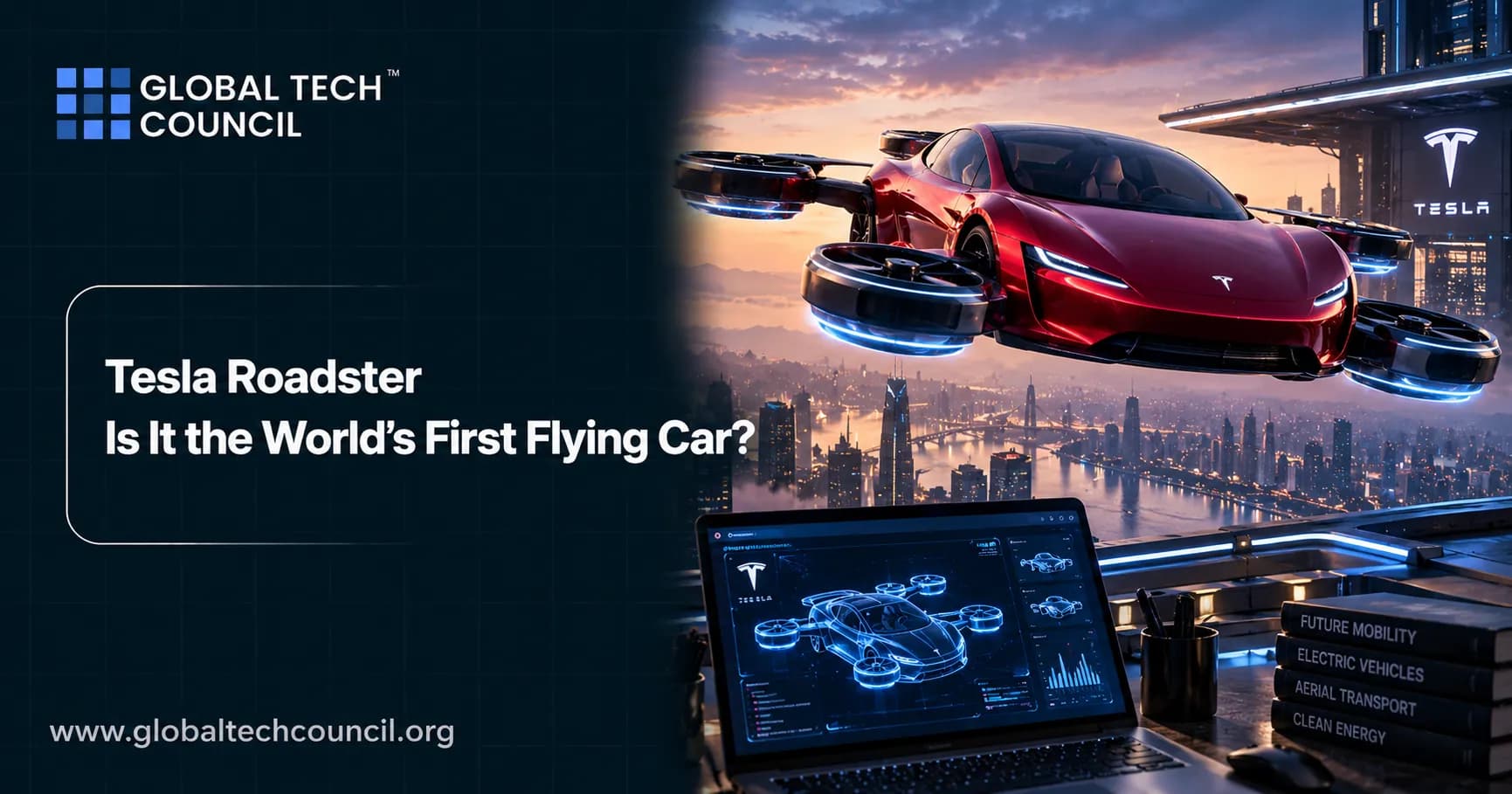
When Tesla showed off its redesigned Roadster in October 2026, the internet quickly asked one big question: has the world finally got a real flying car? The answer is yes and no. The car did leave the ground in a controlled demonstration, and Elon Musk said flying cars are real. But experts, regulators and the fine print tell a more careful story. This article explains what the Tesla flying car can and cannot do, how it works, what it may cost and what to watch next. If you enjoy making sense of big technology claims, a general Tech Certification can give you the foundation to judge them with confidence.
Short Answer: Is the Tesla Roadster a Flying Car?
Not in the everyday sense of the phrase. The Tesla Roadster is an electric sports car with optional rocket-style thrusters that can lift it off the ground for brief moments. It is not an aircraft, it does not cruise through the sky and no aviation authority has approved it. CNN reported that an aviation expert described the demonstration as closer to hopping than flying.

Here is a simple way to compare the claims:
Question | Answer today |
|---|---|
Did the car leave the ground? | Yes, in a controlled demo |
Can it fly long distances? | Not shown |
Is flight approved for public use? | No |
Can customers buy the flying version? | Not yet, and the top version is invitation only |
Has independent testing confirmed the numbers? | Not yet |
What Happened at the Tesla Roadster Unveiling
On Thursday, October 15, 2026, Tesla held a livestreamed event at SpaceX’s rocket test facility in McGregor, Texas. A white prototype climbed a huge ramp that curved over until the car was upside down. It then shot off the end, rolled through the air and landed on its wheels. Tesla also showed the car lifting off to pass over a line of its own vehicles, which included a Cybercab, a Cybertruck, a Semi, a Model Y and a Model 3. Fox News reports nobody sat inside during the stunts, and Tesla relied on automated controls.
Musk said at the event that the future does have flying cars, and Tesla vice president Lars Moravy said the same. Yet Musk also admitted that success was not guaranteed. This was the Roadster’s first real public showing after eight years of waiting, since Tesla first announced the second-generation car in 2017.
Projects like this sit at the edge of engineering, where electric power, rocket science and software meet. If you want to understand how such advanced fields connect, a Deep Tech Certification can broaden your view of emerging technologies and how they are built.
How the Tesla Flying Car Technology Works
Cold-Gas Thrusters
The thrusters do not burn fuel like a normal rocket. They store very highly compressed gas and release it through nozzles to create push. Tesla developed the system with SpaceX. A rough everyday comparison is an inflated balloon released into the air, only with far more pressure and precise aiming.
Suction Fans
Four electric fans near the back of the car pull air from underneath it. This creates suction that presses the tires into the surface, a bit like a vacuum holding the car down. Tesla also uses a sealing system to keep the suction effective. This feature explains how the prototype stayed attached while upside down on the ramp.
Gas Storage
The thruster system needs large tanks. Moravy said the standard thruster setup uses a 200 liter vessel behind the seats, while the Rocket version adds 400 liters for about 600 liters in total. That extra storage takes the place of the passenger seat. He also said refilling the Rocket prototype’s full tank takes about six to seven hours right now.
Driver Controls and Materials
Inside, the Roadster uses a steer-by-wire yoke, which sends steering inputs electronically. The body uses lightweight materials such as magnesium and carbon fiber, and a Track Mode lowers the suspension for sharper handling.
Tesla Roadster vs a True Flying Car
To see why many experts hesitate to call it a real flying car, compare it with other vehicle types:
Feature | Tesla Roadster (Rocket) | Electric air taxi (eVTOL) | Regular car |
|---|---|---|---|
Main purpose | Performance and stunts | Carrying people through the air | Road travel |
Flight style | Short thruster hops | Sustained powered flight | None |
Approval path | Not approved for road use of flight features | Typically needs aviation authority certification | Road safety rules |
Passengers | One seat in the Rocket version | Usually several seats | Several seats |
Refuel or recharge | Gas refill takes hours | Battery charging | Charging or fuel |
This is a general comparison, not a ranking. The Roadster is designed to thrill drivers, not to replace helicopters or airplanes.
The Three Roadster Versions
Based on reports from NBC News and Fox News, Tesla plans three versions:
Performance: Road-ready, with the suction system but no thrusters. Tesla claims it reaches 60 mph in under 1.6 seconds.
Thrust: Race-ready, with four rear cold-gas thrusters and a limited release. Tesla claims a 60 mph time under 0.9 seconds.
Rocket: The full flight system, with about 10 thrusters for acceleration, lift and mid-air control. It is invitation only, seats one person and has a claimed 60 mph time under 0.59 seconds.
Tesla’s website notes that the flying model is not approved for public roads.
Specs Tesla Claims and Why to Be Careful
At the event, Tesla showed a run from zero to 60 mph in about 0.81 seconds. It has also talked about speeds above 230 mph and a range of more than 300 miles. Musk even mentioned a long-term goal of reaching half the speed of sound.
Three cautions apply:
Company numbers: All of these figures come from Tesla’s own tests and projections.
Prototype status: The demo vehicle is not a production car.
Changing promises: The projected range is well below the roughly 620 miles promised in 2017, and the original concept had four seats instead of two.
The wise reader treats these numbers as goals until independent testers confirm them.
What the Tesla Flying Car Launch Teaches Marketers
Even if you never plan to buy a Roadster, the launch is a strong marketing case study. Tesla turned a long delay into suspense, held the event at a rocket facility to underline the SpaceX link, and used a dramatic live stunt that spread across news and social media within hours. It also created product tiers, so more people could take part at different levels of access.
Useful lessons include:
Show the product in action. A bold demonstration is memorable.
Use a simple message. The phrase flying cars are real is easy to repeat.
Create tiers. Different versions suit different audiences and budgets.
Protect trust. If promises slip again, attention can turn into criticism.
Professionals who want to turn these ideas into repeatable skills in branding, campaigns and analytics can explore a Marketing Certification to build a structured foundation.
Tesla Roadster Price, Reservations and Release Date
Tesla did not announce a final purchase price. In 2017, it mentioned a starting price near $200,000, and it had once expected deliveries to begin around 2020. Musk now says production should start in 2028, but that is a target, not a promise.
Reports about reservation payments differ by outlet, so read Tesla’s current terms before paying:
NBC News and CBS News report a $5,000 online deposit for a non-flying Roadster.
Fox News reports that the Performance version requires $5,000 followed by $45,000 within 10 days, for $50,000 total, and that the Thrust version totals $250,000.
Pricing for the Rocket version has not been shared.
According to Fox News, Tesla’s agreement allows cancellation and refunds until a buyer completes the configuration, though the money is not held in escrow or paid interest. Tesla also says it cannot guarantee delivery timing or even delivery itself.
Hurdles Between the Prototype and the Road
The road from demo to showroom is long. Key obstacles include:
Regulation: CBS News notes that technical and regulatory challenges have long held back the flying car industry. Tech Insider adds that the FAA has not approved this vehicle.
Safety: Musk acknowledged that safety was not the only priority for the extreme features and said he was unsure where they would be legal.
Space and weight: Large gas tanks take room, and the Rocket version gives up its passenger seat.
Refill time: Six to seven hours is far too long for a casual daily trip.
Public risk: Thrusters near traffic, buildings and pedestrians raise serious questions.
Delivery history: The Roadster has been delayed for years already.
Skills and Hiring for Breakthrough Engineering Projects
A vehicle that blends electric drive, rocket systems, controls, software and manufacturing needs people with rare skills. For companies, finding and evaluating that talent is a challenge of its own.
AI tools can support parts of the hiring process, but employers still need transparent, job-relevant methods to evaluate applicants. Combining appropriate technology with human judgement can help maintain a thoughtful recruitment process. HireValid can be explored by organisations reviewing their candidate assessment approach.
For learners, the takeaway is practical. Build projects, study the basics of mechanics, electronics and software, and practice explaining your work clearly.
Should You Reserve a Tesla Roadster? A Quick Checklist
Before putting money down, ask yourself:
Have I read the full reservation agreement and refund terms?
Am I comfortable with money being tied up with no guaranteed delivery date?
Do I understand that the flying features are not approved for public roads?
Is the version I want the Performance model, which skips the thrusters?
Can I wait until 2028 or later?
If any answer is no, waiting for independent reviews and a confirmed price is the safer choice.
What to Watch Next
An official price for each version
Independent testing of acceleration, range and safety
Statements from regulators about the flying features
Updates on production plans and timelines
Progress on reducing gas refill time
Final Thoughts
The Tesla Roadster is a spectacular piece of engineering and a masterclass in attention. It also shows how far a demonstration can be from a finished product. Calling it the world’s first flying car is a bold claim that does not yet hold up under careful questions about range, approval and availability. If you love fast electric cars, the Roadster is worth watching. If you are thinking of paying for a reservation, read the terms closely and keep expectations realistic. Either way, the idea of cars and rocket technology working together is no longer only science fiction.
FAQs
1. Is the Tesla Roadster the world’s first flying car?
Tesla has unveiled a Roadster Rocket configuration designed to perform brief aerial maneuvers using cold-gas thrusters. However, it is not accurate to call it the world’s first flying car without qualification, because experimental flying cars and roadable aircraft have existed for decades. Tesla’s concept is notable for combining a sports car design with rocket-inspired propulsion technology.
2. What is the Tesla Roadster Rocket?
The Tesla Roadster Rocket is a flight-capable version of Tesla’s electric sports car concept. According to Tesla, it uses cold-gas thrusters and a specialized suction system to enable unusual movements, including upward thrust and rotation. The Rocket configuration is described as a single-seat, invite-only version.
3. When did Tesla unveil its flying Roadster?
Tesla unveiled the new Roadster with flight-capable technology at an event in Texas on October 15, 2026. The demonstration featured aerial maneuvers using technology developed in collaboration with SpaceX. The vehicle remains a future product rather than a widely available consumer car.
4. How does the Tesla flying car work?
The Rocket configuration uses cold-gas thrusters to generate controlled bursts of thrust, helping the vehicle move upward and sideways or rotate in the air. Tesla also describes a multi-mode fan and ground-sealing system designed to generate suction and increase downforce. These technologies serve different purposes, and the suction system alone does not make the vehicle fly.
5. What role does SpaceX play in the Tesla Roadster?
SpaceX contributes aerospace expertise and technology to the Roadster concept. The collaboration draws on rocket-related engineering, including the use of cold-gas thrusters for controlled movement. This connection distinguishes the Rocket configuration from conventional electric sports cars.
6. Can the Tesla Roadster actually fly?
Tesla says the Rocket version can fly, and its demonstration showed the vehicle briefly leaving the ground and performing aerial maneuvers. However, this is different from demonstrating sustained, practical flight comparable to an aircraft. Its operating range, flight duration, safety procedures, and real-world capabilities still need to be established.
7. Can the Tesla Roadster take off vertically?
The Rocket configuration is designed to use upward-directed thrust, which may allow it to lift off the ground briefly. However, a demonstration of upward movement does not establish that it can perform reliable, repeated vertical takeoffs in everyday conditions. Further technical validation and regulatory approval would be necessary.
8. How fast is the Tesla Roadster?
Tesla has promoted extremely high performance for the next-generation Roadster. During the October 2026 unveiling, company representatives cited acceleration from zero to 60 mph in under one second for the thrust-equipped configuration and a top speed exceeding 230 mph. These are manufacturer claims that should be distinguished from independently verified production-car performance.
9. What is the difference between the Roadster Performance, Thrust, and Rocket versions?
Tesla describes three configurations with different capabilities. Performance is intended as a road-ready two-seat sports car, while Thrust adds cold-gas thrusters for enhanced acceleration. Rocket is described as a single-seat configuration with a full flight system and is invite-only. Availability and specifications may differ by region and final production configuration.
10. Is the Tesla flying Roadster legal to drive on public roads?
The Rocket configuration is explicitly described by Tesla as not approved for public road use. The road-going versions are separate configurations, and their final specifications and approvals will determine where they can legally be driven. Buyers should not assume that a flight-capable prototype is automatically street-legal.
11. Does the Tesla Roadster need approval from aviation authorities?
A vehicle that operates in the air may fall under aviation regulations as well as applicable road-vehicle rules. The exact requirements depend on its design, operating method, and intended use. Reporting following the unveiling noted that regulatory oversight for a car capable of flying was not yet clear.
12. When will the Tesla Roadster be available?
Tesla has indicated that production is targeted for 2028. However, a target production year is not a guaranteed delivery date, particularly given the project’s history of delays. The timeline for the flight-capable Rocket version may also differ from that of the standard road-going model.
13. How much will the Tesla flying car cost?
Tesla had not announced a final retail price for the newly unveiled Roadster at the time of reporting. Its reservation page listed deposits for certain configurations, while the Rocket version was described as invite-only. A reservation deposit is not the same as the full purchase price or a guaranteed delivery.
14. Is the Tesla Roadster fully electric?
The Roadster is designed as an electric sports car. Its flight-capable configuration adds specialized propulsion hardware, including cold-gas thrusters. The complete energy, propulsion, and operating systems of the final Rocket version will need to be assessed against the production specifications.
15. Is the Tesla Roadster safer than a conventional flying car?
There is not enough public evidence to conclude that the Roadster is safer than conventional flying vehicles or aircraft. Flight introduces additional risks, including loss of thrust, unstable movement, landing hazards, and the possibility of debris or injury. Independent testing, emergency procedures, occupant protection, and regulatory certification would be essential.
16. How is the Tesla Roadster different from traditional flying cars?
Traditional flying-car designs generally focus on road travel combined with aircraft-style flight, often using wings, rotors, or other lift systems. Tesla’s Rocket configuration instead emphasizes cold-gas thrusters and a specialized suction system in a sports-car form. Its brief aerial maneuvers are not equivalent to demonstrating the sustained flight capabilities of a roadable aircraft.
17. Have flying cars existed before Tesla’s Roadster?
Yes. Experimental roadable aircraft and flying-car projects predate Tesla’s announcement by many decades. Examples include the Terrafugia Transition and the PAL-V Liberty, which have pursued combinations of road travel and aircraft-style operation. Their development, certification, and availability vary, but their existence means Tesla cannot straightforwardly claim to have invented the flying car.
18. Could the Tesla Roadster change the future of transportation?
The Roadster could influence interest in combining electric vehicles with aerospace-inspired engineering. However, practical adoption would depend on safety, cost, energy requirements, operating limitations, infrastructure, and regulation. Its significance will become clearer if the technology progresses from a dramatic demonstration to a validated and usable product.
19. Will the Tesla flying Roadster be available in India?
There is no confirmed general-release date or complete market-availability plan for India’s flight-capable Roadster configuration. Tesla notes that Rocket features are not available in every region, and the vehicle is not approved for public road use. Any future availability in India would depend on Tesla’s sales plans and applicable Indian road, aviation, and safety regulations.
20. What should buyers know before reserving the Tesla Roadster?
Prospective buyers should distinguish between the standard road-going versions and the invite-only Rocket configuration. They should review the full price, reservation and refund terms, delivery uncertainty, final specifications, and applicable approvals before committing funds. The most important question is whether the final vehicle delivers the advertised capabilities in a form that can legally and safely be used as intended.
Related Articles
View All
News
From CRED to WhatsApp? Why Kunal Shah's Appointment Could Redefine the Future of Messaging
The internet is buzzing with speculation around Kunal Shah's reported appointment to WhatsApp. From building CRED into a fintech powerhouse to potentially shaping the future of one of the world's largest messaging platforms, this move could redefine how communication, AI, payments, and digital experiences converge in the years ahead.

News
Meta Launches Paid Subscriptions For Instagram, Facebook, WhatsApp: What Plus Plans and Meta One Mean
Meta launches paid subscriptions for Instagram, Facebook, WhatsApp with new Plus tiers and a Meta One umbrella for AI, creator, and business plans.

News
Certified Node.js Developer Certification: Your Gateway to a Rewarding Career
In today’s fast-paced world of technology, mastering the skills to develop high-performing, scalable applications is essential for any developer aiming to make a significant impact in the field of web development. Recognizing the growing demand for skilled developers in this specialized area,…
Trending Articles
The Role of Blockchain in Ethical AI Development
How blockchain technology is being used to promote transparency and accountability in artificial intelligence systems.
AWS Career Roadmap
A step-by-step guide to building a successful career in Amazon Web Services cloud computing.
Top 5 DeFi Platforms
Explore the leading decentralized finance platforms and what makes each one unique in the evolving DeFi landscape.