

Meet Muse: Meta's New AI Agent That Can Book Trips, Send Emails, and Shop

Introduction: What Is Meta Muse?
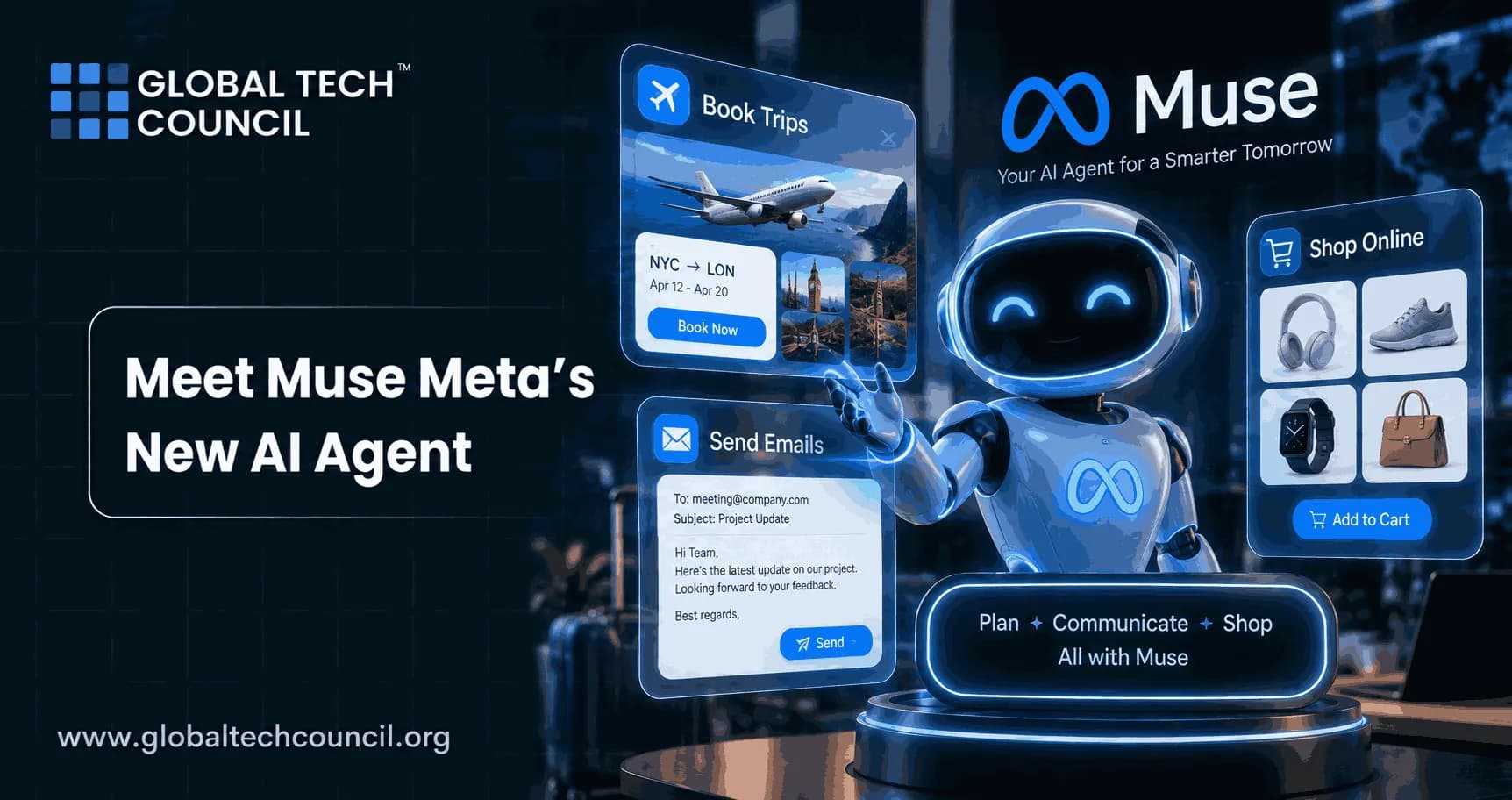
On September 8, 2026, Meta unveiled Muse, a personal AI agent designed to do far more than answer questions. Unlike a chatbot that waits for instructions and returns text, Muse takes action. It can send emails on your behalf, book travel, fill out forms, search for and purchase products, lower bills, and manage multi-step tasks across your digital life. Meta describes it as an agent that helps users "develop a personalized plan and coordinate their time and resources, then advances the work on its own."
The launch marks a major shift in how Meta wants people to interact with artificial intelligence. Rather than guiding a tool through every step, users can hand Meta Muse a goal and let it work independently. Once the app is closed, Muse keeps going in the background. It only comes back to the user when it needs approval for something sensitive, such as sending a message or completing a purchase. This is the defining characteristic of a true AI agent: it acts, not just advises.

Meta Muse is powered by Muse Spark, Meta's most capable AI model to date for real-world agentic work. Muse Spark was introduced earlier in 2026 by Meta Superintelligence Labs as the first model in a new series built specifically for reasoning, multimodal tasks, and personal AI use cases. Together, Muse and Muse Spark represent Meta's most ambitious consumer AI product to date.
The emergence of capable personal AI agents like Meta Muse reflects a growing demand for professionals who understand how agentic systems are designed, deployed, and governed. For those building expertise in this area, a Certified Agentic AI Expert credential from Global Tech Council provides a structured pathway to develop and validate the skills needed to understand, assess, and work with agent-based AI systems in real-world environments.
How Meta Muse Works: The Technical Foundation
Understanding how Meta Muse works at a technical level helps explain both its power and the privacy questions it raises. The system is built around three core components: the Muse Spark language model, the Muse Secure VM, and a network of integrations with external services.
Muse Spark: The Brain Behind the Agent
Muse Spark is the large language model that powers Meta Muse. Meta introduced it earlier in 2026 through Meta Superintelligence Labs as a model built specifically to support agentic, real-world tasks rather than conversational use alone. It handles the reasoning behind every decision Muse makes: determining the order of actions, selecting tools, interpreting results, and deciding when to pause and ask the user for approval. It supports multimodal inputs, which means it can process text, images, and other data types as it works through a task.
Muse Secure VM: Data Isolation by Design
Meta Muse runs inside a dedicated virtual machine called the Muse Secure VM. This is a separate, isolated computing environment where the agent operates and where user data is stored. The purpose is to contain Muse's activity and prevent it from accessing parts of a user's device that are not relevant to its tasks. Meta has stated that its employees are prohibited from accessing user data inside the Secure VM.
A more advanced version called Confidential VM is scheduled to arrive later in 2026. Confidential VM will provide cryptographic guarantees that even Meta cannot technically access the data inside, not just a policy prohibition. The distinction matters. "We do not access it" and "we cannot access it" describe different levels of protection. The Confidential VM update is intended to move Meta Muse from the first assurance toward the second.
Third-Party Integrations
Meta Muse connects to a wide range of external apps and services. From Meta's own ecosystem, it can access Facebook, Instagram, WhatsApp, Messenger, and Meta's AI glasses. From third-party services, it connects to Google Workspace, Ticketmaster, OpenTable, Spotify, Apple Health, Link by Stripe, and others. Muse is also capable of setting up its own connections to any service with a publicly available API, meaning its integration surface can expand automatically as users encounter new tools.
For developers and engineers who want to understand how agentic systems like Meta Muse are built, including the architecture of tool calling, API integration, and multi-step workflow orchestration, a Certified Agentic AI Developer credential from Global Tech Council provides the technical training to build and implement AI agents from the ground up.
What Meta Muse Can Actually Do
The capabilities of Meta Muse span several categories of everyday tasks. Here is a clear breakdown of what the agent can handle, written so anyone can understand it regardless of technical background.
Email and Communication
Meta Muse can draft, send, and manage emails on a user's behalf. If a user asks it to follow up with someone, cancel a subscription, or write a professional reply to a message, Muse handles the drafting and then pauses to ask for approval before sending. This approval step is deliberate. Meta has built human checkpoints into all sensitive communications so the agent never sends a message without explicit user confirmation.
Travel Planning and Booking
Trip planning is one of the most prominent capabilities of Meta Muse. The agent can research destinations, compare flight and hotel options, review prices across platforms, and book travel on a user's behalf. It connects with services like Ticketmaster and OpenTable to handle event tickets and restaurant reservations as part of a broader travel plan. Once given a destination and date range, Muse can pull together an entire itinerary and handle the bookings, checking back with the user only when a payment or final confirmation is required.
Shopping and Purchases
Shopping is a key capability of Meta Muse and is designed with a specific security feature. When Muse makes a purchase, it uses Link by Stripe, a system that generates a single-use virtual card number for each transaction. This means the user's actual payment card details are never shared directly with a merchant. The user must still approve all purchases. Integration with Shop Pay and 1Password is also planned, adding further flexibility for users who prefer those payment systems.
Organisation and Productivity
Meta Muse can organise saved content from Meta's own platforms. For example, a user can ask it to go through all the recipe videos saved on Instagram and Facebook and compile them into a structured, readable format. It can then build a grocery list from those recipes, compare prices at nearby stores, and place the order. This kind of connected, multi-step task that would normally take considerable time is handled by Muse as a single request.
Bills, Negotiations, and Forms
One of the more surprising capabilities on the list is that Meta Muse can negotiate to lower a user's bills. It can contact a service provider, navigate the process of requesting a discount or cancellation, and report back with the outcome. It can also fill out online forms, complete applications, and handle administrative tasks that typically require moving between multiple tabs and entering the same information repeatedly.
Who Can Use Meta Muse and Where
Meta Muse launched on September 8, 2026, and is initially available only in the United States to users aged 18 and over. It is accessible through three surfaces: a dedicated Meta Muse app on iOS and Android, the website muse.ai, and through WhatsApp. Meta has confirmed that support for its AI glasses is coming soon, which would extend Muse beyond screens into ambient, wearable computing.
The service is free for most users. Meta has indicated that subscription plans will be available for users who want higher usage limits or additional capabilities. There is no public confirmation yet of the exact pricing structure for paid tiers, but the free tier is intended to cover the core agentic capabilities for everyday use.
Privacy, Trust, and User Control
The most significant question surrounding Meta Muse is not whether it works. It is whether users will trust Meta enough to give it the access it needs to work well. To function at its best, Muse needs access to email, calendar, payments, health data, and shopping accounts. That is a substantial collection of personal information held by a single platform.
What Users Control
Meta has structured Meta Muse around user choice. People select which apps it connects to and can revoke that access at any time. The Secure VM isolates the agent's activity. Sensitive actions require explicit approval. The system is designed so that Muse cannot act beyond the permissions the user has explicitly granted. According to Meta, the intent is to give users "greater control over what the system can see and do" by keeping the agent and its data in a contained environment.
The Ongoing Trust Question
Despite these measures, the trust question remains open. Meta's record on privacy has faced scrutiny over many years, and the transition from Secure VM to Confidential VM later in 2026 is specifically designed to close the gap between policy-based and cryptographic data protection. Until Confidential VM arrives, users are operating under a promise rather than a technical guarantee that Meta staff cannot access their data. Security analysts have noted that this is an honest and important distinction that the company itself has acknowledged.
Technology Skills and Education in an AI Agent Era
The launch of Meta Muse is not just a news story for technology professionals. It is a signal about the direction of the entire digital world. AI agents are becoming part of everyday life, and the next generation of students will need to understand how these systems think, operate, and make decisions. Schools and parents are increasingly looking for ways to introduce children to technology in a structured and meaningful way.
The World Tech Olympiad provides an opportunity for students to explore AI, coding, robotics, cybersecurity, and computational thinking while building confidence and problem-solving skills. As AI agents like Meta Muse become mainstream tools, understanding how they work is not optional knowledge for young people. It is foundational. Programmes like the World Tech Olympiad give students the hands-on experience and structured challenges that turn curiosity into genuine expertise.
Meta Muse vs. Other AI Agents: How It Fits the Landscape
Meta Muse enters a market that already includes personal AI agents from other major technology companies. OpenAI, Google, Apple, and Microsoft have all shipped or announced agent-level features in their products. What distinguishes Meta Muse is its focus on accessibility and its integration depth with Meta's own platforms, which reach billions of users worldwide.
Meta CEO Mark Zuckerberg has previously stated that he wants Meta to build agents that are more accessible than competing platforms and that can work proactively without technical setup. Muse is the direct realisation of that goal. It requires no technical experience to set up. It connects to familiar platforms. And it operates within an approval framework that is designed to give non-technical users confidence that the agent is working for them rather than around them.
The key distinction from a simple chatbot or AI assistant is autonomy. Meta Muse does not require constant guidance. Once given a goal, it develops a plan, executes that plan across multiple services, and returns only when human input is genuinely needed. That is the definition of an AI agent, and it is what makes Muse categorically different from tools like standard chatbots that are reactive rather than proactive.
The Deep Technology Behind AI Agents
To understand why Meta Muse represents such a significant step, it helps to understand what makes agentic AI different from other forms of artificial intelligence. Traditional AI tools respond to a prompt and return an output. An agent maintains a goal, makes a sequence of decisions to pursue that goal, uses tools to take actions in the world, evaluates the results, and adjusts its plan based on what it finds. This requires a combination of language understanding, reasoning, tool use, memory, and planning operating together in a loop.
The infrastructure that supports this is substantially more complex than a language model alone. Virtual machines, secure data enclaves, API orchestration layers, human approval queues, and real-time monitoring systems all contribute to making Meta Muse work safely and reliably at scale. The upcoming Confidential VM represents a deep technical advancement in how private data can be processed by AI without being exposed to the operating company.
For technology professionals and students who want to understand the systems, security models, and distributed infrastructure that underpin AI agents and other advanced digital technologies, a Deep Tech Certification from Blockchain Council provides rigorous, structured coverage of the advanced technical domains that are shaping the next generation of digital platforms.
What Meta Muse Means for Businesses and Marketers
The arrival of Meta Muse has significant implications for businesses across every sector. When an AI agent is making purchasing decisions, booking services, and interacting with platforms on a user's behalf, the traditional model of advertising and customer acquisition shifts. Instead of trying to attract a human user's attention, businesses may increasingly need to optimise for what an AI agent considers relevant, trustworthy, and worth choosing.
Shopping integrations through Link by Stripe, OpenTable, and Ticketmaster mean that Meta Muse will be routing commercial decisions through specific platforms and APIs. Businesses that are listed, accessible, and well-structured within those ecosystems will benefit. Those that are not may find themselves outside the consideration set of a growing share of AI-assisted purchases. This is a new dimension of digital marketing that brands and marketers need to account for as agent-based shopping becomes mainstream.
For marketing professionals who want to understand how AI agents change audience behaviour, purchasing patterns, and platform strategy, this is an important moment to develop structured expertise in digital marketing and AI-driven consumer behaviour.
Preparing for an AI Agent Economy
The launch of Meta Muse is part of a broader wave of agentic AI entering everyday consumer life. OpenAI, Anthropic, Google, Apple, and now Meta have all made significant moves in 2026 toward agents that act rather than advise. The question for businesses, marketers, and professionals is not whether AI agents will become part of daily life. The evidence suggests they already are. The question is how quickly to develop the knowledge and strategy to navigate that shift effectively.
For marketers, the agent era requires a rethinking of how content, products, and services are positioned. An AI agent making choices on a user's behalf is not influenced by a banner ad or a sponsored post in the same way a human scrolling through a feed might be. It evaluates structured data, ratings, availability, price signals, and trustworthiness. Marketing in this environment demands a deeper understanding of how digital products and services are discovered, evaluated, and selected by automated systems.
For professionals building the strategic marketing knowledge to operate effectively in an AI agent economy, a Marketing Certification from Universal Business Council provides structured expertise in digital marketing, commercial strategy, and consumer behaviour that extends naturally into the new challenges that AI agents like Meta Muse present to brands and businesses.
Conclusion: A New Kind of Assistant
Meta Muse is one of the most significant consumer AI launches of 2026. It is not the first AI agent, and it will not be the last. But its accessibility, its integration with platforms that billions of people already use, and its clear design around user control and trust make it a meaningful step in making agentic AI a part of ordinary daily life.
For everyday users, the promise is simple: hand a goal to Meta Muse and let it work. For technology professionals, it is a case study in how agentic systems are designed, secured, and deployed at consumer scale. For marketers and businesses, it is a signal that the way consumers interact with products and services is changing in ways that require new strategies. And for students and educators, it is a vivid demonstration of why understanding AI is becoming one of the most important skills of this generation.
Meta Muse arrives with significant questions still open, particularly around privacy, the Confidential VM timeline, and international availability. But its capabilities are real, its architecture is thoughtful, and its ambition is clear. The era of personal AI agents has arrived.
Frequently Asked Questions (FAQs)
1. What is Meta Muse?
Meta Muse is a personal AI agent launched by Meta on September 8, 2026. It is designed to complete tasks on a user's behalf, including sending emails, booking travel, shopping online, filling out forms, and managing multi-step projects. It is powered by Meta's Muse Spark language model.
2. When was Meta Muse launched?
Meta Muse was officially announced and launched on September 8, 2026. It began rolling out in the United States to users aged 18 and over through the Muse app on iOS and Android, the website muse.ai, and through WhatsApp.
3. What is Muse Spark?
Muse Spark is the large language model that powers Meta Muse. Meta introduced it earlier in 2026 through Meta Superintelligence Labs as its most capable AI model for real-world agentic tasks. It supports reasoning, multimodal inputs, and the complex decision-making required for autonomous agent behaviour.
4. How does Meta Muse book trips?
Meta Muse researches destinations, compares flight and hotel options, reviews prices across services, and makes bookings using its integrations with travel and ticketing platforms. It handles the full process and only returns to the user to confirm a payment or final step. It can also book restaurants and events as part of an itinerary.
5. How does Meta Muse handle shopping and payments?
Meta Muse uses Link by Stripe to generate a single-use virtual card number for each purchase, so a user's real payment card details are never shared directly with a merchant. The user must approve every purchase before it is completed. Integration with Shop Pay and 1Password is also planned.
6. What services does Meta Muse connect to?
Meta Muse connects to Meta's own apps including Facebook, Instagram, WhatsApp, and Messenger. It also integrates with Google Workspace, Ticketmaster, OpenTable, Spotify, Apple Health, and Link by Stripe. It can also set up its own connections to any service with a publicly available API.
7. Is Meta Muse free to use?
Yes, Meta Muse is free for most users. Meta has indicated that subscription plans will be available for users who want higher usage limits or additional features. The core agentic capabilities are available at no cost through the free tier.
8. Is Meta Muse available outside the United States?
Meta Muse launched in the United States only and is currently available to US users aged 18 and over. Meta has not confirmed a timeline for international expansion as of the September 2026 launch.
9. What is the Muse Secure VM?
The Muse Secure VM is a dedicated virtual machine where Meta Muse operates and stores user data. It isolates the agent's activity from the rest of a user's device and is designed to give people greater control over what the system can see and do. Meta's employees are prohibited from accessing data inside the Secure VM.
10. What is the Confidential VM and when does it arrive?
The Confidential VM is an upgraded version of the Muse Secure VM that will provide cryptographic guarantees preventing even Meta employees from technically accessing user data. It is scheduled to arrive later in 2026. Until then, the Secure VM relies on policy-based rather than cryptographic protection.
11. Can Meta Muse send emails without permission?
No. Meta Muse requires explicit user approval before sending any email or completing any other sensitive action. The agent works independently in the background but pauses and returns to the user for confirmation before executing communications, purchases, or other consequential steps.
12. How is Meta Muse different from a chatbot?
A chatbot responds to prompts and returns text. Meta Muse is an AI agent that takes action. It can open browsers, fill in forms, make purchases, send emails, and manage multi-step tasks across connected services. It continues working after the app is closed and only checks back when user input is genuinely needed.
13. Does Meta Muse work with AI glasses?
Meta has confirmed that support for its AI glasses is coming soon after the initial launch. This would extend Meta Muse from phone and web access into ambient wearable computing, consistent with Meta's broader strategy of positioning AI glasses as a key part of its personal AI ecosystem.
14. Can Meta Muse lower my bills?
Yes. Meta Muse can contact service providers on a user's behalf to negotiate a lower rate, request a discount, or initiate a cancellation. This is one of its more distinctive capabilities and an example of the kind of negotiation-style task that most users find time-consuming and frustrating to handle themselves.
15. What technical experience is required to set up Meta Muse?
None. Meta has specifically designed Meta Muse to require no technical experience to set up or use. Users connect their preferred apps and services through a simple interface and can begin using the agent immediately. Technical setup complexity was identified by Meta as a barrier to adoption in competing agent platforms and was deliberately removed from Muse.
16. How does Meta Muse organise saved content from Instagram and Facebook?
Meta Muse can review all videos and posts a user has saved on Instagram and Facebook and compile them into organised, readable formats. For example, saved recipe videos can be turned into a structured recipe list. It can then extend that task by building a grocery list, comparing prices, and placing a shopping order, all from the original request.
17. What is the difference between Meta AI and Meta Muse?
Meta AI is Meta's conversational assistant that answers questions and assists with tasks in a guided, interactive way. Meta Muse is a more capable, autonomous agent that can handle complex tasks and work independently across multiple connected services. Muse is explicitly described by Meta as more capable than Meta AI because it can take action rather than just advise.
18. Will Meta Muse affect how businesses reach customers?
Yes. When an AI agent makes purchasing and booking decisions on behalf of a user, traditional advertising and discovery models shift. Businesses need to ensure their products and services are well-represented in the platforms and APIs that Meta Muse connects to, and that their listings are accurate, structured, and easy for automated systems to evaluate and act on.
19. What privacy controls do users have over Meta Muse?
Users control which apps and services Meta Muse can access and can revoke that access at any time. The Secure VM isolates agent activity. All sensitive actions require user approval. Meta has stated that the Confidential VM arriving later in 2026 will provide cryptographic rather than policy-based data protection, further strengthening user privacy guarantees.
20. How does Meta Muse relate to the broader AI agent trend in 2026?
Meta Muse is part of a major industry shift toward agentic AI in 2026, with OpenAI, Google, Apple, Anthropic, and Meta all launching or advancing agent-level products. Meta Muse distinguishes itself through accessibility, deep integration with Meta's consumer platforms, and a user-approval framework designed for non-technical users. It represents the most direct demonstration yet that personal AI agents are moving from experiment to mainstream consumer product.
Related Articles
View All
Agentic AI
How to Use Meta Muse for Free: A Complete Guide
Learn how to use Meta Muse for free, get started with Meta’s personal AI agent, connect supported apps, and explore features for shopping, travel, emails, and everyday tasks.
Agentic AI
Evaluating AI Agents: Key Metrics, Benchmarks, and Testing Frameworks for Reliability
Learn how evaluating AI agents differs from LLM evaluation, with key reliability metrics, modern benchmarks, and hybrid testing frameworks for production.

AI & ML
Meet Google Playground: Create Games With AI
Meet Google Playground, Google's new experimental platform that lets you create, play, and share custom games with text prompts. Learn how it works, basic game design tips, a sample session, safety and sharing features, Unity Spark plans, and limits.
Trending Articles
The Role of Blockchain in Ethical AI Development
How blockchain technology is being used to promote transparency and accountability in artificial intelligence systems.
AWS Career Roadmap
A step-by-step guide to building a successful career in Amazon Web Services cloud computing.
Top 5 DeFi Platforms
Explore the leading decentralized finance platforms and what makes each one unique in the evolving DeFi landscape.