

What Is Adversarial Machine Learning?
 Tosh Marketing
 Adversarial Machine Learning (AML) is a branch of AI focused on how machine learning models can be fooled by malicious or deceptive inputs. These inputs, called adversarial examples, are intentionally designed to mislead a model into making wrong predictions — even though the inputs appear normal to humans.
In 2025, adversarial attacks are a real-world problem for industries using AI in security, finance, healthcare, and autonomous vehicles. Understanding how these attacks work and how to defend against them is essential for creating trustworthy AI systems.

How Do Adversarial Attacks Work?
Machine learning models learn from patterns in data. If an attacker understands or guesses these patterns, they can make small, intentional changes to the input data. These changes confuse the model into producing incorrect results without triggering any obvious alerts.
For example, slightly altering the pixels in a stop sign image can cause a self-driving car’s AI to misread it as a speed limit sign — a dangerous outcome from a small tweak.
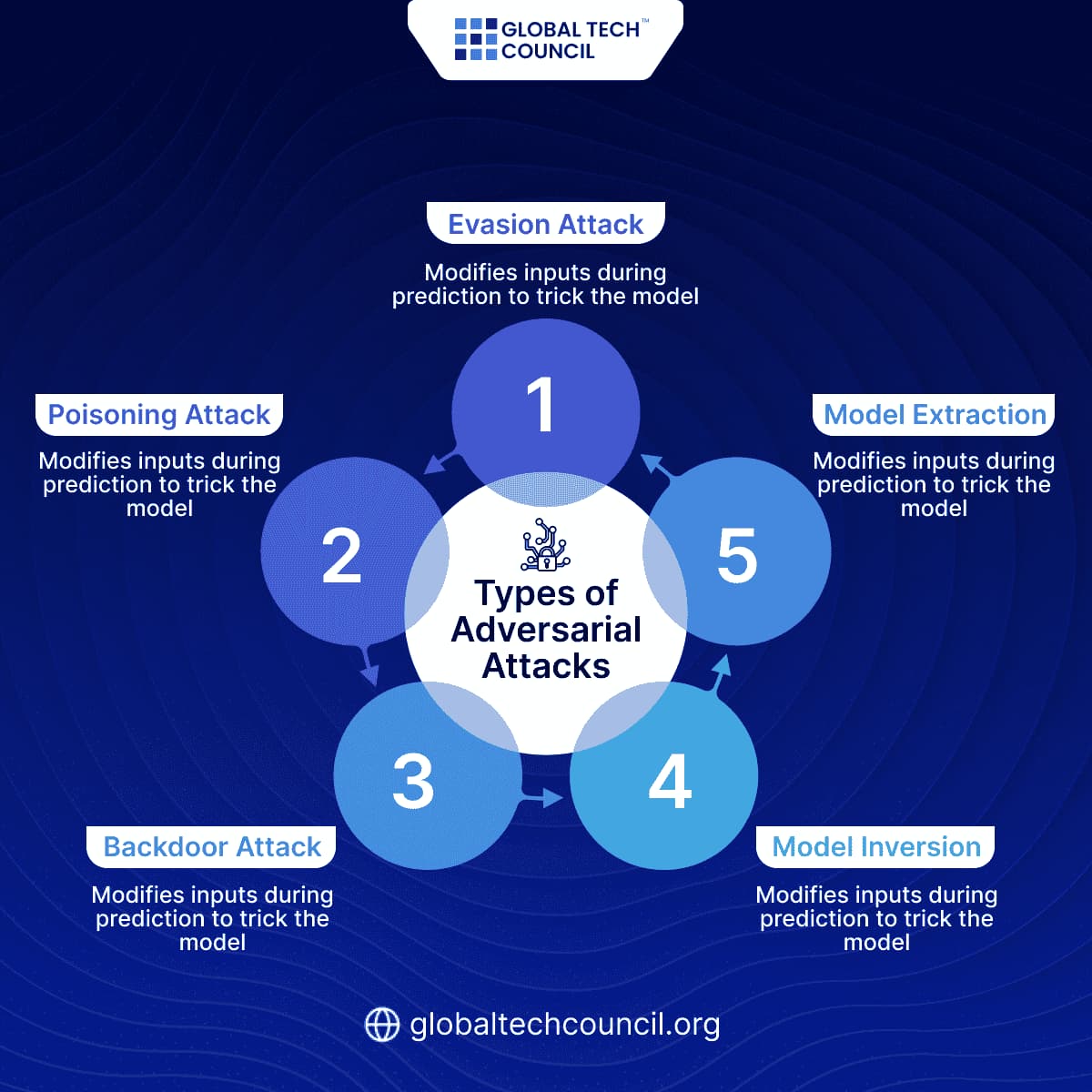
Types of Adversarial Attacks
There are multiple ways to attack a machine learning model. Each method targets different parts of the AI pipeline.
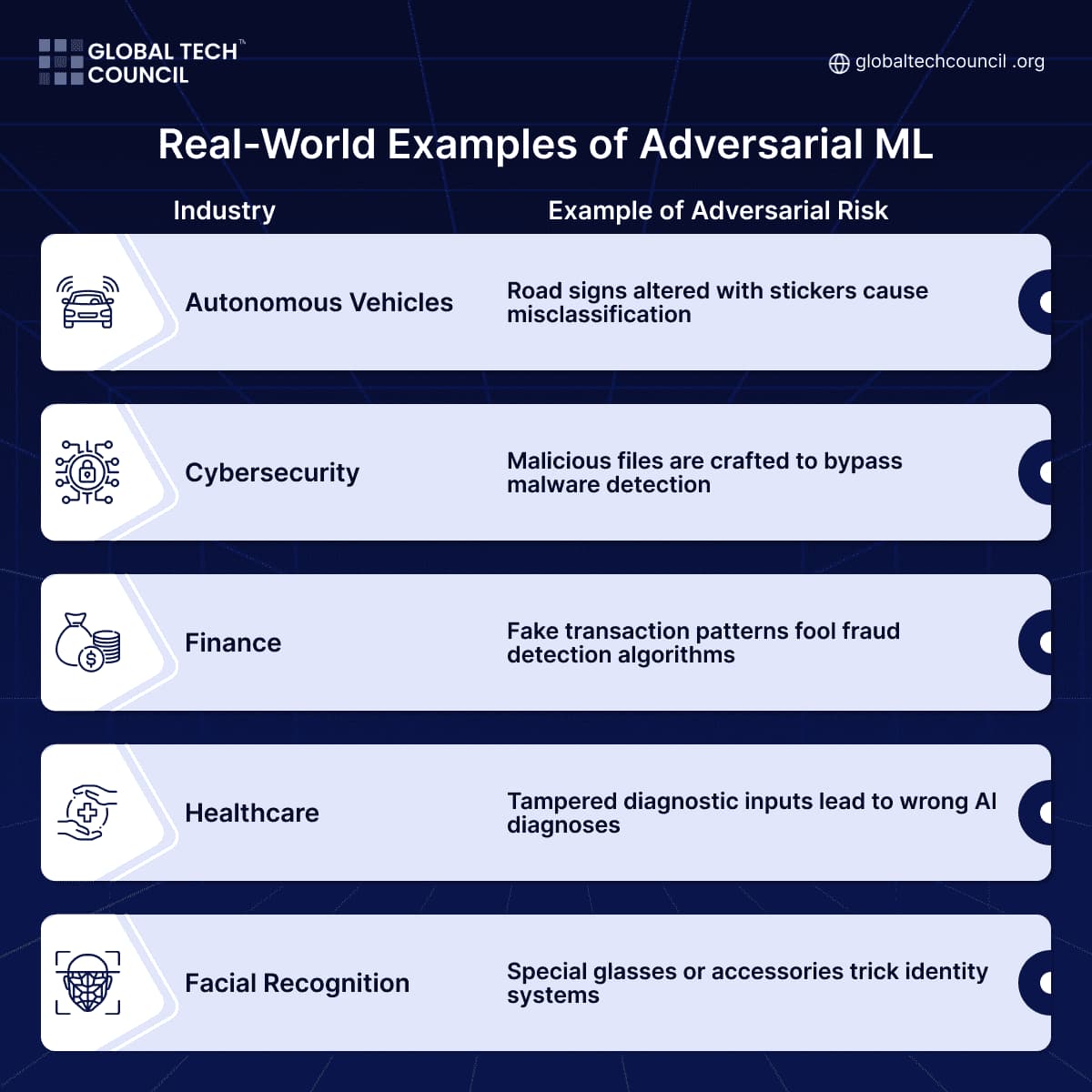
Real-World Examples of Adversarial ML
These attacks are not just theoretical. Real incidents and research show that adversarial manipulation already affects commercial systems.
How to Defend Against Adversarial Attacks?
As attacks grow more advanced, researchers and engineers use different defense strategies to protect machine learning models.
- Adversarial training: Train the model with examples of attacks so it learns to resist them
- Input filtering: Clean or transform data before it reaches the model
- Model hardening: Use architectures and regularization methods that reduce sensitivity to small changes
- Monitoring: Track the model’s behavior in real time to detect suspicious inputs
No defense is foolproof, but combining several techniques can make models significantly more secure.
Why Is Adversarial Machine Learning Important in 2025?
AI is now used in high-stakes environments. A small failure caused by an adversarial input can lead to financial loss, security breaches, or even physical harm. As more businesses and governments rely on AI, protecting models from attacks becomes a core responsibility.
AML is also an emerging career area. Cybersecurity experts, data scientists, and machine learning engineers are working together to create safer models.
How Can You Start Learning?
If you’re new to this topic, start by building a strong foundation in data science and machine learning. Once you’re confident with model training and evaluation, you can dive into tools like Foolbox, CleverHans, and IBM’s Adversarial Robustness Toolbox.
You can also enroll in a Data Science Certification to strengthen your fundamentals. If you’re exploring deeper technologies like AI security, blockchain, or quantum computing, visit the Blockchain Council.
Conclusion
Adversarial Machine Learning shows that being accurate isn’t enough — models also need to be resilient. As AI becomes part of critical systems, attackers are getting smarter, and so must we. Understanding and defending against adversarial threats is no longer optional — it’s a key part of responsible AI development.
Related Articles
View All
AI & ML
Generative AI vs. Traditional Machine Learning: Key Differences, Use Cases, and Career Paths
Learn the key differences between generative AI and traditional machine learning, including model goals, data needs, enterprise use cases, and career paths.

AI & ML
Machine Learning Security
Machine learning has quietly become the engine behind modern technology. It powers recommendation systems, fraud detection, medical diagnostics, and even the tools used to write code itself. Convenient, efficient, and occasionally a bit too trusting of whatever data you feed it. That trust is…
AI & ML
What is Deep Learning
Deep learning has become one of the most influential technologies in artificial intelligence. It supports virtual assistants, recommendation engines, medical image analysis, fraud detection, language models, content generation, and advanced automation systems. Although the term sounds highly…
Trending Articles
The Role of Blockchain in Ethical AI Development
How blockchain technology is being used to promote transparency and accountability in artificial intelligence systems.
AWS Career Roadmap
A step-by-step guide to building a successful career in Amazon Web Services cloud computing.
Top 5 DeFi Platforms
Explore the leading decentralized finance platforms and what makes each one unique in the evolving DeFi landscape.