

Can an AI Model Create a Better AI Model Than Itself?

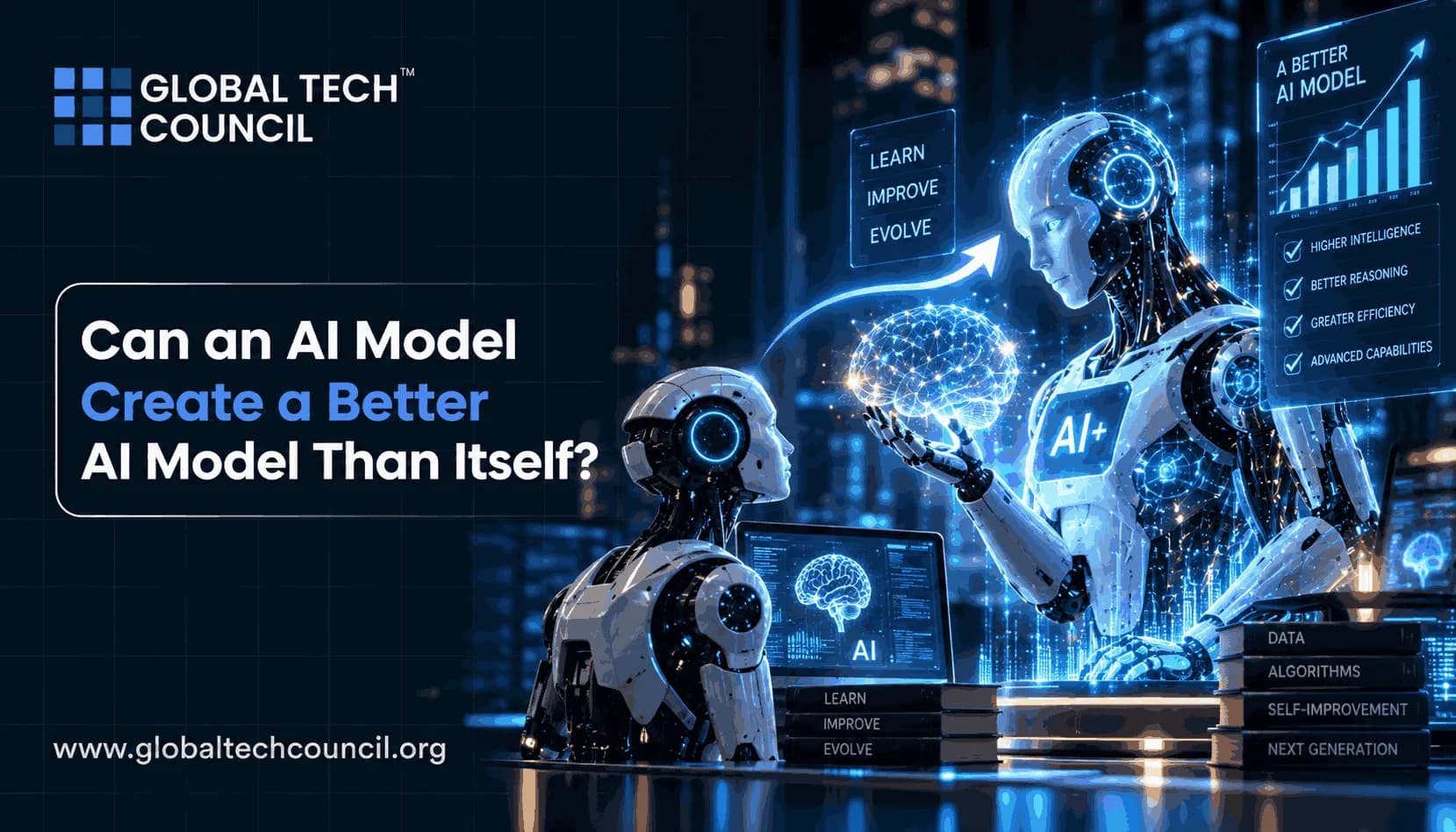
There's a specific, almost paradoxical question buried inside AI development today: can a system that generates training data, feedback, or even code for a new model actually produce something more capable than itself? On the surface, this seems logically impossible, how can a teacher create a student smarter than the teacher? Yet several documented techniques in machine learning research suggest the answer is more nuanced than a flat no, and the specific conditions under which it can happen reveal a lot about how AI capability actually compounds. Understanding this nuance precisely is exactly the kind of technical clarity a Certified Artificial Intelligence (AI) Expert develops, learning to separate genuine capability transfer from simple copying.
This article breaks down the specific mechanisms that allow one AI model to contribute to building a more capable successor, the research evidence behind each one, and where the real limits of this process currently sit.

Why This Seems Contradictory at First Glance
The intuitive assumption is that a model can only pass along what it already knows, meaning any system it helps create should top out at the original model's own capability level. This assumption turns out to be only partly true, because "helping create" a new model involves several different mechanisms, some of which genuinely can produce a more capable result than the source model alone.
Building and testing these mechanisms directly is specialized, hands-on work, and it's exactly what a Certified Artificial Intelligence (AI) Developer does in practice, since implementing a training pipeline that genuinely surpasses its source model requires careful engineering decisions about data quality, architecture, and evaluation rather than simply copying an existing model's outputs.
Knowledge Distillation: Usually Preserves, Rarely Exceeds
The most common technique connecting one model to another is knowledge distillation, where a smaller "student" model learns to replicate a larger "teacher" model's behavior. In most cases, distillation aims to preserve the teacher's capability in a smaller, more efficient package rather than exceed it, and student models typically perform slightly below their teacher on most benchmarks.
That said, there are documented cases where distilled models perform surprisingly well on specific tasks, sometimes matching or narrowly exceeding their teacher in narrow areas, particularly when the smaller model's simpler architecture happens to generalize better on certain types of problems or when the distillation process filters out noisy or lower-quality reasoning present in the original teacher's outputs.
Where a Model Can Genuinely Help Build Something Better
Several specific research findings suggest real pathways where a model contributes to a more capable successor, not by simply copying itself, but by playing an assistive role in a larger process.
Weak-to-Strong Generalization
Research into this area has explored whether a weaker AI model can help train or supervise a stronger one that ends up more capable than the weaker supervisor itself. Early results suggest that under the right conditions, a stronger student model can learn generalizable patterns from a weaker teacher's imperfect guidance and end up outperforming that teacher, particularly on tasks where the weaker model's mistakes are inconsistent rather than systematically biased.
Self-Distillation and Iterative Refinement
In some training setups, a model generates its own training data, that data gets filtered for quality, and a new version trained on the filtered data outperforms the original on specific benchmarks. This works because filtering removes lower-quality outputs from the training mix, effectively concentrating the model's own best reasoning into the next version's training data rather than diluting it with weaker examples.
Contributing to Infrastructure Rather Than Direct Copying
Systems like Google DeepMind's AlphaEvolve illustrate a different pathway entirely. Rather than one model directly training a copy of itself, AlphaEvolve uses Gemini models to optimize the training pipeline and infrastructure used to build future Gemini versions. The resulting model isn't simply a copy of the original with tweaks, it benefits from genuinely improved training efficiency and data quality, allowing the new version to reach a higher capability level than would have been possible through the original process alone.
Why This Isn't the Same as True Generational Leapfrogging
Despite these genuine mechanisms, it's worth being precise about what hasn't been demonstrated. No documented system has shown a model independently redesigning its own fundamental architecture to produce a categorically smarter successor without human-defined objectives, curated training data, and extensive evaluation guiding the process. What's actually happening in each of the examples above involves a combination of AI assistance and deliberate human engineering decisions working together, not a model single-handedly out-designing itself.
Understanding exactly where AI assistance ends and where deliberate human engineering decisions still carry the more capable outcome requires deep technical grounding, and professionals who build that through a Deep Tech Certification are better equipped to evaluate specific claims about one model "creating" a better one, rather than accepting simplified headline versions of more nuanced research results.
A Creative Parallel: Refinement Producing Something Better Than the Starting Point
A gentler version of this same idea, later iterations improving meaningfully on earlier ones through a structured refinement process, shows up in creative applications too. One emerging application is AI microdrama, where generative AI helps bring serialized stories, characters, and fictional worlds to life. Later episodes in a series often benefit from accumulated audience feedback and refined character consistency established in earlier episodes, producing content that resonates more effectively than the earliest installments, a creative, low-stakes illustration of how iterative refinement can genuinely build toward something better than where the process started.
What This Means for How These Results Get Talked About
Findings like weak-to-strong generalization or self-distillation are genuinely interesting and worth taking seriously, but they get easily oversimplified into more dramatic claims like "AI is already building smarter versions of itself independently." The reality is more precise and, frankly, more interesting: specific technical conditions allow a less capable or narrower system to meaningfully contribute to a more capable successor, but always within a framework of human-defined objectives, curated data, and careful evaluation.
Communicating this accurately matters, especially as more businesses build products around these techniques. Professionals who pair real technical understanding with a Marketing Certification are better positioned to describe these nuanced research findings honestly, rather than rounding them up into claims that don't hold up under closer examination.
Final Thoughts
An AI model can, under specific and well-documented conditions, contribute to building a more capable successor, whether through filtered self-distillation, weak-to-strong generalization research, or by improving the training infrastructure used to build the next version. What hasn't been demonstrated is a model doing this entirely independently, without human-defined goals, curated data, and careful evaluation shaping the outcome. The nuanced answer, yes under the right conditions, but always within a human-guided framework, is both more accurate and more genuinely interesting than either a flat no or an overstated claim of full autonomy.
FAQs
1. Can an AI model create a better AI model than itself?
An AI model can help create or improve another AI model that performs better on specific tasks. It can generate code, suggest architectures, create synthetic training data, optimize algorithms, or help evaluate candidate models. However, creating a broadly more capable successor entirely autonomously is a much harder problem and is not established as a routine capability of current AI systems.
2. How can one AI model help create a better AI model?
An AI model can contribute to several stages of model development, including data generation, code development, hyperparameter optimization, testing, and evaluation. Automated systems can then compare candidate models against predefined objectives. This creates an AI-assisted development loop in which the original model contributes to building a potentially improved successor.
3. What does it mean for an AI model to be “better” than itself?
A model can be considered better if a successor achieves higher performance on relevant benchmarks or real-world tasks. Improvement could involve reasoning accuracy, coding ability, efficiency, reliability, context handling, or other measurable capabilities. A model that performs better on one benchmark is not necessarily better across every capability.
4. Is creating a better AI model the same as recursive self-improvement?
Not necessarily. Recursive self-improvement involves a repeated process in which an AI contributes to improving itself or its successors, with each generation potentially helping produce the next. A one-time AI-assisted model upgrade is better described as automated or AI-assisted development rather than a complete recursive self-improvement loop.
5. Can an AI write the code for a more advanced AI model?
AI models can already generate, explain, debug, and optimize software code. They can therefore assist researchers and engineers in developing machine learning systems. However, producing useful code is only one part of creating a better model because training data, compute, architecture, optimization, evaluation, and deployment also matter.
6. Can an AI design a better neural network architecture?
AI can search through possible neural network architectures and propose configurations that may perform better for a particular objective. Techniques such as neural architecture search and evolutionary optimization automate parts of this process. The resulting architecture still needs to be trained and rigorously evaluated.
7. Can an AI train its successor?
An AI can participate in pipelines that generate training examples, produce labels, create synthetic data, optimize training code, or evaluate candidate models. These processes can help train a successor model. Whether the original AI can independently decide how to train, evaluate, deploy, and improve its successor is a much stronger form of autonomy.
8. Can an AI model improve another AI model without human intervention?
Some stages of AI development can be automated with limited direct human involvement. For example, an automated system can generate candidate solutions, run tests, score them, and select promising results. However, modern AI development generally still relies on human-defined objectives, infrastructure, evaluation criteria, safeguards, or oversight.
9. What role does synthetic data play in creating better AI models?
Synthetic data can provide additional training examples when suitable human-generated data is limited or expensive to obtain. An AI model can generate examples that are then filtered and used to train another model. The quality of synthetic data is critical because errors or biases in generated material can be transferred to the successor.
10. Can AI-generated training data make the next AI model smarter?
It can, particularly when generated examples provide useful information, additional task coverage, or high-quality demonstrations. However, more synthetic data does not automatically produce a better model. Data quality, diversity, verification, and the training procedure determine whether AI-generated data actually improves performance.
11. Can an AI model discover better algorithms than humans?
AI systems can search large spaces of possible algorithms and identify solutions that humans may not have considered. Google DeepMind's AlphaEvolve, for example, combines Gemini models with automated evaluation and evolutionary search to discover and optimize algorithms. Such systems demonstrate that AI can contribute to algorithm discovery, but this is different from unrestricted autonomous AI research.
12. What is AI-assisted recursive improvement?
AI-assisted recursive improvement describes a process where AI systems help improve algorithms, software, training procedures, or other AI systems through repeated iterations. Humans or automated evaluation systems may define the objectives and constraints. It is more limited than a hypothetical system that independently controls every stage of its own development.
13. Could a weaker AI create a stronger AI?
In principle, yes, if the weaker AI has useful capabilities for a particular development task and is connected to suitable tools and evaluation systems. For example, a model that is weaker at general reasoning could still generate an algorithm that is more efficient than an existing human-designed algorithm. “Stronger” therefore needs to be defined in terms of the capability being measured.
14. Could an AI model create a better version of itself?
An AI could potentially generate code, training strategies, or other modifications that are incorporated into a successor model. However, changing a model's software or generating a proposed improvement does not automatically mean the model can independently retrain and deploy a superior version. The complete development loop requires substantial infrastructure and reliable verification.
15. What is the role of automated evaluation in AI self-improvement?
Automated evaluation determines whether a proposed modification actually produces an improvement. A candidate model or algorithm can be tested against predefined benchmarks, simulations, or functional tests. This creates a feedback mechanism that allows an automated system to reject unsuccessful changes and retain promising ones.
16. What are the limitations of AI creating better AI?
AI-generated improvements can be incorrect, overfit to benchmarks, introduce new errors, or optimize one capability while harming another. Models can also struggle to recognize their own limitations. Reliable external testing and diverse evaluation are therefore important when determining whether a proposed successor is genuinely better.
17. Can an AI model recursively create increasingly capable AI models?
A theoretical recursive improvement loop could involve one AI generating improvements, those improvements producing a stronger successor, and the successor contributing to the next generation. Such a loop could potentially accelerate AI development. However, maintaining reliable improvements across repeated generations is a significant technical challenge.
18. Could AI creating better AI lead to superintelligence?
Recursive improvement is one possible pathway discussed in research on the future development of advanced AI. If an AI system could reliably improve the mechanisms responsible for its own capabilities, repeated improvements could potentially produce systems substantially more capable than their predecessors. The speed, limits, and consequences of such a process remain uncertain.
19. How is AI creating a better AI different from normal AI model upgrades?
A normal model upgrade is typically designed and managed by an AI development organization using human-selected training methods, data, infrastructure, and evaluation procedures. AI-assisted development can automate some of these tasks. A fully recursive system would go further by allowing AI systems to repeatedly drive increasingly large portions of their own improvement process.
20. Is AI capable of building a better AI than itself today?
AI systems can already contribute meaningfully to the development of improved algorithms, code, training methods, and models. However, there is an important difference between assisting with individual development tasks and independently creating a broadly superior successor through a continuous recursive loop. Current evidence supports the former much more clearly than the latter.
Related Articles
View All
AI & ML
Can AI Build a Better Version of Itself?
Explore whether AI can build a better version of itself, how self-improving systems might work, and the technical, safety, and practical limits of AI-driven development.

AI & ML
Can Gemini Improve Itself? Google’s AI and Recursive Self-Improvement
Explore whether Google Gemini can improve itself, how DeepMind is developing self-improving AI systems, and what separates current capabilities from true recursive self-improvement.
AI & ML
Can ChatGPT Improve Itself? Understanding RSI in LLMs
Explore whether ChatGPT can improve itself, how recursive self-improvement differs from normal model training, and what current LLMs can and cannot do autonomously.
Trending Articles
The Role of Blockchain in Ethical AI Development
How blockchain technology is being used to promote transparency and accountability in artificial intelligence systems.
AWS Career Roadmap
A step-by-step guide to building a successful career in Amazon Web Services cloud computing.
Top 5 DeFi Platforms
Explore the leading decentralized finance platforms and what makes each one unique in the evolving DeFi landscape.