

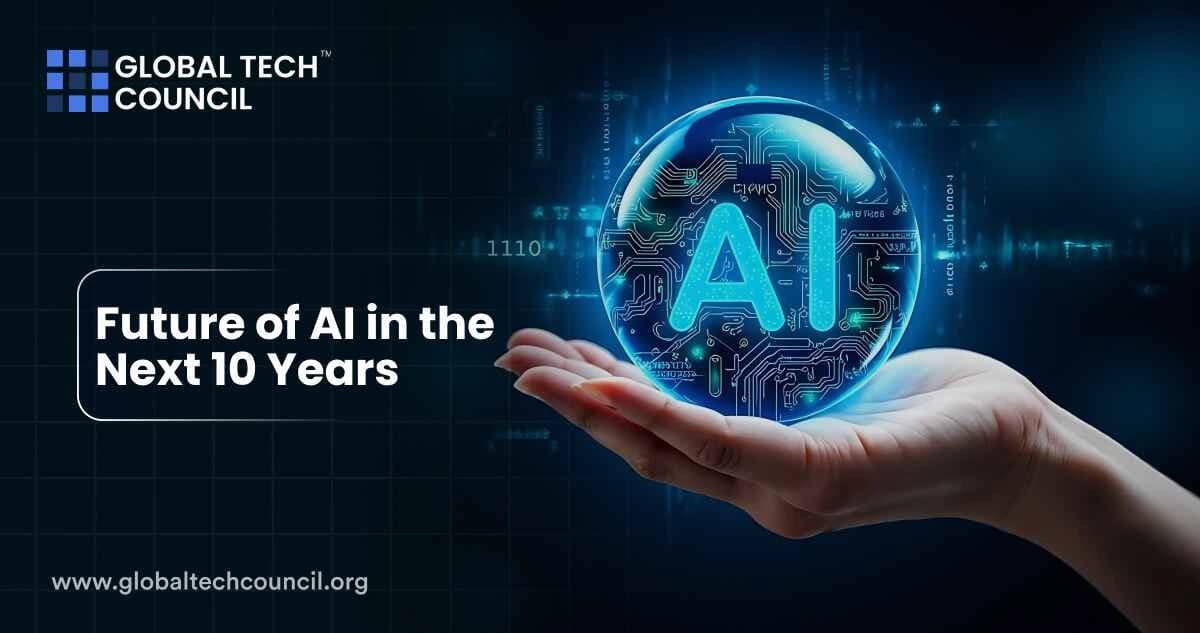
Future of AI in the Next 10 Years
 Tosh Marketing
 Artificial intelligence is entering a defining decade. What began as a powerful support tool is rapidly becoming a core layer of modern business, software, communication, and decision-making. From intelligent assistants and autonomous workflows to personalized healthcare and smarter education, AI is reshaping how the world works.
The next 10 years will not simply bring faster tools. They will bring a new operating model for industries, teams, and professionals. Companies that understand this shift early will gain a competitive advantage, while individuals who build practical AI skills will be better prepared for the future of work.

That is why structured learning paths such as AI Expert certification, Agentic AI certification, AI Powered coding expert certification, deeptech certification, and AI powered digital marketing expert are becoming increasingly valuable for professionals who want to stay relevant and lead with confidence.
This article explores how AI is likely to evolve over the next decade, where it will create the biggest impact, what challenges it will introduce, and how individuals and businesses can prepare for an AI-driven future.
The Next Decade of AI Starts Now
Artificial intelligence is no longer an emerging trend waiting for adoption. It is already influencing customer experiences, software systems, operational efficiency, content creation, and strategic planning. What makes the coming decade different is that AI will no longer sit at the edge of workflows. It will move to the center.
Today, many AI systems still require heavy human prompting and oversight. In the future, they will become more proactive, more context-aware, and more capable of completing meaningful work with limited supervision. This shift will change how teams are built, how products are developed, and how organizations compete.
Several trends are driving this transformation:
- AI systems are becoming better at reasoning and decision support
- Businesses are integrating AI into daily workflows instead of isolated tools
- AI is moving beyond text into images, audio, video, and real-world interaction
- Automation is becoming more adaptive and less rule-based
- AI governance is becoming a boardroom level concern
In simple terms, the next decade will be defined by AI moving from assistant to infrastructure.
AI Will Move from Reactive to Proactive
One of the biggest shifts in the future of AI will be the move from systems that react to prompts to systems that anticipate needs and take initiative.
AI Will Start Managing Work, Not Just Supporting It
Right now, many AI tools respond to one request at a time. In the future, AI will increasingly be able to:
- Track goals across projects
- Suggest next actions automatically
- Coordinate with business tools and databases
- Follow up on unfinished tasks
- Learn from user preferences and work patterns
This means AI will become more embedded in professional workflows. Instead of opening a separate AI tool, users will interact with AI inside project management systems, CRMs, coding environments, communication platforms, and business dashboards.
Why This Matters for Productivity
The practical impact is significant. Businesses will spend less time on repetitive administration and more time on strategy, creativity, and customer value. Teams will become leaner, but not necessarily smaller. Their work will simply become more amplified.
This is one reason why AI literacy is no longer optional. Understanding how to use, guide, and supervise AI systems will become a baseline professional skill in many sectors.
Agentic AI Will Redefine Digital Work
One of the most exciting developments in the future of AI is the rise of agentic AI. This is where AI systems move beyond answering questions and begin completing end-to-end tasks.
What Makes Agentic AI Different?
An agentic AI system can take a goal, break it into steps, use tools, gather information, and execute a sequence of actions. For example, instead of simply explaining how to launch a campaign, it may eventually be able to:
- Research competitors
- Draft campaign messaging
- Segment target audiences
- Build a content calendar
- Recommend budget allocation
- Prepare performance reports
This makes agentic AI especially valuable in roles that involve planning, coordination, and repetitive execution.
Where Agentic AI Will Be Used Most
Over the next decade, agentic AI is likely to play a major role in:
- Customer service operations
- Software quality assurance
- Sales follow up and lead nurturing
- Internal reporting and analytics
- Recruitment workflows
- Finance operations
- Research and documentation
The rise of autonomous systems will also increase demand for professionals who can build, supervise, and optimize them. That is why specialized learning in this area is becoming more important.
Software Development Will Enter an AI First Era
Few industries are changing as quickly as software development. AI is already helping developers write code, fix bugs, generate tests, and explain complex functions. In the next 10 years, this evolution will go much further.
Developers Will Become System Architects
The role of the developer will become less about writing every line manually and more about directing systems intelligently. Developers will increasingly focus on:
- Designing scalable architectures
- Reviewing and validating AI generated code
- Connecting AI models to applications
- Improving performance and security
- Building AI aware user experiences
- Creating resilient automation pipelines
This does not reduce the importance of coding. It changes the value of coding. The future developer will need stronger judgment, broader system awareness, and better collaboration with AI tools.
Why AI Enhanced Coding Skills Matter
As AI becomes part of software engineering, professionals who understand both coding and AI workflows will stand out. That is where a practical path like an AI Powered coding expert certification can help bridge the gap between traditional development and AI enhanced engineering.
Businesses will increasingly seek developers who can work with AI, not just around it.
AI Will Reinvent How Businesses Make Decisions
Another major transformation over the next decade will be in decision-making. AI will increasingly support not only execution, but also strategic thinking.
AI as a Decision Intelligence Layer
Companies generate huge amounts of data, but most teams still struggle to turn that data into timely action. AI will help close that gap by:
- Identifying patterns in customer behavior
- Forecasting market trends
- Detecting operational inefficiencies
- Simulating business scenarios
- Summarizing strategic risks and opportunities
This will make decision-making faster, more evidence-based, and more adaptive.
Human Judgment Will Remain Essential
Even the most advanced AI cannot fully replace leadership judgment. AI can surface possibilities, but humans still need to define priorities, weigh trade-offs, and make values-based choices.
The businesses that succeed will not be those that automate blindly. They will be the ones that combine AI insight with human oversight.
Marketing Will Become More Predictive and Personalized
Digital marketing will likely be one of the biggest beneficiaries of AI over the next decade. The shift will go far beyond content generation.
AI Will Power Smarter Customer Journeys
In the coming years, AI will help marketers create more precise and responsive campaigns by enabling:
- Better audience segmentation
- Personalized messaging at scale
- Dynamic content optimization
- Predictive campaign planning
- More accurate customer intent analysis
- Faster testing and iteration
Instead of broad campaigns built around assumptions, marketers will be able to create adaptive experiences based on real-time behavior and signals.
Brand Strategy Still Needs Human Direction
Although AI can produce content quickly, it cannot replace deep brand understanding, emotional nuance, and cultural sensitivity. Strong marketing will still require human creativity and editorial judgment.
That is why marketers who want to future-proof their careers should focus not only on creativity, but also on AI integration. A program such as AI powered digital marketing expert can help professionals understand how to use AI strategically in campaign planning, audience targeting, and digital growth.
AI Will Create a New Standard for Customer Experience
Customer expectations are rising, and AI will play a major role in meeting them.
The Future Customer Experience Will Be Intelligent by Default
Over the next 10 years, customers will increasingly expect brands to provide:
- Faster support
- Personalized recommendations
- Smarter self-service options
- More accurate product suggestions
- Context-aware communication
AI will help businesses meet these expectations by making interactions more relevant and responsive.
Real World Example
A retail brand could use AI to recognize a customer’s browsing behavior, recommend products based on intent, answer support questions instantly, and trigger personalized follow-up messages. This kind of seamless experience will become a standard competitive requirement, not a luxury feature.
AI in Healthcare Will Focus on Precision and Prevention
Healthcare is one of the most promising and high-impact areas for AI over the next decade.
Where AI Will Deliver the Most Value
AI is expected to improve healthcare in several important ways:
- Earlier disease detection
- Better analysis of medical images
- Smarter clinical documentation
- Personalized treatment planning
- Faster drug discovery
- Improved patient monitoring
The greatest long-term benefit may come from prevention. AI can help detect subtle patterns earlier than traditional methods, which may improve outcomes and reduce healthcare costs.
Trust Will Be Critical
Healthcare requires accuracy, transparency, and accountability. That means AI in this field must be developed and used with extreme care. Regulation, validation, and human review will remain essential.
In this space, the future of AI is not about replacing doctors. It is about equipping them with better tools.
AI Will Personalize Education at Scale
Education is another field where AI has the potential to create long-term transformation.
Why Traditional Learning Models Are Struggling
Most learning systems still assume that everyone learns at the same pace and in the same format. In reality, learners have different needs, strengths, and goals.
AI can help close that gap by making education more adaptive and personalized.
What AI Powered Learning Will Look Like
Over the next decade, AI may increasingly support:
- Personalized lesson pathways
- Real-time tutoring and explanation
- Instant assignment feedback
- Language translation for global learners
- Career and skill recommendations
- Better support for lifelong learning
This will be especially important in a world where job requirements continue to evolve quickly. People will need to reskill and upskill more often, and AI can help make that process more accessible and effective.
AI Will Push the Boundaries of Deep Technology
The next 10 years of AI will not be limited to business automation and digital tools. AI will also accelerate progress in deep technology fields that shape the future of science, infrastructure, and innovation.
What Deeptech Means in the Age of AI
Deep technology includes advanced domains such as:
- Robotics
- Quantum research
- intelligent manufacturing
- autonomous systems
- advanced computing
- biotech innovation
AI will act as a catalyst across these areas by speeding up research, improving simulations, optimizing systems, and enabling more intelligent machines.
Why Deeptech Skills Will Matter More
As industries become more technically advanced, professionals who understand the intersection of AI and deep technology will be in growing demand. Learning pathways connected to deeptech certification can help professionals stay aligned with the future direction of innovation.
This is especially relevant for those working in research, engineering, advanced product design, and emerging technologies.
Governance, Ethics, and AI Regulation Will Shape Adoption
As AI becomes more powerful, the conversation will no longer be only about what AI can do. It will also be about what AI should do.
Responsible AI Will Become a Competitive Advantage
In the next decade, organizations will need to think carefully about:
- How AI decisions are made
- What data is used to train systems
- Whether AI outputs are fair and explainable
- How privacy and security are protected
- When humans must remain in the loop
These are not abstract concerns. They affect trust, compliance, customer confidence, and brand reputation.
The Companies That Lead Will Be the Ones That Build Trust
Businesses that treat AI governance seriously will be better positioned for long-term growth. Those that ignore it may face operational, legal, and reputational risks.
In other words, responsible AI will not just be a compliance issue. It will be a business strategy issue.
The Most Valuable Skill Will Be AI Judgment
As AI becomes more capable, one human skill will become more valuable than ever: judgment.
Why Judgment Matters More Than Ever
AI can generate content, code, recommendations, and analysis. But humans still need to decide:
- What problem is worth solving
- Which output is reliable
- What action is appropriate
- When AI should be used and when it should not
This means the future belongs to professionals who can think critically, ask better questions, and apply AI with context and care.
The Rise of the Hybrid Professional
The strongest career opportunities will likely go to people who combine:
- Technical understanding
- Domain expertise
- Strategic thinking
- Communication skills
- Ethical awareness
That could be a marketer who understands automation, a developer who understands business strategy, or a leader who understands AI systems well enough to guide teams effectively.
How to Prepare for the Future of AI
The future of AI is already taking shape, which means preparation should begin now.
Practical Ways to Stay Ahead
Professionals and organizations can prepare by:
- Building a strong foundation in AI concepts and applications
- Experimenting with AI tools in real workflows
- Learning how to supervise and evaluate AI outputs
- Strengthening digital and strategic skills
- Investing in practical certifications and applied training
This is where programs such as AI Expert certification and Agentic AI certification become useful. They provide structured knowledge, industry relevance, and a clearer path to career growth in an AI-driven market.
Conclusion
The future of AI in the next 10 years will be defined by deeper integration, smarter systems, and wider real-world impact. AI will become more proactive, more personalized, more autonomous, and more embedded across industries.
From software development and marketing to healthcare, education, and deep technology, the next decade will reward those who know how to work with AI thoughtfully and effectively.
The most important takeaway is this: AI is not just changing tools. It is changing how value is created. The professionals and businesses that adapt early, build responsibly, and invest in the right skills will be the ones that lead the future.
FAQs About the Future of AI in the Next 10 Years
What is the future of AI in the next 10 years?
The future of AI will involve more intelligent automation, stronger decision support, personalized user experiences, deeper industry integration, and wider use of autonomous systems across business and daily life.
Will AI replace human jobs completely?
AI is more likely to change jobs than eliminate all of them. Many roles will evolve, and people who learn to use AI effectively will have better career opportunities.
What is agentic AI?
Agentic AI refers to AI systems that can plan, take actions, use tools, and complete multi-step tasks with limited supervision rather than only responding to single prompts.
Why is AI important for businesses?
AI helps businesses improve efficiency, reduce manual work, personalize customer experiences, analyze data faster, and make smarter decisions.
Which industries will benefit most from AI?
Industries such as healthcare, software development, marketing, finance, logistics, education, and customer service are expected to see major transformation through AI.
How will AI change software development?
AI will help developers automate repetitive coding tasks, improve testing, accelerate debugging, and focus more on architecture, system design, and product strategy.
Is digital marketing a good field for AI adoption?
Yes, digital marketing is one of the strongest use cases for AI because it benefits from personalization, content automation, audience targeting, and predictive analytics.
What is deep technology in relation to AI?
Deep technology refers to advanced technical fields such as robotics, intelligent systems, advanced computing, and scientific innovation where AI can drive major breakthroughs.
Do professionals need AI certifications to stay relevant?
Certifications are not the only path, but they can help professionals build structured knowledge, validate practical skills, and stand out in a competitive job market.
What is the most important skill for the AI future?
One of the most important skills will be judgment. Knowing how to evaluate AI outputs, ask better questions, and use AI responsibly will be critical in the next decade.
Related Articles
View All
AI & ML
NVIDIA’s New AI Models: Nemotron 3.5 Lightning, Cosmos 3 and the Future of Agentic AI
Explore NVIDIA Nemotron 3.5 Lightning and Cosmos 3, how they support agentic and Physical AI, and what these models reveal about NVIDIA’s evolving vision for autonomous intelligent systems.

AI & ML
NVIDIA Cosmos 3 Explained: The Next Generation of Physical AI
Explore NVIDIA Cosmos 3, an open foundation model for Physical AI that combines vision reasoning, world generation, multimodal understanding, and action prediction for robotics and autonomous systems.
AI & ML
The Future of System One Models
Explore the future of System One Models, including how fast, structured, probabilistic AI could reshape automation, real-time software, decision systems, and machine-native intelligence.
Trending Articles
The Role of Blockchain in Ethical AI Development
How blockchain technology is being used to promote transparency and accountability in artificial intelligence systems.
AWS Career Roadmap
A step-by-step guide to building a successful career in Amazon Web Services cloud computing.
Top 5 DeFi Platforms
Explore the leading decentralized finance platforms and what makes each one unique in the evolving DeFi landscape.