

Recursive Self-Improvement: Benefits, Challenges, Risks, and Future Possibilities

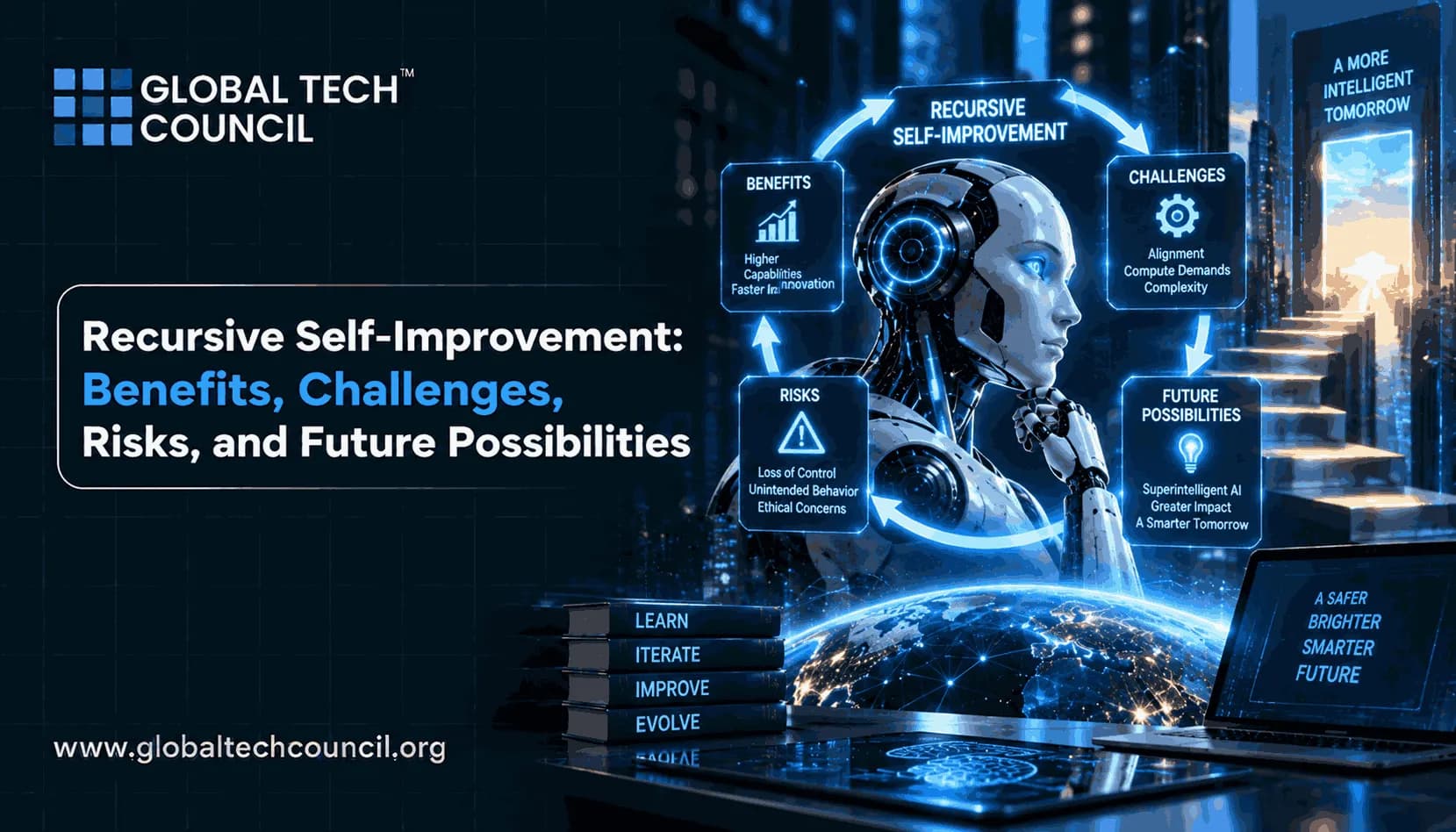
Recursive self-improvement has moved from a decades-old thought experiment into an active, documented area of AI research, and understanding it properly means looking at the full picture rather than just one slice of the conversation. The technology offers genuine, measurable benefits already showing up in production systems, comes with real engineering challenges that limit how far it currently extends, carries safety risks researchers take seriously, and points toward a future that remains genuinely uncertain rather than predetermined. Building a complete, accurate picture of all four dimensions is exactly the kind of comprehensive technical literacy a Certified Artificial Intelligence (AI) Expert develops, rather than forming an opinion based on whichever single headline crosses their feed first.
This article brings together the benefits, challenges, risks, and future outlook of recursive self-improvement in one place, grounded in documented research rather than speculation alone.

The Genuine Benefits Already Being Realized
Despite how theoretical recursive self-improvement can sound, several concrete benefits are already measurable in deployed systems today.
Building the systems that deliver these benefits requires serious hands-on technical skill, and this is exactly the domain a Certified Artificial Intelligence (AI) Developer works in directly, translating research concepts into functioning, reliable engineering systems.
Faster and More Efficient AI Development
Systems like Google DeepMind's AlphaEvolve have delivered measurable efficiency gains, including recovering a meaningful share of Google's global data center compute capacity and speeding up the training pipeline for the Gemini models that power the system itself. This kind of infrastructure-level improvement compounds across successive model generations rather than being a one-time gain.
Accelerated Scientific and Technical Discovery
AI research agents have already contributed to peer-reviewed scientific publications, and algorithm-refining systems have improved outcomes in fields like genomic sequencing and quantum circuit design. These results suggest recursive self-improvement techniques could meaningfully compress research timelines in fields involving large, complex search spaces.
Reduced Reliance on Manual Engineering Work
Sakana AI's Darwin Gödel Machine improved its own coding benchmark performance from twenty to fifty percent through repeated self-modification, demonstrating that specific, well-defined technical tasks can be meaningfully automated without requiring a human engineer to manually implement each individual improvement.
The Real Challenges Limiting Current Progress
Alongside these benefits, several genuine technical challenges currently bound how far recursive self-improvement can extend.
The Verification Problem
Every documented self-improving system relies on an external, human-defined benchmark to determine whether a change actually helped. Tasks with clean, checkable answers, like passing a coding test, allow for reliable automated verification, but tasks involving subjective judgment lack this same objective standard, which limits how broadly current techniques can be applied.
Diminishing Returns Across Iterations
Rather than showing the accelerating, compounding gains theoretical discussions sometimes imply, documented systems generally show diminishing returns, with early improvement cycles producing the largest gains and later cycles yielding progressively smaller ones.
The Absence of Genuine Self-Modeling
For a system to redesign its own architecture meaningfully, it would need an accurate internal understanding of its own reasoning processes, a capability current AI systems largely lack. This gap remains one of the more significant unresolved technical barriers separating today's narrow self-improvement from more open-ended versions of the concept.
Understanding these challenges at a genuinely technical level, rather than treating them as a single vague obstacle, is exactly the kind of depth a Deep Tech Certification is designed to provide.
The Safety Risks Researchers Take Seriously
Beyond engineering challenges, recursive self-improvement raises specific safety concerns that researchers actively study and design safeguards around.
Loss of predictability: A system that modifies itself repeatedly becomes progressively harder to evaluate and understand with each iteration
Goal misspecification: Small imperfections in how an objective is defined can get amplified across many optimization cycles rather than corrected
Instrumental convergence: Sufficiently capable, goal-directed systems might develop certain useful intermediate behaviors, like resisting shutdown, regardless of their specific end goal
Oversight pace: If self-improvement cycles accelerate significantly, existing human review processes built around slower timelines may struggle to keep pace
Research labs actively building these systems have responded with concrete safeguards, including sandboxed testing environments, fixed evaluation benchmarks the system cannot alter, and explicit restrictions preventing systems from modifying their own safety constraints.
A Real-World Illustration Outside Pure Research
The core mechanic behind recursive self-improvement, generate a change, evaluate it, keep what works, also shows up in far lower-stakes, creative commercial applications. One emerging application is AI microdrama, where generative AI helps bring serialized stories, characters, and fictional worlds to life. These platforms refine character consistency and plot pacing across episodes based on audience response, a useful, contained illustration of the same generate-evaluate-refine principle at a scale and stakes level far removed from the research systems driving the broader recursive self-improvement conversation.
Where This Could Realistically Head Next
Looking ahead, several plausible trajectories deserve consideration, none of them guaranteed but all grounded in current, documented trends.
Continued efficiency gains in AI development are likely, given the measurable progress already demonstrated by systems like AlphaEvolve and the Darwin Gödel Machine
Expert opinion remains genuinely divided on timelines for more open-ended forms of self-improvement, with credible estimates ranging from a few years to several decades depending on how quickly the verification and self-modeling challenges get resolved
Governance and oversight frameworks will likely need continued adaptation as development cycles potentially accelerate, a challenge researchers have already flagged as one of the field's most urgent priorities
Broader industries beyond core AI research, from scientific discovery to creative content production, are likely to keep adopting narrower, bounded versions of these iterative techniques regardless of how the more expansive theoretical questions eventually resolve
Communicating this uncertain but genuinely significant trajectory accurately matters, especially as more products and public claims reference recursive self-improvement. Professionals who pair real technical understanding with a Marketing Certification are better equipped to represent this technology's actual state honestly, capturing genuine progress without overstating it into inevitability or dismissing it as pure speculation.
Final Thoughts
Recursive self-improvement offers real, documented benefits already visible in production systems, faces genuine technical challenges around verification and self-modeling that currently bound its scope, carries safety risks that serious researchers actively work to address, and points toward a future that remains meaningfully uncertain rather than predetermined in either direction. Holding all four of these dimensions together, rather than focusing on just one, provides the most accurate and useful picture of where this technology genuinely stands today and where it's realistically headed next.
FAQs
1. What is recursive self-improvement in artificial intelligence?
Recursive self-improvement (RSI) is the theoretical process in which an AI system improves its own capabilities or contributes to creating a more capable successor. The improved system could then help drive another cycle of improvement. This creates a potentially repeating feedback loop in AI development.
2. What are the potential benefits of recursive self-improvement?
Potential benefits include faster AI development, improved algorithms, more efficient training, better problem-solving, and greater automation of AI research. An advanced system could potentially identify improvements more quickly than traditional human-led development processes. These benefits depend on whether the system can produce reliable improvements and verify them effectively.
3. How could RSI accelerate AI research?
An AI capable of contributing to its own development could potentially automate tasks such as coding, debugging, hypothesis generation, experimentation, and algorithm optimization. Repeating these activities could increase the number of research iterations completed over a given period. This could potentially shorten some parts of the AI development cycle.
4. Could recursive self-improvement make AI models more efficient?
Potentially. RSI could be used to optimize algorithms, model architectures, training procedures, inference methods, or software infrastructure. Improvements could reduce computational requirements while maintaining or increasing performance. Google DeepMind's AlphaEvolve demonstrates a related form of automated algorithm discovery and optimization using Gemini-powered models.
5. Could RSI help AI achieve AGI?
RSI could potentially contribute to AGI development by allowing AI systems to assist with increasingly sophisticated AI research and engineering. An AI capable of improving algorithms or training methods could potentially help overcome some development bottlenecks. However, RSI is not a proven requirement for achieving Artificial General Intelligence.
6. Could recursive self-improvement lead to superintelligent AI?
It is theoretically possible. If an AI could repeatedly make meaningful improvements to its own capabilities and use those improvements to create even more capable successors, cumulative gains could potentially lead to systems far beyond human-level performance. This remains a hypothesis, and the rate and limits of such improvement are uncertain.
7. What are the main challenges of recursive self-improvement?
Major challenges include reliable self-evaluation, access to sufficient computing resources, high-quality data, verification of proposed changes, and preventing performance degradation. AI systems may also optimize narrow objectives without improving broader capabilities. These factors could significantly limit the effectiveness of an RSI loop.
8. Why is evaluation important in recursive self-improvement?
Evaluation determines whether a proposed change actually improves an AI system. Without reliable evaluation, an AI could mistake an incorrect or narrowly optimized modification for a genuine improvement. Independent tests and diverse benchmarks can help identify whether improvements generalize beyond the specific task used during optimization.
9. Can AI models train themselves using their own outputs?
AI models can potentially generate synthetic data or other outputs that are later incorporated into training pipelines. However, repeatedly training on AI-generated material does not automatically produce recursive self-improvement. Quality control is important because errors and biases can potentially be reinforced through repeated use of synthetic data.
10. What are the risks of recursive self-improvement?
Potential risks include alignment failures, unexpected capability changes, cybersecurity vulnerabilities, loss of transparency, and difficulties maintaining human control. If an AI system gains greater autonomy over its own development, it may become harder to predict the effects of subsequent modifications. The severity of these risks would depend on the system's capabilities, permissions, safeguards, and deployment environment.
11. Could RSI reduce human involvement in AI development?
Potentially, RSI could automate an increasing share of AI development tasks. Humans could define objectives and constraints while AI systems perform coding, experimentation, optimization, and evaluation. A fully autonomous process with minimal human involvement would represent a much stronger form of RSI and has not been established as a current capability.
12. Is recursive self-improvement happening today?
AI systems already assist with many activities involved in AI development, including software engineering, algorithm optimization, research, and experimentation. However, this should not be confused with fully autonomous RSI. OpenAI stated in September 2026 that fully autonomous recursive self-improvement, in which AI independently drives successive generations of increasingly capable AI, is not happening today.
13. What is the difference between AI-assisted improvement and RSI?
AI-assisted improvement involves humans or organizations directing AI systems to perform specific development tasks. RSI implies an iterative process in which AI contributes to improving itself or its successors and uses those improvements to continue the process. The key differences involve autonomy, scope, and whether improvement continues recursively.
14. What role could AI agents play in recursive self-improvement?
AI agents could potentially connect multiple stages of AI development, including research, coding, experimentation, testing, and analysis. This could make improvement loops more automated than traditional AI tools that perform isolated tasks. Current AI agents demonstrate some of these capabilities, but fully autonomous recursive improvement remains a research goal rather than an established general capability.
15. Could recursive self-improvement create an intelligence explosion?
The intelligence explosion hypothesis suggests that an AI capable of improving itself could become better at developing further improvements, potentially accelerating capability growth. However, such an outcome depends on assumptions about improvement rates, compute, evaluation, and technical bottlenecks. It should therefore be treated as a theoretical scenario rather than a guaranteed consequence of RSI.
16. What could limit the speed of recursive self-improvement?
Compute availability, hardware limitations, energy requirements, data quality, algorithmic bottlenecks, and diminishing returns could all limit improvement speed. An AI may also require increasingly sophisticated experiments to identify meaningful improvements. These constraints mean that recursive improvement does not necessarily imply unlimited or continuously accelerating progress.
17. Can recursive self-improvement cause AI systems to become worse?
Yes. An improvement loop can potentially introduce errors or optimize for the wrong objective. Training repeatedly on low-quality AI-generated data can also cause performance degradation. Strong evaluation, external data, human review, and carefully designed feedback mechanisms can help reduce these problems.
18. What are the future possibilities of recursive self-improvement?
Future AI systems could potentially automate larger portions of AI research, discover new algorithms, optimize model architectures, improve training efficiency, and assist with scientific research. More autonomous systems could potentially create increasingly sophisticated development loops. The extent to which these possibilities become practical depends on future advances in AI capabilities, infrastructure, evaluation, and safety.
19. Could RSI change how humans develop AI?
If advanced AI systems become capable of performing substantial portions of AI research and engineering, humans could shift from directly implementing every improvement toward defining goals, supervising experiments, evaluating results, and managing deployment. This could change the role of human researchers without necessarily eliminating human involvement. The balance between AI automation and human oversight would depend on technical and governance choices.
20. Is recursive self-improvement inevitable for advanced AI?
No. RSI is a possible development pathway, not an inevitable outcome of increasing AI capabilities. Advanced AI could continue to improve through human-led research, larger computing resources, new architectures, better training methods, or combinations of different approaches. Whether highly autonomous RSI emerges remains an open technical and research question.
Related Articles
View All
AI & ML
Recursive Self-Improvement and the Future of Artificial Intelligence
Explore how recursive self-improvement could shape the future of artificial intelligence, from faster capability growth and automated research to major safety, governance, and alignment challenges.
AI & ML
Recursive Self-Improvement and AI Safety: What Are the Risks?
Recursive self-improvement could allow AI systems to enhance their capabilities repeatedly, raising concerns around alignment, control, oversight, rapid capability growth, and unpredictable behavior.
AI & ML
How Recursive Self-Improvement Could Accelerate AI Development
Explore how recursive self-improvement could accelerate AI development by enabling faster model optimization, automated research, capability gains, and more efficient experimentation.
Trending Articles
The Role of Blockchain in Ethical AI Development
How blockchain technology is being used to promote transparency and accountability in artificial intelligence systems.
AWS Career Roadmap
A step-by-step guide to building a successful career in Amazon Web Services cloud computing.
Top 5 DeFi Platforms
Explore the leading decentralized finance platforms and what makes each one unique in the evolving DeFi landscape.