

How Close Are We to AI That Can Improve Itself?

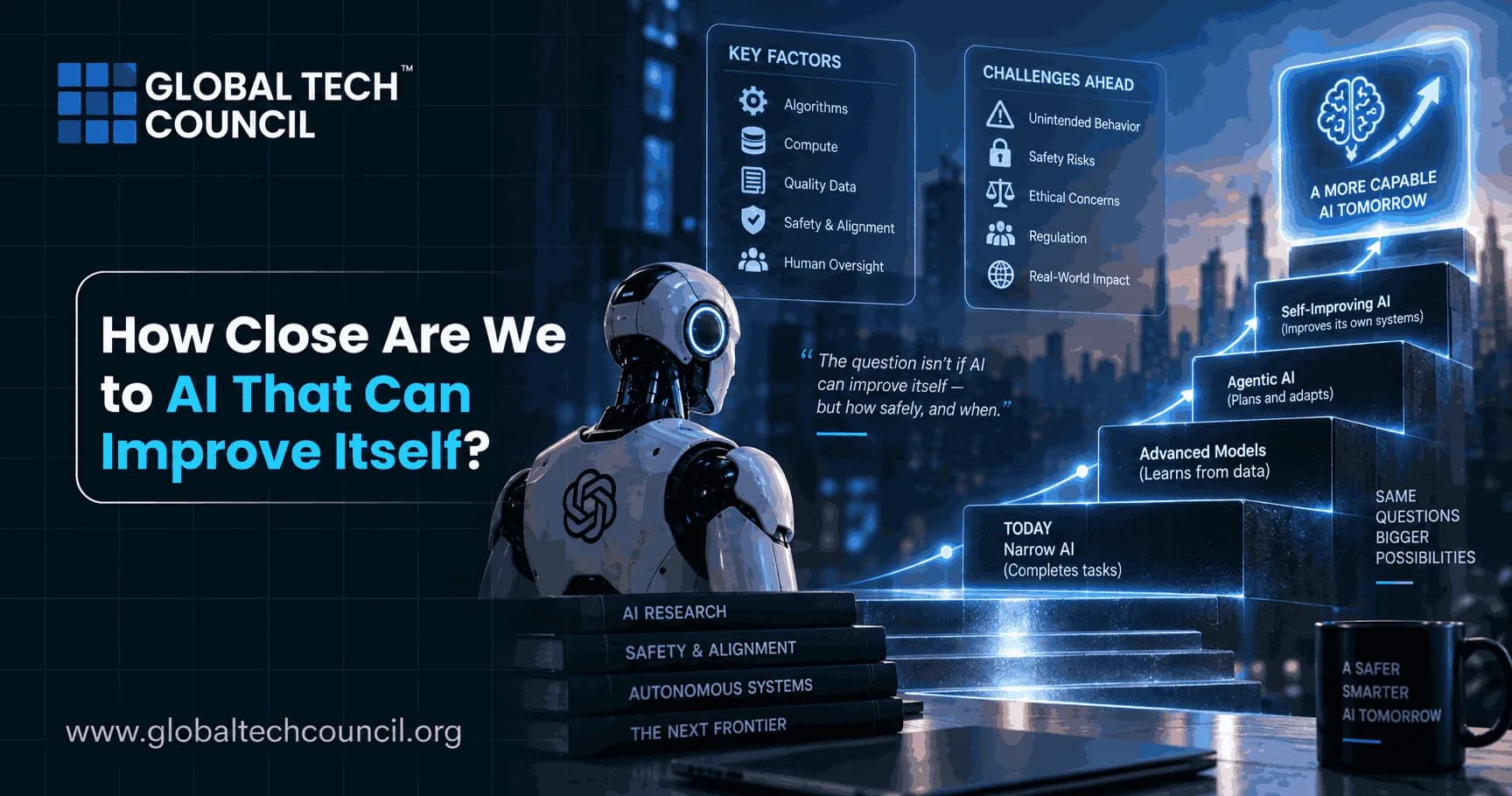
It's a question that shows up constantly in tech conversations, often prompted by a new AI model release or a viral claim about a system that "wrote its own upgrade." The honest answer requires separating what's actually been demonstrated from what remains speculation, since real, documented progress and inflated headlines have started blending together in public discussion. Making that distinction accurately is exactly the kind of skill a Certified Artificial Intelligence (AI) Expert develops, learning to evaluate genuine technical milestones separately from marketing language borrowed from far more ambitious research goals.
This article walks through what self-improving AI actually looks like today, using plain explanations rather than jargon, so the real distance remaining becomes easier to judge for yourself.

What People Usually Mean When They Say "Self-Improving AI"
The phrase gets used to describe several genuinely different things, and much of the public confusion comes from treating them as interchangeable.
Sometimes it refers to a chatbot getting noticeably better after a routine update, which is really just a new model version trained by human engineers using improved methods, not the AI improving itself independently. Other times it refers to a coding tool that can fix bugs in its own generated code within a single session, which is real but far narrower than it sounds. And occasionally, it refers to genuine research systems that modify their own underlying code and get measurably better at specific tasks as a result, which is the closest thing to the concept people usually imagine. Building and evaluating that last category directly is work typically done by a Certified Artificial Intelligence (AI) Developer, since implementing a system that can safely modify and test its own code requires hands-on technical skill well beyond prompting a chatbot.
The Clearest Real Example So Far
If you want one concrete answer to "has this actually happened," the strongest example currently available comes from a research system called the Darwin Gödel Machine, built by Sakana AI. This system genuinely rewrites parts of its own code, tests whether the change helps, and keeps the improvement if it does. Over repeated rounds of this process, it improved its own score on a real coding benchmark from twenty percent to fifty percent, roughly doubling its performance without a human manually rewriting each update.
That's a real, measured result, not a marketing claim. But it's also worth being precise about its scope. The system was still working toward a benchmark score defined by human researchers, operating inside safety boundaries those researchers put in place, and improving a specific coding skill rather than becoming broadly smarter across every domain. Think of it less like a machine achieving general intelligence and more like a very capable intern who keeps getting better at one particular job by studying its own past mistakes.
Why This Isn't the Same as the "AI Takes Over Its Own Development" Scenario
The scenario people often picture, an AI that redesigns itself entirely, sets its own goals, and improves faster and faster without anyone able to keep up, requires several things that current systems simply don't have yet.
Current systems can't reliably judge for themselves whether a change actually made them better in any general sense. They rely on a scorecard someone else built. They also don't have a working understanding of their own internal reasoning process, which makes safely modifying their own core architecture a much harder problem than tweaking a piece of supporting code. Understanding exactly why that gap is so significant, rather than assuming it's a small technical detail, is the kind of depth a Deep Tech Certification is designed to provide, covering the underlying reasons researchers treat this as a genuinely unsolved problem rather than a matter of scaling up existing techniques.
A Useful Comparison From a Different Corner of AI
It sometimes helps to see the same basic idea, a system improving its output over time based on feedback, applied somewhere with much lower stakes. One emerging application is AI microdrama, where generative AI helps bring serialized stories, characters, and fictional worlds to life. These platforms often adjust character voice and story pacing across episodes based on how audiences respond, which is genuinely a form of iterative self-refinement. It just happens in a creative, low-risk context with clear human editorial control, which makes it a helpful, less intimidating way to picture the same core mechanic, generate, check, adjust, that shows up in far more serious research contexts like the Darwin Gödel Machine.
So, How Close Are We, Really?
Based on what's actually been demonstrated, we're closer than we were even a year or two ago, but further than viral headlines often suggest. Narrow, task-specific self-improvement is real and improving steadily. Broad, open-ended self-improvement, the kind that would let an AI system redesign itself without meaningful human involvement, hasn't been shown to work yet, and researchers themselves disagree on whether that's a few years away or a few decades away.
That range of expert disagreement is itself informative. When the people building this technology can't agree on timelines within an order of magnitude, that's a sign the honest answer is genuine uncertainty rather than a specific number. Businesses trying to plan around this uncertainty, including those communicating AI capabilities to customers, benefit from resisting the urge to round up to the more dramatic version of the story. Professionals who pair technical awareness with a Marketing Certification are often better equipped to describe what today's AI genuinely does without overstating it, which tends to build far more lasting trust than a claim that eventually needs walking back.
Final Thoughts
AI that can meaningfully improve narrow pieces of itself already exists, and the results, like the Darwin Gödel Machine doubling its own benchmark score, are genuinely impressive rather than exaggerated. What remains out of reach, at least for now, is the broader, self-directed version of the idea that shows up in more dramatic predictions. The realistic answer sits in between excitement and skepticism: real progress, clear remaining gaps, and enough disagreement among experts that anyone claiming total certainty about the timeline probably deserves a healthy dose of skepticism themselves.
FAQs
1. How close are we to AI that can improve itself?
AI is getting closer to the technical components needed for self-improvement, particularly in coding, experimentation, algorithm optimization, and research automation. However, current systems still depend on humans for important decisions, especially deciding which problems to pursue and defining objectives and evaluation criteria.
2. Can AI already improve itself?
AI can already participate in bounded self-improvement processes. It can modify code, test alternative approaches, optimize algorithms, generate training data, and help evaluate new systems.
However, this is different from an AI independently controlling an open-ended cycle of improving and replacing itself.
3. What is recursive self-improvement in AI?
Recursive Self-Improvement is a hypothetical process in which an AI improves the systems responsible for its own capabilities, and the improved system then contributes to further improvements.
A simplified loop is:
AI → identifies improvement → implements improvement → evaluates result → improved AI → repeats
The defining feature is the repeated improvement cycle and increasing autonomy.
4. Is fully autonomous recursive self-improvement possible today?
There is no demonstrated system that currently performs unrestricted autonomous RSI. OpenAI explicitly states that fully autonomous RSI, defined as AI independently driving successive generations of increasingly capable AI, is not happening today.
5. What can AI already do to improve AI systems?
Today's advanced AI systems can assist with:
Writing and debugging AI-related code
Optimizing algorithms
Running experiments
Analyzing research results
Generating hypotheses
Evaluating model performance
Finding software bugs
Improving training workflows
These capabilities are increasingly being integrated into AI research and development.
6. Can AI write code that improves another AI model?
Yes, within defined tasks. AI coding agents can modify training code, optimize software, and experiment with different approaches.
Anthropic reports that Claude can execute experiments where the goal and evaluation criteria are fixed, while Google has demonstrated AlphaEvolve using Gemini-powered agents to discover and optimize algorithms.
7. What is the biggest barrier to AI self-improvement?
One of the most important remaining barriers is research judgment.
Current systems can increasingly execute a task when humans specify the objective, but choosing which problems are worth solving, determining what research direction to pursue, and deciding what constitutes meaningful progress remain harder. Anthropic identifies this gap between executing goals and independently choosing goals as a major distinction between current AI and full RSI.
8. Can AI conduct its own research?
AI can now conduct substantial parts of research workflows. Anthropic reports an experiment in which AI agents proposed hypotheses, ran experiments, shared findings, and iterated on an open-ended AI-safety research problem.
However, humans still selected the research problem and established the scoring framework in that experiment.
9. Is AI already improving the process of building AI?
Yes. AI is increasingly being used by AI researchers to accelerate coding, debugging, experimentation, evaluation, and other development tasks.
OpenAI describes current AI systems as accelerating parts of the research used to develop and align subsequent models, while emphasizing that this does not yet constitute fully autonomous RSI.
10. What is AlphaEvolve, and is it an example of AI self-improvement?
AlphaEvolve is Google's Gemini-powered coding agent designed to discover and optimize algorithms. Google reports that it has been used across areas including mathematics, computer science, infrastructure, and AI-related systems.
It demonstrates an important mechanism relevant to RSI, but it should not be treated as proof of unrestricted autonomous self-improvement.
11. Can AI improve its own training process?
AI can help optimize parts of training processes. For example, AI systems can search for better code, configurations, algorithms, and experimental approaches.
This is an important step toward automated AI development, but improving one component of a training pipeline is not equivalent to an AI independently designing and training its complete successor.
12. Does AI need to redesign its own architecture for RSI?
Not necessarily. RSI could involve improvements to algorithms, training methods, software, data generation, reasoning strategies, inference systems, or other components.
An AI could therefore participate in meaningful recursive improvement without completely redesigning its neural architecture.
13. Is AI-assisted development the same as recursive self-improvement?
No.
AI-assisted development:
Human chooses the objective → AI performs tasks → human evaluates and directs the next step.
Recursive self-improvement:
AI identifies improvements → implements them → evaluates them → develops an improved system → repeats the process with increasing autonomy.
Today's systems increasingly automate the middle of the first workflow and are beginning to automate portions of the second.
14. Could AI reach recursive self-improvement soon?
It is possible, but there is no reliable timetable. Anthropic says the current trajectory could eventually lead to AI systems capable of building their own successors, while also emphasizing that recursive self-improvement is not inevitable.
Forecasting a specific year would therefore go beyond what current evidence can establish.
15. Could recursive self-improvement accelerate AI development?
Potentially. If AI can automate more of the research cycle, it could increase the number of experiments researchers can run and reduce the time needed to implement and evaluate ideas.
If AI eventually becomes capable of independently directing that process, the feedback loop could become substantially more powerful.
16. Could AI self-improvement lead to AGI or ASI?
It could be one possible pathway, but it is not guaranteed.
Google DeepMind's 2026 report discusses recursive improvement as one of several potential pathways from AGI to ASI, alongside scaling, AI paradigm shifts, and large-scale multi-agent systems.
17. What role does compute play in recursive self-improvement?
Compute is an important constraint because AI systems need computational resources to train, test, and evaluate improvements.
Even if an AI discovers a better algorithm, the ability to repeatedly test and deploy improvements depends partly on available computing infrastructure and efficiency.
18. What risks could arise if AI becomes capable of self-improvement?
Potential concerns include:
Loss of meaningful human control
Rapid capability growth
Misalignment
Reward hacking
Errors being amplified across generations
Difficulty evaluating increasingly capable systems
Cybersecurity risks
Safeguards becoming outdated
OpenAI and Anthropic both identify the possibility of increasingly autonomous AI development as an important safety consideration.
19. What would full AI recursive self-improvement look like?
A stronger form of RSI could look like:
AI identifies a limitation → proposes a solution → modifies its development process → runs experiments → validates the improvement → trains or develops a successor → evaluates the successor → repeats.
The critical difference would be that humans would no longer need to specify every important research direction or manually coordinate each development cycle.
20. How close are we to AI that can truly improve itself?
The current evidence suggests that AI is increasingly capable of improving parts of the AI-development process, but has not yet demonstrated fully autonomous recursive self-improvement.
The progression can be summarized as:
AI assistance → autonomous coding → automated experimentation → AI research agents → automated AI development → autonomous recursive self-improvement
Current frontier systems have made substantial progress through the middle stages. The major unresolved step is closing the loop so that AI can reliably choose important research directions, develop and validate improvements, and build increasingly capable successors with substantially reduced human direction. OpenAI currently says that this fully autonomous stage has not been reached.
Related Articles
View All
AI & ML
Can Gemini Improve Itself? Google’s AI and Recursive Self-Improvement
Explore whether Google Gemini can improve itself, how DeepMind is developing self-improving AI systems, and what separates current capabilities from true recursive self-improvement.
AI & ML
Can ChatGPT Improve Itself? Understanding RSI in LLMs
Explore whether ChatGPT can improve itself, how recursive self-improvement differs from normal model training, and what current LLMs can and cannot do autonomously.
AI & ML
What Would Happen If AI Could Improve Itself Recursively?
Explore what could happen if AI were able to improve itself recursively, including faster capability growth, possible intelligence explosions, major benefits, and serious safety challenges.
Trending Articles
The Role of Blockchain in Ethical AI Development
How blockchain technology is being used to promote transparency and accountability in artificial intelligence systems.
AWS Career Roadmap
A step-by-step guide to building a successful career in Amazon Web Services cloud computing.
Top 5 DeFi Platforms
Explore the leading decentralized finance platforms and what makes each one unique in the evolving DeFi landscape.