

Can Gemini Improve Itself? Google’s AI and Recursive Self-Improvement

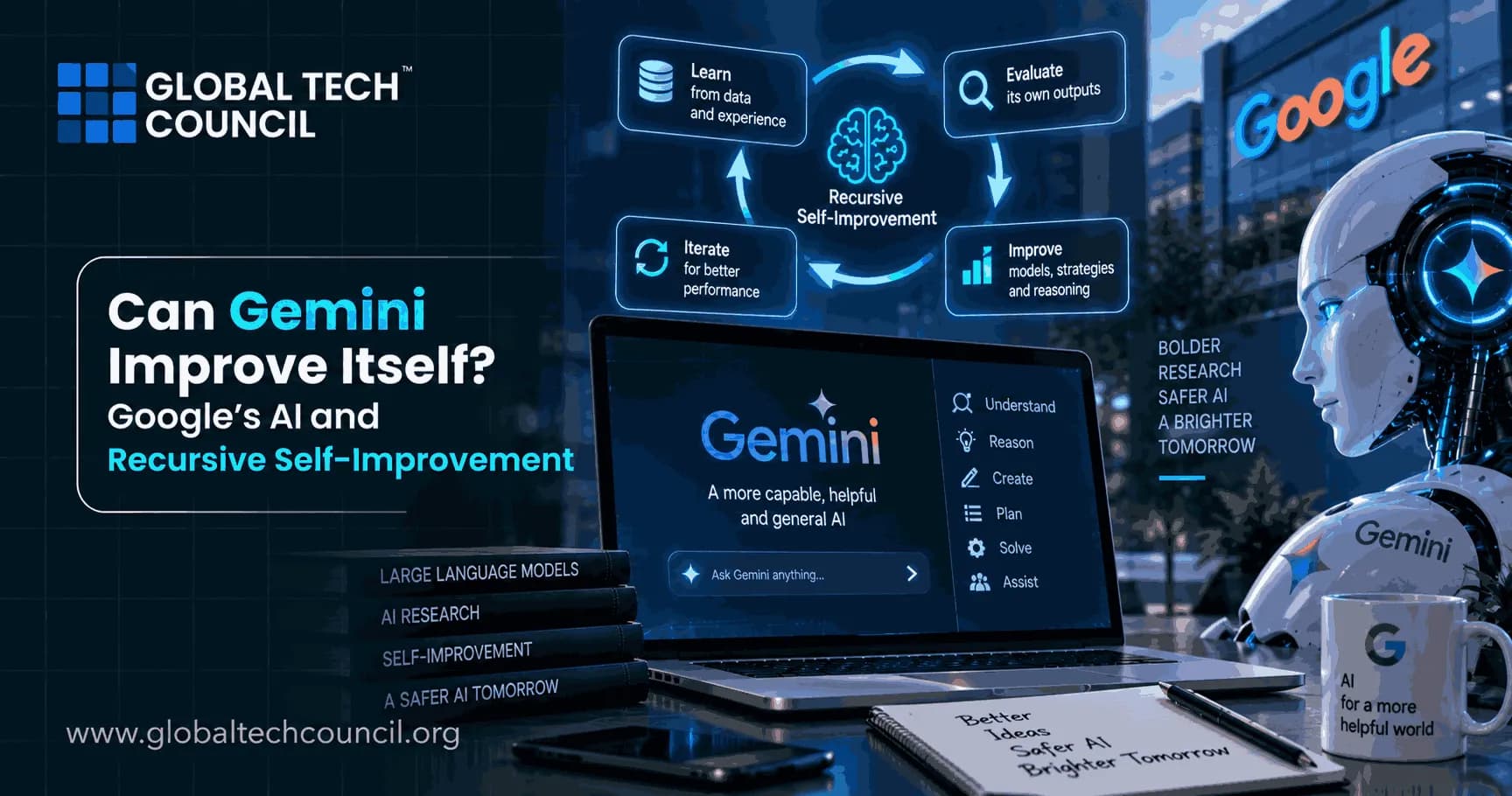
Gemini is Google's flagship AI model, and it also sits at the center of one of the most concrete, documented examples of AI-assisted self-improvement available today. Unlike vague claims about "self-improving AI" floating around tech headlines, Google DeepMind has published specific, measurable results showing how AI tools have already sped up parts of Gemini's own training process. Understanding exactly what that means, and what it doesn't mean, requires separating real technical achievement from speculation, which is precisely the kind of clarity a Certified Google Gemini Professional credential is built to provide, covering how Gemini and its surrounding development tools actually function rather than relying on secondhand headlines.
This article breaks down what's actually happening inside a Gemini conversation versus between model versions, what Google's AlphaEvolve system has genuinely demonstrated, and how close any of this comes to real recursive self-improvement.

What Gemini Does and Doesn't Do Within a Conversation
Like other large language models, Gemini does not modify its own underlying weights or retrain itself during a conversation with a user. It can use the context of an ongoing exchange, including its own earlier responses, to refine or correct an answer as the conversation continues, but this adjustment disappears once the session ends and has no permanent effect on the model itself.
Understanding this distinction clearly, between temporary, in-context refinement and genuine, lasting self-modification, is foundational to evaluating any self-improvement claim accurately. It's the kind of nuance a Certified Artificial Intelligence (AI) Expert learns to explain precisely, since this exact confusion drives a large share of inflated claims about AI capability circulating publicly.
AlphaEvolve: Google's Real Contribution to This Conversation
The genuinely notable development connecting Gemini to recursive self-improvement research is AlphaEvolve, a system built by Google DeepMind that uses Gemini models to generate, test, and refine algorithms and code across a range of technical problems.
What AlphaEvolve Has Actually Demonstrated
It uses Gemini to generate multiple candidate solutions to a defined technical problem, then automatically evaluates and refines the strongest candidates over repeated cycles
It has been credited with recovering a meaningful share of Google's global data center compute capacity through improved scheduling algorithms
It contributed to more efficient quantum circuit designs and improvements in genomic sequencing models
Most notably for this specific question, it has been used to speed up the training pipeline for the Gemini models that power the system itself, a genuine, if narrow, example of AI improving infrastructure tied directly to its own lineage
Why This Still Falls Short of Full Recursive Self-Improvement
Despite how genuinely impressive these results are, it's worth being precise about their scope rather than rounding up to a more dramatic conclusion.
AlphaEvolve operates against a scoring function that Google's researchers define for each specific problem, meaning the system doesn't decide for itself what counts as an improvement. It optimizes algorithms and code within a fixed system rather than redesigning Gemini's core architecture independently. And human oversight remains involved throughout, from selecting which problems to apply the system to, to validating the results before they're deployed. Grasping exactly where this line sits, between genuinely impressive, bounded optimization and fully autonomous architectural self-redesign, is the kind of technical depth a Deep Tech Certification is designed to provide, going beyond headline summaries into the actual mechanics researchers use to draw this distinction.
How This Compares to Other AI Labs
Google isn't alone in exploring AI-assisted development, and comparing approaches helps put Gemini's situation in context. OpenAI has described its coding models as playing a role in developing their own successors, while independent research labs like Sakana AI have built systems, such as the Darwin Gödel Machine, that go further by directly rewriting their own code and measurably improving benchmark performance through the process. Google's AlphaEvolve sits in an interesting middle position: it's a production system with concrete, deployed results, but its self-referential loop, improving Gemini's own training, remains one specific, well-documented application rather than a broader claim about Gemini redesigning itself generally.
A Creative Parallel Worth Understanding
The underlying principle behind AlphaEvolve, generate multiple options, evaluate them, and keep what performs best, also shows up in far more contained, creative applications outside pure research. One emerging application is AI microdrama, where generative AI helps bring serialized stories, characters, and fictional worlds to life. These platforms often refine character voice and plot pacing across episodes based on audience engagement data, a smaller-scale, narrative-focused example of the same generate-evaluate-refine cycle, though scoped to storytelling rather than the technical infrastructure improvements AlphaEvolve targets.
Why Accurate Framing Matters When Discussing Gemini's Capabilities
Because Gemini is one of the most widely used AI products available, claims about its capabilities travel fast and often get simplified along the way. A specific, bounded result like AlphaEvolve speeding up a training pipeline can easily get flattened into a much broader, less accurate claim like "Google's AI improves itself," which overstates what's actually been demonstrated.
This makes precise communication genuinely important, not just an academic concern. Professionals who pair real technical understanding with a Marketing Certification are better positioned to describe developments like AlphaEvolve accurately, distinguishing documented, narrow achievements from the more expansive claims sometimes attached to them, which builds credibility that holds up under scrutiny rather than requiring correction later.
Final Thoughts
Gemini itself does not modify its own weights during use, and it hasn't achieved recursive self-improvement in the full technical sense of the term. What Google has genuinely demonstrated, through AlphaEvolve, is that AI can meaningfully speed up and improve specific components of the infrastructure used to train future Gemini models, a real and verifiable result that remains bounded by human-defined objectives and oversight. That distinction, between a documented, narrow achievement and a sweeping claim of autonomous self-improvement, is exactly what separates an accurate understanding of Google's AI progress from an exaggerated one.
FAQs
1. Can Gemini improve itself?
Gemini can contribute to processes that improve AI systems, but this is not the same as fully autonomous recursive self-improvement. Google DeepMind has developed systems such as AlphaEvolve, which uses Gemini-powered models to generate and evaluate improved algorithms. Human researchers and predefined evaluation systems remain important parts of the process.
2. What is recursive self-improvement in AI?
Recursive self-improvement (RSI) refers to a process in which an AI system improves its own capabilities, creates an improved version of itself, and then uses that improved version to drive further improvements. In a fully autonomous scenario, this loop could continue with limited human intervention. This is different from ordinary model updates or AI-assisted software development.
3. Is Gemini currently capable of recursive self-improvement?
Gemini demonstrates capabilities that can support parts of an RSI process, but there is no public evidence that Gemini independently performs an unrestricted, end-to-end recursive self-improvement loop. Google DeepMind has demonstrated AI systems that generate, test, and optimize algorithms, but these systems operate within defined objectives, evaluation mechanisms, and technical constraints.
4. What is AlphaEvolve, and how is it related to Gemini?
AlphaEvolve is a Gemini-powered coding agent designed to discover and optimize algorithms. It combines large language models with automated evaluators and an evolutionary framework that selects promising solutions for further exploration. Google DeepMind reports that AlphaEvolve has been used for algorithm optimization in mathematics, computing infrastructure, chip design, and AI training.
5. Has Gemini helped improve its own training process?
Yes, Gemini-powered systems have contributed to improvements in AI training. Google DeepMind reported that AlphaEvolve optimized a matrix multiplication kernel used in Gemini, producing a 23% speedup for that kernel and reducing Gemini's training time by about 1%. This is an example of AI-assisted optimization rather than proof that Gemini independently retrained and redesigned itself.
6. Can Gemini write code that improves AI models?
Gemini can generate and analyze code, and Gemini-powered systems can search for improved algorithms. AlphaEvolve, for example, generates candidate programs and uses automated evaluators to measure their performance. This allows AI to participate directly in parts of the software and algorithm optimization process.
7. Is AlphaEvolve an example of recursive self-improvement?
AlphaEvolve demonstrates an important building block associated with recursive improvement, but calling it unrestricted RSI would be misleading. It can iteratively evolve algorithms based on measurable evaluation criteria, and Google DeepMind says it has even helped optimize processes involved in training the models underlying AlphaEvolve. However, it operates within a defined framework rather than independently controlling the entire AI development lifecycle.
8. How does Gemini-powered algorithm optimization work?
A Gemini model can generate candidate algorithms or code, after which automated evaluators test those candidates against predefined objectives. Promising solutions can be selected for additional iterations, creating an evolutionary optimization loop. This allows the system to search through many possible solutions more efficiently than manually testing every option.
9. Can Gemini modify its own neural network weights?
Gemini should not be understood as routinely rewriting its own underlying neural-network weights during normal use. Model training and updates are separate engineering processes involving data, compute, optimization methods, evaluation, and deployment. Gemini-powered systems can assist with parts of these processes without independently controlling the complete training pipeline.
10. What is the difference between Gemini improving itself and Gemini helping Google improve AI?
Gemini improving itself would imply that the system independently identifies and implements changes to its own capabilities and continues the process recursively. Gemini helping Google improve AI means researchers use Gemini or Gemini-powered agents to perform tasks such as coding, debugging, algorithm discovery, experimentation, or optimization. The second scenario is already demonstrated, while the first represents a much stronger form of autonomy.
11. Could Gemini eventually achieve recursive self-improvement?
Recursive improvement is one possible pathway discussed by Google DeepMind for progressing from artificial general intelligence toward artificial superintelligence. However, this is a research possibility rather than evidence that Gemini has already achieved autonomous RSI. Major technical challenges remain around reliable evaluation, control, compute, goal specification, and ensuring that improvements actually increase useful capabilities.
12. What role do automated evaluators play in Gemini self-improvement?
Automated evaluators provide measurable criteria for determining whether an AI-generated solution is actually better. In AlphaEvolve, proposed programs are tested and scored against evaluation metrics before promising solutions are retained for further exploration. This verification step helps prevent an iterative optimization system from simply accepting every AI-generated idea.
13. Can Gemini learn from its own generated outputs?
Gemini can generate information, code, hypotheses, and other outputs that can potentially be used within AI development workflows. However, using AI-generated outputs as training material is not automatically the same as permanent self-learning. Training a new or updated model requires a controlled process involving data selection, optimization, evaluation, and deployment.
14. Does Gemini automatically become smarter after every conversation?
No. A normal conversation with Gemini should not be interpreted as the model permanently updating its underlying parameters after every interaction. Conversational context can affect responses within a session or product feature, while lasting model improvements generally require separate training or engineering processes.
15. What are the main technical challenges of recursive self-improvement?
Key challenges include reliable self-evaluation, avoiding degradation, maintaining alignment with objectives, obtaining sufficient computing resources, verifying generated changes, and ensuring that improvements transfer to real-world capabilities. An AI system also needs reliable mechanisms for determining whether a proposed modification genuinely improves the system rather than merely optimizing a narrow benchmark.
16. Could recursive self-improvement make AI development faster?
Potentially, yes. AI systems that can discover algorithms, write code, run experiments, and evaluate results could reduce the time required for parts of AI research and engineering. Google reports that AlphaEvolve has already reduced some optimization work from weeks of expert effort to days of automated experimentation.
17. Could Gemini improve the algorithms used to train AI?
Gemini-powered systems can help discover and optimize algorithms used in AI infrastructure and training. AlphaEvolve has been used to improve algorithms connected to AI training and inference, including a matrix multiplication kernel used in Gemini. This demonstrates practical algorithmic optimization, although it does not mean Gemini independently redesigns all of its own training methods.
18. What would true autonomous recursive self-improvement require?
A stronger form of autonomous RSI would require an AI system to identify useful improvements, modify or create relevant algorithms or systems, test those changes reliably, deploy an improved successor, and repeat the cycle. It would also need sufficient access to computing resources and development infrastructure. Importantly, the system would need robust safeguards and evaluation mechanisms to prevent unintended degradation or behavior.
19. Could recursive self-improvement lead to superintelligent AI?
Recursive improvement is one theoretical pathway that could contribute to a transition from AGI to artificial superintelligence. Google DeepMind's research on the path from AGI to ASI explicitly identifies recursive improvement as one of several possible pathways. Whether such a process would occur, how quickly it could progress, and whether it would produce superintelligence remain open research questions.
20. Is Gemini already a self-improving AI?
Gemini can participate in AI improvement workflows, and Google DeepMind's Gemini-powered systems demonstrate increasingly sophisticated algorithm discovery and optimization. However, this should be distinguished from a fully autonomous AI that independently redesigns itself and repeatedly creates more capable successors. Current evidence supports describing Gemini as an important component of AI-assisted improvement rather than claiming that it has achieved unrestricted recursive self-improvement.
Related Articles
View All
AI & ML
Recursive Self-Improvement: Benefits, Challenges, Risks, and Future Possibilities
Explore recursive self-improvement in AI, including its potential benefits, technical challenges, safety risks, and future possibilities for more capable and autonomous systems.
AI & ML
How Recursive Self-Improvement Could Accelerate AI Development
Explore how recursive self-improvement could accelerate AI development by enabling faster model optimization, automated research, capability gains, and more efficient experimentation.
AI & ML
Could Recursive Self-Improvement Lead to Superintelligent AI?
Explore whether recursive self-improvement could lead to superintelligent AI, how rapid capability growth might occur, and the major technical, safety, and governance questions involved.
Trending Articles
The Role of Blockchain in Ethical AI Development
How blockchain technology is being used to promote transparency and accountability in artificial intelligence systems.
AWS Career Roadmap
A step-by-step guide to building a successful career in Amazon Web Services cloud computing.
Top 5 DeFi Platforms
Explore the leading decentralized finance platforms and what makes each one unique in the evolving DeFi landscape.