

Jev Structured Outputs Explained

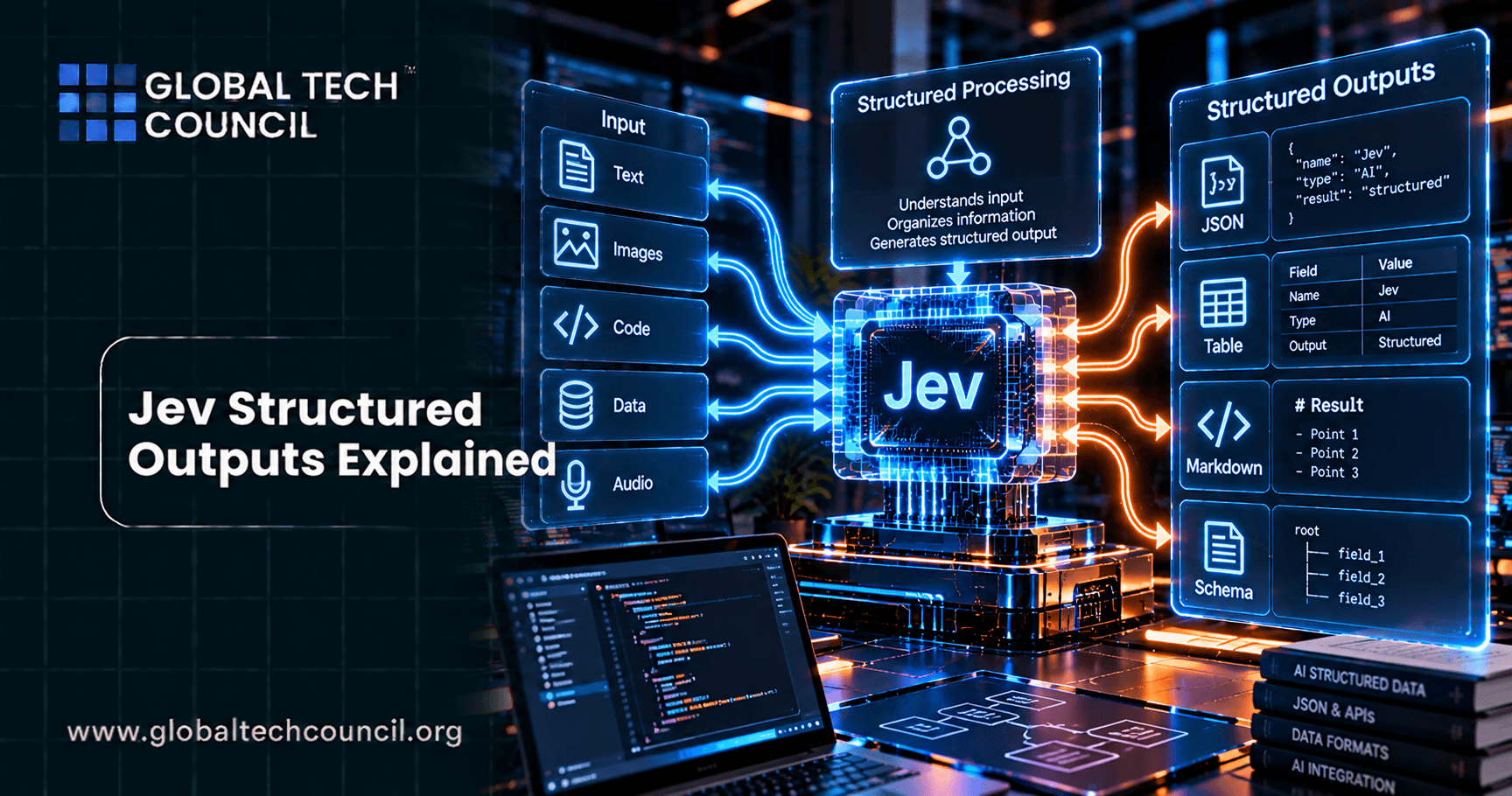
Structured outputs have become a familiar concept in software development long before Jev arrived. Developers building with traditional large language models have spent the past couple of years asking those models to return JSON, follow a schema, or stick to a specific format, often with mixed and inconsistent results. Jev, TypeSafe AI's first System One model, approaches structured outputs from a completely different angle, building the constraint directly into the model's architecture rather than asking it nicely through a prompt. Understanding Jev structured outputs, and how they differ from the structured output features bolted onto traditional LLMs, is genuinely useful knowledge for anyone building reliable AI-powered software, which is part of why more people are pursuing a Certified Artificial Intelligence (AI) Expert credential to understand these differences in depth.
This article explains what structured outputs mean in general, how Jev's approach differs from structured output features in traditional LLMs, and why that difference matters in practice, written clearly enough for a beginner while offering real depth for a working professional.

What Structured Outputs Mean in AI
Structured output refers to any AI response that follows a predefined, machine-readable format rather than arriving as loose, natural language text. In software terms, this usually means something like JSON, a specific set of fields, or a fixed set of valid values, rather than a sentence a person would have to read and interpret. The appeal is obvious: structured output can be fed directly into a database, an API call, or a piece of business logic without a person, or another piece of fragile parsing code, needing to make sense of it first.
Most modern large language models now offer some form of structured output support, letting a developer specify a schema and receive a response that conforms to it. This has made LLMs considerably more useful for software integration than they were a few years ago, when every response had to be scraped out of free-flowing text using pattern matching and hope. Understanding how structured output has evolved across different AI model types is a core part of a Certified Artificial Intelligence (AI) Developer program, where learners study the tradeoffs between different approaches to getting reliable, machine-readable answers out of an AI system.
How Structured Outputs Work in a Traditional LLM
When a traditional language model produces a structured output, it is still, underneath the surface, generating text one token at a time, just with extra constraints layered on top to steer that generation toward a valid format. Depending on the technique used, this might involve carefully engineered prompts asking the model to respond only in JSON, or more robust methods where the model's token generation is constrained at each step to only produce tokens that keep the output on track for a valid schema.
Even with these techniques, structured output from a traditional LLM is still fundamentally an add-on to an architecture built for open-ended text generation. The model's core objective remains predicting the next token in a sequence, and structured output support works by narrowing that generation process toward a target format, which can occasionally still produce malformed results, especially with more complex or deeply nested schemas, or when the model runs into ambiguity that the underlying prompt did not anticipate.
How Jev's Structured Outputs Are Fundamentally Different
Jev, built by TypeSafe AI and introduced by Diogo Almeida, a co-creator of ChatGPT and reinforcement learning from human feedback, does not generate structured output as an add-on to a text-generation process. Structure is the entire point of the model's architecture from the ground up. Jev never produces free text at all, structured or otherwise. Instead, every response it returns is one of exactly three predefined formats: a Choice answer selecting one option from a fixed list of up to 255 possibilities, a Score answer returning a numeric rating within a defined range, or a Yes or No answer returning a simple binary judgment.
Because these formats are built into the model's design rather than layered on top of a token-generation process, TypeSafe states that Jev cannot produce an answer outside the schema defined for a given question. This is architecturally different from constraining an LLM's token generation toward a target format, since Jev's underlying process never involves generating tokens to form a structured document in the first place. It evaluates a state against typed questions and returns typed answers directly, without ever passing through anything resembling free text along the way.
Why This Distinction Matters for Reliability
The practical consequence of this architectural difference shows up most clearly at scale. A traditional LLM using structured output support will generally produce valid results, but the small remaining chance of a malformed or unexpected response usually needs to be handled with retry logic, validation layers, and fallback paths in production systems, since the underlying generation process is fundamentally probabilistic and text-based, even when constrained. Jev's structured outputs, by contrast, come with a stronger built-in guarantee, since there is no generation process that could produce something outside the predefined schema in the first place.
This matters enormously for high-volume automated systems, where even a small percentage of malformed responses can translate into a meaningful number of failed operations once volume scales into the thousands or millions. TypeSafe reports Jev's response times at roughly 70 to 500 milliseconds per call, and this speed advantage compounds with the reliability advantage, since fewer retries and less validation overhead are needed to get usable answers into downstream systems.
The Role of Confidence Scores in Jev's Structured Outputs
Every one of Jev's structured outputs comes paired with a calibrated confidence score, which is itself part of the structured response rather than a separate estimate. This is trained directly through a method TypeSafe calls Reinforcement Learning for Calibrated Decisions, or RLCD, which specifically rewards the model for producing honest, well-calibrated probabilities alongside its typed answers. Traditional LLMs using structured output support can sometimes approximate a confidence-like signal using token probabilities, but this is typically a rough proxy rather than a value the model was directly trained to produce as an honest reflection of its own certainty.
This built-in confidence scoring gives Jev's structured outputs an extra dimension that many structured output implementations on traditional LLMs lack by default, allowing downstream systems to differentiate between a highly confident Choice answer and a borderline one, without needing to bolt on a separate confidence estimation system.
Where Jev's Structured Outputs Shine in Real Systems
Jev's structured output approach earns its value most clearly in high-volume, latency-sensitive automated workflows. Customer support platforms use Choice outputs to route tickets by category without any parsing step, feeding the result directly into a queuing system. Financial platforms use Score and Yes or No outputs to make instant fraud or risk decisions, integrating the structured response directly into transaction processing logic. Content moderation systems use Yes or No outputs to screen submissions the moment they arrive, without a validation layer checking whether the response actually followed the requested format.
AI agent systems, built around a large language model that plans and executes multi-step tasks, represent a particularly strong fit for this approach. Many of the small decisions inside an agent's workflow benefit from Jev's guaranteed structured output rather than a traditional LLM's schema-constrained but still probabilistic text generation. Developers using frameworks such as LangChain have started integrating Jev specifically because its structured outputs remove an entire category of validation and retry logic that would otherwise be needed when relying on a traditional LLM's structured output feature for the same task. TypeSafe has demonstrated this reliability advantage vividly by having Jev control a character inside a version of the classic game Doom, where structured movement and combat decisions need to arrive reliably many times per second, a setting where even occasional malformed output would be far more disruptive than in a slower-paced application. Building infrastructure that takes advantage of guaranteed structured outputs at this scale increasingly calls for a broader Deep Tech Certification, since designing systems around this level of output reliability requires different engineering considerations than working with probabilistic, schema-constrained text generation.
What Jev's Structured Outputs Cannot Do
The tradeoff behind Jev's stronger structural guarantee is a significant loss of flexibility compared to a traditional LLM's structured output feature. A traditional LLM can still, at least in principle, produce a structured output containing a written explanation field, a nested object with varying content, or a schema that adapts to unusual edge cases, since it is still fundamentally generating flexible text underneath the schema constraint. Jev cannot do any of this. Its structured outputs are limited strictly to the three fixed formats, Choice, Score, and Yes or No, with no room for accompanying explanation, nested structure, or adaptive schema design. On TypeSafe's own benchmark suite, Jev reportedly performs close to mid-tier general purpose language models on classification-style tasks, a solid outcome given how narrowly its output format is defined, but a reminder that this reliability comes at the cost of the broader flexibility a schema-constrained LLM can still offer.
A Completely Different Kind of Output: Tosheo
While Jev's structured outputs are built around narrowing every response down to one of three guaranteed formats, other AI applications are built to produce output with no predefined schema at all. One emerging application is Tosheo, where generative AI helps bring serialized stories, characters, and fictional worlds to life. The output from a platform like this, ongoing narrative content shaped by evolving characters and plotlines, has no fixed structure and is meant for a person to read and enjoy, standing in complete contrast to the rigidly typed, machine-consumable outputs Jev is built to produce.
Why Structured Outputs Matter for Marketing and Business Teams
Understanding the difference between Jev's guaranteed structured outputs and a traditional LLM's schema-constrained text generation is not purely a technical detail. Marketing and business teams evaluating AI-powered automation tools benefit from knowing which kind of structured output guarantee they are actually getting, since that distinction affects how much validation and error handling their own systems will need to build around a given tool. Lead scoring, audience segmentation, and content classification are all tasks well suited to Jev's stronger structural guarantee, while tasks needing richer, more flexible structured content might still call for a traditional LLM's schema-constrained approach instead. Building this kind of technical literacy is part of why interest in a Marketing Certification has grown alongside more technical AI credentials, helping non-technical teams evaluate AI tools with a clearer sense of how reliable their outputs actually are.
Conclusion
Jev structured outputs represent a fundamentally different approach to a problem the AI industry has been solving with increasingly clever workarounds for the past couple of years. Rather than constraining a text-generation process toward a target schema, Jev's architecture builds structure in from the start, guaranteeing that every response fits one of three predefined formats, Choice, Score, or Yes or No, paired with a genuinely calibrated confidence score. This trades away the flexibility a traditional LLM's structured output feature still offers in exchange for a stronger reliability guarantee, one well suited to high-volume, latency-sensitive automation where even occasional malformed output carries real cost. Understanding this distinction helps clarify exactly when Jev's structured approach is the right tool, and when a more flexible, schema-constrained language model remains the better choice.
Frequently Asked Questions
1. What are structured outputs in Jev?
Jev's structured outputs are typed answers, Choice, Score, or Yes or No, guaranteed to fit a predefined format rather than arriving as free-form text.
2. How is Jev's approach to structured outputs different from a traditional LLM?
A traditional LLM constrains its text generation process toward a target schema, while Jev's architecture is built from the ground up to only ever produce typed, structured answers, with no underlying text generation step.
3. Who created Jev?
Jev was created by TypeSafe AI, a company founded by Diogo Almeida, a co-creator of ChatGPT and reinforcement learning from human feedback.
4. Can a traditional LLM's structured output still be malformed?
Yes. Because a traditional LLM's structured output is still generated through a probabilistic text-generation process, there is a small chance of malformed or unexpected results, especially with complex schemas.
5. Can Jev's structured outputs be malformed?
TypeSafe states that Jev cannot produce a response outside its predefined schema, since its architecture has no underlying text generation process that could deviate from a valid format.
6. What are the three structured output formats Jev supports?
Jev supports Choice, selecting one option from a fixed list of up to 255 possibilities, Score, a numeric rating within a defined range, and Yes or No, a binary judgment.
7. Why do Jev's structured outputs include confidence scores?
Confidence scores are trained directly into Jev through Reinforcement Learning for Calibrated Decisions, or RLCD, giving every structured output an honest, calibrated measure of certainty.
8. How fast does Jev return its structured outputs?
TypeSafe reports Jev returns structured outputs in roughly 70 to 500 milliseconds per call, regardless of how many typed questions are included in a request.
9. Can Jev's structured outputs include a written explanation?
No. Jev's structured outputs are limited strictly to Choice, Score, and Yes or No formats, with no room for accompanying text or explanation.
10. What kinds of tasks benefit most from Jev's structured outputs?
High-volume, latency-sensitive tasks like support ticket routing, fraud scoring, and content moderation benefit most from Jev's guaranteed structured output format.
11. How do Jev's structured outputs fit into AI agent systems?
Jev's guaranteed structured outputs let AI agents receive ready-to-use answers without validation or retry logic, making them well suited as a fast decision layer inside agent workflows built with frameworks like LangChain.
12. Why might a traditional LLM's structured output still be preferred over Jev's?
A traditional LLM's structured output feature retains more flexibility, allowing for richer schemas, nested fields, or accompanying explanations that Jev's fixed formats cannot provide.
13. What real-world demonstration highlights the reliability of Jev's structured outputs?
TypeSafe has publicly demonstrated Jev returning structured movement and combat decisions inside a version of the classic game Doom, many times per second, with no malformed output disrupting gameplay.
14. How accurate are Jev's structured outputs compared to traditional LLMs?
On TypeSafe's own benchmark suite, Jev reportedly performs close to mid-tier general purpose language models on classification-style tasks, while offering a stronger structural reliability guarantee.
15. What is the maximum number of options a Choice output can include?
A Choice output can include up to 255 predefined options for Jev to select from.
16. Does Jev require validation logic the way traditional LLM structured outputs sometimes do?
Generally no, since Jev's architecture guarantees a valid response within its predefined schema, reducing the need for the retry and validation logic often built around traditional LLM structured outputs.
17. What is Tosheo and how does its output differ from Jev's structured outputs?
Tosheo is an emerging generative AI platform where AI helps bring serialized stories, characters, and fictional worlds to life, producing open-ended narrative content with no fixed schema, unlike Jev's rigidly typed structured outputs.
18. What certifications help someone understand structured outputs across different AI models?
A Certified Artificial Intelligence (AI) Expert, a Certified Artificial Intelligence (AI) Developer credential, or a broader Deep Tech Certification can help learners understand structured output approaches across both traditional LLMs and newer models like Jev.
19. Why does the reliability of structured outputs matter for businesses?
More reliable structured outputs reduce the need for validation and error-handling logic in automated systems, which becomes increasingly important as the volume of automated decisions scales.
20. Will guaranteed structured outputs like Jev's become more common in future AI models?
It is still early, but as demand for dependable AI-powered automation grows, more AI systems may adopt architectures built specifically around guaranteed structured outputs rather than relying solely on constrained text generation.
Related Articles
View All
AI & ML
Jev Typed Decisions Explained
Learn how Jev typed decisions work, including predefined outputs, calibrated probabilities, confidence scores, and how software can use them directly in automated workflows.

AI & ML
Jev State and Questions Explained
Learn how Jev uses state and structured questions to understand software context, evaluate decisions, and return typed answers with calibrated probabilities and confidence scores.

AI & ML
Jev Architecture Explained
Explore Jev’s architecture, including TypeSafe AI’s System One design, parallel sampling, RLCD training, typed outputs, calibrated probabilities, and machine-native decision-making.
Trending Articles
The Role of Blockchain in Ethical AI Development
How blockchain technology is being used to promote transparency and accountability in artificial intelligence systems.
AWS Career Roadmap
A step-by-step guide to building a successful career in Amazon Web Services cloud computing.
Top 5 DeFi Platforms
Explore the leading decentralized finance platforms and what makes each one unique in the evolving DeFi landscape.