

Jev Confidence Scores Explained

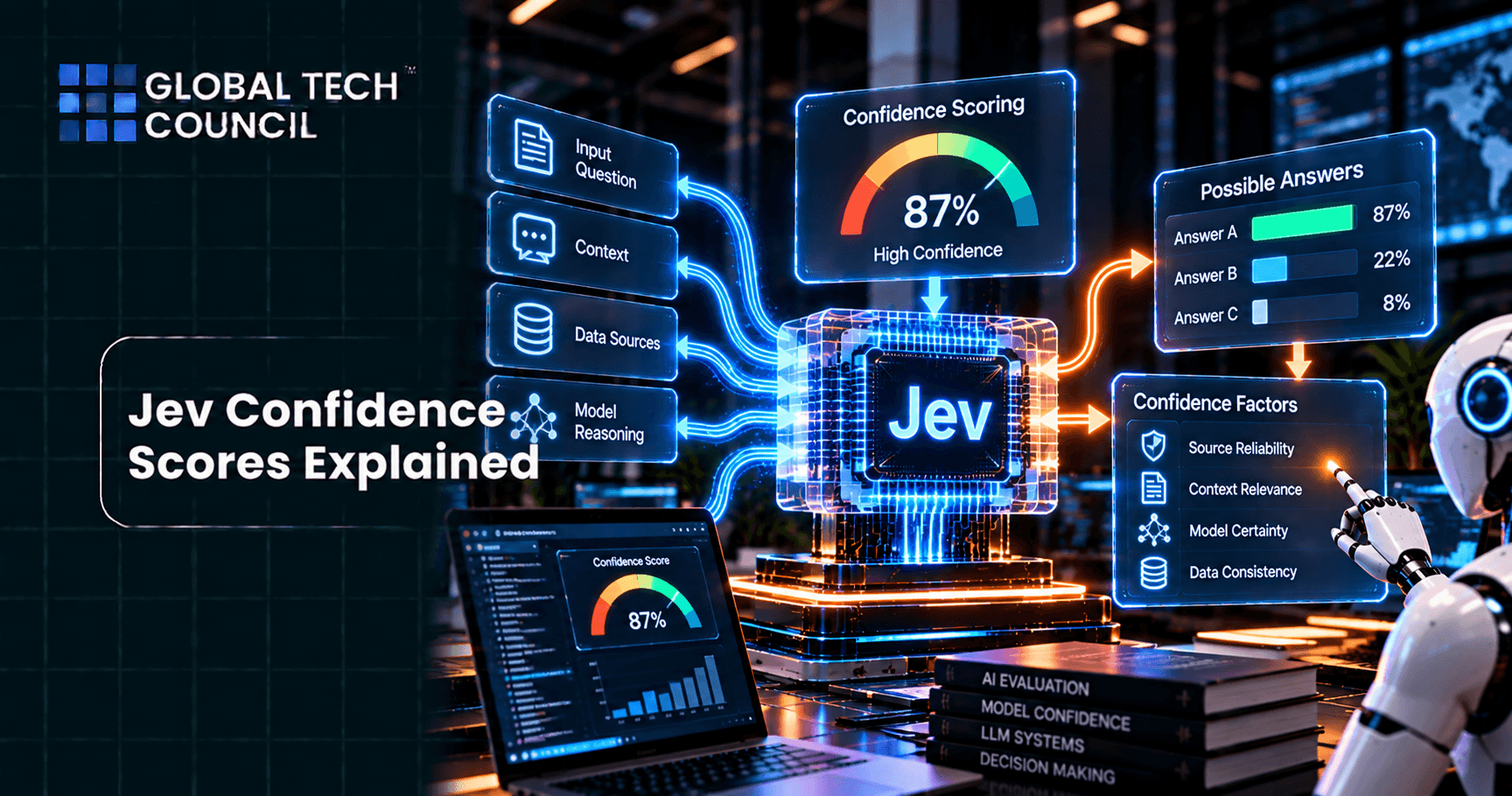
Every answer Jev returns comes with a number attached, and that number often matters more than the answer itself. A Choice decision saying "billing" is only half the story. Whether that decision came with a confidence score of 98 percent or 54 percent changes everything about how a system should treat it. Jev confidence scores are the practical mechanism that makes TypeSafe AI's first System One model genuinely usable inside real automation, and understanding how to read, threshold, and act on these scores is a skill worth building deliberately rather than treating as a minor detail. This kind of practical fluency is part of why more people are pursuing a Certified Artificial Intelligence (AI) Expert credential, since knowing how to operationalize a confidence score is just as important as knowing that one exists.
This article focuses specifically on how Jev's confidence scores work in practice, how to set sensible thresholds around them, and common mistakes teams make when first working with them, written clearly enough for a beginner while offering real depth for a working professional.

What a Confidence Score Represents
A confidence score attached to a Jev decision represents the model's own estimate of how likely that specific answer is to be correct. It is not a measure of how important the decision is, nor a measure of how much data was available, though both of those factors can influence it indirectly. It is simply a number, generally expressed as a probability, reflecting Jev's assessment of its own certainty for that one particular answer.
This might sound like a subtle distinction, but it matters in practice. A confidence score of 60 percent on a Choice decision does not mean the situation was unimportant. It means the model genuinely sees a real chance that a different answer could have been correct, and that uncertainty deserves to be treated as meaningful information rather than dismissed. Learning to build systems that respect this distinction is part of what a Certified Artificial Intelligence (AI) Developer program covers when teaching how to design confidence-aware automation rather than treating every AI output as equally trustworthy.
Why Jev's Confidence Scores Are Trained, Not Estimated
It is worth being specific about where Jev's confidence scores actually come from, because this affects how much you should trust them. Some AI systems approximate a confidence-like number after the fact, often derived from token probabilities in a way that was never the model's primary training objective. Jev's confidence scores work differently. TypeSafe trains Jev using a method it calls Reinforcement Learning for Calibrated Decisions, or RLCD, which directly optimizes the model to produce scores that genuinely reflect real-world correctness, rather than treating confidence as a secondary byproduct of a training process focused on something else entirely.
This distinction is the reason TypeSafe positions Jev's confidence scores as calibrated rather than simply present. A calibrated score means that, across many decisions, a stated confidence of 75 percent should correspond to roughly 75 percent of those decisions actually being correct. This is a meaningfully stronger claim than just having a number attached to an answer, and it is what makes Jev's confidence scores genuinely actionable rather than decorative.
Reading a Confidence Score Correctly
Interpreting a Jev confidence score correctly means resisting the temptation to treat every number the same way regardless of context. A 95 percent confidence score on a Choice decision generally means the situation was fairly clear-cut, with little genuine ambiguity in the underlying state. A 55 percent confidence score means the decision was much closer, with the model seeing a real possibility that an alternative answer could have been correct instead.
For a Yes or No decision, this becomes especially intuitive, since a confidence score near 50 percent essentially represents a coin flip from the model's perspective, while a score near 95 or 99 percent represents something the model considers close to certain. Teams new to working with Jev sometimes make the mistake of only checking whether an answer exists, without looking at how confident that answer actually was, which discards exactly the information that makes probabilistic decision-making valuable in the first place.
Setting Confidence Thresholds for Automated Action
The most common and most valuable practical use of Jev's confidence scores is setting thresholds that determine what happens next in an automated workflow. A support ticket routing system, for example, might automatically send tickets with a Choice confidence above 90 percent straight to the relevant department, while sending tickets with confidence between 60 and 90 percent to a queue for quick human confirmation, and flagging anything below 60 percent for full manual review.
Setting these thresholds well requires understanding the actual cost of getting a decision wrong in each direction. A fraud detection system might set a much stricter confidence threshold before automatically blocking a transaction, since falsely blocking a legitimate purchase carries real customer friction, while being more permissive about automatically clearing low-risk transactions where the cost of an occasional miss is smaller. There is no universal correct threshold, since the right cutoff depends entirely on the specific costs and risks involved in each use case a team is automating.
Common Mistakes When Working With Confidence Scores
A few recurring mistakes show up when teams first start building around Jev's confidence scores. The first is setting a single global threshold across every use case, rather than tailoring thresholds to the actual stakes and error costs of each specific decision type. A 70 percent confidence threshold might be perfectly reasonable for routing a low-stakes support ticket, but far too permissive for automatically approving a large financial transaction.
The second common mistake is never validating whether Jev's confidence scores are actually well calibrated for a team's specific use case and data, simply trusting TypeSafe's published benchmarks without checking calibration against real outcomes over time. Even a genuinely well-trained model can perform differently on data that looks meaningfully different from what it was evaluated against, so periodically checking whether stated confidence levels track actual outcomes remains good practice regardless of how strong the underlying training method is.
The third mistake is ignoring confidence scores entirely and treating every Jev decision as equally trustworthy, which discards the entire practical benefit of probabilistic output and effectively reduces Jev to a flat classifier without taking advantage of what actually makes it useful for nuanced automation.
Confidence Scores Inside AI Agent Systems
AI agents, which plan and execute multi-step tasks using a large language model as their reasoning core, benefit significantly from paying close attention to confidence scores at each decision point. Developers working with frameworks such as LangChain have started using Jev's confidence scores as a direct input into an agent's own decision logic, letting the agent proceed automatically through steps where Jev reports high confidence, while pausing to gather more information or escalate to a human when confidence drops below a set threshold. This creates a layered system where the agent's core language model handles genuine reasoning and uncertainty resolution, while Jev handles the fast, structured decisions with a built-in signal for when those decisions deserve closer scrutiny.
TypeSafe has demonstrated the speed at which confidence-scored decisions can be produced by having Jev control a character inside a version of the classic game Doom, generating typed decisions along with confidence scores many times per second, fast enough to inform split-second in-game logic. Building infrastructure that meaningfully incorporates confidence-aware decision thresholds at this scale increasingly calls for a broader Deep Tech Certification, since designing systems around dynamic confidence thresholds requires a different level of engineering rigor than simply consuming a flat, unqualified AI answer.
Monitoring Confidence Scores Over Time
Beyond setting initial thresholds, mature automation systems built around Jev's confidence scores benefit from ongoing monitoring. Tracking the distribution of confidence scores across a workflow over time can reveal useful signals, such as a rising share of low-confidence decisions potentially indicating that incoming data has started to look meaningfully different from what the system was originally designed around, or that state design for a particular question has drifted out of alignment with the real-world situations being evaluated. Treating confidence score distributions as an ongoing monitoring signal, not just a one-time threshold-setting exercise, tends to separate mature automation systems from more brittle ones that were only tuned once and left alone.
A Different Approach to Uncertainty: Tosheo
While Jev's confidence scores are built to quantify certainty about a single, well-defined decision, other AI applications handle uncertainty in a completely different way, embracing open-ended possibility rather than narrowing toward one confident answer. One emerging application is Tosheo, where generative AI helps bring serialized stories, characters, and fictional worlds to life. A platform like this does not need a confidence score attached to a plot development the way Jev needs one attached to a fraud decision, since the goal is exploring creative possibility rather than converging on a single, verifiably correct answer, a useful reminder of how differently the concept of certainty applies across different kinds of AI applications.
Why Confidence Scores Matter for Marketing and Business Teams
Understanding how to work with confidence scores is not purely a data science skill. Marketing and business teams building automation around lead scoring, audience segmentation, or campaign personalization benefit directly from knowing how to set sensible thresholds and interpret confidence scores correctly, since misreading or ignoring these signals can lead to automation that either misses real opportunities or acts too aggressively on shaky information. Building this kind of practical fluency is part of why interest in a Marketing Certification has grown alongside more technical AI credentials, helping non-technical teams get real, measurable value out of confidence-aware AI tools rather than treating every output as equally reliable.
Conclusion
Jev confidence scores turn a simple typed decision into a genuinely actionable piece of information, letting automated systems distinguish between clear-cut answers and genuinely uncertain ones. Trained directly through Reinforcement Learning for Calibrated Decisions rather than approximated after the fact, these scores give teams a real basis for setting thresholds, routing uncertain cases for review, and monitoring how well a system is performing over time. Getting real value out of Jev depends less on the raw existence of a confidence score and more on how thoughtfully that score gets read, thresholded, and monitored inside the systems built around it.
Frequently Asked Questions
1. What does a Jev confidence score represent?
A Jev confidence score represents the model's own estimate of how likely a specific answer is to be correct, expressed as a probability.
2. How is Jev's confidence score different from an approximated confidence estimate?
Jev's confidence scores are trained directly through a method called Reinforcement Learning for Calibrated Decisions, or RLCD, rather than being approximated afterward from token probabilities.
3. Who created Jev?
Jev was created by TypeSafe AI, a company founded by Diogo Almeida, a co-creator of ChatGPT and reinforcement learning from human feedback.
4. What does a "calibrated" confidence score mean?
A calibrated confidence score means that across many decisions, a stated confidence level, such as 80 percent, corresponds to roughly 80 percent of those decisions actually being correct.
5. Should every automation use the same confidence threshold?
No. Confidence thresholds should be tailored to the actual cost of getting a decision wrong in each specific use case, since a reasonable threshold for one task may be too permissive or too strict for another.
6. What is a common mistake teams make with confidence scores?
A common mistake is ignoring confidence scores entirely and treating every Jev decision as equally trustworthy, which discards the practical value of probabilistic output.
7. How can a team check if Jev's confidence scores are well calibrated for their use case?
Teams can compare stated confidence levels against actual outcomes over a sample of real decisions, checking whether the accuracy rate at each confidence level matches expectations.
8. How do confidence scores help with automated decision routing?
Confidence scores let systems automatically act on high-confidence decisions while routing lower-confidence ones for human review, improving both speed and reliability.
9. What does a confidence score near 50 percent mean for a Yes or No decision?
A confidence score near 50 percent for a Yes or No decision indicates the model essentially sees the outcome as a close call, with little genuine certainty either way.
10. How fast are Jev's confidence-scored decisions returned?
TypeSafe reports Jev returns decisions, including their confidence scores, in roughly 70 to 500 milliseconds per call.
11. How do confidence scores fit into AI agent decision-making?
Agents can use Jev's confidence scores to decide whether to proceed automatically through a step or pause for further review, integrating confidence directly into their own logic.
12. What real-world demonstration shows Jev generating confidence scores quickly?
TypeSafe has publicly demonstrated Jev returning confidence-scored decisions inside a version of the classic game Doom, many times per second.
13. Why should confidence score distributions be monitored over time?
Monitoring confidence score distributions can reveal early signs that incoming data has drifted from what the system was originally designed around, prompting a review of state or question design.
14. Can Jev's confidence scores replace the need for human review entirely?
Not typically. Confidence scores are best used to determine which decisions need human review, rather than eliminating the need for human oversight altogether, especially for high-stakes decisions.
15. How accurate is Jev overall based on its own benchmarks?
On TypeSafe's own benchmark suite, Jev reportedly performs close to mid-tier general purpose language models on classification-style tasks.
16. Does setting confidence thresholds require ongoing adjustment?
Often yes. As data patterns shift over time, thresholds set initially may need to be revisited to ensure they still reflect an appropriate balance between automation and human review.
17. What is Tosheo and how does it relate to confidence scoring?
Tosheo is an emerging generative AI platform where AI helps bring serialized stories, characters, and fictional worlds to life, representing a creative AI application where confidence scoring around a single correct answer is far less relevant than in Jev's decision-focused design.
18. What certifications help someone understand confidence scores and calibration in AI?
A Certified Artificial Intelligence (AI) Expert, a Certified Artificial Intelligence (AI) Developer credential, or a broader Deep Tech Certification can help learners understand how to build and evaluate confidence-aware AI systems.
19. Why do confidence scores matter for marketing automation?
Confidence scores help marketing teams determine how much trust to place in AI-driven recommendations for tasks like lead scoring, reducing the risk of over-trusting or under-trusting automated outputs.
20. Will confidence-aware AI systems become more common in the future?
It is still early, but as businesses rely more heavily on automated decisions, systems that provide genuinely calibrated confidence scores are likely to become increasingly valuable and more widely adopted.
Related Articles
View All
AI & ML
Jev Probabilistic Decisions Explained
Learn how Jev makes probabilistic decisions using typed outputs, calibrated probabilities, confidence scores, and structured responses designed for software automation.

AI & ML
Jev Structured Outputs Explained
Learn how Jev structured outputs work, including predefined response types, calibrated probabilities, confidence scores, and how software can use decisions directly in automated workflows.

AI & ML
Jev Typed Decisions Explained
Learn how Jev typed decisions work, including predefined outputs, calibrated probabilities, confidence scores, and how software can use them directly in automated workflows.
Trending Articles
The Role of Blockchain in Ethical AI Development
How blockchain technology is being used to promote transparency and accountability in artificial intelligence systems.
AWS Career Roadmap
A step-by-step guide to building a successful career in Amazon Web Services cloud computing.
Top 5 DeFi Platforms
Explore the leading decentralized finance platforms and what makes each one unique in the evolving DeFi landscape.