
Suyash Raizada
Why AI Needs System One Models
Explore why AI may need System One Models for fast, structured, machine-native decisions, and how they address limitations of LLMs in software automation and real-time workflows.


Browse the latest ai articles, tutorials, and research from Global Tech Council.(628 articles)
Explore why AI may need System One Models for fast, structured, machine-native decisions, and how they address limitations of LLMs in software automation and real-time workflows.
Explore how System One AI enables fast decision-making through structured outputs, calibrated probabilities, parallel processing, and machine-native intelligence for software automation.
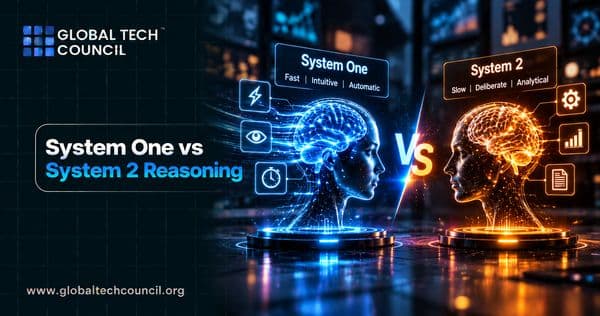
Compare System 1 and System 2 reasoning, including how fast, intuitive thinking differs from slower, deliberate analysis and how both concepts relate to human and AI decision-making.
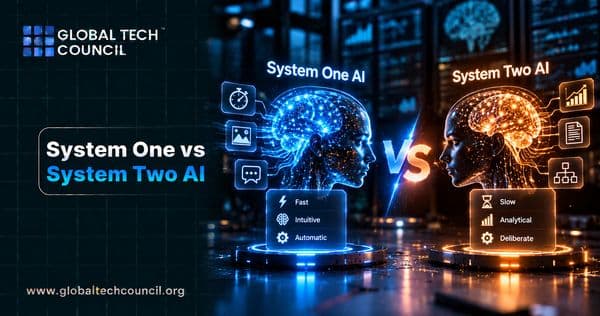
Compare System One and System Two AI, including how fast, intuitive decision-making differs from slower, deliberate reasoning and where each approach fits in modern AI systems.
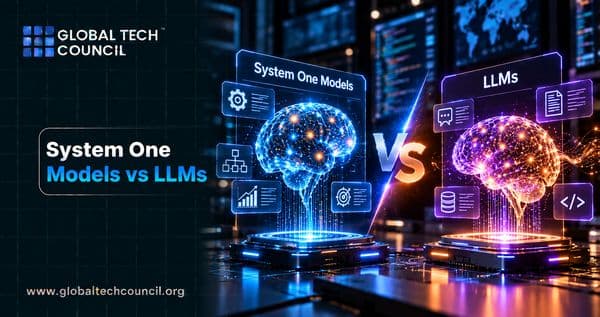
Compare System One Models and LLMs, including differences in outputs, architecture, speed, confidence, automation, and how each approach fits into modern software workflows.

System One AI focuses on fast, structured decision-making for software. Learn how System One Models work, how they use calibrated confidence, and how they differ from traditional LLMs.
Learn what System One AI is, how System One Models make fast, structured decisions for software, and how they differ from traditional LLMs and generative AI.
Jev is not a traditional generative AI model. Learn how TypeSafe AI’s System One Model differs from generative AI through typed outputs, calibrated probabilities, and automation-focused decision-making.

Jev is not a traditional large language model. Learn how TypeSafe AI’s System One Model differs from LLMs through typed outputs, calibrated probabilities, and automation-focused decision-making.

Compare Jev with traditional classification models, including differences in outputs, probabilities, flexibility, automation, and how each approach fits into software decision workflows.
Compare Jev with traditional machine learning models, including differences in outputs, decision-making, confidence, automation, training, and software integration.

Compare Jev with AI agents, including differences in decision-making, autonomy, tool use, workflow execution, and how Jev can function inside larger agentic AI systems.