

Do you know what is the Internet of Things?
 Monisa Nadeem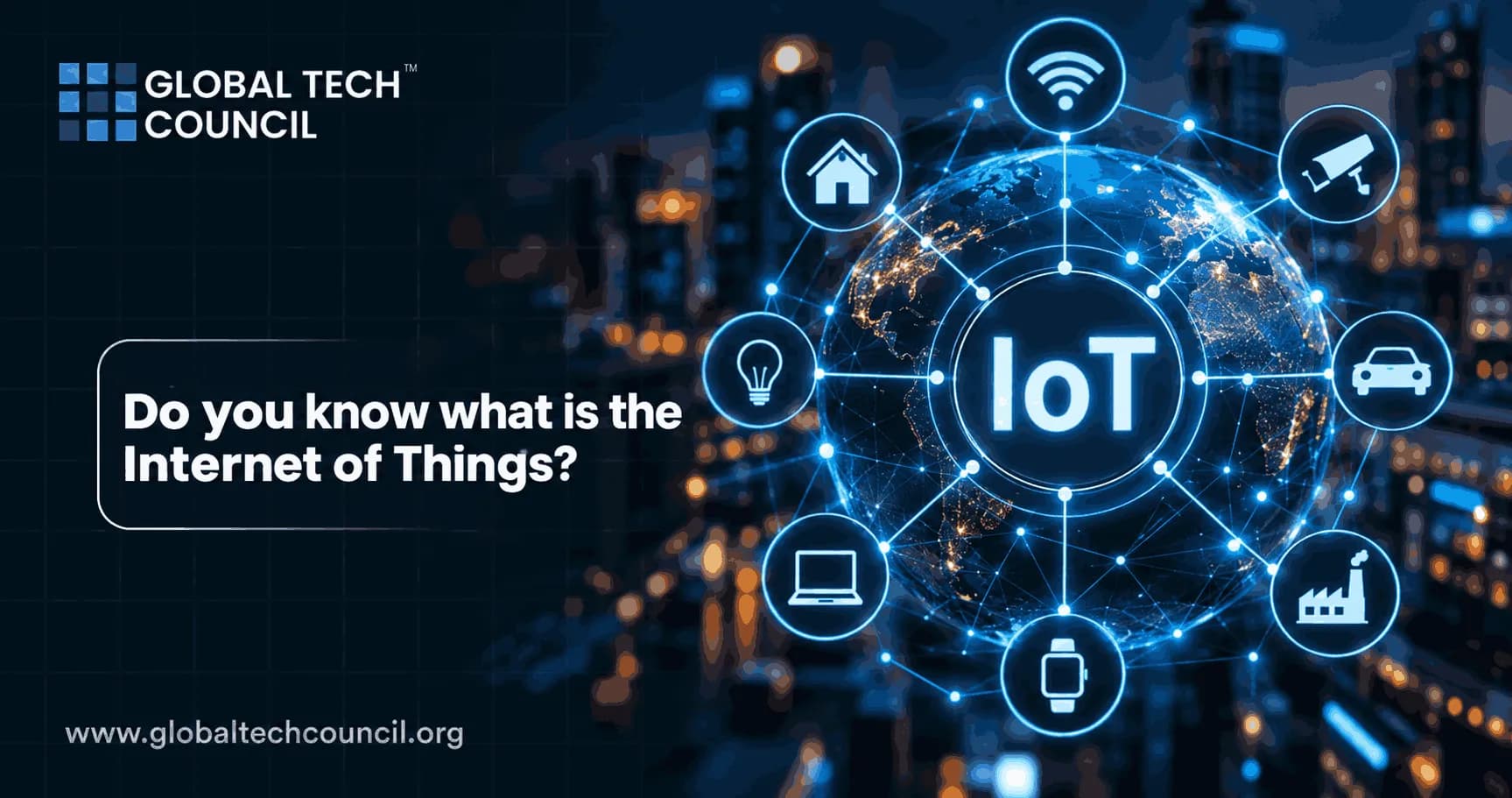
The Internet of Things describes a network of physical devices, from home thermostats to industrial machinery, embedded with sensors, software, and connectivity that let them collect and exchange data without requiring constant human input. It is not a single product or platform. It is a broad category covering everything from a smart refrigerator that tracks grocery inventory to a factory sensor monitoring equipment vibration for early failure detection. Professionals building expertise in this space often start with a Certified Internet-of-Things (IoT) Expert credential, which builds the foundational understanding needed to see how these connected devices actually communicate, process data, and integrate into larger systems.
Breaking Down What IoT Actually Means
The term gets used loosely in marketing, so it helps to understand the specific components that define a genuine IoT system rather than any connected gadget being labeled with the buzzword.

Sensors and actuators form the physical layer. These are the components that collect real-world data, temperature, motion, light, pressure, or moisture, and in some cases take physical action based on that data, like a smart valve adjusting water flow automatically.
Connectivity links devices to networks. IoT devices transmit collected data using various protocols, including Wi-Fi, Bluetooth, cellular networks, and specialized low-power protocols like Zigbee or LoRaWAN, chosen based on range, power consumption, and bandwidth needs for the specific application.
Data processing turns raw signals into useful information. Some processing happens directly on the device itself, called edge computing, while other systems send raw data to cloud servers for more intensive analysis, a distinction that significantly affects speed, cost, and privacy.
User interfaces make the system actionable. Whether it is a smartphone app showing your home security camera feed or a dashboard displaying factory equipment health metrics, this layer translates collected data into something a person can actually understand and act on.
Why IoT Has Grown So Quickly Across Industries
IoT adoption has accelerated dramatically over the past decade, driven by a combination of falling hardware costs, expanding network infrastructure, and genuine business value that companies have been able to measure and justify.
Sensor and chip costs have dropped significantly, making it economically viable to embed connectivity into products that would have been prohibitively expensive to network just a decade ago.
5G and expanded broadband coverage have given IoT devices the bandwidth and low latency needed for applications like autonomous vehicles and real-time industrial monitoring that earlier network generations could not reliably support.
Predictive maintenance has become a genuine cost-saver for manufacturers, since sensors monitoring equipment health can flag potential failures before they cause expensive unplanned downtime, a use case that has driven substantial industrial IoT investment.
Consumer demand for smart home convenience has normalized connected devices in everyday life, with smart speakers, thermostats, and security systems becoming mainstream household products rather than niche early-adopter purchases.
Healthcare applications have expanded rapidly, including wearable devices monitoring vital signs and remote patient monitoring systems that let doctors track chronic conditions without requiring constant in-person visits.
Real-World IoT Applications Across Different Sectors
IoT is not a single use case. It manifests differently depending on the industry and the specific problem being solved, and understanding this range helps clarify just how broad this technology category actually is.
Smart homes use connected thermostats, lighting, security cameras, and appliances that can be controlled remotely and often learn user habits to automate routine adjustments without manual input.
Industrial IoT, sometimes called IIoT, covers factory sensors, supply chain tracking devices, and connected machinery that manufacturers use to monitor production efficiency, predict maintenance needs, and reduce operational waste.
Smart agriculture relies on soil moisture sensors, weather stations, and automated irrigation systems that help farmers optimize water usage and crop yields based on real-time environmental data rather than fixed schedules.
Connected vehicles and fleet management use GPS tracking, engine diagnostics, and driver behavior monitoring to improve logistics efficiency, reduce fuel costs, and enhance safety across commercial vehicle fleets.
Smart city infrastructure includes connected traffic lights that adjust based on real-time congestion, environmental sensors monitoring air quality, and smart utility meters that give both providers and consumers more accurate, granular usage data.
Building and Developing IoT Systems
Creating a functional IoT product or deploying an IoT system within an existing business requires technical skills spanning hardware, networking, and software development, a combination that distinguishes IoT work from purely software-focused technology careers.
Embedded systems programming forms a core skill, since developers need to write efficient code that runs on resource-constrained microcontrollers rather than full-scale computers with abundant processing power and memory.
Networking protocol knowledge matters significantly, since choosing the right connectivity approach, whether Bluetooth Low Energy for a wearable or cellular connectivity for a remote agricultural sensor, directly affects battery life, range, and overall system reliability.
Cloud platform integration has become essential, since most IoT systems at scale rely on cloud services for data storage, processing, and the dashboards that make collected data actually useful to end users or business decision-makers.
Security implementation requires particular attention, since IoT devices have historically been a weak point in overall network security, and developers building these systems need genuine expertise in securing devices that often have limited processing power available for traditional security measures. Professionals building these systems from the ground up benefit from a Certified Internet-of-Things (IoT) Developer credential, which reflects the hands-on technical capability needed to actually build reliable, secure connected devices rather than simply understanding IoT concepts at a theoretical level.
Where Generative AI Is Extending Into Adjacent Creative Technology
While IoT connects physical devices and sensors, the broader technology landscape includes rapidly evolving applications of generative AI that, while different in focus, reflect the same trend of technology expanding into increasingly specialized and creative domains.
AI Microdrama and the Expanding Reach of Connected Technology
One emerging application is AI microdrama, where generative AI helps bring serialized stories, characters, and fictional worlds to life. While this sits outside traditional IoT applications specifically, it illustrates the same broader pattern seen across the connected technology landscape, where specialized tools increasingly generate, monitor, and personalize content and experiences at a scale that would have been impossible without the underlying advances in data processing and automation that both IoT and generative AI depend on.
Security and Privacy Considerations Every IoT Deployment Must Address
IoT's rapid growth has brought genuine security and privacy challenges that anyone working in or deploying this technology needs to understand seriously rather than treating as an afterthought.
Many IoT devices ship with weak default security settings, including default passwords that users never change, creating vulnerabilities that have been exploited in several high-profile botnet attacks using compromised smart devices.
Data privacy concerns grow with device proliferation, since IoT sensors in homes, vehicles, and wearables collect increasingly detailed personal information, raising legitimate questions about who has access to that data and how it gets used or sold.
Regulatory frameworks are still catching up, with different countries and regions implementing varying IoT security and data protection requirements, creating compliance complexity for companies building and selling connected devices across multiple markets.
Understanding how IoT intersects with adjacent technologies matters increasingly, since many advanced IoT deployments now combine sensor data with blockchain for secure data verification or artificial intelligence for predictive analysis. A broader Deep Tech Certification can help professionals understand these cross-disciplinary connections, since the most sophisticated current IoT applications rarely function as an isolated technology stack anymore.
Communicating IoT's Value to Businesses and Consumers
Getting genuine adoption for an IoT product or business solution requires more than sound engineering. It requires explaining the practical value clearly to audiences who may not understand or trust connected device technology.
Consumers often remain skeptical of smart home devices due to genuine privacy concerns and past security incidents, meaning companies need to address these concerns directly and transparently rather than simply promoting convenience features alone.
Enterprise buyers need clear ROI justification, since industrial IoT investments often require significant upfront hardware and integration costs that decision-makers need to see translate into measurable efficiency gains or cost savings.
Technical complexity needs translation for non-technical stakeholders, since the genuine value of a predictive maintenance system or a smart irrigation platform gets lost if it is only explained in terms of sensors and data pipelines rather than tangible business outcomes.
Teams responsible for this kind of communication often rely on a Marketing Certification to help translate genuinely useful IoT capabilities into messaging that builds real trust and demonstrates clear value, rather than relying on vague buzzwords that leave both consumers and business buyers uncertain about what an actual connected product delivers.
Understanding IoT as an Expanding, Interconnected Technology Landscape
The Internet of Things has moved from a futuristic concept into everyday infrastructure, quietly embedded in homes, factories, farms, and cities in ways many people interact with daily without necessarily recognizing the underlying technology at work. Understanding what genuinely qualifies as an IoT system, how these devices actually communicate and process data, and where real security and privacy challenges remain unresolved gives anyone entering this field, or simply trying to make informed decisions as a consumer or business leader, a genuinely useful foundation. As IoT continues expanding and increasingly intersecting with AI, cloud computing, and other emerging technologies, the organizations and professionals who understand both its real capabilities and its genuine limitations will be best positioned to build systems that deliver lasting, practical value rather than simply chasing the next connected device trend.
FAQs
1. What Is the Internet of Things (IoT)?
The Internet of Things (IoT) refers to a network of physical devices connected to the internet that can collect, exchange, and sometimes act on data. These devices can include sensors, appliances, vehicles, industrial machines, wearable devices, and smart home products.
2. How Does the Internet of Things Work?
IoT systems typically use sensors or connected devices to collect data from their surroundings. The data is transmitted through a network to edge devices or cloud platforms, where it can be processed and analyzed before generating an action, alert, or useful insight.
3. What Are the Main Components of IoT?
The main components of an IoT system generally include sensors and devices, connectivity, data processing, and applications or user interfaces. Cloud computing, edge computing, analytics, and security technologies can also play important roles in larger IoT deployments.
4. What Are Some Examples of IoT Devices?
Examples include smart thermostats, fitness trackers, connected security cameras, smart speakers, industrial sensors, connected vehicles, medical monitoring devices, and smart appliances. These devices can collect data and communicate with other systems over a network.
5. What Is the Difference Between IoT and the Internet?
The traditional internet primarily connects computers, phones, servers, and people to exchange information. IoT extends connectivity to physical objects and machines, allowing them to sense conditions, communicate data, and potentially respond automatically.
6. How Is IoT Used in Smart Homes?
Smart home IoT devices can monitor and control lighting, temperature, security systems, appliances, and energy consumption. Users can often manage connected devices through mobile applications, voice interfaces, or automated rules.
7. How Is IoT Used in Healthcare?
IoT can support healthcare through connected medical devices, remote patient monitoring, wearable sensors, and equipment tracking. These technologies can help collect health-related measurements and transmit information to authorized healthcare systems or professionals.
8. How Is IoT Used in Manufacturing?
Industrial IoT (IIoT) connects machines, sensors, and production systems to collect operational data. Manufacturers can use this information for equipment monitoring, predictive maintenance, quality control, process optimization, and operational visibility.
9. What Are the Benefits of the Internet of Things?
IoT can improve automation, operational efficiency, monitoring, resource management, and data-driven decision-making. Organizations can use real-time or historical device data to identify patterns, detect problems, and optimize processes.
10. What Is Industrial Internet of Things (IIoT)?
The Industrial Internet of Things refers to IoT technologies used in industrial and enterprise environments. IIoT commonly connects machinery, sensors, control systems, and operational platforms to improve monitoring, automation, maintenance, and productivity.
11. What Technologies Are Used in IoT?
IoT can involve technologies such as sensors, wireless networks, cloud computing, edge computing, artificial intelligence, machine learning, data analytics, and embedded systems. Communication technologies can include Wi-Fi, Bluetooth, cellular networks, and other connectivity standards depending on the application.
12. How Does Artificial Intelligence Improve IoT?
Artificial Intelligence and Machine Learning can analyze large volumes of data generated by connected devices. AI can help identify anomalies, predict equipment failures, classify events, optimize operations, and automate decisions in certain IoT applications.
13. What Is Edge Computing in IoT?
Edge computing processes data closer to where it is generated instead of sending everything to a centralized cloud environment. This can reduce latency, lower bandwidth requirements, and support applications that require faster responses.
14. Is IoT Secure?
IoT security depends on how devices, networks, software, data, and access controls are designed and maintained. Weak passwords, outdated firmware, insecure communications, and poorly protected interfaces can create vulnerabilities, making security an important part of IoT deployment.
15. What Are the Major Challenges of IoT?
Common challenges include cybersecurity, privacy, interoperability, device management, connectivity, data management, scalability, and maintenance. Large IoT deployments can involve thousands or millions of devices, making consistent security and lifecycle management particularly important.
16. How Does IoT Affect Data Privacy?
IoT devices can collect detailed information about environments, behavior, usage patterns, and connected users. Organizations deploying IoT systems should consider data minimization, access controls, secure storage, appropriate retention policies, and applicable privacy requirements.
17. Can IoT Work Without the Cloud?
Yes. IoT devices can process data locally using embedded computing or edge computing systems. Cloud services are useful for centralized storage, analytics, device management, and large-scale processing, but they are not required for every IoT architecture.
18. What Is the Role of IoT in Smart Cities?
IoT can support smart-city applications such as traffic monitoring, smart lighting, environmental sensing, waste management, parking systems, and infrastructure monitoring. Connected sensors can provide data that helps cities understand conditions and manage resources more efficiently.
19. What Is the Future of the Internet of Things?
The future of IoT is likely to involve greater integration with AI, edge computing, automation, robotics, digital twins, and advanced connectivity. Connected systems may become more capable of analyzing data locally and responding to changing conditions with less manual intervention.
20. Why Is the Internet of Things Important?
IoT connects the physical and digital worlds by allowing devices and machines to collect, communicate, and use data. Its importance comes from the potential to improve monitoring, automation, efficiency, safety, and decision-making across homes, businesses, industries, and public infrastructure.
Related Articles
View All
Internet Of Things
Internet of Things (IoT): History, Present & Future
IoT is the loudest and the craziest buzz in the town presently, all for good reasons. It is an exponentially growing phenomenon taking every industrial and financial sector by storm, proving its potential, and leveraging support for unraveled opportunities. Using an integrated mix of numerous…

Internet Of Things
Internet of Things (IoT) Device Management And Its Future
With smart devices all around us, it is difficult not to talk about the Internet of Things. Safe to say, a future without internet-linked devices seems impossible. To begin with, Internet of Things experts have incorporated IoT in cars, merchandise, and home decor. Additionally, manufacturers are…

Internet Of Things
The 5 Popular Trends of Internet Of Things (IoT) In 2022
The Internet of things has become a trend that is influencing the ongoing datafication and digitalization of our current society in a number of ways. IoT is everywhere from the latest technical developments, including self-driving vehicles, to remote medical devices, and autonomous manufacturing…
Trending Articles
The Role of Blockchain in Ethical AI Development
How blockchain technology is being used to promote transparency and accountability in artificial intelligence systems.
AWS Career Roadmap
A step-by-step guide to building a successful career in Amazon Web Services cloud computing.
Top 5 DeFi Platforms
Explore the leading decentralized finance platforms and what makes each one unique in the evolving DeFi landscape.