

Cross Validation Explained: Estimating Model Performance Reliably
 Suyash Raizada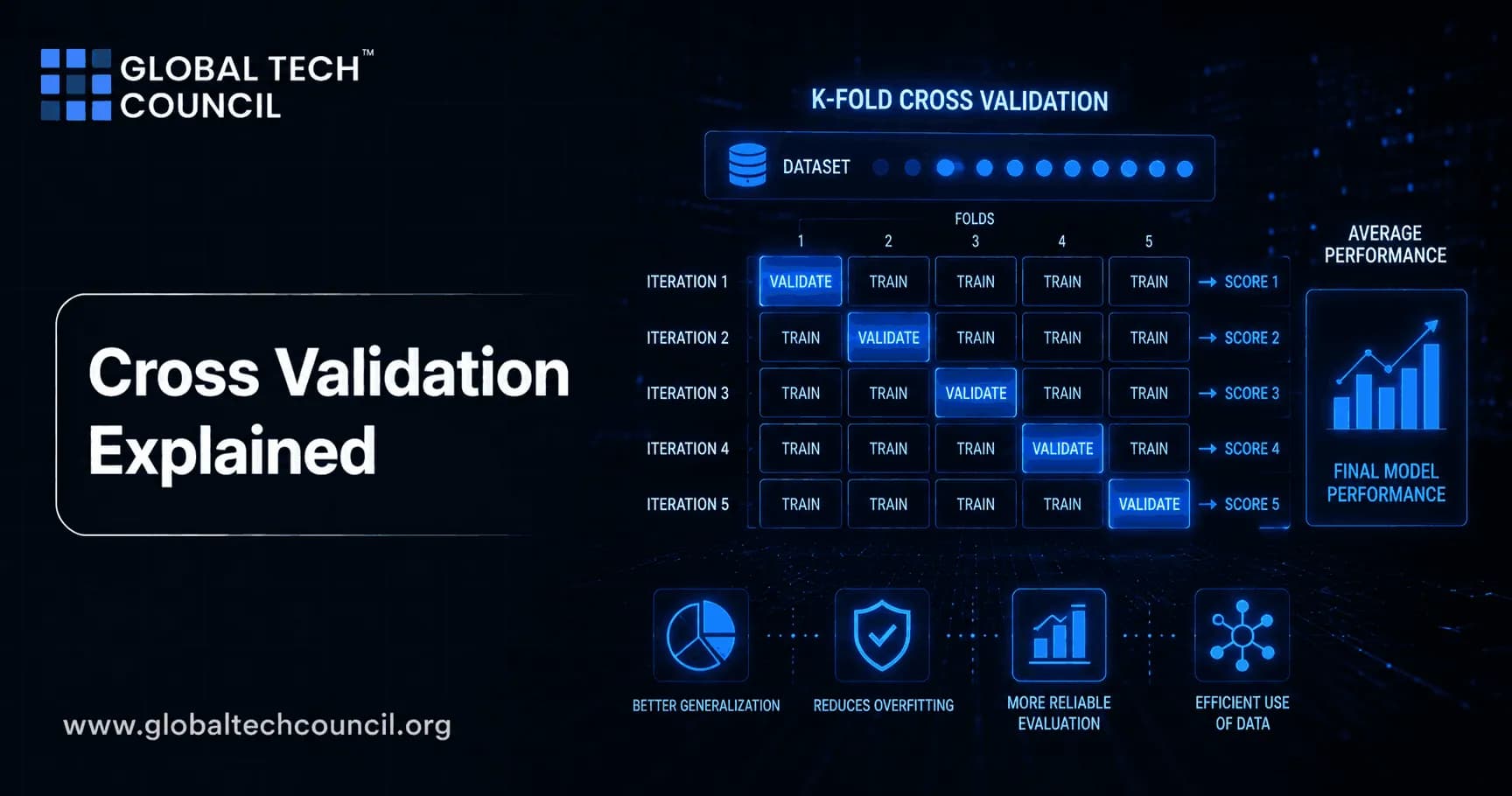
Cross validation explained simply: you train and test a model several times on different slices of the same dataset so your performance estimate is not hostage to one lucky train-test split. It is not magic. Used well, it gives you a steadier read on generalization. Used carelessly, especially during hyperparameter tuning, it can make a weak model look production-ready.
If you are preparing for machine learning work in a real team, this is one of those topics that separates notebook experiments from defensible model evaluation. It also connects directly to the machine learning, artificial intelligence, and data science certification paths on Global Tech Council.

What Is Cross Validation?
Cross validation is a resampling method for estimating how a model will perform on unseen data. Instead of splitting your data once into training and test sets, you split it into multiple folds. The model trains on some folds and tests on the remaining fold. You repeat that process, then average the metric.
In k-fold cross validation, the dataset is divided into k non-overlapping parts. With 5-fold cross validation, for example, the model trains five times. Each run uses four folds for training and one fold for testing. The final score is usually the mean of the five test scores, often with a standard deviation.
That standard deviation matters. A model with 0.91 accuracy plus or minus 0.02 is a different risk profile from a model with 0.91 accuracy plus or minus 0.14. The mean gives you the headline. The spread tells you how fragile the estimate is.
In production environments, consistent model evaluation is closely tied to reproducibility, experiment tracking, and deployment readiness. A Certified MLOps Expert credential helps professionals develop expertise in managing these operational aspects, ensuring that validated machine learning models can be deployed, monitored, and maintained effectively throughout their lifecycle.
Why Cross Validation Beats a Single Split in Many Cases
A single train-test split can be noisy, especially when the dataset is small. One unlucky split may place rare examples only in the test set. One lucky split may hide the hard cases from evaluation. Cross validation reduces that dependency because every sample gets used for testing once and for training several times.
Use it when:
Your dataset is limited and you cannot afford to waste samples.
You need a stable comparison between two candidate models.
Your class distribution is uneven and one split may be misleading.
You want to report both an average metric and variation across folds.
For classification problems with imbalanced labels, use stratified k-fold cross validation. It preserves class proportions in each fold. In scikit-learn, StratifiedKFold does not shuffle by default. That default has bitten many beginners when rows are sorted by date, class, hospital site, or customer segment. Set shuffling deliberately when the data is exchangeable, and set random_state so your result can be reproduced.
Common Cross Validation Types
K-fold cross validation
This is the default choice for many tabular machine learning problems. Five or ten folds are common. Ten folds may reduce bias slightly, but it costs more. Five folds is often enough for routine model selection.
Stratified k-fold
Use this for classification when label proportions matter. If fraud is 1 percent of your dataset, ordinary k-fold splitting can produce folds with too few fraud cases to measure anything meaningful.
Leave-one-out cross validation
Leave-one-out cross validation trains on all samples except one, then tests on the held-out sample. It has low bias in some settings, but a high computational cost and can have high variance. Do not reach for it automatically.
Time series cross validation
Random folds are wrong for forecasting and many event-driven systems. If you train on future data and test on past data, your score is fiction. Use forward chaining or a rolling-window split so training data always comes before validation data.
Nested Cross Validation: When Tuning Enters the Room
Nested cross validation uses two loops. The outer loop estimates performance. The inner loop chooses hyperparameters, preprocessing options, feature selection settings, or even the algorithm itself.
This matters because tuning on the same cross validation folds that you use for final reporting contaminates the estimate. You are not just training a model. You are searching. Every extra choice gives the process another chance to fit noise.
The scikit-learn documentation warns about this directly: using the same cross validation process for tuning and evaluation can underestimate overfitting. If your pipeline includes GridSearchCV, RandomizedSearchCV, feature selection, scaling decisions, threshold tuning, or model family selection, nested cross validation is the cleaner evaluation.
A typical nested setup looks like this:
Split the data into outer folds.
For each outer training fold, run inner cross validation to choose the best pipeline.
Evaluate that chosen pipeline once on the outer test fold.
Aggregate the outer fold scores.
Slow? Yes. Worth it? For high-stakes, small-sample, or heavily tuned models, yes.
Where People Get Cross Validation Wrong
The most common mistake is data leakage before the split. Scaling the whole dataset before cross validation leaks test-fold statistics into training. So does selecting features on the full dataset before folds are created.
Put preprocessing inside the pipeline. In scikit-learn, that means Pipeline with steps such as StandardScaler, SelectKBest, and the estimator. The split must wrap the entire process, not just the final classifier.
Another practical error is asking for more folds than you have examples in the smallest class. scikit-learn will tell you plainly: ValueError: n_splits=5 cannot be greater than the number of members in each class. If you see that, do not silence it by changing random seeds. Reduce the number of folds, collect more data, or rethink the label design.
Is Nested Cross Validation Always the Gold Standard?
To be blunt, no. It is the right tool when the evaluation risk justifies the cost. It is not a badge you add to every project.
Recent research supports a more careful view. Work published in 2024 asking whether cross validation is the gold standard for evaluating model performance found that k-fold cross validation does not always outperform simpler plug-in evaluation across a wide range of models when bias, interval coverage, and variability are considered. Leave-one-out cross validation may reduce bias in some cases, but the gain can be small compared with evaluation variance.
Empirical work comparing nested and flat cross validation across many algorithms and real-world binary datasets points the same way. Nested cross validation produced less biased accuracy estimates, as expected. But flat cross validation often selected algorithms of comparable quality, especially when the algorithms had only a small number of hyperparameters.
That matches what many practitioners see. If you are fitting logistic regression with a small regularization grid on a large dataset, nested cross validation may be overkill. If you are comparing gradient boosting, random forests, support vector machines, feature selection methods, and preprocessing variants on 300 patient records, use nested cross validation.
What Recent Work Says About Reliability
Nested cross validation has shown strong value in complex applied settings. Studies in telecom and transportation modeling report that boosting models evaluated with nested schemes cut error substantially in high-speed train network KPI prediction compared with standard cross validation schemes. In vehicle-to-everything quality of service prediction, nested evaluation helped ensemble methods reach R-squared values around 0.95 while avoiding test-set contamination.
The R package nestedcv is another useful signal of where practice is heading. It formalizes outer folds for final performance estimation and inner folds for model or feature selection. It also supports metrics such as AUC, accuracy, and RMSE, plus schemes for imbalanced data, including nested random oversampling.
There is also work on consensus features nested cross validation, often shortened to cnCV. The idea is to reduce runtime and produce more stable feature sets by using consensus across folds. In high-dimensional problems, fewer false positives can matter as much as a slightly better score.
How to Choose the Right Validation Strategy
Use this practical rule set:
Large dataset, simple model: a clean holdout set may be enough. Keep a final untouched test set if decisions are expensive.
Moderate dataset, routine tabular model: use 5-fold or 10-fold cross validation. Repeat it if the metric varies widely.
Imbalanced classification: use stratified folds and report metrics such as precision, recall, F1, ROC AUC, or PR AUC, not accuracy alone.
Time-dependent data: use time-aware splits. Random folds can leak the future.
Heavy tuning or feature selection: use nested cross validation.
Regulated or high-risk domain: prefer conservative evaluation, document the full pipeline, and keep a final external validation set when possible.
Cross validation estimates model performance. It does not guarantee production success. Distribution shift, bad labels, missing monitoring, and delayed feedback can still break a model that scored well in cross validation.
Building dependable AI systems also requires knowledge that extends beyond model evaluation, including cloud infrastructure, software engineering, cybersecurity, and scalable deployment practices. A Deep Tech Certification helps professionals strengthen these advanced technical capabilities, enabling them to implement robust machine learning solutions across enterprise environments.
Metrics: Do Not Average Blindly
Choose the metric before you start tuning. Accuracy is fine for balanced classification, but weak for rare-event detection. RMSE punishes large regression errors more than MAE. ROC AUC can look healthy even when precision at the operating threshold is poor.
Report fold-level scores when possible. A mean score hides failure modes. If one fold collapses, inspect it. Maybe that fold contains a different geography, product version, sensor type, or acquisition channel. That is not noise. That is a deployment warning.
Learning Path for Professionals
If you want to use cross validation correctly at work, build one small project three ways: a single holdout split, ordinary k-fold cross validation, and nested cross validation with hyperparameter tuning. Compare the reported scores. Then check how the selected model behaves on a truly untouched test set.
For a structured next step, explore Global Tech Council resources in machine learning, AI, and data science. Connect this topic to model selection, feature engineering, experiment tracking, and responsible AI evaluation. Those skills show up repeatedly in real ML interviews and certification assessments.
Next action: take one model you have already trained, move every preprocessing step inside a pipeline, run 5-fold stratified cross validation, then repeat with nested cross validation if you tuned hyperparameters. The difference between those two numbers will teach you more than another theory article.
Along with technical expertise, professionals benefit from understanding how machine learning outcomes support broader business goals and decision-making. A Marketing & Business Certification helps develop these business-focused skills, enabling practitioners to communicate model performance more effectively and align AI initiatives with organizational objectives.
FAQs
1. What is cross validation in machine learning?
Cross validation is a model evaluation technique that estimates how well a machine learning model is likely to perform on unseen data. Instead of relying on a single train-test split, it repeatedly trains and evaluates the model on different subsets of the dataset to provide a more reliable assessment of generalization.
2. Why is cross validation important?
Cross validation helps reduce the risk of obtaining misleading performance estimates from a single data split. It provides a more robust evaluation, supports better model selection, and helps identify models that generalize well beyond the training dataset.
3. How does cross validation work?
The dataset is divided into multiple subsets, known as folds. During each iteration, one fold is used for validation while the remaining folds are used for training. The process repeats until every fold has served as the validation set, and the evaluation metrics are averaged across all iterations.
4. What is K-Fold cross validation?
K-Fold cross validation divides the dataset into K equally sized folds. The model is trained and evaluated K times, each time using a different fold for validation. Five-fold and ten-fold cross validation are among the most commonly used configurations because they provide a practical balance between computational cost and reliable performance estimates.
5. What is Stratified K-Fold cross validation?
Stratified K-Fold ensures that each fold maintains approximately the same class distribution as the original dataset. This approach is particularly useful for classification problems involving imbalanced classes because it provides more representative training and validation subsets.
6. What is Leave-One-Out Cross Validation (LOOCV)?
Leave-One-Out Cross Validation uses one observation as the validation set while training on all remaining observations. This process repeats for every sample in the dataset, making it suitable for very small datasets, although it can be computationally expensive for larger ones.
7. What is Repeated K-Fold cross validation?
Repeated K-Fold performs K-Fold cross validation multiple times using different random data splits. Averaging results across repeated runs can provide a more stable estimate of model performance, particularly when working with relatively small datasets.
8. What is Time Series cross validation?
Time Series cross validation is designed for chronological data where preserving the order of observations is essential. Instead of randomly splitting data, it evaluates models using earlier observations for training and later observations for validation, helping prevent information leakage.
9. What is nested cross validation?
Nested cross validation uses two levels of cross validation: one for hyperparameter tuning and another for unbiased model evaluation. This approach reduces optimistic performance estimates that can result from tuning and evaluating on the same validation data.
10. What metrics are commonly used with cross validation?
The appropriate evaluation metric depends on the machine learning task. Classification models commonly use accuracy, precision, recall, F1 score, ROC-AUC, and log loss, while regression models often use Mean Absolute Error (MAE), Mean Squared Error (MSE), Root Mean Squared Error (RMSE), and R-squared.
11. What are the advantages of cross validation?
Cross validation provides more reliable estimates of model performance, makes better use of available data, supports fair model comparison, reduces evaluation bias from a single train-test split, and improves confidence in model selection decisions.
12. What are the limitations of cross validation?
Cross validation increases computational cost because models must be trained multiple times. It may also be less appropriate for certain types of dependent or streaming data unless specialized validation techniques, such as time series cross validation, are used.
13. How does cross validation help prevent overfitting?
Cross validation evaluates model performance across multiple independent validation folds rather than relying solely on training accuracy. This approach helps identify models that memorize training data instead of learning patterns that generalize well to unseen observations.
14. How does cross validation support hyperparameter tuning?
Cross validation provides a consistent framework for comparing different hyperparameter configurations using multiple validation splits. Combining cross validation with tuning methods such as Grid Search, Random Search, or Bayesian Optimization generally produces more dependable model selection results.
15. Which machine learning libraries support cross validation?
Popular libraries include Scikit-learn, TensorFlow, PyTorch, XGBoost, LightGBM, CatBoost, and many AutoML platforms. Scikit-learn is especially well known for offering built-in utilities for K-Fold, Stratified K-Fold, cross-validation scoring, and hyperparameter search.
16. What common mistakes should beginners avoid?
Common mistakes include performing data preprocessing before splitting data, allowing information leakage, using inappropriate validation methods for time-series datasets, evaluating only one metric, ignoring class imbalance, and tuning hyperparameters on the final test set instead of using separate validation procedures.
17. What are best practices for using cross validation?
Choose the validation strategy based on the dataset and problem type, use stratification for imbalanced classification tasks, maintain separate test data for final evaluation, combine cross validation with proper preprocessing pipelines, document experiments, and report average performance along with variability across folds.
18. How does cross validation fit into MLOps?
In MLOps, cross validation is commonly integrated into automated model training and evaluation pipelines. It supports reproducible experimentation, standardized model comparison, quality assurance, and governance before models are promoted to production environments.
19. What trends are shaping model validation in 2025-2026?
Emerging trends include automated validation within AutoML platforms, distributed cross validation for large datasets, validation workflows for foundation models, AI-assisted experiment management, fairness-aware evaluation, continuous validation during model retraining, and tighter integration with enterprise MLOps platforms.
20. What is the future of cross validation in machine learning?
Cross validation will remain a fundamental technique for evaluating machine learning models because reliable performance estimation is essential regardless of advances in algorithms or computing infrastructure. Future AI platforms are expected to automate more of the validation process while preserving rigorous evaluation standards, helping organizations deploy trustworthy models with greater confidence. Even the smartest model deserves to prove itself more than once, because one lucky test split is not a convincing career résumé.
Related Articles
View All
Machine Learning
Model Deployment Explained: Moving Machine Learning from Notebook to Production
Learn what model deployment means, how models move from notebooks to production, and which MLOps practices keep systems reliable after release.

Machine Learning
Model Training Explained: How Machine Learning Models Learn
Model training explained with the learning loop, loss functions, backpropagation, gradient descent, mini-batches, validation, and practical debugging tips.

Machine Learning
Feature Engineering in Machine Learning: Techniques to Improve Model Performance
Learn practical feature engineering in machine learning, including encoding, scaling, missing values, temporal features, selection, and leakage control.
Trending Articles
The Role of Blockchain in Ethical AI Development
How blockchain technology is being used to promote transparency and accountability in artificial intelligence systems.
AWS Career Roadmap
A step-by-step guide to building a successful career in Amazon Web Services cloud computing.
Top 5 DeFi Platforms
Explore the leading decentralized finance platforms and what makes each one unique in the evolving DeFi landscape.